
Executive Summary
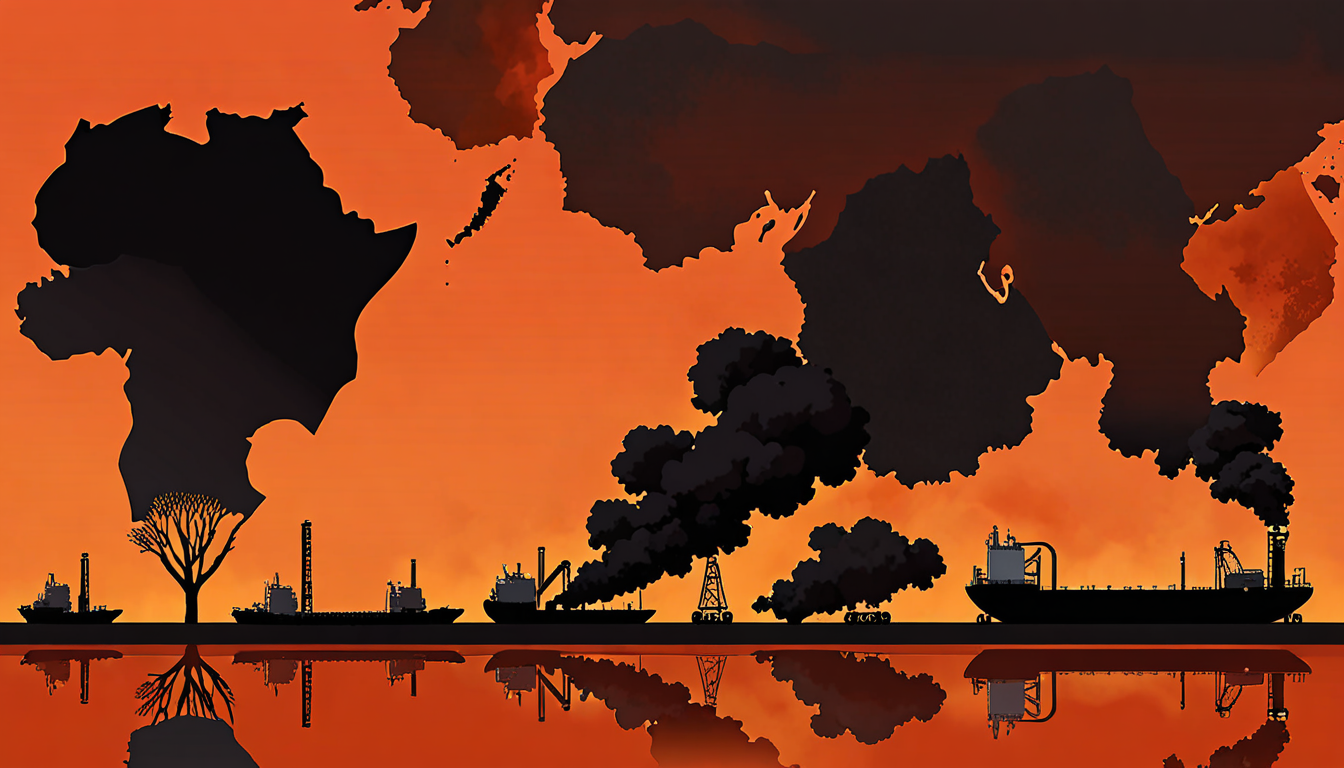
- Africa, a net importer of refined oil products with zero involvement in the Iran conflict, is bearing devastating collateral economic damage—fuel prices up 35% in Nigeria, 20% of Kenyan outlets running dry, $1.4M/week in flower export losses, and 8,000 tonnes of tea stranded at Mombasa.
- The continent faces a triple cascade: fuel price shocks destroying household purchasing power, fertilizer supply disruptions threatening the upcoming planting season, and shipping route collapse severing export lifelines for agricultural economies.
- Nigeria's Dangote Refinery—the continent's largest—is emerging as an unexpected strategic asset, completing its first continental-scale refined product deliveries to 5+ African nations, potentially reshaping Africa's energy dependency model for a generation.
Chapter 1: The Anatomy of an Imported Crisis
On Day 30 of the US-Israeli war on Iran, Lagos taxi driver Adegbola Isaac went to fill up his car. Fuel had climbed to 1,350 naira ($0.99) per liter—a 35% increase since the war began. That single hike wiped out most of his daily profit.
Isaac is one of millions across the African continent now paying the price for a conflict 6,000 kilometers away that they had no part in starting. Since Iran's IRGC imposed what has become known as the "Hormuz toll booth" regime—rerouting ships through a controlled corridor near Larak Island, demanding documentation, clearance codes, and payments of up to $2 million per transit—the global energy supply architecture has fractured along lines that punish the world's poorest consumers most severely.
Africa's vulnerability is structural. According to UNCTAD's 2025 report, which described the continent as "the epicenter of overlapping global crises," more than half of Africa's imports and exports flow through just five non-African trading partners. Nearly every major African economy is a net importer of refined petroleum products. Even Nigeria—the continent's largest crude producer at roughly 1.3 million barrels per day—lacks sufficient domestic refining capacity and has historically imported the majority of its finished fuel from European refineries.
The transmission mechanism is brutally direct:
- Hormuz blockade → global crude and refined product prices surge 30-50%
- Middle Eastern refined product exports (which supply much of Africa) → physically disrupted
- Shipping costs → tripled due to dual chokepoint closure (Hormuz + Red Sea Houthi escalation)
- African import bills → explode, with governments choosing between subsidies and passthrough
- Consumer prices → surge, destroying purchasing power in economies where 40-60% of household income already goes to food and fuel
This is not the first time Africa has absorbed the shockwaves of global crises it did not cause. COVID-19 devastated African economies despite the continent's relatively low case rates. Russia's invasion of Ukraine triggered a wheat and fertilizer crisis that pushed millions into food insecurity. Now the Iran war threatens to compound both traumas before recovery from either was complete.
Chapter 2: Country-by-Country Damage Assessment
Kenya: Fuel, Tea, and Flowers Under Siege
Kenya presents perhaps the most comprehensive case study of Africa's multi-channel vulnerability. The country sources 100% of its fuel from the Middle East, primarily the UAE. Independent fuel retailers report that 20% of outlets are already affected by supply shortages, with the government absorbing massive costs to hold pump prices steady—a fiscal position that cannot last.
But Kenya's pain extends far beyond fuel. The flower industry—one of the country's largest foreign exchange earners, employing hundreds of thousands—has reported weekly losses of $1.4 million since the war began. The losses stem from two concurrent crises: declining European demand as consumers retrench amid energy-driven inflation, and shipping disruptions that delay or prevent fresh-cut flower deliveries that have a shelf life measured in days.
Meanwhile, between 6,000 and 8,000 tonnes of tea worth approximately $24 million sit stranded at the port of Mombasa. According to trade officials, about 65% of East Africa's tea market has been directly affected by the war. For a commodity that depends on uninterrupted global shipping and timely delivery, the dual chokepoint crisis (Hormuz plus renewed Houthi attacks in the Red Sea) has been devastating.
Nigeria: The Refining Paradox
Nigeria encapsulates the resource curse in miniature. Despite being Africa's largest oil producer, the country imports the vast majority of its refined petroleum products—a structural failure decades in the making. Lagos fuel prices surging 35% illustrates how crude production capacity without refining infrastructure leaves a nation just as vulnerable as any landlocked importer.
South Africa: Panic Buying and the Saudi Dependency
South Africa sources a significant share of its fuel from Saudi Arabia. When the kingdom activated its East-West pipeline (routing crude to the Red Sea port of Yanbu, bypassing Hormuz), it partially mitigated crude supply disruption—but refined product availability remains constrained. Diesel-dependent industries have begun panic-buying, despite government assurances about untapped strategic reserves and diversified supply routes. The BBC reports that Zimbabwe, in desperation, has announced plans to increase ethanol blending in petrol from 5% to 20%—a measure that poses risks to vehicle engines and increases pollutant emissions.
East Africa: The Tea-Flower-Tourism Triple Hit
Ethiopia, Uganda, Tanzania, and Rwanda face a convergence of shocks. Ethiopia's economy relies heavily on imported refined petroleum from the UAE, Saudi Arabia, and Kuwait—all accessed through Hormuz. The GERD dam negotiations with Egypt have stalled as international mediators redirect diplomatic bandwidth to the Iran crisis. Uganda's fuel stock was initially projected to last only weeks.
Tanzania, Cameroon, Ghana, Togo, and Ivory Coast have scrambled for alternative supply arrangements, with many turning to Nigeria's Dangote Refinery—a pivot that may reshape the continent's energy architecture.
Chapter 3: The Dangote Factor—Africa's Accidental Energy Shield
In a war that has destroyed established supply chains, Nigeria's Dangote Refinery has emerged as a potential strategic inflection point for Africa's energy independence.
The 650,000+ barrel-per-day refinery—the continent's largest by a wide margin—this week announced the completion of its first continental-scale refined product deliveries, shipping 12 cargoes of gasoline, diesel, and jet fuel to Ivory Coast, Cameroon, Tanzania, Ghana, and Togo. This was the first time the refinery operated at this export scale since reaching full capacity earlier in 2026.
The significance is hard to overstate. For decades, African oil producers exported crude and reimported refined products at massive cost. The Dangote Refinery breaks that cycle, at least partially, by offering:
- Proximity: Shorter shipping distances than Middle Eastern or European refineries, reducing both costs and transit risks.
- Crude availability: Nigeria produces crude oil domestically, reducing (though not eliminating) dependency on Hormuz-transiting supplies.
- Scale: At full capacity, the refinery can process nearly 10% of Africa's total crude oil production.
Bloomberg reported this week that South Africa, Kenya, and Ghana have all reached out to Dangote for additional fuel deals. Energy analyst Olufola Wusu notes: "As long as there is a steady supply of crude oil, the refinery has the capacity to meet some of the needs from across the continent."
But the Dangote solution has limits. The refinery's planned expansion timeline could be slowed by global equipment supply chain constraints. Its crude oil feedstock—while domestically sourced—still depends on Nigerian production infrastructure that suffers from chronic oil theft (estimated at 200,000-400,000 bpd) and underinvestment. And a single facility, however large, cannot substitute for the distributed refining capacity the continent actually needs.
Still, the Iran war may prove to be the shock that permanently alters Africa's energy calculus—accelerating demand for domestic refining capacity, reducing tolerance for crude-export/refined-import dependency, and validating the industrial policy argument for strategic refining investment.
Chapter 4: The Fertilizer Time Bomb
Fuel is the immediate crisis. Fertilizer is the slow-motion catastrophe that may prove more consequential.
The Strait of Hormuz accounts for roughly 30% of global seaborne fertilizer trade and 44% of global sulfur trade (sulfur is essential for phosphate fertilizer production). With the strait effectively blockaded—the IRGC's toll system permits only a trickle of approved vessels—nitrogen fertilizer prices have surged 50%, with urea reaching $674/ton and DAP at $851/ton.
For African agriculture, this is potentially devastating. The planting season across much of sub-Saharan Africa begins in April-May with the onset of rains. Fertilizer must be procured, shipped, and distributed weeks in advance. Every day the blockade continues erodes the window for adequate soil preparation.
UNCTAD has warned that fertilizer access across Africa—including conflict-wracked nations like Sudan and Somalia—is "set to be impacted." The UN announced on Friday (March 28) that it is pursuing a mechanism to allow fertilizer to resume safe transit through Hormuz, hoping this narrow humanitarian corridor could build confidence for wider diplomatic efforts.
But even if a fertilizer passage materializes, the pricing damage is done. African smallholder farmers—who operate on the thinnest of margins—cannot absorb a 50-100% increase in input costs. The result will be reduced fertilizer application, lower yields, higher food prices, and increased food insecurity in a region where 282 million people are already chronically undernourished.
The historical parallel is grimly instructive. After Russia's 2022 invasion of Ukraine disrupted Black Sea grain and fertilizer shipments, Africa experienced a food price spike that pushed an estimated 30 million additional people into acute hunger. The Iran war's fertilizer disruption threatens to be larger in scale and longer in duration.
Chapter 5: Scenario Analysis
Scenario A: Managed De-escalation (25%)
Premise: Pakistan's Islamabad mediation framework (hosting Saudi Arabia, Turkey, and Egypt today, March 29) produces a Hormuz transit agreement within 2-3 weeks. The IRGC toll system is formalized but made affordable and non-discriminatory.
Africa impact: Fuel prices stabilize within 4-6 weeks. Fertilizer deliveries resume partially for the 2026 planting season. Dangote Refinery gains permanent continental market share. Kenya's export sector recovers by Q3.
Trigger signals: Hormuz toll rates drop below $500K/transit. Insurance markets cautiously reopen. IEA SPR drawdown pace slows.
Scenario B: Prolonged Managed Ambiguity (50%)
Premise: Neither full ceasefire nor full escalation. The Hormuz toll regime persists, creating a two-tier shipping system. Selective passage for "friendly nations" continues while Western-flagged vessels face exclusion. The April 6 Trump deadline passes with another extension.
Africa impact: Fuel prices remain 25-40% above pre-war levels through 2026. Fertilizer scarcity reduces yields in the upcoming harvest cycle, pushing food prices 5-8% higher by Q4. Continental energy security becomes a permanent policy priority. Dangote-style refining investment accelerates across multiple African nations. Flower and tea export industries permanently lose market share to non-African competitors.
Historical parallel: The 1973 OPEC embargo lasted 5 months. Its impact on developing economies persisted for years, permanently reshaping energy policy in importing nations. Africa could face a similar structural adjustment period.
Scenario C: Full Escalation / Ground War (25%)
Premise: Trump's April 6 deadline triggers military action against Iranian energy infrastructure. 82nd Airborne deploys to Kharg Island. IRGC responds with total Hormuz closure and mine deployment. Brent exceeds $150. IEA declares emergency.
Africa impact: Continental energy crisis. Rolling blackouts in major economies. Food emergency across the Sahel and East Africa. IMF emergency lending activated for 10+ African nations. UNHCR refugee flows as economic migrants move toward North Africa and Europe. Dangote Refinery operates at maximum capacity but cannot fill the gap. Domestic crude production becomes a national security asset.
Risk factors: This scenario transforms Africa's economic challenge into a humanitarian emergency on a scale rivaling COVID's worst months on the continent.
Chapter 6: Investment Implications
Africa Energy Infrastructure
- Dangote Industries and Nigerian energy infrastructure stand to benefit from permanent continental market realignment.
- Refinery investment projects across the continent gain urgency and political support.
- Solar and renewable microgrids—already growing rapidly in East Africa—gain additional momentum as energy security diversification.
Agricultural Commodities
- African agricultural commodity exporters (cocoa, coffee, tea) face pricing compression from higher input costs.
- Fertilizer producers with non-Hormuz supply chains (Moroccan OCP Group for phosphates, domestic ethanol producers) gain relative advantage.
- Food import-dependent economies face fiscal strain, potential credit rating pressure.
Emerging Market Debt
- African sovereign bond spreads are widening. Egypt, Ethiopia, Kenya, Nigeria, and Ghana face elevated refinancing risk.
- The $90 billion external debt maturity wall (S&P estimate for 2026) collides with reduced fiscal capacity, increasing default probability for vulnerable issuers.
Dangote-Style Industrial Policy
- The crisis validates the case for import-substitution industrialization in strategic sectors (refining, fertilizer production, grain storage).
- Pan-African infrastructure investment (AFCFTA trade corridors, intra-continental shipping routes) gains political momentum.
Conclusion
Africa did not start this war. It has no seat at the negotiation table in Islamabad, no voice in the Schrödinger diplomacy between Washington and Tehran, no leverage over the IRGC's toll booth at Hormuz. Yet it bears consequences as severe as any combatant.
This is a pattern. From COVID to Ukraine to Iran, the world's fastest-growing continent—home to 1.4 billion people—consistently absorbs the shocks generated by conflicts and crises among more powerful nations. The structural vulnerability is clear: import dependency for refined fuel, fertilizer dependency on global commodity flows, export dependency on shipping routes controlled by others.
But within the crisis, a structural shift is emerging. Dangote's continental refinery deliveries, the scramble for alternative supply routes, the renewed political appetite for domestic industrial capacity—these may prove to be the war's lasting legacy for Africa. The question is whether the continent's leaders can convert this crisis-driven momentum into permanent institutional change, or whether—as has happened so many times before—the urgency fades as global prices normalize, and the next crisis finds Africa just as vulnerable as the last.
As UNCTAD analyst Zainab Usman warns: "If the conflict persists for another month or two, honestly, we're going to be in unknown terrain that no one can really predict."
Africa has been in unknown terrain before. It has always been someone else's unknown terrain that sent it there.
Leave a Reply