
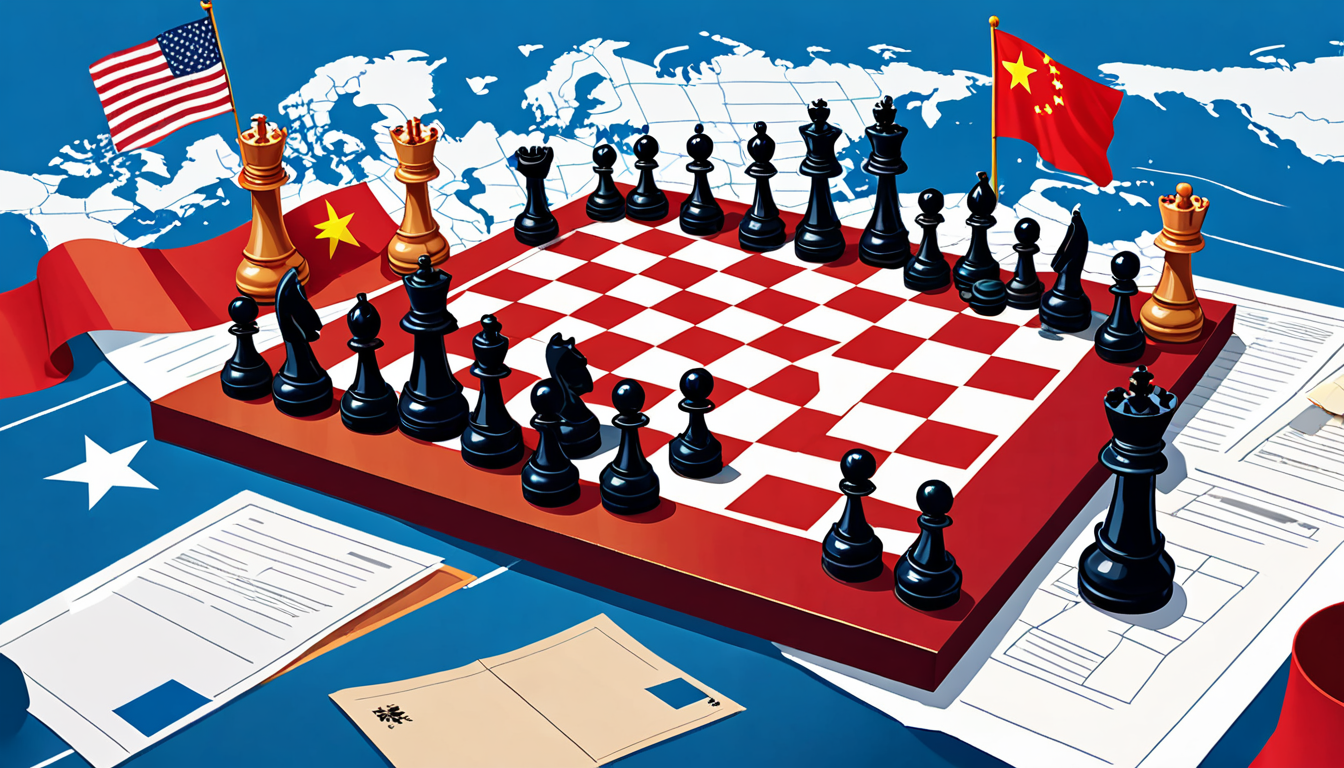
How Beijing is weaponizing Washington's own playbook in the post-SCOTUS tariff vacuum — and why the May 14 summit may be the most consequential U.S.-China meeting since Nixon
Executive Summary
- China launched two retaliatory trade investigations on March 27, directly mirroring Trump's Section 301 probes — a calculated legal positioning move ahead of the May 14–15 Beijing summit that could reshape the global trade architecture.
- The Supreme Court's February 20 IEEPA ruling created a tariff vacuum that both sides are now racing to fill: Washington through Section 122 stopgap tariffs (expiring July 24) and new Section 301 probes, Beijing through mirror investigations designed as bargaining chips.
- The convergence of three crises — the Iran war's fifth week, collapsing consumer sentiment (Michigan 53.3), and the 150-day tariff clock — gives both sides unprecedented leverage and vulnerability, making the summit a potential inflection point for the post-WWII trade order.
Chapter 1: The Legal Earthquake — How SCOTUS Rewrote the Trade War
On February 20, 2026, the U.S. Supreme Court delivered a ruling that fundamentally altered the landscape of American trade policy. In Learning Resources, Inc. v. Trump, the Court held 6-3 that the International Emergency Economic Powers Act (IEEPA) does not authorize the president to impose tariffs — effectively invalidating the primary legal mechanism Trump had used to wage his trade war since 2025.
The ruling was seismic. As Justice Kavanaugh warned in his dissent, the federal government "may be required to refund billions of dollars to importers" and the decision "could generate uncertainty regarding various trade agreements" worth trillions of dollars, including deals with China, the United Kingdom, and Japan.
The White House responded within 24 hours. On February 21, Trump invoked Section 122 of the Trade Act of 1974, imposing a blanket 10% ad valorem import surcharge on all goods entering the United States. The legal rationale: a "balance-of-payments emergency." But Section 122 comes with a critical constraint — it expires after 150 days. The clock started February 24. It runs out on July 24, 2026.
Treasury Secretary Bessent insisted that combining Section 122, Section 232 (national security), and Section 301 (unfair trade practices) tariffs would "result in virtually unchanged tariff revenue in 2026." But the patchwork nature of this approach reveals a deeper vulnerability: the legal foundation of American protectionism is now a Jenga tower, and Beijing knows it.
On March 11, the U.S. Trade Representative (USTR) launched the next phase — Section 301 investigations into "structural excess capacity and production" targeting 16 economies, including China, the European Union, Japan, India, Mexico, South Korea, and Taiwan. A separate investigation targeting dozens of countries, including China, focuses on goods potentially made with forced labor. Public comments are due by April 15, with an initial hearing scheduled for May 5 — just nine days before Trump lands in Beijing.
Chapter 2: Beijing's Mirror Move — The Anatomy of China's Counter-Probes
China's Commerce Ministry announcement on March 27 was surgical in its precision. Two investigations, each designed to mirror one of Washington's Section 301 probes:
Probe 1: Market Access and Technology Export Controls. This investigation examines U.S. policies that restrict Chinese goods from entering the American market and that limit U.S. exports of advanced technology products to China. It collapses two of Washington's most sensitive pressure points — import barriers and semiconductor export controls — into a single investigative framework. The message: if you investigate our excess capacity, we investigate your technology embargo.
Probe 2: Green Energy Trade Barriers. This probe targets U.S. restrictions on Chinese clean energy exports — a direct counter to Washington's tariffs on Chinese EVs, solar panels, and batteries. Bloomberg reported that China is "preparing a legal basis for retaliation against any new US duties" through this investigation.
Both probes are expected to take six months, with a possible three-month extension — timing them to conclude between September 2026 and March 2027, well after the July 24 Section 122 expiry and squarely in the middle of U.S. midterm election season.
China's trade representative had warned at pre-summit talks in Paris that the U.S. investigations "could threaten a hard-won stability in economic relations." The probes are Beijing's way of formalizing that warning into institutional action.
What makes this move particularly astute is its restraint. China explicitly chose not to impose immediate retaliatory tariffs. Instead, it is building a legal dossier — the trade policy equivalent of cocking a gun without firing. This gives Xi maximum flexibility at the May summit: he can offer to shelve the investigations as a concession, or escalate them as a punishment, depending on what Trump puts on the table.
Chapter 3: The Three Clocks — Converging Deadlines That Shape the Summit
Three separate timers are now running simultaneously, each constraining both Washington and Beijing in different ways.
Clock 1: The Section 122 Tariff Expiry (July 24, 2026)
The 10% blanket tariff is a stopgap. Without Congressional action to extend it — politically difficult given the Iran war's impact on consumer prices — it vanishes in four months. The administration needs Section 301 findings to generate replacement tariffs, but that process typically takes 12–18 months. Trump is in a legal no-man's-land: the old tariffs are unconstitutional, the new ones haven't been born yet, and the bridge tariff has a ticking fuse.
China knows this. Every month closer to July 24 without a deal increases Beijing's leverage. If the Section 122 tariffs expire without replacement, Chinese exporters face a temporary window of reduced duties — a powerful incentive for Beijing to run the clock.
Clock 2: The Iran War and Consumer Sentiment Crisis (Ongoing)
Michigan consumer sentiment plunged to 53.3 in March — down from 56.6 in February — as the Iran war enters its fifth week. One-year inflation expectations surged to 3.8% from 3.4%, the highest since the war began. Brent crude closed at $112.57 on Friday, the highest in three years. The CME FedWatch tool shows a 52% probability of a rate hike — the first time that threshold has been crossed.
Trump cannot afford a two-front economic war. With approval ratings at a record 36%, the Iran war consuming political oxygen, and consumer prices rising at a pace that threatens recession, a trade breakthrough with China — even a modest one — would be a desperately needed win. Beijing understands that Trump needs the summit to succeed more than Xi does.
Clock 3: The May 14–15 Summit and Section 301 Hearing Calendar
The USTR's initial Section 301 hearing is scheduled for May 5, just nine days before Trump arrives in Beijing. This creates a remarkable choreography: the U.S. will be publicly building a legal case for new tariffs on China while simultaneously sitting down with Xi to negotiate.
The summit agenda, per Reuters, includes possible "goodwill agreements on trade in agriculture and airplane parts," plus the inevitable flashpoints of Taiwan, technology controls, and — now — China's dual counter-probes. The original trip, scheduled for late March, was delayed by the Iran war. Trump's commitment to the rescheduled May date signals that he views the China relationship as essential to his broader geopolitical strategy, particularly as he seeks Beijing's help with Iran (Chinese special envoy Zai Jun has been conducting shuttle diplomacy throughout the conflict).
Chapter 4: The Strategic Calculus — Who Holds the Cards?
Washington's Hand
Strengths:
- The U.S. still runs a massive trade deficit with China (~$280B annually), giving Section 301 investigations genuine legal ammunition
- Section 232 (national security) tariffs on steel, aluminum, and semiconductors remain untouched by the SCOTUS ruling
- China's economy faces its own headwinds: property sector weakness, youth unemployment, and deflation risk
- The Iran war, paradoxically, gives Trump leverage over China's energy security — Beijing depends on Gulf oil flowing through Hormuz
Weaknesses:
- The legal patchwork (Section 122 + 232 + 301) is fragile and litigable
- Consumer sentiment collapse and inflation expectations undermine domestic support for trade confrontation
- The 150-day clock removes the ability to play the long game
- Midterm elections in November 2026 create political constraints on extended economic pain
Beijing's Hand
Strengths:
- The counter-probes provide structured leverage without immediate economic costs
- China has proven willing to endure short-term trade pain for long-term strategic positioning (2018–2020 trade war precedent)
- Gallium, germanium, and rare earth export controls give China asymmetric leverage over U.S. defense and technology supply chains — especially critical during the Iran war munitions depletion crisis
- The Supreme Court ruling creates permanent legal uncertainty around any new U.S. tariff regime
Weaknesses:
- Section 301 investigations into forced labor practices carry significant reputational risk in Western markets
- The Turnberry EU-US trade deal ratification (417-154 on March 26) signals transatlantic alignment that could isolate Beijing
- China's own green energy exports face growing protectionism globally, not just from the U.S.
- Xi's domestic political position requires demonstrable progress on U.S. relations to justify the summit optics
Chapter 5: Scenario Analysis
Scenario A: Summit Breakthrough — Managed De-escalation (25%)
Premise: Trump and Xi reach a framework agreement on May 14–15 that pauses both sides' trade investigations in exchange for targeted concessions.
What it looks like:
- China shelves its dual counter-probes
- U.S. narrows Section 301 scope to exclude China from the excess capacity investigation (while keeping it on other partners)
- Goodwill deals on agricultural purchases ($30-50B), Boeing orders, and partial relaxation of semiconductor export controls
- China quietly eases gallium/germanium restrictions
Why 25%:
- Historical precedent is mixed. The Phase One deal of January 2020 collapsed within 18 months. The October 2025 tariff truce held longer but was always conditional.
- Trump's domestic political needs favor a deal, but his base — already fractured by the Iran war (CPAC split, 36% approval) — may resist perceived weakness on China
- The Section 301 hearing on May 5 creates bureaucratic momentum that's difficult to reverse in nine days
- The trigger: Trump privately signals willingness to let Section 122 expire without replacement; Xi offers a concrete purchase commitment
Historical parallel: Nixon's 1972 China visit succeeded because both leaders needed a strategic reset. The current dynamics share that desperation, but lack the back-channel groundwork (Kissinger spent 18 months preparing; Witkoff and Kushner are absorbed by Iran).
Scenario B: Managed Ambiguity — Probes Continue, Summit Produces Optics (50%)
Premise: The summit produces headlines but no structural changes. Both sides' investigations continue on separate tracks.
What it looks like:
- Joint statement on "constructive dialogue" and "mutual respect"
- Minor deliverables: student exchange restart, consulate reopenings, agricultural purchases
- Both sides' trade probes continue, with tacit understanding they're bargaining chips for post-summit negotiations
- Section 122 tariffs approach their July expiry without clear replacement, creating market uncertainty
- U.S. asks China for help on Iran mediation; China agrees to "urge restraint" without concrete action
Why 50%:
- This is the modal outcome in U.S.-China summitry. Of the seven Xi-Trump/Biden-era summits since 2017, five produced this pattern: positive atmospherics, limited substance, back to confrontation within months.
- The structural incentives for delay are strong on both sides. China benefits from running the Section 122 clock. Trump benefits from appearing to engage while keeping his tariff options open.
- The trigger: Witkoff and Chinese counterparts agree on a "framework for further discussions" that preserves optionality
Historical parallel: The June 2019 Osaka G20 meeting between Trump and Xi produced a ceasefire that lasted barely four months before tariffs escalated again.
Scenario C: Escalation Spiral — Probes Become Tariffs (25%)
Premise: The May 5 Section 301 hearing produces politically charged findings. Trump, facing midterm pressure and Iran war fatigue, pivots to China confrontation. Beijing retaliates symmetrically.
What it looks like:
- USTR announces preliminary tariff actions based on Section 301 excess capacity findings
- China converts counter-probe findings into retaliatory tariffs on U.S. agriculture, LNG, and aircraft
- The May 14–15 summit is either canceled or becomes a confrontational meeting
- Rare earth and critical mineral export controls tighten further, compounding the Iran war's defense supply chain crisis
- Global markets face simultaneous Middle East conflict premium and trade war premium
Why 25%:
- Trump's political calculus could shift rapidly. If consumer sentiment continues deteriorating, scapegoating China may become more attractive than negotiating with Xi.
- The forced labor investigation creates potential "poison pill" findings that are politically impossible to ignore
- Historical frequency: since 2018, approximately 3 of 10 major U.S.-China negotiating moments have resulted in escalation rather than de-escalation
- The trigger: a political event (Republican primary challenge, Iran war casualty spike, market crash) forces Trump to demonstrate "toughness" before the summit
Historical parallel: The May 2019 escalation, when trade talks collapsed and tariffs jumped from 10% to 25% on $200B in Chinese goods, came after what both sides described as "productive discussions."
Chapter 6: Market Implications and Investment Positioning
The July 24 Tariff Cliff
The Section 122 expiry creates a binary event for trade-sensitive sectors. If tariffs lapse without replacement, import-dependent industries (retail, automotive, electronics assembly) benefit temporarily, while domestic manufacturers lose protection. The uncertainty alone is likely to suppress capex decisions through mid-summer.
The Green Energy Front
China's probe into U.S. green energy barriers directly threatens the Inflation Reduction Act's domestic manufacturing requirements. If China establishes a legal basis for WTO retaliation against IRA subsidies, it could undermine the act's industrial policy objectives. Solar panel, battery, and EV manufacturers with both U.S. and Chinese operations face heightened regulatory risk.
Critical Minerals Leverage
China's existing export controls on gallium, germanium, and rare earths — which predated the counter-probes — take on new significance in the context of the Iran war. The U.S. has fired over 850 Tomahawk missiles in four weeks, and defense production requires precisely the materials China controls. Any escalation in the trade war directly impacts the munitions replenishment timeline.
Asset class positioning:
- Overweight: U.S. defense contractors (reload trade), domestic agriculture (both sides use ag as bargaining chip, prices rise on uncertainty), gold (dual geopolitical risk)
- Underweight: Trade-exposed tech (semiconductors, consumer electronics), Chinese ADRs (regulatory risk), European exporters (caught between U.S. and China probes)
- Watch: The July 24 tariff expiry creates potential volatility in import-heavy sectors; consumer discretionary faces dual pressure from trade uncertainty and Iran-driven inflation
Conclusion: The Post-Rules Era
What makes this moment historically unusual is not the trade conflict itself — the U.S. and China have been in some form of economic competition since at least 2001 — but the simultaneous erosion of the legal, institutional, and geopolitical frameworks that previously contained it.
The Supreme Court removed one set of rules. The Iran war is removing another. China's counter-probes are exploiting both vacuums with precision that suggests years of strategic preparation.
The May 14 summit will not resolve the U.S.-China trade conflict. But it will likely determine whether the post-SCOTUS tariff regime evolves into a managed, rules-based system or degenerates into a tit-for-tat escalation cycle with no legal guardrails.
With consumer sentiment cratering, the Iran war consuming military and diplomatic bandwidth, and a 150-day tariff clock ticking toward zero, both sides are negotiating not from strength, but from varieties of weakness. History suggests that's when the most dangerous miscalculations occur — and, occasionally, when the most creative deals are struck.
Key Data Points
| Indicator | Value | Context |
|---|---|---|
| Michigan Consumer Sentiment (March) | 53.3 | Down from 56.6 in Feb; 5.8% decline |
| 1-Year Inflation Expectations | 3.8% | Up from 3.4% in Feb |
| Section 122 Tariff Expiry | July 24, 2026 | 118 days remaining |
| Section 301 Hearing | May 5, 2026 | 9 days before summit |
| Trump-Xi Summit | May 14-15, 2026 | Beijing |
| China Counter-Probe Timeline | 6-9 months | Sept 2026 – March 2027 |
| CME FedWatch Rate Hike Probability | 52% | First time above 50% |
| Brent Crude | $112.57/bbl | 3-year high |
| Trump Approval Rating | 36% | Record low (Reuters/Ipsos) |
| U.S.-China Trade Deficit | ~$280B/yr | Primary Section 301 driver |
Sources: Reuters, Bloomberg, AP, CNBC, USTR, White House, Supreme Court, University of Michigan, CME Group, EY
Leave a Reply