
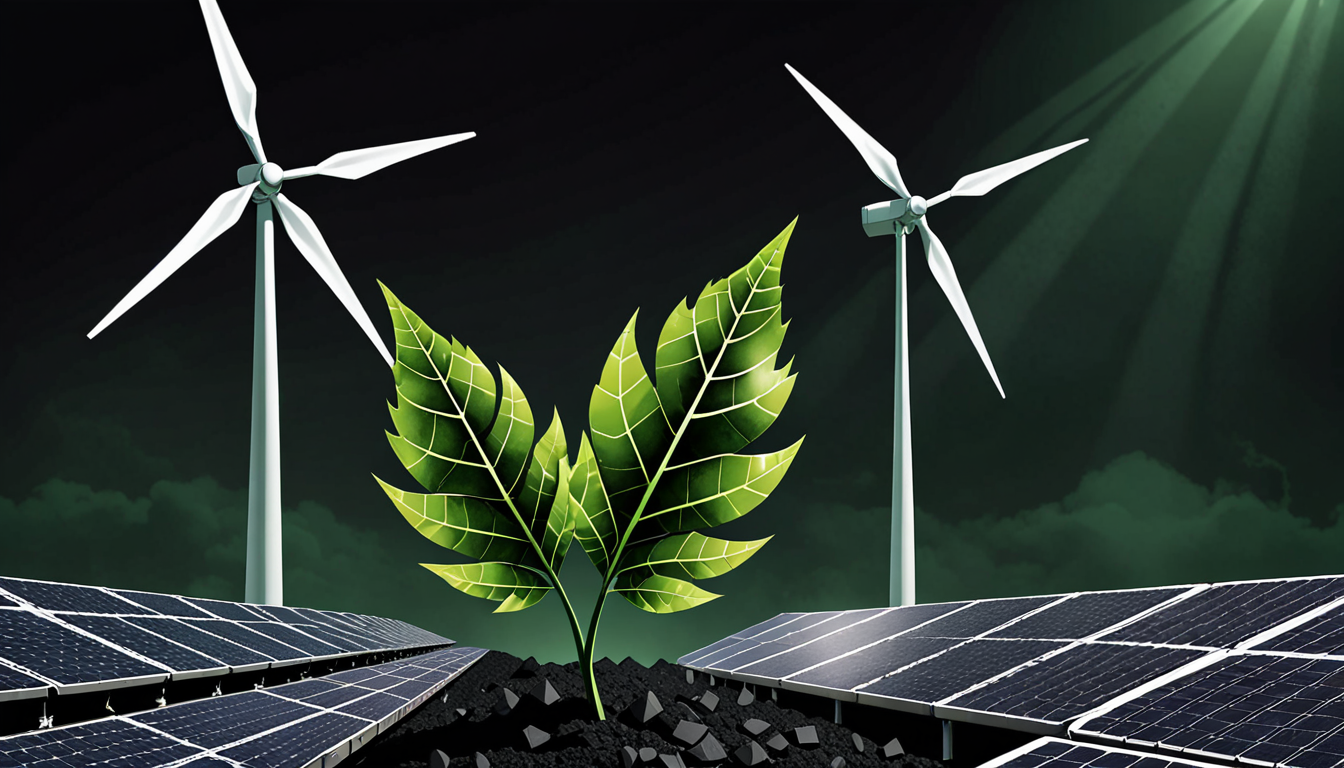
The EU ratifies Turnberry, retreats on the Green Deal, and Asia returns to coal — all in the same week the WTO convenes to discuss fossil fuel subsidies
Executive Summary
The Iran war has triggered a structural retreat from global climate commitments that may prove more consequential than the conflict itself. In a single 48-hour span, the European Parliament ratified the Turnberry trade deal with Washington (417–154) while Brussels signaled it would scale back flagship Green Deal targets; Asian nations from India to Vietnam accelerated coal burning to replace lost LNG; and the WTO's 14th Ministerial Conference opened in Yaoundé with fossil fuel subsidy reform on the agenda — yet no political will to act on it. This is not a temporary detour. The decisions being locked in today — new coal plants, LNG terminals, fossil fuel infrastructure with 30-year lifespans — represent a "carbon lock-in" that climate scientists warn will make the 1.5°C target mathematically impossible.
Chapter 1: The Week Everything Converged
On March 26, 2026, three things happened that will shape the planet's energy future for decades.
First, the European Parliament voted 417–154 (with 71 abstentions) to ratify the Turnberry Agreement — the EU-US trade deal struck at Trump's Scottish golf resort in July 2025. The deal sets US tariffs on EU goods at 15% while the EU eliminates duties on most American industrial products. MEPs attached safeguards — a "sunset clause" expiring March 2028, a "sunrise clause" conditioning tariff preferences on US compliance, and steel/aluminum linkage provisions — but the fundamental architecture was approved: Europe would accept Trump's trade terms, partly because it desperately needs American LNG to replace the energy it is losing to the Iran war.
Second, Reuters reported that the EU was being forced to scale back its flagship climate policies — including the European Green Deal — as Iran war energy prices made ambitious emissions targets politically and economically unviable. Dutch TTF gas benchmarks had nearly doubled to over €60/MWh, European gas storage sat at just 30% capacity after a harsh winter, and the EU had already lowered its gas storage target from 90% to 80%.
Third, the WTO's 14th Ministerial Conference opened in Yaoundé, Cameroon, with 79 members having unveiled a package on fossil fuel subsidy reform. But the irony was devastating: the world's trade ministers were gathering to discuss reducing fossil fuel subsidies at the exact moment governments were frantically increasing them to shield citizens from wartime energy prices.
These three events are not coincidental. They represent a structural inflection point — the moment when the world's most ambitious climate framework began to buckle under the weight of geopolitical reality.
Chapter 2: The Turnberry Trap — Energy Leverage as Trade Policy
To understand why the European Parliament voted to accept a trade deal widely acknowledged as imbalanced, you need to understand Europe's energy predicament.
The Iran war has removed approximately 11 million barrels per day of oil from global markets and disrupted 140 billion cubic meters of annual gas trade, according to IEA chief Fatih Birol. Qatar's Ras Laffan terminal — the world's largest LNG facility — was struck by Iranian missiles and drones in March, with estimates of 3–5 years for full repair. Europe entered the crisis with gas storage at historic lows after the 2025–2026 winter.
The Trump administration understood this leverage perfectly. The Turnberry deal included a $750 billion US energy purchase commitment from Europe, effectively locking the continent into American LNG dependency for years. As German MEP Bernd Lange admitted before the vote: "Of course, that's imbalanced, but if we could improve it, maybe we can live with it."
The safeguards MEPs attached — sunset in 2028, sunrise conditionality — are politically face-saving but structurally weak. LNG import terminals being fast-tracked across Europe have 25–30 year operational lifespans. Once built, the infrastructure creates its own constituency for continued fossil fuel imports. As Oxford University's Jan Rosenow warned: the risk is a "carbon lock-in effect" where newly built infrastructure stays online for decades.
This mirrors a historical pattern. After the 1973 OPEC embargo, Western nations responded with massive investments in North Sea oil, Alaskan drilling, and nuclear power — investments that shaped energy policy for 40 years. After Russia's 2022 invasion of Ukraine, Europe fast-tracked LNG terminals that are now being filled with American gas. Each crisis produces infrastructure that outlasts the crisis itself.
The Turnberry vote was not merely a trade decision. It was Europe implicitly accepting that its energy transition would be subordinated to American geopolitical leverage — a structural shift disguised as a temporary accommodation.
Chapter 3: The Green Deal Unravels
The European Green Deal, launched in 2019, was the world's most comprehensive climate policy framework: net-zero emissions by 2050, 55% reduction by 2030, the Carbon Border Adjustment Mechanism (CBAM), the Emissions Trading System (ETS), and binding renewable energy targets. It was Europe's claim to global climate leadership.
That framework is now cracking under wartime pressure.
Reuters' Ron Bousso reported on March 26 that the EU "may be forced to scale back its flagship climate policies and geopolitical aims as the Iran war drives up energy prices — with lasting consequences for the bloc's energy strategy." This is not speculation. Concrete policy retreats are already underway:
Gas storage target reduction: The EU lowered its mandatory gas storage target from 90% to 80% — an acknowledgment that filling storage at wartime prices is financially impossible for many member states.
Fuel subsidy expansion: Multiple EU countries have introduced or expanded fossil fuel subsidies. Slovenia imposed fuel rationing (50 liters per vehicle). Spain announced a €5 billion energy package. Germany restricted price increases. France's TotalEnergies implemented voluntary price freezes. Portugal cut diesel taxes. These are the exact opposite of carbon pricing signals the Green Deal was designed to send.
Renewable project delays: Higher interest rates driven by wartime inflation make capital-intensive renewable projects less viable. The Guardian reported that "market volatility, an expected rise in interest rates and sluggish permitting make investors wary" of clean energy investments. Meanwhile, the US government paid a French company $1 billion to abandon offshore wind projects and pursue fossil fuel development instead.
Coal resurgence: The dirtiest fossil fuel is making a comeback. India, Thailand, and Vietnam are burning more coal to compensate for LNG shortfalls. China, which reduced coal generation for the first time in 2025, will likely reverse that trend after the destruction of Qatar's LNG infrastructure, according to Columbia University's Ira Joseph.
The critical insight is that these aren't temporary emergency measures. Each coal plant restarted, each LNG terminal contracted, each renewable project delayed creates path dependencies that compound over decades. The IEA's own modeling shows that infrastructure decisions made in 2026–2027 will determine whether the world stays within 2°C of warming — and the current trajectory points firmly in the wrong direction.
Chapter 4: Asia's Coal Relapse
The climate retreat is not just a European phenomenon. Across Asia, the Iran war is driving a wholesale return to coal — the energy source the world had been slowly weaning itself from.
The mechanism is straightforward. Asian economies are heavily dependent on imported LNG, much of which transited the Strait of Hormuz. With that route effectively closed, countries face a brutal choice: burn coal or face blackouts.
India cut excise duties on diesel to zero (from Rs 10) and on petrol to Rs 3 (from Rs 13) — massive fossil fuel subsidies in a country that had been gradually reducing them. India is simultaneously increasing coal imports and production, targeting 1.1 billion tonnes of domestic coal output.
Vietnam and Thailand are burning more coal to meet demand shortfalls, reversing commitments made at COP26 in Glasgow to phase down coal.
China presents the most significant case. After reducing coal generation for the first time in 2025 — a landmark achievement — the destruction of LNG supply from Qatar and the broader Hormuz disruption is pushing China back toward coal. China accounts for over 50% of global coal consumption; any reversal there swamps progress everywhere else.
Pakistan, despite its remarkable rooftop solar boom, is also increasing coal usage from its Thar coalfield to compensate for unaffordable LNG imports.
The cruel irony: some of the countries most vulnerable to climate change — Bangladesh, Pakistan, Vietnam — are being forced to accelerate the very emissions that threaten their existence, because the immediate energy crisis leaves no alternative.
There is one bright spot. Countries with high renewable penetration — Spain, Portugal, Nepal (70% EV adoption), and regions of China — are significantly more insulated from the fossil fuel price shock. As Rosenow noted, "electricity generated from wind and solar is largely insulated from fossil fuel price volatility — once built, the fuel is free." But this benefit accrues to countries that invested in renewables before the crisis, not those scrambling to respond during it.
Chapter 5: The Yaoundé Paradox — WTO, Fossil Fuels, and the Broken Multilateral System
The WTO's 14th Ministerial Conference (MC14) opened in Yaoundé on March 26 with an ambitious agenda: WTO reform, dispute settlement revival, digital trade rules, and — notably — fossil fuel subsidy reform. Seventy-nine members had signed onto a Trade and Environmental Sustainability Structured Discussions (TESSD) package, including ministerial statements on trade-related climate measures and fossil fuel subsidies.
The timing makes this agenda almost farcical. At the exact moment the WTO is discussing fossil fuel subsidy reduction, its member governments are frantically increasing those subsidies. The EU is subsidizing gas and diesel. India is cutting fuel taxes. The US is paying companies to abandon wind farms. Japan is drawing down its 145-day strategic petroleum reserve. South Korea has passed a 25 trillion won (US$16.6 billion) wartime supplementary budget, much of it directed at energy costs.
This is not the first time war has undermined climate action at the multilateral level. The 2022 Russian invasion of Ukraine led to a European coal revival that added an estimated 200 million tonnes of CO2 to the atmosphere. But the 2026 crisis is qualitatively different in scale: the IEA describes it as worse than the 1973, 1979, and 2022 crises combined.
The WTO's inability to address this contradiction reflects a deeper structural problem. The multilateral trading system was designed for a world where trade liberalization was the primary objective. Climate policy was bolted on later, awkwardly and incompletely. When energy security and climate goals collide — as they have collided this month — energy security wins every time. No government facing blackouts or $100 oil will sacrifice citizens' welfare for emissions targets.
The four ministerial sessions on WTO reform scheduled for March 26–27 focus on institutional governance, not the fundamental question: can a rules-based trading system survive when its largest members routinely invoke national security exceptions to override trade commitments?
Chapter 6: Scenario Analysis — Where Does the Green Transition Go from Here?
Scenario A: Accelerated Transition (15%)
Premise: The Iran war serves as a "Pearl Harbor moment" for energy independence, driving massive investment in renewables, nuclear, and storage.
Evidence for: John Kerry called oil and gas a "security challenge." UN Secretary General Guterres said fossil fuel addiction is "destabilizing both the climate and global security." Spain and Portugal demonstrate that high renewable penetration insulates against price shocks. The economic argument for renewables — free fuel once built — has never been stronger.
Evidence against: The political economy points in the opposite direction. High fossil fuel prices generate windfall profits that flow back into exploration and infrastructure. The Trump administration is actively subsidizing fossil fuels. Capital costs for renewables are rising with inflation. Supply chain disruptions (aluminum from the Middle East accounts for 9% of global production) constrain manufacturing capacity.
Trigger conditions: A swift ceasefire (before April 6 Trump deadline) combined with a dramatic policy reversal — perhaps a new IEA emergency ministerial or a UN General Assembly resolution on energy security through renewables.
Historical precedent: After the 1973 oil embargo, Denmark invested heavily in wind power and is now nearly energy-independent. But Denmark was the exception, not the rule. Most nations doubled down on fossil fuels.
Scenario B: Managed Retreat (50%)
Premise: Climate targets are quietly downgraded while governments maintain rhetorical commitment. The Green Deal survives in name but is hollowed out in practice.
Evidence for: This is the pattern already emerging. The EU lowered storage targets, expanded fuel subsidies, and ratified Turnberry — while still officially committed to net-zero by 2050. Asian nations restart coal "temporarily" but the plants run for decades. The WTO discusses fossil fuel reform while members do the opposite.
Evidence against: Some institutional momentum persists. The EU's CBAM is already operational. The ETS continues to price carbon. Renewable energy investment, while challenged, hasn't collapsed.
Trigger conditions: This is the default trajectory. It requires no specific trigger — merely the continuation of current policy contradictions.
Historical precedent: This mirrors the post-2009 financial crisis pattern, when governments abandoned fiscal stimulus for austerity while maintaining growth rhetoric. Climate commitments follow the same trajectory: ambition in communiqués, retreat in budgets.
Time frame: The 2030 EU target of 55% emissions reduction becomes effectively unattainable by late 2026 if current infrastructure decisions persist. The gap between target and trajectory widens every month.
Scenario C: Full Reversal (35%)
Premise: The energy crisis triggers an explicit repudiation of climate targets, with governments openly prioritizing energy security over emissions reduction.
Evidence for: Trump's $1 billion payment to abandon wind farms is an early signal. CERAWeek 2026 in Houston showcased fossil fuel industry triumphalism. The Republican coalition at CPAC is increasingly hostile to climate policy. If the Iran war extends beyond April 6, the political pressure for "drill, baby, drill" intensifies globally.
Evidence against: The economic case for renewables remains strong at the technology level. Solar and wind are now the cheapest new electricity sources in most markets. Complete reversal would require governments to actively dismantle existing renewable capacity, not just slow new builds.
Trigger conditions: Extension of the Iran war beyond Q2 2026, combined with a severe recession. Political populism seizes on energy costs as a wedge issue (already happening in European elections). The Turnberry sunset clause expires in 2028 without renewal, triggering a transatlantic trade war that prioritizes LNG over climate cooperation.
Historical precedent: The 1980s saw a complete abandonment of the post-1973 energy conservation agenda once oil prices fell. Reagan dismantled Carter's solar panels from the White House roof — a symbolic act that defined a generation of energy policy.
Chapter 7: Investment Implications
Fossil fuel equities: The structural case for fossil fuel investment has strengthened. Not because of higher prices per se, but because the policy environment has shifted from "managed decline" to "strategic necessity." European energy majors (Shell, TotalEnergies, BP) that had been pressured to increase renewable spending are now being rewarded for fossil fuel production.
Renewable energy: Near-term headwinds from higher capital costs, supply chain disruptions (aluminum, shipping), and policy uncertainty. But medium-term fundamentals remain strong — the cost advantage of free fuel is structural. The divergence between near-term pain and long-term economics creates opportunities for patient capital. Companies with existing operational capacity (Ørsted, Iberdrola) are better positioned than those with construction pipelines.
LNG infrastructure: The biggest structural beneficiary. Cheniere, Venture Global, and TC Energy are locked into decades of European demand. The Turnberry deal's $750 billion energy commitment provides unprecedented demand certainty.
Carbon markets: EU ETS prices face downward pressure as political willingness to enforce tight caps erodes. Carbon credits may face a "credibility discount" if the gap between stated targets and actual emissions widens.
Agricultural commodities: The fertilizer-food chain remains under severe stress. Urea prices have surged to $700/tonne from $400–490 pre-war. With 30% of global seaborne fertilizer trade blocked at Hormuz and Northern Hemisphere spring planting underway, crop yield reductions of 3–5% are increasingly priced in. Wheat, corn, and soybean futures carry structural risk premiums.
Coal equities: Contrarian beneficiary. India, China, and Southeast Asia's return to coal benefits producers like Coal India, China Shenhua, and Adaro Energy. But this is a trade, not an investment — the structural decline of coal resumes once the immediate crisis passes.
Conclusion
The Iran war did not create the tension between energy security and climate action — that contradiction was always embedded in the global transition strategy. What the war has done is expose it, brutally and simultaneously across every continent.
The decisions being made this week — Turnberry ratification, Green Deal scaling, coal restarts, LNG lock-ins — will compound for decades. Every new LNG terminal that begins construction in 2026 will still be operating in 2056. Every coal plant restarted "temporarily" creates jobs, communities, and political constituencies that resist closure. The climate clock does not pause for geopolitics.
The most honest assessment: the world entered the Iran war on a narrow but plausible path to limiting warming to 2°C. It will exit the war — whenever that happens — on a path where even 2.5°C requires extraordinary effort. The Green Deal was not killed by a single blow. It is being dismantled by a thousand rational decisions, each defensible in isolation, collectively catastrophic.
As the Guardian's reporting captured the paradox perfectly: "War is being used as a false justification for rushed and irresponsible extraction. Instead, this should be the final wake-up call that there is a better way." Whether that wake-up call is heeded — or drowned out by the roar of LNG tankers — will define the climate trajectory for the rest of the century.
Related Reading
- Europe scales back climate goals to ease Iran war energy shock — Reuters
- What does the Iran war mean for clean energy transition? — The Guardian
- EU lawmakers support EU–US trade deal, with conditions attached — Euronews
- Fertilizer prices surge amid Iran war — CNBC
- WTO MC14 opens in Yaoundé — WTO
Sources: Reuters, The Guardian, Euronews, AP News, NPR, CNBC, WTO, IEA, Oxford University, Columbia University Center on Global Energy Policy, European Parliament, Ninety One Asset Management, CRU Group, Argus Media
Leave a Reply