
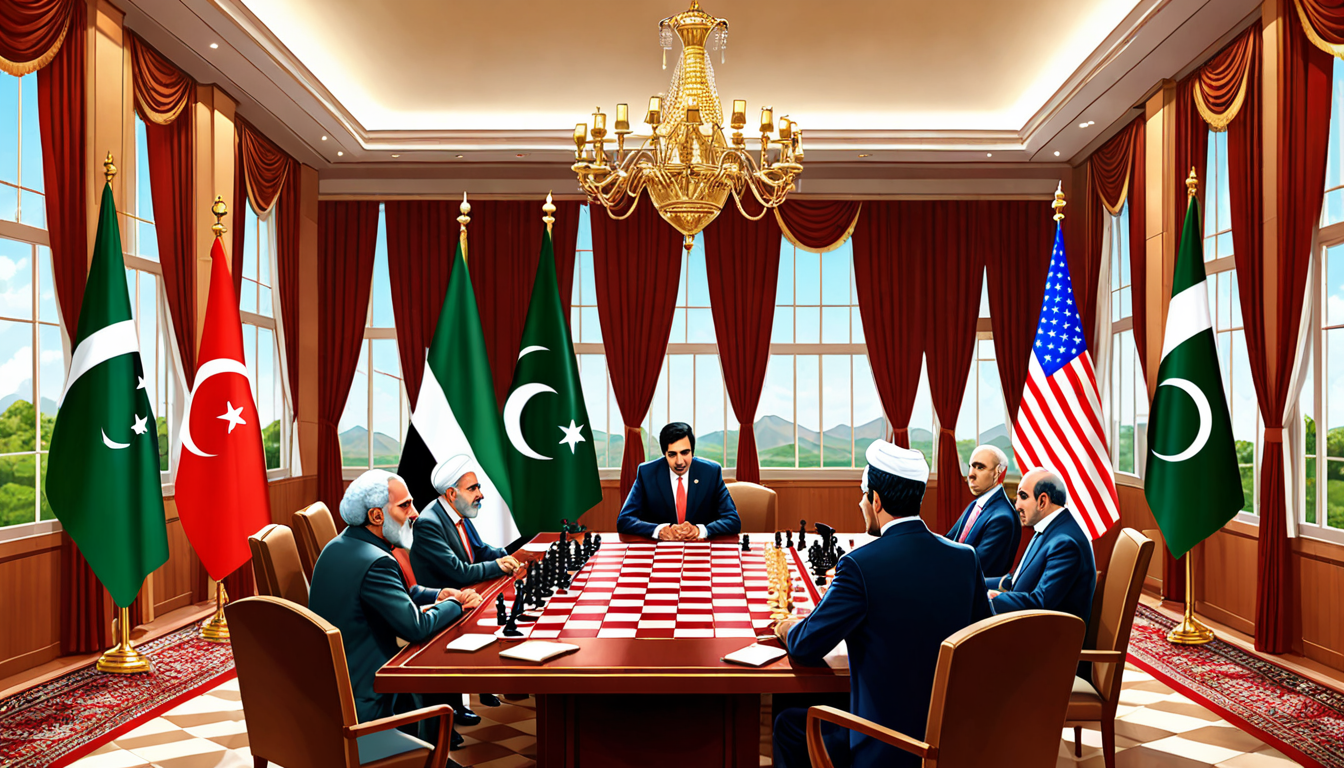
As Iran appoints an IRGC hardliner to replace its assassinated security chief, a surprising backchannel through Islamabad—and the quiet rise of war-skeptic JD Vance—may represent the conflict's first genuine off-ramp
Executive Summary
- Pakistan has emerged as the lead mediator in the Iran war, with Army Chief Asim Munir speaking directly to Trump and PM Sharif holding parallel talks with Iran's Pezeshkian. Islamabad is now the proposed venue for face-to-face US-Iran talks this week—potentially including Vice President JD Vance as chief US negotiator.
- Iran is sending contradictory signals: appointing IRGC veteran Mohammad Bagher Zolghadr as new SNSC chief (replacing assassinated Ali Larijani) signals internal hardening, while backchannel contacts through Egypt, Pakistan, Oman, Qatar, and Turkey suggest at least some faction is exploring an exit.
- The five-day window to March 27 is the most dangerous and promising period of the entire conflict—dangerous because fighting has intensified even as diplomatic signals multiply, promising because for the first time a credible venue, mediator, and US interlocutor (Vance) with genuine skepticism about the war are converging simultaneously.
Chapter 1: The Surprise Mediator
When Pakistan's Army Chief General Asim Munir picked up the phone to call Donald Trump on Sunday, March 22, it marked a significant shift in the conflict's diplomatic geometry. Pakistan—sharing a 959-kilometer border with Iran, hosting the world's second-largest Shia population, and maintaining working relationships with both Washington and Tehran—was positioning itself as the indispensable go-between.
The timing was not accidental. Trump's 48-hour ultimatum to Iran—reopen the Strait of Hormuz or face the destruction of its power grid—was set to expire within hours. Financial markets were bracing for catastrophe. The Munir-Trump call was followed almost immediately by Pakistani Prime Minister Muhammad Shehbaz Sharif holding talks with Iranian President Masoud Pezeshkian. Within 24 hours, Islamabad had established simultaneous communication with both warring parties—the basic prerequisite for any mediation.
What makes Pakistan's bid distinctive is not just geography but institutional credibility. Unlike Oman (the traditional US-Iran intermediary) or Turkey (whose Erdoğan has struggled to maintain neutrality), Pakistan's military establishment has deep operational ties to both the Pentagon and Iran's security apparatus. During the 2025 Geneva nuclear talks, Pakistani intelligence served as a quiet backchannel when formal negotiations stalled. Now, with the stakes exponentially higher, Islamabad is cashing in that capital.
The Egyptian foreign ministry confirmed on Monday that its foreign minister, Badr Abdelatty, had coordinated multilateral discussions involving Pakistan, Qatar, Turkey, Iran, and US Special Envoy Steve Witkoff. But multiple diplomatic sources indicate Pakistan has moved beyond mere coordination to actively proposing a framework: face-to-face talks in Islamabad between senior US and Iranian officials, potentially as early as this week.
Chapter 2: The Vance Variable
Perhaps the most consequential development is who Washington may send to Islamabad. According to Bloomberg, CNN, and The Guardian, citing Pakistani and Israeli sources, Vice President JD Vance is the frontrunner to represent the United States—not Steve Witkoff, who has led previous nuclear negotiations, and not Jared Kushner, Trump's son-in-law.
This matters enormously. Vance is, by multiple accounts, a private skeptic about the Iran war. His Senate career was defined by opposition to American military interventionism. During the 2024 presidential campaign, he repeatedly argued that the United States was overextended in the Middle East. His intellectual formation—shaped by realist thinkers skeptical of regime change—stands in stark contrast to the hawks who drove the initial strikes on February 28.
Sending Vance would signal to Tehran that someone within the US power structure genuinely wants an exit. It would also create a significant domestic political dynamic: if Vance secures a ceasefire, he positions himself as the administration's peace-maker, differentiating himself from Trump's own escalatory rhetoric. If talks fail, Vance can return to Washington having demonstrated effort, while Trump retains the option of military escalation.
The Israeli reaction is revealing. According to Axios, Israeli officials were "surprised" by Trump's sudden claims that productive talks were underway and that agreements had been reached on multiple points. Israel, while aware of mediation efforts by Turkey, Egypt, and Pakistan, had not been consulted on the proposed Islamabad framework. Netanyahu's office issued a careful statement saying Israel was "continuing to strike, in Iran and in Lebanon"—a hedge that preserves operational freedom regardless of diplomatic developments.
Chapter 3: The Zolghadr Appointment—A Hardliner in the War Room
On the very day that backchannel talks were crystallizing, Iran made a personnel decision that sent the opposite signal. Mohammad Bagher Zolghadr, a veteran Islamic Revolutionary Guard Corps commander, was named the new Secretary of the Supreme National Security Council (SNSC), replacing Ali Larijani, who was killed in an Israeli airstrike last week.
Zolghadr's appointment is significant for several reasons. Unlike Larijani—a politically savvy pragmatist who served as Iran's institutional glue and who had navigated the complex space between reformists and hardliners—Zolghadr is a pure IRGC product. He served as deputy commander of the IRGC's ground forces during the Iran-Iraq War and later held senior positions in Iran's internal security apparatus. His worldview is forged in the IRGC's institutional culture of resistance, strategic patience, and skepticism of Western negotiations.
The appointment suggests that the power center around Mojtaba Khamenei—the new supreme leader who remains invisible and possibly incapacitated—has tilted decisively toward the military establishment. With Larijani dead and Foreign Minister Araghchi reportedly sidelined in an internal power struggle, the voices counseling caution have been systematically eliminated or marginalized.
This creates a fundamental paradox at the heart of any peace process. Even if backchannel contacts are genuine, does the person on the other end of the line have the authority to deliver? Iran's political authority structure has been shattered by the Israeli assassination campaign. The supreme leader is invisible. The SNSC chief is brand new. The foreign minister's status is unclear. Parliament Speaker Ghalibaf—who partially denied negotiations while leaving the door open—may be freelancing.
As The Guardian noted, "The possibility remained that one of Iran's reduced leadership group was dangerously freelancing, and, if so, a massive political backlash would occur."
Chapter 4: The Cluster Bomb Calculus—Why Both Sides Need an Exit
The military reality on the ground is creating pressure for diplomacy, even as it simultaneously makes diplomacy more difficult.
Israel's vulnerability: Iran's use of cluster munitions on ballistic missiles has exposed a genuine gap in Israeli air defenses. According to The Guardian and the IDF itself, roughly half of the missiles launched from Iran since February 28 have carried cluster warheads. At least 19 ballistic missiles with cluster warheads have penetrated Israeli airspace and struck urban areas, killing at least nine people and wounding dozens. The Khorramshahr missile can carry up to 80 submunitions that scatter mid-air—making interception after dispersal "virtually impossible," according to Israeli missile expert Tal Inbar. The IDF claims to have destroyed 70% of Iran's ballistic missile launchers and achieved near-total control of Iranian airspace. But "near-total" is not total, and Iran continues to fire salvos, including a new barrage at Israel early Tuesday, March 25. Iranian missiles struck Tel Aviv on Tuesday, causing building damage and at least four casualties.
Iran's devastation: The death toll in Iran has surpassed 1,500 (military and civilian combined), with some rights groups reporting figures as high as 3,230 as of March 21. Iran's leadership has been systematically targeted—the supreme leader killed, Larijani assassinated, the Imam Hossein strategic missile base south of Yazd struck on March 22. The Hormuz blockade, while effective as economic leverage (oil prices remain above $100), has also isolated Iran from potential allies. Lebanon has expelled Iran's ambassador. Gulf states that Iran struck are demanding its neutralization. The "Ring of Fire"—Iran's network of regional proxies—lies in ruins.
The mutual exhaustion logic: Both sides are suffering, but neither is close to achieving their stated objectives. Israel cannot stop every Iranian missile. Iran cannot force the US-Israeli coalition to halt its campaign through Hormuz alone. The war has entered what military theorists call a "hurting stalemate"—the condition historically most conducive to negotiation.
The 1988 Iran-Iraq War ceasefire provides the closest historical parallel. After eight years of devastating conflict, Ayatollah Khomeini accepted UN Resolution 598—which he famously compared to "drinking poison"—not because Iran had been militarily defeated, but because the costs had become unsustainable. Iran's current leadership, however fractured, may be approaching a similar calculation. The question is whether any individual has both the will and the authority to drink the cup.
Chapter 5: The Five Competing Mediators—and Why That's a Problem
The diplomatic landscape is crowded to the point of dysfunction. At least five countries are actively mediating or claiming to mediate:
Pakistan has the strongest current bid, with direct military-to-military channels to both sides and a concrete proposal for Islamabad talks. Pakistan Army Chief Munir's relationship with the Pentagon, combined with Pakistan's cultural and religious ties to Iran, gives it unique credibility. The proposed Vance visit would represent the highest-level US diplomatic engagement since the war began.
Oman has traditionally served as the primary US-Iran intermediary. The 2015 JCPOA backchannel ran through Muscat. Oman's foreign minister confirmed he was holding talks on reopening Hormuz. But Oman's approach is incremental and procedural—unsuited to the current crisis tempo.
Egypt coordinated the multilateral discussions on Sunday, with Foreign Minister Abdelatty hosting the conversation involving multiple parties. Egypt's role is more facilitator than mediator—a convening power rather than a guarantor.
Turkey under Erdoğan has sought to position itself as peacemaker, but Turkey's NATO membership and its own complex relationship with Iran limit its credibility in Tehran's eyes.
Qatar, despite having its own infrastructure devastated by IRGC strikes (Ras Laffan LNG facility destroyed, 17% of global capacity), remains diplomatically engaged. Qatar's record in hostage negotiations and Taliban talks gives it some credibility, though its status as a victim of Iranian strikes creates obvious tensions.
The risk of mediator competition is not merely diplomatic vanity. Each channel creates separate expectations, different narratives, and opportunities for both sides to play mediators against each other. During the 1990s Oslo process, the multiplicity of backchannel communications between Israel and the PLO occasionally produced contradictory commitments that undermined trust. The same dynamic is already visible: Trump claims a 15-point deal framework, Iran denies any negotiations took place, and multiple mediating capitals each claim credit for progress that may not exist.
Chapter 6: Trump's 15-Point Mirage
Trump's public description of the emerging deal framework deserves scrutiny, because it reveals either the contours of a real agreement or the outlines of a fantasy—and the difference matters enormously for markets and geopolitics.
According to Trump's press briefings on Monday, the framework includes:
- Joint US-Iran control of the Strait of Hormuz — "me and the ayatollah. Whoever the ayatollah is."
- No nuclear weapons — "not even close"
- Elimination of highly enriched uranium stockpile — "no nuclear dust"
- Missile limitations — "low-key on the missiles"
- Regional peace — talks between Iran and Gulf neighbors
- No uranium enrichment
The last point is the most telling. Iran abandoning its right to enrich uranium would be an extraordinary concession—the single issue on which Tehran has refused to compromise for two decades. Even the 2015 JCPOA preserved Iran's enrichment rights, limiting only the level and quantity. If Iran has genuinely agreed to "no enrichment," it would represent a capitulation beyond what any previous US administration achieved.
The more likely interpretation is that Trump is either conflating preliminary contacts with substantive agreements, or that an Iranian interlocutor made vague assurances that Trump has amplified into firm commitments. Iran's foreign ministry response—that "messages arrived through some friendly countries indicating America's request for negotiations to end the war, which were responded to appropriately"—is consistent with receiving and replying to a diplomatic probe, not agreeing to a comprehensive framework.
Chapter 7: Scenario Analysis
Scenario A: The Islamabad Breakthrough (20%)
Premise: Vance travels to Islamabad. A senior Iranian official (likely Araghchi or Ghalibaf) participates. Both sides agree to a 72-hour ceasefire and a framework for Hormuz reopening in exchange for a US commitment to halt strikes on energy and civilian infrastructure.
Why 20%: The fundamental "who speaks for Iran?" problem remains unresolved. Zolghadr's appointment suggests the IRGC—not the foreign ministry—holds the real power. Any agreement Araghchi or Ghalibaf makes could be repudiated by the military establishment. Additionally, Israel has not been included in the proposed talks and Netanyahu has explicitly stated strikes will continue. A US-Iran ceasefire that excludes Israel is structurally incomplete.
Historical precedent: The 2015 JCPOA took 20 months of intensive negotiations even with a functional Iranian government and a US president (Obama) committed to diplomacy. The idea that a five-day window can produce a "complete and total resolution" strains credulity.
Trigger: Vance actually arrives in Islamabad and meets face-to-face with an authorized Iranian representative.
Scenario B: Managed Ambiguity Continues (50%)
Premise: The five-day window passes without either breakthrough or catastrophic escalation. Trump extends the deadline again, citing "progress." Backchannel contacts continue through multiple mediators. The Hormuz blockade remains partial (Iran's Larak corridor toll system persists). Oil prices fluctuate between $95-110. Military operations continue at current tempo.
Why 50%: This is the path of least resistance for all parties. Trump gets to claim diplomacy is working without making concessions. Iran avoids the catastrophic escalation of energy infrastructure strikes while maintaining Hormuz leverage. Israel continues its air campaign against Iranian military targets. Markets price in continued uncertainty without the shock of total breakdown.
Historical precedent: The Korean War armistice negotiations at Panmunjom lasted over two years (1951-1953) while fighting continued. The current conflict may similarly enter a phase where diplomacy and warfare coexist indefinitely.
Trigger: The March 27 deadline expires without either talks or strikes on energy infrastructure.
Scenario C: Escalation Despite Diplomacy (30%)
Premise: An escalatory event—whether an Iranian missile strike causing mass casualties in Israel, an Israeli strike killing another senior Iranian leader, or an accident in the congested Hormuz waters—shatters the diplomatic window. Trump reverts to his original threat. Iran's IRGC-dominated leadership, empowered by Zolghadr, orders full Hormuz closure and mine deployment.
Why 30%: The fighting has not stopped. Iran fired missiles at Israel on Tuesday morning. Israel struck Tehran with "unprecedented" force on Monday. The IDF chief stated the Hezbollah fight was "just beginning." In an environment of active combat, a single incident can overturn weeks of diplomatic effort. The 1914 precedent is instructive: multiple Great Powers were pursuing diplomatic solutions even as mobilization schedules and military logic dragged them into war.
Trigger: A mass-casualty event on either side, or a direct US military confrontation with Iranian naval forces in the Strait.
Time frame: All scenarios play out within the March 27 deadline window, with longer-term implications extending months.
Chapter 8: Market Implications and Investment Signals
Oil: The Islamabad talks introduce a diplomatic premium that will partially offset the war premium. Brent has retreated from $112 to ~$103 on the relief rally, but the Oman physical premium ($162) signals that the real-economy impact remains severe. A genuine Vance visit to Islamabad could push Brent below $100 temporarily; a collapse of talks would likely send it above $115. The paper-physical spread remains the single most important indicator of actual versus perceived supply disruption.
Dollar: The dollar fell on Monday as Trump paused strikes, cooling supply-shock fears. But the dollar remains the structural beneficiary of the conflict as the ultimate safe haven. A successful Islamabad framework would weaken the dollar; continued ambiguity sustains it.
Defense stocks: The Zolghadr appointment and continued military operations on both sides reinforce the structural defense spending tailwind. Gulf states have signaled $30-50B in new procurement. Elbit, L3Harris, Raytheon, and European defense names (Rheinmetall, Leonardo) remain positioned for multi-year order cycles regardless of diplomatic outcomes.
Pakistani assets: Pakistan's emergence as peace broker is a significant positive signal for Pakistani sovereign bonds and the rupee. Successful mediation would boost Pakistan's international standing and potentially unlock financial support from grateful Gulf states. The Karachi Stock Exchange has already responded positively.
Insurance/reinsurance: The April 1 reinsurance renewal cliff remains the critical date for shipping and energy markets. A diplomatic framework, even preliminary, before April 1 could prevent the most catastrophic insurance market dislocation. Without it, war-risk premiums will effectively create a second blockade—financial rather than physical.
Conclusion: The Paradox of Simultaneous War and Peace
The next 72 hours will test whether the Iran war follows the pattern of the Cuban Missile Crisis—where backdoor diplomacy resolved a confrontation that seemed to be spiraling beyond control—or the pattern of World War I, where multiple diplomatic initiatives failed to overcome the momentum of military escalation.
The Islamabad gambit has genuine structural advantages: a credible mediator (Pakistan), a war-skeptic negotiator (Vance), and mutual exhaustion creating incentives for both sides. But it also faces structural obstacles that no amount of diplomatic skill can easily overcome: Iran's shattered chain of command, the untested Zolghadr's authority, Israel's exclusion from any US-Iran framework, and the fundamental question of whether Trump's 15-point framework bears any relationship to reality.
The appointment of an IRGC hardliner to Iran's most powerful security position on the same day that peace talks are proposed is not necessarily contradictory—it may be an attempt to ensure military buy-in for any eventual agreement. But it also means that if talks fail, the person in charge of Iran's war strategy is someone whose entire career has been built on resistance to Western pressure.
The Islamabad gambit is real. Whether it represents a genuine off-ramp or merely the latest iteration of the Schrödinger's diplomacy that has defined this conflict—simultaneously alive and dead until observed—will be determined not in press conferences or social media posts, but in the quiet rooms of Islamabad, where the distance between war and peace may be measured in millimeters.
Sources: The Guardian, Al Jazeera, Bloomberg, BBC, CNN, NBC News, ABC News Australia, India Today, Axios, ISW-CTP, Indian Express
Leave a Reply