
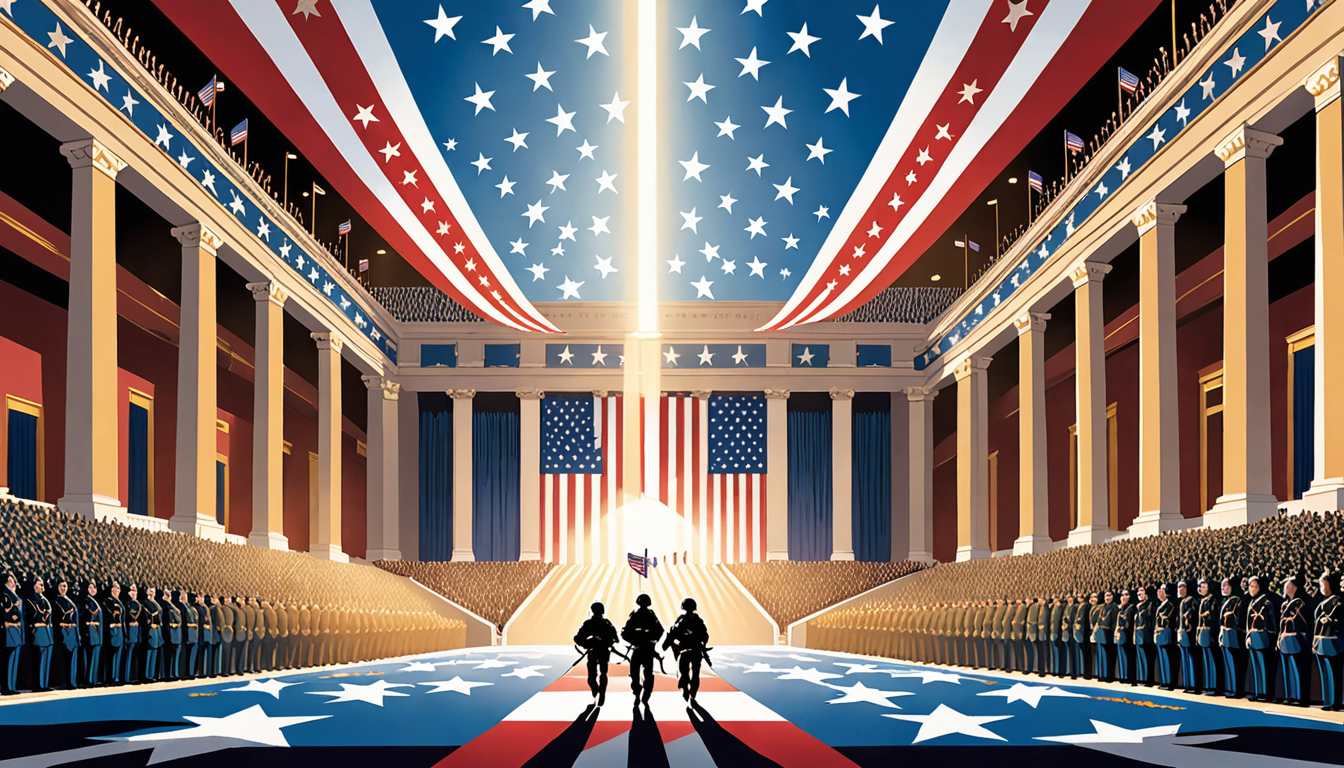
As the 82nd Airborne deploys to the Middle East, CPAC opens with the right openly divided — and Trump conspicuously absent
Executive Summary
- The Conservative Political Action Conference (CPAC) opens March 25 in Texas with unprecedented open division over the Iran war — and neither Trump nor Vance is scheduled to speak
- The 82nd Airborne Division has been ordered to the Middle East, with 2,000 paratroopers preparing for potential ground operations including a Kharg Island seizure, even as Trump's approval hits 36%
- The convergence of military escalation abroad and political fracture at home creates a strategic paradox: the war Trump launched to project strength is becoming the thing most likely to cost Republicans the 2026 midterms
Chapter 1: The Ghost of CPAC Past
One year ago, CPAC was a coronation. Donald Trump, freshly reinstalled in the White House, stood before thousands of cheering conservatives in National Harbor, Maryland, and proclaimed the dawn of a "new and lasting political majority." Elon Musk, then still basking in the glow of his DOGE cost-cutting crusade, wielded a chainsaw onstage — a theatrical symbol of the administration's war on government bureaucracy.
The 2025 gathering was a victory lap: Republicans controlled both chambers of Congress, Trump's approval hovered around 47%, and the "America First" agenda appeared unstoppable. The most contentious debate was whether to cut government spending by 30% or 50%.
Fast forward to March 25, 2026, at the Gaylord Texan Resort in Grapevine, Texas. The mood could not be more different. Neither Donald Trump nor Vice President JD Vance has been publicly announced as a speaker — marking Trump's first absence from CPAC since 2016, when he skipped during the Republican primary. The conspicuous no-shows from virtually every major 2028 hopeful — including Ron DeSantis and Marco Rubio — signal something deeper than scheduling conflicts.
They signal a movement that no longer knows what it stands for on the most consequential question of the moment: Should America be at war with Iran?
Chapter 2: The Fault Lines
The Iran war has accomplished something that four years of Democratic opposition, two impeachments, and an insurrection could not: it has created genuine, open ideological division within the MAGA movement itself.
The speakers' list at CPAC 2026 reads like a catalogue of contradictions. Steve Bannon, the movement's populist-nationalist id, has warned bluntly on his War Room podcast that "we are going to bleed support" if the Iran conflict becomes "a hard slog." Bannon's calculus is purely electoral: he sees the midterms approaching in November and recognizes that the "America First" brand was built on the explicit promise of not doing precisely what the administration is now doing — launching a major military campaign in the Middle East.
On the other side stands Senator Ted Cruz of Texas, a full-throated war supporter. "I think President Trump was exactly right to act to protect Americans," Cruz told CBS News, framing the conflict through the lens of national security rather than nationalist restraint.
Then there is Matt Gaetz, the former Florida congressman turned One America News host, who represents a third current entirely: the populist right's growing discomfort with what Gaetz characterizes as excessive coziness with Israel. This strain of conservative opinion, amplified by figures like Tucker Carlson, challenges the Republican Party's decades-old alliance with the Israeli right — and has drawn sharp accusations of antisemitism from pro-Israel Republican groups.
These aren't marginal figures arguing at the periphery. They are the movement's headliners, its opinion-shapers, its ideological architects. And they fundamentally disagree on whether the defining action of Trump's second term was wise, necessary, or disastrous.
The Numbers Tell the Story
The raw polling data illuminates the fracture:
- 86% of self-identified conservatives still approve of Trump's overall job performance (AP-NORC, February 2026)
- But 55% of all Americans oppose military action against Iran, and 60% oppose the deployment of ground troops (CBS/YouGov, March 2026)
- Trump's overall approval has fallen to 36% — a historic low for a first-term president this early in his second year
- Republican generic ballot advantage for the midterms has evaporated, with the House majority now rated as "in jeopardy"
The gap between the 86% conservative approval and the 36% overall number reveals the problem: Trump retains his base but is hemorrhaging everyone else. And within that base, the Iran war is the one issue where the consensus fractures.
Chapter 3: Escalation Abroad
The domestic political crisis cannot be understood in isolation from what is happening militarily. On the same day CPAC opens in Texas, the Pentagon has ordered the leadership of the 82nd Airborne Division — the Army's elite rapid-response force — to deploy to the Middle East.
This is not a routine rotation. The 82nd Airborne's Immediate Response Force, approximately 2,000 paratroopers from Fort Liberty (formerly Fort Bragg), North Carolina, is designed for one thing: being anywhere in the world within 18 hours, ready to fight. Their commanding general, Brigadier General Brandon Tegtmeier, has already been ordered to deploy with his command element.
The specific mission under active planning, according to multiple reports from the New York Times, Washington Post, Forbes, and Axios, is the seizure of Kharg Island — the small island 16 miles off Iran's coast that handles approximately 90% of Iran's oil exports. Additionally, approximately 2,300 Marines from the 31st Marine Expeditionary Unit are scheduled to arrive in the Middle East later this week, providing additional amphibious assault capability.
Why Kharg Island Matters
Kharg Island is Iran's economic jugular. The logic from the administration's perspective is straightforward: seize the island, and you simultaneously eliminate Iran's ability to fund the war while creating leverage to force Tehran to reopen the Strait of Hormuz, which has been effectively closed since the conflict began in late February.
The comparison that hawks like Senator Lindsey Graham invoke is Iwo Jima — a contested island seizure that accelerated the end of a larger war. The comparison that critics invoke is Iraq 2003 — a military operation sold as a quick strike that metastasized into a decades-long quagmire.
What makes the Kharg Island planning particularly significant is its timing. Just 48 hours earlier, Trump had delayed his own self-imposed deadline for Iran to reopen the Strait of Hormuz, claiming "productive talks" were underway. Iran's Foreign Ministry categorically denied any negotiations, calling Trump's claim "part of efforts to lower energy prices and buy time for the implementation of his military plans."
This is the Schrödinger's diplomacy that has characterized the conflict since Day 20: the United States simultaneously claims to be negotiating and prepares for a ground invasion. The 15-point peace plan reportedly conveyed through Pakistani intermediaries demands the dismantling of Iran's nuclear program, an end to its ballistic missile program, cessation of proxy support, and reopening of the Strait of Hormuz — terms that no Iranian government could accept and survive politically.
Chapter 4: The War Powers Clock
The deployment of the 82nd Airborne triggers a crucial legal and political mechanism that compounds the CPAC fracture: the War Powers Resolution.
Under the War Powers Act of 1973, the president must notify Congress within 48 hours of deploying troops into hostilities and must withdraw them within 60 days unless Congress provides authorization. Trump launched Operation Epic Fury on approximately February 27, 2026. That means the 60-day clock expires in late April — right when the midterm campaign season begins in earnest.
This creates an impossible trilemma for Republican lawmakers:
- Vote to authorize the war — and own it before voters in November, when 55% of Americans oppose the conflict
- Vote against authorization — and rupture the party by publicly breaking with their own president during wartime
- Do nothing — and allow the constitutional ambiguity to persist, satisfying no one and leaving the legal basis for ground operations in question
The CPAC debate is, in many ways, a preview of this congressional showdown. The hawks (Cruz, Graham) versus the nationalists (Bannon, elements of the MAGA base) versus the libertarian-adjacent skeptics (Gaetz, Carlson's audience) — this three-way split will be replayed on the House and Senate floor within weeks.
Historical Precedent: When Wars Split the War Party
The pattern of foreign wars fracturing the party that launched them is well-documented:
The Korean War and Truman (1950-1952): Harry Truman's approval fell from 46% to 22% as the Korean War dragged on. The "police action" that was supposed to be quick and decisive became a grinding stalemate. Truman chose not to run for re-election in 1952, and Republicans swept Congress.
Vietnam and Johnson (1965-1968): Lyndon Johnson's war in Vietnam split the Democratic Party so severely that he too withdrew from the 1968 presidential race. The division was not just hawks versus doves — it was between the party's working-class base (which bore the burden of the draft) and its intellectual wing (which opposed the war on moral grounds). The parallel to the MAGA base versus conservative elites is striking.
Iraq and Bush (2003-2006): George W. Bush maintained solid Republican support for the Iraq War through 2004, but by 2006, Republican voters began to waver. The party lost 30 House seats and 6 Senate seats in the midterms. Crucially, the fracture began within the conservative movement — with figures like William F. Buckley writing in 2006 that "one can't doubt that the American objective in Iraq has failed."
The Iran war is following the Bush trajectory at roughly three times the speed. It took three years for Iraq to fracture the Republican coalition; the Iran war is accomplishing it in three weeks.
Chapter 5: The Convergence Week Deepens
The CPAC fracture does not exist in a vacuum. It is one element of what this publication previously described as "Convergence Week" — a period where multiple crises interact and amplify each other.
The Turnberry Vote (March 26): Tomorrow, the European Parliament votes on ratifying the EU-US Turnberry trade deal. US Ambassador Andrew Puzder has warned that rejecting the deal would be "economic malpractice" and that Europe could lose "favorable access" to American LNG. The deal — which cuts EU tariffs on US goods to zero while tripling tariffs on European products — faces opposition from MEPs who view it as capitulation. But with the Hormuz blockade devastating Europe's energy supply and Russia's LNG ban taking effect in April, the leverage is entirely on Washington's side. The European People's Party, the Parliament's largest group, is expected to vote in favor, making approval likely.
The Denmark Election Results: Denmark's election produced an inconclusive result, with Prime Minister Mette Frederiksen's Social Democrats winning the largest share (21.9%) but falling well short of a majority. Former Foreign Minister Lars Løkke Rasmussen's centrist Moderates (14 seats) emerge as kingmaker in the 179-seat parliament. Crucially, Greenland — the issue that triggered the snap election after Trump's territorial ambitions — was not a decisive campaign issue. Voters cared more about migration, welfare, and the cost of living. Weeks of coalition talks lie ahead, during which Denmark's defense and Arctic policy hang in the balance.
WTO MC14 Opens (March 26-29): The World Trade Organization's 14th Ministerial Conference begins tomorrow in Yaoundé, Cameroon — the first MC hosted in Africa. The US has proposed a radical shift toward "plurilateral" agreements that would bypass the WTO's consensus-based system, effectively allowing subgroups of wealthy nations to set rules. India and developing nations view this as an existential threat to trade sovereignty. WTO Deputy Director-General Jean-Marie Paugam has warned that the Hormuz-driven fertilizer crisis will compound food price inflation, with "harvests shrinking and prices rising" through 2027.
The Port Arthur Refinery Explosion: An explosion and fire at a major refinery in Port Arthur, Texas — one of the largest in the United States — sent gasoline and diesel futures sharply higher on Tuesday. This domestic supply disruption compounds the international crisis: Brent crude climbed back above $103/barrel, WTI to $92, while the physical-paper oil spread (Oman crude at $162 versus Brent futures at $103) remains historically wide.
Market Snapshot (March 25)
| Indicator | Level | Change |
|---|---|---|
| Brent Crude | ~$97-103 | Volatile (ceasefire hopes vs. denial) |
| WTI | ~$87-92 | Down on diplomatic signals |
| S&P 500 | Pulled back after Monday rally | Gave back gains |
| Gold | ~$4,400 | Seeking direction |
| Bitcoin | $70,600 | +5% relief rally |
| US 10Y | 4.38%+ | Elevated |
| Nifty 50 | +700pts at open | Oil below $100 hopes |
Chapter 6: Scenario Analysis — The Political Trajectories
Scenario A: Managed De-escalation (25%)
Premise: The 15-point plan, while unacceptable in full, provides a framework for backchannel negotiations. Pakistan's Islamabad mediation yields a face-saving partial agreement — Iran partially reopens Hormuz, the US halts Kharg Island planning.
Basis for probability: Historical precedent of the JCPOA (2015), where years of escalation preceded a negotiated outcome. However, the current conditions are far less favorable: Iran's leadership is fractured (Mojtaba Khamenei's role, IRGC autonomous operations), there is no clear interlocutor, and Trump's domestic political incentives push toward appearing tough, not conciliatory.
Trigger conditions: Iran signals willingness to partially reopen Hormuz; Vance (war skeptic) gains influence over Rubio (hawk); oil prices create sufficient economic pain to force both sides toward compromise.
Political impact on CPAC divide: Would vindicate the nationalist wing (Bannon), allowing them to claim the war achieved its objectives without escalation. Republican midterm prospects improve.
Timeframe: 2-4 weeks for preliminary agreement, 3-6 months for implementation.
Scenario B: Escalation Into Ground War (40%)
Premise: The 82nd Airborne deploys to a staging area, and within the five-day window (by March 27-28), the Kharg Island seizure is ordered. Iran retaliates asymmetrically — mining additional waterways, cyberattacks, proxy activation.
Basis for probability: The deployment of the 82nd Airborne's command element is the strongest signal yet that ground operations are seriously being planned, not just threatened. Multiple credible outlets (NYT, WaPo, Reuters) confirm active planning. The 15-point plan's maximalist demands suggest it was designed to be rejected, providing political cover for escalation. Historical parallel: Kosovo 1999, where NATO's credible threat of ground invasion preceded Milošević's capitulation — but also Iraq 2003, where the ground invasion was followed by a protracted occupation.
Trigger conditions: Iran rejects the 15-point plan (highly likely); Hormuz remains closed past March 27; 82nd Airborne reaches forward staging area; Trump judges that appearing decisive benefits him more than negotiating.
Political impact on CPAC divide: The nationalist wing openly breaks with the war. Bannon's "bleeding support" warning becomes reality. War Powers Resolution vote forces Republicans to choose sides. Midterm risk escalates dramatically.
Timeframe: Ground operations possible within 1-2 weeks; consequences over months to years.
Scenario C: Prolonged Ambiguity — "The Slow Burn" (35%)
Premise: Neither full escalation nor de-escalation. The 82nd Airborne deploys but does not engage. Hormuz remains partially closed (the Larak corridor toll system continues). Markets price in a permanent war premium. The conflict becomes background noise — devastating but normalized.
Basis for probability: This is the most common outcome of modern military confrontations (see: the Korean DMZ, the Taiwan Strait, the Israel-Lebanon border pre-2026). Neither side has an incentive to escalate to the point of catastrophic loss, but neither can accept the political cost of backing down. The "Schrödinger's diplomacy" pattern — simultaneous claims of talks and denials — is structurally designed to sustain this ambiguity.
Trigger conditions: Iran maintains selective Hormuz access (Larak corridor); US maintains military pressure without committing to ground operations; oil stabilizes at $90-110 (painful but not catastrophic); voters' attention shifts to domestic issues.
Political impact on CPAC divide: The war recedes as a flashpoint, but the underlying tension persists. Republicans enter midterms with a war that is neither won nor lost — the worst possible political position. Historical parallel: LBJ in 1966, before the full electoral reckoning of 1968.
Timeframe: Months; potentially extends through the midterm elections.
Chapter 7: Investment Implications
The domestic political fracture has direct market implications that compound the war premium:
Defense Sector (Overweight): Regardless of scenario, defense spending increases. The 82nd Airborne deployment signals commitment. L3Harris, Raytheon, Elbit Systems remain beneficiaries. The CPAC division does not extend to defense appropriations — hawks and nationalists both support a strong military, even if they disagree on its deployment.
Energy Equities (Overweight with Caution): The Port Arthur refinery explosion compounds the Hormuz supply shock. Downstream companies face margin compression (as covered in previous analysis), but upstream producers benefit. The political dynamic is important: neither party can afford to be seen as allowing gasoline prices to rise further, creating bipartisan support for domestic production incentives.
Political Risk Premium (Elevated): The CPAC fracture introduces a new variable: the possibility that Republican infighting delays or prevents War Powers authorization, creating legal uncertainty about continued operations. Markets have not yet priced in the political risk of a party that controls Congress being unable to authorize its own president's war.
Short European Services, Long Dollar: The Turnberry vote, even if approved, locks Europe into energy dependency on the US. The structural weakness of the euro relative to the dollar persists as long as the Hormuz crisis continues. European services PMI (50.5, stagnation threshold) reflects the real economy impact.
Agricultural Commodities (Overweight): The WTO's fertilizer warning ("harvests shrink, prices rise") and the spring planting season in the Northern Hemisphere create a time-sensitive food inflation dynamic that compounds regardless of which political scenario unfolds.
Conclusion: The War That Came Home
The conservative movement that gathered at CPAC one year ago was unified by a single, simple idea: Donald Trump was the vessel for an "America First" agenda that would bring jobs home, cut government, and keep America out of foreign wars. Two out of three isn't bad — except when the third item is the one that voters feel most viscerally.
The 82nd Airborne's deployment to the Middle East is a military fact. The CPAC fracture is a political fact. The convergence of these two facts — escalation abroad while the domestic coalition splinters — creates a feedback loop that has historically proven fatal to presidential agendas.
Truman lost Congress. Johnson lost his party. Bush lost his majority. The pattern is consistent: when the party of war begins arguing with itself about the war, the electoral reckoning is not far behind.
The question is not whether the Iran war will affect the 2026 midterms. It already has. The question is whether the November elections will look more like 2006 (a wave that reshuffles Congress but leaves the war continuing) or 1968 (a political earthquake that reshapes American politics for a generation).
From the Gaylord Texan Resort in Grapevine, Texas, where the biggest names in conservatism are conspicuously absent from the podium, the answer is already beginning to take shape.
Related Reading
- The 15-Point Paradox: Diplomacy or Escalation Cover?
- Ground War Threshold: 82nd Airborne and Kharg Island
- Trade & Tariffs Hub
Sources: AP News, CNN, The Guardian, Washington Post, New York Times, Forbes, Axios, Reuters, Euronews, ABC News, Bloomberg, CNBC, Times of India, CBS News, DW
Leave a Reply