
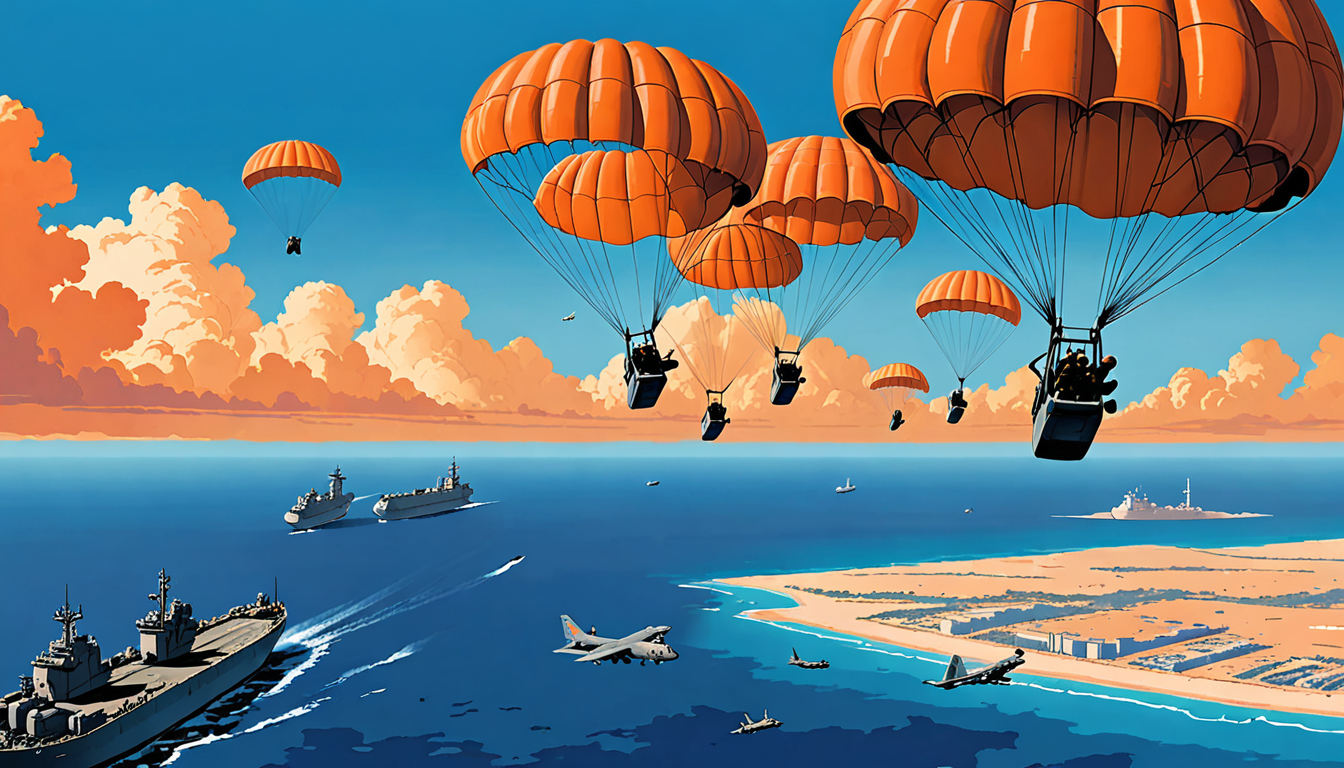
Day 25 of the Iran war marks a dangerous inflection point — the moment air campaigns give way to boots on the ground
Executive Summary
The Pentagon's order to deploy approximately 1,000–3,000 soldiers from the 82nd Airborne Division to the Middle East signals a potential paradigm shift in the Iran conflict: the transition from air war to ground operations. The most discussed target is Kharg Island, a 20-square-kilometer speck in the northern Persian Gulf that handles 90% of Iran's crude oil exports. This deployment arrives amid a surreal diplomatic backdrop — Trump declaring "we've won this" and claiming a "significant prize" from Iran related to the Strait of Hormuz, while Iran categorically denies any negotiations are taking place. With Trump's approval rating hitting a record-low 36% and 55% of Americans opposing ground troops in Iran, the 82nd Airborne's movement toward the Gulf represents the single most consequential escalation decision since the war began on February 28.
Chapter 1: The Deployment — What We Know
On March 24, the Pentagon issued written orders to deploy elements of the 82nd Airborne Division from Fort Liberty (formerly Fort Bragg), North Carolina, to the Middle East. The exact numbers remain contested — CBS News reports fewer than 1,500 troops, Bloomberg says approximately 2,000, while Politico cites about 3,000, suggesting the deployment scope is still being finalized or deliberately kept ambiguous.
What is confirmed: a command element and ground forces are deploying. The division's commanding general and key staff have already departed. This is not a routine rotation — it is the first Army ground combat unit ordered to the theater since the war began.
The 82nd Airborne is not an arbitrary choice. It is the U.S. military's Global Response Force (GRF), designed to deploy anywhere in the world within 18 hours of receiving orders. Its Immediate Response Force (IRF) — roughly a brigade of 3,000 paratroopers — maintains the highest readiness state of any conventional unit in the American military. These are soldiers trained to parachute into contested or hostile territory, seize airfields, and establish a foothold for follow-on forces.
This deployment adds to a growing ground force posture in the region. Two Marine Expeditionary Units — roughly 4,400 Marines aboard amphibious warships — are already en route or in theater, having departed from California. Combined with the 82nd Airborne contingent, the U.S. is assembling its largest ground force presence in the Middle East since the height of the ISIS campaign.
The critical distinction: until now, the war has been exclusively an air campaign. U.S. Central Command reports over 9,000 combat flights striking more than 9,000 military targets — IRGC headquarters, ballistic missile sites, missile defense systems, military manufacturing facilities, and Iranian navy vessels. The introduction of airborne infantry fundamentally changes the character of the conflict.
Chapter 2: The Kharg Island Calculus
Why Kharg Matters
Kharg Island sits approximately 25 kilometers off Iran's southwestern coast in the northern Persian Gulf. It is small — roughly 20 square kilometers — but its strategic importance is almost impossible to overstate. According to Iran Open Data Center analysis of tanker tracking data, 96% of Iran's crude oil exports flow through the Kharg terminal. The BBC and most other assessments cite 90%.
The reason is geological: Kharg Island's surrounding deep waters allow supertankers (VLCCs) to dock directly at its long jetties, unlike most of Iran's shallow, gently sloping coastline. Iran has attempted to build alternative export routes — most notably the Jask terminal on the Gulf of Oman, outside the Strait of Hormuz — but none comes close to replacing Kharg's capacity or infrastructure.
Seizing Kharg Island would accomplish two objectives simultaneously: it would eliminate Iran's ability to export oil (and thus its primary revenue stream), and it could provide leverage to force the reopening of the Strait of Hormuz without requiring the dangerous and technically challenging task of mine clearance.
The Military Equation
Senator Lindsey Graham has publicly advocated seizing Kharg Island, referencing the Battle of Iwo Jima — the bloodiest battle in Marine Corps history — as he urged aggressive action. The White House Principal Deputy Press Secretary stated bluntly that the military "can take out Kharg Island at any time if the President gives the order."
But the reality is far more complicated than political rhetoric suggests. Mark Cancian, a senior adviser at the Center for Strategic and International Studies (CSIS), warned that "there's not a lot of support nearby." An amphibious or airborne assault on Kharg would face several challenges:
Distance and isolation. Kharg is 25 km from the Iranian mainland, but within range of Iran's coastal anti-ship missiles, artillery, and remaining air defenses. Any force on the island would need continuous air cover and naval support.
Iran's coastal defenses. Despite 25 days of air strikes degrading Iran's military infrastructure, the IRGC's asymmetric coastal capabilities — fast attack boats, anti-ship cruise missiles, and shore-based artillery — remain partially intact. The shallow, confined waters of the northern Gulf favor the defender.
Holding vs. seizing. Taking an island is one operation; holding it against sustained counterattack is another. Iran could subject Kharg to continuous rocket and missile bombardment from the mainland. The Iran-Iraq War's "Tanker War" (1984–1988) demonstrated Tehran's willingness to endure devastating strikes on Kharg rather than capitulate — Iraqi aircraft struck the island's facilities over 50 times, yet Iran repeatedly repaired and resumed exports.
Timeline. Sources with knowledge of the planning told Axios that any Kharg Island operation would require approximately one month of additional air strikes to further degrade Iranian defenses before ground forces could move. This suggests the 82nd Airborne deployment is preparatory positioning, not an imminent assault.
Chapter 3: The Schrödinger Diplomacy Paradox
The 82nd Airborne deployment unfolds against what may be the most contradictory diplomatic backdrop of any modern conflict.
Trump's Victory Declaration
On March 24, President Trump declared in the Oval Office: "We've won this. This war has been won." He claimed Iran had offered a "very significant prize" related to the Strait of Hormuz and energy flows, describing it as "worth a tremendous amount of money." He listed his negotiating team — Secretary Rubio, Vice President Vance, envoy Witkoff, and son-in-law Jared Kushner — and asserted: "The other side, I can tell you, they'd like to make a deal."
Iran's Categorical Denial
Iran's Foreign Ministry dismissed Trump's claims entirely. Parliamentary Speaker Ghalibaf called the negotiations "fake news intended to manipulate financial and oil markets and to escape the quagmire in which America and Israel are trapped." Foreign Ministry spokesperson Esmail Baghaei denied Iran was negotiating with the U.S. — but then acknowledged that the ministry was "responding to requests through intermediaries of friendly countries."
The Backchannel Reality
NPR confirmed that backchannel efforts to open dialogue are indeed underway. Pakistan has publicly offered to host talks, with Prime Minister Shehbaz Sharif declaring on social media that Islamabad "stands ready" to facilitate. An Israeli official told NPR that planning was underway for talks in Pakistan later this week. Egypt, Turkey, and Qatar are also relaying messages between the parties.
The paradox: the U.S. is simultaneously deploying ground combat troops while claiming victory in peace talks, while Iran is simultaneously denying negotiations while acknowledging intermediary contacts. This is not diplomacy — it is what analysts have labeled "Schrödinger's diplomacy," where both states of reality coexist.
The Strategic Logic
This apparent contradiction has internal logic. The 82nd Airborne deployment serves as coercive leverage — a signal that ground operations are being actively prepared, raising the stakes for Iran. In diplomatic theory, this is "compellence through credible threat": the deployment makes the threat of a Kharg Island seizure tangible rather than theoretical.
For Iran, denying negotiations while engaging through intermediaries preserves domestic legitimacy. The IRGC's mosaic command structure — fragmented after the death of Ayatollah Khamenei and the contested succession by his son Mojtaba — cannot afford to appear weak. Publicly acknowledging talks with the nation bombing their country would be politically fatal.
Chapter 4: Historical Precedents — When Air Wars Became Ground Wars
The transition from air campaign to ground operations is one of the most consequential escalation decisions in military history. Three precedents illuminate the risks.
Desert Storm (1991): The 100-Hour Ground War
The Gulf War followed a 38-day air campaign with a 100-hour ground offensive. The 82nd Airborne played a significant role, conducting the leftmost flanking maneuver in the "Hail Mary" sweep around Iraqi defenses. The air campaign had devastated Iraqi forces — destroying 40% of armored vehicles and breaking morale — making the ground phase swift. But Iraq in 1991 was a conventional army in open desert. Iran's terrain, ideology, and asymmetric capabilities are fundamentally different.
Key difference from Iran 2026: Iraq had concentrated conventional forces in Kuwait. Iran's military assets are dispersed across its vast 1.65 million km² territory, with IRGC forces embedded in civilian areas and a mountain-and-coastline geography that nullifies many advantages of airborne operations.
Kosovo (1999): Air Power's Limits
NATO's 78-day air campaign against Serbia succeeded in forcing withdrawal from Kosovo — but only after the threat of a ground invasion became credible. The Serb military survived the air campaign largely intact; it was the political calculation that NATO would eventually commit ground troops that changed Milošević's calculus.
Parallel to Iran 2026: The 82nd Airborne deployment may serve the same function — making the ground threat credible enough to shift Iranian calculations — without necessarily requiring an actual assault. The signal may be the weapon.
Iraq 2003: The Invasion Trap
The U.S. rapidly toppled Saddam Hussein's government with a swift ground campaign that included the 82nd Airborne. The conventional phase lasted weeks. The subsequent occupation lasted eight years, cost over 4,400 American lives and over $2 trillion, and destabilized the entire region.
The central lesson: Seizing territory is one capability; governing or holding it is another. Any ground operation in Iran — whether Kharg Island or securing nuclear facilities (another discussed objective) — raises the question: what comes next?
Chapter 5: Scenario Analysis
Scenario A: Coercive Positioning Without Assault (40%)
Thesis: The 82nd Airborne deployment is primarily a bargaining chip — a credible threat to extract concessions through backchannel diplomacy.
Evidence:
- Multiple intermediary channels (Pakistan, Oman, Egypt, Turkey, Qatar) are actively relaying messages
- Trump's five-day postponement of power plant strikes suggests willingness to negotiate
- The reported "prize" related to Hormuz may indicate partial Iranian concessions on shipping
- An actual ground assault on Kharg requires ~30 additional days of preparation per military sources
Trigger conditions: Iran agrees to limited Hormuz reopening for non-belligerent commercial vessels; backchannel talks produce framework for further de-escalation through Islamabad.
Historical frequency: Coercive deployments without subsequent ground action occurred in ~60% of similar Cold War/post-Cold War crises (Cuban Missile Crisis 1962, Desert Shield pre-offensive phase 1990, Kosovo 1998–99 pre-bombing phase).
Timeframe: 1–3 weeks for diplomatic progress; deployment serves as standing leverage.
Scenario B: Limited Ground Operation — Kharg Island Seizure (35%)
Thesis: If diplomacy fails or the five-day window (March 23–28) passes without progress, the U.S. executes a targeted seizure of Kharg Island to simultaneously choke Iran's revenue and reopen global oil flows.
Evidence:
- White House explicitly confirmed "the military can take out Kharg Island at any time"
- Lindsey Graham and other Congressional hawks publicly advocating the operation
- Marine Expeditionary Units in theater provide amphibious capability; 82nd Airborne provides airborne assault capability
- 9,000+ air strikes have significantly degraded Iranian air defenses and missile sites
Trigger conditions: Iran expands mine-laying into the wider Gulf; Hormuz remains fully closed past March 28; oil prices spike above $120/barrel, creating unsustainable domestic political pressure; April 1 reinsurance cliff approaches without resolution.
Historical precedent: Operation Praying Mantis (1988) — the largest U.S. naval engagement since WWII — saw American forces destroy two Iranian oil platforms and sink/damage six Iranian vessels in a single day. Kharg seizure would be exponentially more complex.
Risk factors: Holding Kharg under sustained IRGC rocket bombardment from 25 km away; potential casualties from anti-ship missiles targeting supporting naval vessels; international legal questions about seizing sovereign territory; triggering Iran's "cornered animal" response (expanding war to Gulf state infrastructure).
Timeframe: ~30 days from deployment order (mid-to-late April) for operational readiness.
Scenario C: Escalation Spiral — Broader Ground Conflict (25%)
Thesis: The ground war expands beyond Kharg to include securing Iran's enriched uranium stockpile, establishing a buffer zone along the Iranian coast, or responding to Iranian asymmetric attacks on Gulf state allies.
Evidence:
- The Intercept reports that securing Iran's highly enriched uranium stockpile is among discussed ground objectives
- IAEA reported a projectile hit Iran's Bushehr nuclear power plant on March 24
- Iran has already struck Bahrain (at least 2 killed), and Tel Aviv with a 100kg warhead
- 70% of Iran's missile launchers destroyed per Israeli officials, but IRGC retains asymmetric capabilities
Trigger conditions: Iranian attack causes mass casualties at a U.S. base or allied capital; nuclear proliferation concern escalates (damaged Bushehr poses contamination risk); domestic political dynamics in both countries make de-escalation impossible.
Historical parallel: Iraq 2003 mission creep — initial "decapitation strike" expanded to full invasion, then occupation. The 82nd Airborne's initial deployment to Iraq was also described as limited.
Timeframe: If triggered, escalation would occur within 2–6 weeks of initial ground operations.
Chapter 6: Market Impact and Investment Implications
The Ground War Premium
Markets have been pricing a "headline diplomacy" discount — Brent crude dipped below $100 on March 25 Asian trading on hopes for de-escalation. But the 82nd Airborne deployment introduces a new risk factor: the ground war premium.
Historical data on ground escalation:
- Desert Shield → Desert Storm (1990–91): Oil jumped 130% during the crisis ($21 → $46), then crashed 33% once the ground war proved swift. But confidence in a swift resolution is far lower with Iran.
- Iraq invasion 2003: Oil rose from $25 to $37 (+48%) in the buildup, then fell briefly before rising to $147 by 2008 as occupation costs mounted.
Current positioning:
- Brent crude: ~$99–103 (volatile, whipsawing on diplomatic headlines)
- Physical-paper spread: Oman spot crude ($162) vs Brent futures ($103) — a $59 gap reflecting real physical scarcity vs. speculative hope
- Gold: Declining despite risk-on environment — "safe haven failure" as liquidity demands force selling
- VIX: Elevated but not spiking — suggesting markets price managed ambiguity, not ground war
Key asset implications:
| Scenario | Oil | Defense Stocks | USD | Equities |
|---|---|---|---|---|
| Coercive positioning (A) | $95–105 range-bound | Moderate upside | Stable | Relief rally potential |
| Kharg seizure (B) | Spike to $120–140, then $90–100 if successful | Sharp rally (L3Harris, Raytheon, Elbit) | Strong safe haven bid | -5% to -10% initial shock |
| Broader ground war (C) | $140+ sustained | Supercycle pricing | Dollar weaponization risk | Bear market deepening |
The April 1 reinsurance cliff remains the most underappreciated catalyst. If ground operations begin before maritime insurance markets stabilize at the April 1 renewal date, the Chubb/DFC $20B facility becomes the only viable underwriter — effectively nationalizing Gulf shipping insurance under U.S. government control.
Sector-Specific Calls
Beneficiaries: Defense contractors (especially those with airborne/amphibious platforms — L3Harris, Raytheon, Lockheed Martin), cybersecurity firms (CrowdStrike, Palo Alto Networks given ongoing IRGC cyber operations), and energy producers with non-Gulf exposure (Cheniere, Pioneer Natural Resources).
Casualties: Airlines (jet fuel above $140, plus Middle East airspace restrictions), European industrials (energy cost pass-through), and Gulf-exposed financial institutions (insurance, trade finance).
Chapter 7: The Domestic Political Vise
The 82nd Airborne deployment occurs in what may be the worst domestic political environment for military escalation since Vietnam.
Trump's approval: 36% — his lowest since returning to office, according to Reuters/Ipsos polling released March 24. The poll found:
- 60% oppose military action against Iran (CBS/YouGov)
- 55% specifically oppose sending ground troops
- 65% believe Trump will send troops anyway
- Only 25% of Australians approve of the war (Guardian Essential poll)
- 59% of UK public oppose (YouGov UK)
The DHS shutdown — now in its 37th day — compounds the political crisis. Over 450 TSA officers have quit, ICE agents are manning airport security, and spring break travel is in chaos. The newly confirmed DHS Secretary Mullin inherits a department in crisis.
Congress faces a fork: the deployment of ground combat troops to the Middle East without explicit Congressional authorization will trigger a political firestorm. The War Powers Resolution gives the President 60 days to conduct military operations before requiring Congressional approval — but the 82nd Airborne deployment starts that clock in a far more visible and controversial way than air strikes did.
The Vietnam parallel is increasingly invoked: a president escalating a foreign war that lacks public support while domestic crises mount. The difference: the Iran war is 25 days old, not years, and the economic consequences (oil prices, inflation, supply chain disruption) are hitting American consumers immediately rather than gradually.
Conclusion
The 82nd Airborne's movement toward the Persian Gulf is the clearest signal yet that the Iran war may cross the threshold from air campaign to ground conflict. Whether this deployment serves as a bargaining chip or a prelude to the seizure of Kharg Island will likely be determined within the next 30 days.
The paradox at the heart of this moment is acute: the United States is simultaneously pursuing diplomacy and preparing for its most significant ground combat operation since the 2003 invasion of Iraq. History suggests these two tracks are not contradictory — the most consequential diplomatic breakthroughs often occur under the shadow of imminent military action. But history also warns that once ground forces are committed, the logic of escalation becomes self-reinforcing.
The next 72 hours — as the March 28 five-day deadline approaches, Pakistan's hosting offer awaits response, and the 82nd Airborne's advance elements arrive in theater — will determine whether this deployment becomes a footnote in a diplomatic resolution or the opening chapter of a far longer and costlier war.
Sources: AP News, CBS News, CNN, NPR, Bloomberg, Reuters, BBC, Forbes, Axios, The Intercept, Newsweek, The Guardian, Kpler, Iran Open Data Center, CSIS
Leave a Reply