
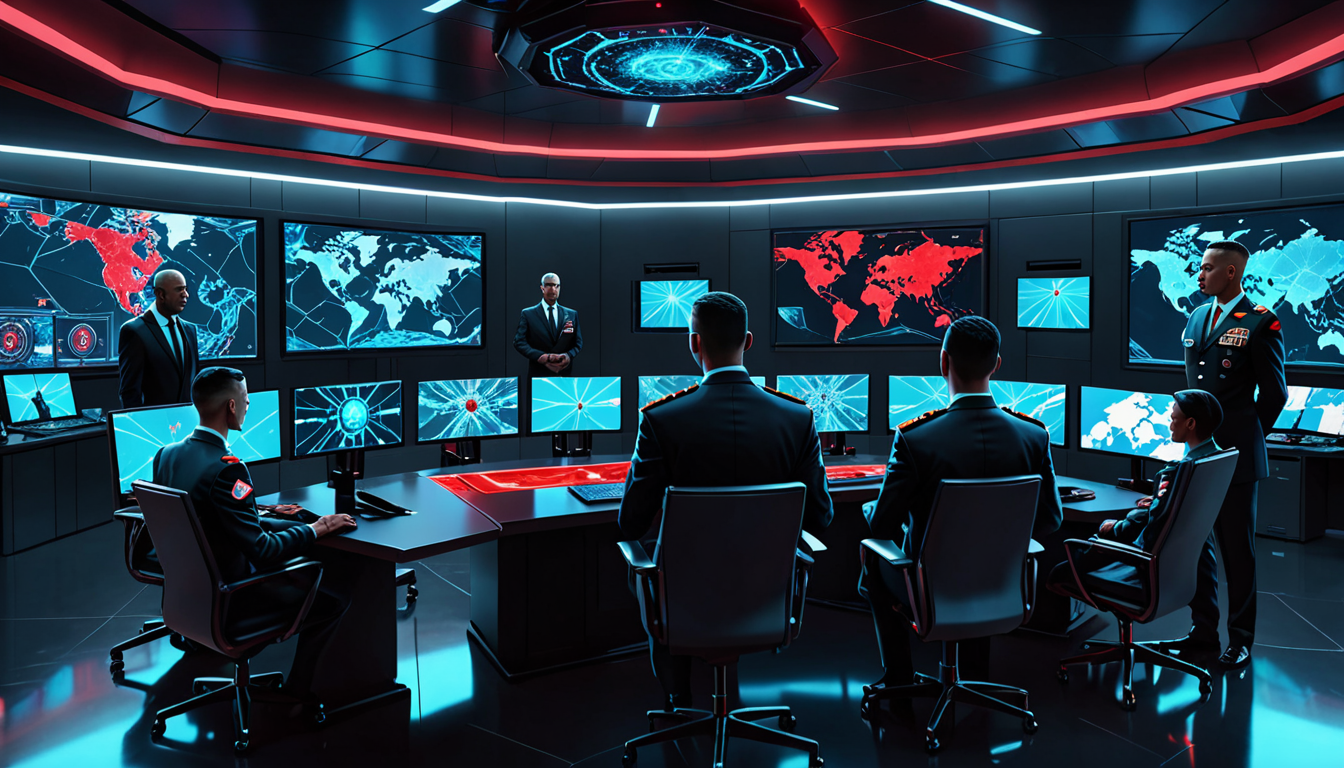
The Pentagon just made an AI targeting system its official backbone — and the implications stretch far beyond the battlefield
Executive Summary
The Pentagon has designated Palantir's Maven Smart System as an official "program of record," locking in long-term funding and embedding AI-driven targeting as the cornerstone of U.S. military strategy. This decision, made amid a war that has already seen AI identify over 1,000 targets in its opening hours, marks a structural shift: the military-industrial complex is now, functionally, a military-AI complex. The move raises urgent questions about accountability, the erosion of human judgment in lethal decision-making, and the emergence of data centers as legitimate military targets — while creating a new investment paradigm that collapses the distinction between Silicon Valley and the defense sector.
Chapter 1: The Maven Memo — What Actually Happened
On March 9, 2026, Deputy Secretary of Defense Steve Feinberg — himself the co-founder of private equity giant Cerberus Capital Management — signed a letter to senior Pentagon leaders and military commanders that may prove to be one of the most consequential defense decisions of the decade. The memo directed that Palantir's Maven Smart System be designated as an official "program of record," the bureaucratic term that transforms an experimental tool into a permanent, funded pillar of military infrastructure.
The distinction matters enormously. Before this designation, Maven existed in a kind of institutional gray zone — widely used, continuously expanded, but technically operating under temporary authorities and ad hoc funding. A program of record receives its own dedicated budget line in the Department of Defense's annual appropriation, undergoes formal milestone reviews, and becomes embedded in the military's institutional DNA in a way that makes it nearly impossible to remove.
Feinberg's letter ordered that oversight of Maven be transferred from the National Geospatial Intelligence Agency to the Pentagon's Chief Digital Artificial Intelligence Office within 30 days, with future contracting handled by the U.S. Army. The language was unambiguous: Maven would "provide warfighters with the latest tools necessary to detect, deter, and dominate our adversaries in all domains."
This was not a surprise. Maven has been the primary AI operating system for U.S. military operations throughout the Iran campaign, which began on February 28. But formalizing it transforms what was a wartime expedient into a permanent feature of American military power — with all the institutional, ethical, and financial consequences that entails.
Chapter 2: Inside the Machine — How Maven Actually Works
To understand what the Pentagon just locked in, you need to understand what Maven actually does — and what it doesn't.
Maven is a command-and-control software platform built on Palantir's Gotham infrastructure. It ingests data from satellites, drones, radar systems, ground sensors, signals intelligence, human intelligence reports, and open-source information. Using machine learning algorithms, it fuses these data streams to identify, classify, and prioritize potential targets — enemy vehicles, weapons stockpiles, command centers, air defense systems, communications nodes.
But Maven doesn't just find targets. It recommends how to hit them. The system suggests specific munitions based on stockpile availability and historical performance against similar targets. It calculates fuel requirements, flight paths, and timing windows. It even uses automated reasoning to evaluate the legal grounds for a strike under the laws of armed conflict.
At its most efficient, Maven collapses what once took human analysts days or weeks into minutes. During the opening hours of Operation Epic Fury, the system assisted in identifying and engaging approximately 1,000 targets — a volume that would have been physically impossible for human intelligence teams working alone.
Crucially, Maven incorporates large language models, including Anthropic's Claude, which scans and summarizes relevant documents to provide context for targeting decisions. This creates a layered AI stack: machine learning for pattern recognition, computer vision for imagery analysis, and LLMs for document comprehension and reasoning.
Palantir insists — and the Pentagon officially agrees — that humans remain in the loop. No strike is executed without human authorization. But as Craig Jones, a senior lecturer at Newcastle University and an expert in kill chains, has observed: "The AI machine is making recommendations for what to target, which is actually much quicker in some ways than the speed of thought. So you've got scale and you've got speed."
The concern, as David Leslie, professor of ethics at Queen Mary University of London, frames it, is "cognitive off-loading" — humans tasked with approving strike decisions can feel detached from consequences because the effort to think through the decision has been made by a machine. When the machine produces 50 targets per hour and each requires a yes-or-no decision, the human reviewer becomes, in practice, a rubber stamp.
Chapter 3: The School Strike and the Accountability Vacuum
The theoretical risks became tragically concrete on March 1, when a U.S. missile struck the Shajareh Tayyebeh Elementary School inside a Revolutionary Guard compound in Minab, Iran, killing over 165 people — mostly girls.
The immediate public reaction blamed AI. If machines were choosing targets, surely the machine had failed. But the reality, according to multiple investigations and former military officials, was more uncomfortable: it was humans who failed, not machines.
The school had been located inside the IRGC compound and was publicly listed in Iranian business directories. Satellite imagery showed new walls and a separate entrance had been added over time. But human intelligence analysts failed to update decades-old targeting databases, and human reviewers in the 24-48 hours before the strike did not notice the changes. As Reuters reported, even a basic internet search would have revealed the school's existence.
This is the paradox that now haunts the Maven program. The system's defenders argue — with some justification — that AI could have caught the error, since it excels at processing exactly the kind of multi-source data that human analysts missed. But the system's structure, which compresses decision timelines from days to minutes, may have also reduced the time available for the kind of careful, skeptical review that could have flagged the anomaly.
Jack Shanahan, a senior fellow at the Center for New American Security and the founding director of Project Maven, captured the tension: "There will be a risk of becoming overly reliant on machine outputs and short-circuiting critical human review."
The school strike triggered a political firestorm. Over 120 Democratic members of Congress sent a letter to Defense Secretary Pete Hegseth questioning the extent of AI use during Iran strikes. The incident has become a Rorschach test: critics see proof that AI-driven warfare is inherently reckless; proponents argue it demonstrates the continued need for better AI, not less of it.
Chapter 4: The Anthropic Paradox — When Your AI Has a Conscience
Perhaps the most revealing subplot in the Maven story involves Anthropic, the San Francisco AI company founded by former OpenAI researchers with an explicit mission of building "safe" artificial intelligence.
Anthropic's Claude model has been integrated into Maven's targeting stack since Anthropic signed its Pentagon contract in 2024. But the relationship soured in late February 2026, when the Trump administration moved to banish Anthropic from federal systems after the company refused to remove safety guardrails that prevented Claude from being used for fully autonomous weapons targeting or surveillance of U.S. citizens.
The timing was extraordinary: Anthropic was effectively fired from the Pentagon just days before Operation Epic Fury began — meaning Claude was still running inside Maven during the opening strikes, including potentially during the school bombing. OpenAI, Anthropic's chief rival, immediately signed its own military deal to replace it.
This created what might be called the Anthropic Paradox. The company that tried hardest to be the responsible actor in AI development found its technology used in the most controversial application imaginable. Meanwhile, its rival — which had no such scruples — was rewarded with the contract.
The Pentagon subsequently declared Anthropic a "supply chain risk," not because of any technical failure, but because of its insistence on ethical constraints. In bureaucratic terms, a company that refused to let its AI autonomously kill people was deemed less reliable than one that didn't object.
For investors and policymakers, this precedent is chilling. It signals that in the emerging military-AI complex, companies that impose ethical limits on their products will be punished, while those that offer unconstrained capability will be rewarded. The market has already internalized this message: Palantir's stock has doubled in the past year, lifting its market value to nearly $360 billion.
Chapter 5: Data Centers as Battlefields — The New Geography of War
The Maven formalization also accelerates a development that may reshape how nations think about critical infrastructure: the emergence of data centers as legitimate military targets.
On March 3, three days after the Iran war began, the Islamic Revolutionary Guard Corps launched kamikaze drone strikes against Amazon-owned data centers in the United Arab Emirates and Bahrain. The attacks caused structural damage, power disruptions, and service outages across the region. Iran's stated justification was not to disrupt civilian services but to target "the role of these centers in supporting the enemy's military and intelligence activities."
Iran followed up with a Tasnim News Agency tweet listing dozens of regional data centers — including those owned by Microsoft, Google, and others — as "Enemy Technology Infrastructure" suitable for targeting.
Legal scholars agree the logic has merit. "A data center that is used solely or primarily for military applications is targetable," said Ioannis Kalpouzos, a visiting professor of international law at Harvard. The Pentagon's Joint Warfighter Cloud Capability runs on commercial cloud infrastructure from Microsoft, Amazon, Google, and Oracle. When a military runs on the cloud, the cloud becomes a target.
But the cloud is not cleanly separable into military and civilian components. The same physical facilities often serve both purposes. A data center in Northern Virginia might simultaneously process Pentagon targeting data and Netflix streams. Bombing it to disable Maven could knock out civilian services for millions.
This dual-use problem creates a new version of the Cold War's "nuclear sponge" — communities hosting data centers may find themselves living next to legitimate military targets. As Defense Secretary Hegseth accelerates AI integration across the military, every new data center construction becomes, in some sense, a potential expansion of the battlefield into American suburbs and farmland.
Chapter 6: Scenario Analysis — Where This Goes
Scenario A: Accelerated Integration and Normalization (45%)
Rationale: The Iran war has provided Maven with an operational track record that would have taken years of peacetime exercises to accumulate. The program-of-record designation ensures stable funding. Institutional momentum, combined with Feinberg's explicit directive, makes expansion across all military branches near-certain by FY2027.
Historical precedent: The adoption of precision-guided munitions (PGMs) after the 1991 Gulf War followed a similar pattern — wartime success led to rapid institutionalization, and within a decade PGMs went from a small fraction of munitions used to the dominant paradigm. The F-117 stealth fighter, initially controversial, became standard doctrine after its Gulf War performance.
Trigger conditions: Continued operational success in Iran with no major AI-attributable civilian casualty event; congressional defense hawks maintain appropriations support; no successful challenge from traditional defense contractors (Lockheed, Raytheon) seeking to build competing systems.
Investment implications: Palantir (PLTR) becomes a core defense holding. The company's $10B Army contract ceiling likely expands. Adjacent beneficiaries include Anduril, Shield AI, and cloud providers with defense clearances (AWS GovCloud, Azure Government). Traditional defense primes face pressure to either acquire AI capabilities or become junior partners.
Scenario B: Ethical Backlash and Regulatory Constraint (30%)
Rationale: The school strike and the Anthropic controversy have created a political constituency for AI weapons regulation. The 120+ Democratic congressional letter is a leading indicator. European allies, already uncomfortable with AI targeting, may condition intelligence-sharing on human oversight requirements.
Historical precedent: The cluster munitions and landmine bans of the 1990s-2000s followed similar patterns — initial military enthusiasm followed by civilian casualty incidents that shifted public opinion and triggered international agreements (Ottawa Treaty 1997, Convention on Cluster Munitions 2008). However, the U.S. refused to sign either treaty, suggesting domestic political constraints may be more relevant than international pressure.
Trigger conditions: Additional high-profile civilian casualty events attributed (correctly or not) to AI targeting; 2026 midterm elections shift congressional composition; allied nations impose conditions on intelligence-sharing; major AI companies beyond Anthropic publicly resist military applications.
Investment implications: Regulatory overhang on pure-play defense AI stocks. Increased demand for "human-in-the-loop" verification systems. Companies offering transparency and audit tools for AI decision-making could benefit. ESG-oriented investors may create selling pressure on Palantir, though this has historically had limited price impact.
Scenario C: Competitive Escalation and AI Arms Race (25%)
Rationale: The demonstrated effectiveness of Maven in Iran provides a proof-of-concept that rival powers — particularly China — cannot ignore. Beijing's military AI programs (already substantial) will accelerate, creating a feedback loop where each side's advances justify further investment by the other.
Historical precedent: The Soviet response to U.S. precision warfare in the Gulf War drove a generation of Russian military modernization, including the development of area-denial systems (S-400, Iskander) specifically designed to counter U.S. technological advantages. China's response to the perceived "Revolution in Military Affairs" has similarly driven its investment in AI-enabled warfare since the mid-2010s.
Trigger conditions: China accelerates PLA AI integration in response to Iran operations; Russia leverages energy windfall from high oil prices to fund military AI development; Taiwan contingency planning incorporates AI targeting as a central element; arms control frameworks fail to materialize.
Investment implications: Global defense AI spending enters a supercycle. Semiconductor stocks with defense exposure (particularly AI inference chips) benefit. The distinction between "defense tech" and "commercial AI" continues to blur, potentially creating new categories of dual-use technology export controls.
Chapter 7: Investment Implications — The Military-AI Complex
The Maven formalization creates a new investment framework that investors ignore at their peril.
The Palantir Premium: With a $360B market cap, Palantir trades at a valuation that already reflects significant government revenue growth. But program-of-record status changes the risk profile — it transforms volatile project-based revenue into predictable, multi-decade budget-line funding. The parallel is Lockheed Martin's F-35 program, which despite massive cost overruns has generated reliable revenue for over two decades precisely because it achieved program-of-record status. Palantir's stock may be expensive, but the quality of its revenue is about to improve dramatically.
The "Ethics Discount": Anthropic's experience establishes a template. Companies that impose ethical constraints on military AI use face exclusion from the fastest-growing segment of government contracting. This creates a perverse incentive structure: the market will reward unconstrained AI capability and punish restraint. For investors in AI companies, the question "Would this company refuse a military contract on ethical grounds?" has become a material risk factor.
Cloud as Defense Infrastructure: Amazon, Microsoft, Google, and Oracle all derive significant revenue from defense cloud contracts. The JWCC program alone is worth billions. But the data-center-as-target revelation introduces a new physical risk: cloud infrastructure in geopolitically exposed regions (Middle East, Pacific) may require hardening, redundancy, or relocation — all of which increase capital expenditure. AWS and Azure's defense margins may compress.
Defense Primes Under Pressure: Traditional defense contractors (Lockheed Martin, Raytheon, Northrop Grumman, General Dynamics) face a strategic dilemma. Their hardware — missiles, aircraft, ships — is still essential, but the value chain is shifting toward the software that decides when and where to use it. Palantir's Maven sits atop systems built by the primes, extracting a growing share of defense value. The historical parallel is how IBM's software dominance in the 1960s-70s eventually gave way to Microsoft and Intel, which captured more value by controlling the operating layer rather than the hardware.
Conclusion
The Pentagon's formalization of Palantir's Maven as a program of record is not merely a procurement decision. It is the moment the United States officially committed to AI-driven warfare as doctrine — not as an experiment, not as a supplement, but as the operating system of American military power.
The implications cascade outward. For warfare: decisions that once took days now take minutes, with all the speed advantages and accountability gaps that entails. For technology: the line between a Silicon Valley startup and a defense contractor has effectively dissolved. For ethics: the company that tried to impose limits was fired; the one that didn't was rewarded. For geography: the cloud that powers civilian life is now indistinguishable from military infrastructure, making data centers potential targets. For investors: the military-AI complex is not emerging — it has arrived.
The school in Minab should haunt this story. Not because AI killed those children — it was human negligence, tragically. But because the system that is now permanent, funded, and expanding is one in which humans have less and less time to catch the errors that machines don't make and machines don't catch the errors that humans do. The kill chain has gone corporate. The question is whether anyone is still watching the chain.
Sources: Reuters, NBC News, The Guardian, CNA, The Intercept, Semafor, Bloomberg
Leave a Reply