
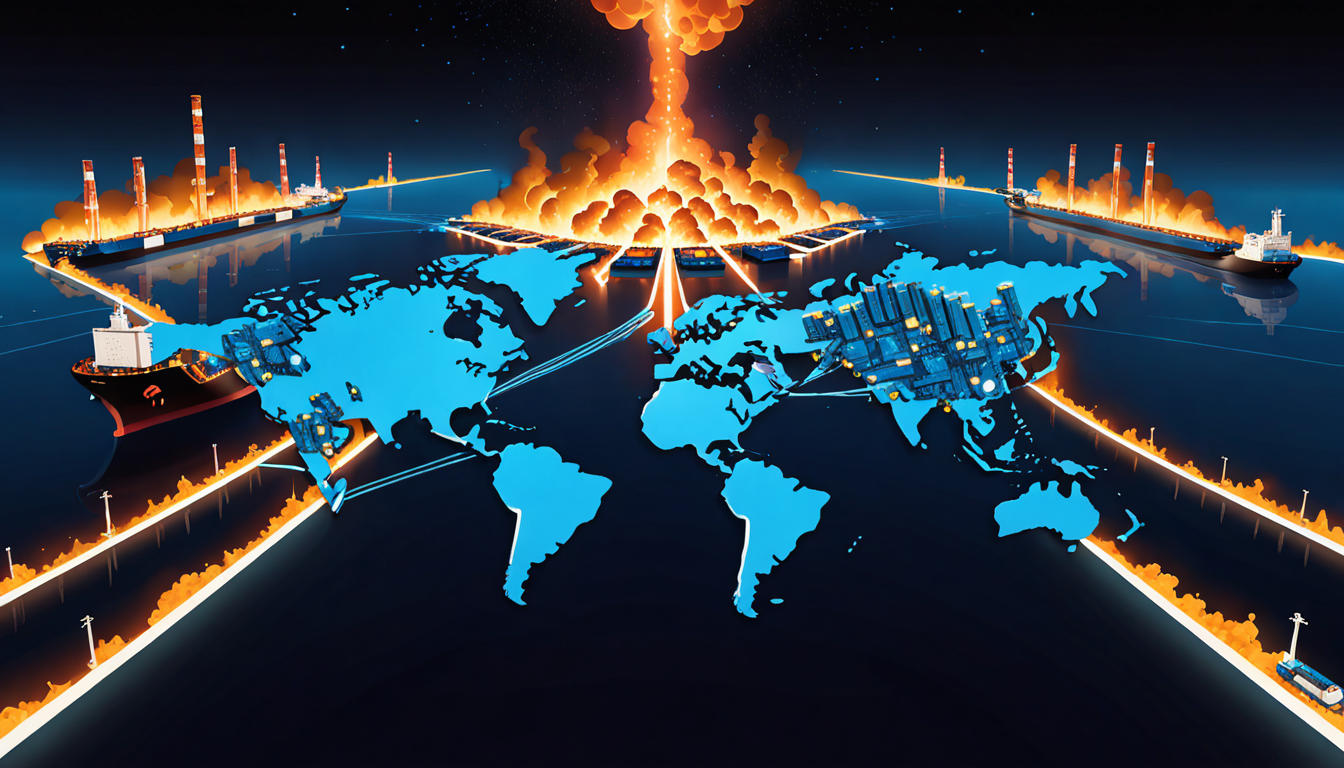
How a $4.18 trillion semiconductor surge and a three-week chokepoint blockade are splitting the global economy in two
Executive Summary
The WTO's March 2026 Global Trade Outlook reveals a world economy being pulled apart by two opposing mega-forces. AI-enabling goods surged 21.9% to $4.18 trillion in 2025, accounting for 42% of all trade growth—yet the Strait of Hormuz blockade threatens to erase those gains entirely. Global merchandise trade growth is projected to collapse from 4.6% in 2025 to just 1.9% in 2026, with a worst-case scenario of 1.4% if energy prices remain elevated. Meanwhile, China's share of US imports has cratered from 13.8% to 9.3% in a single year, triggering the largest peacetime rerouting of global supply chains in modern history.
Chapter 1: The AI Supercycle That Saved 2025
When the WTO released its March 2026 Global Trade Outlook and Statistics on March 19, the headline number stunned trade economists: global merchandise trade grew 4.6% in 2025, nearly doubling prior expectations. The driver was not conventional commerce in raw materials, manufactured goods, or consumer electronics. It was artificial intelligence.
Trade in AI-enabling goods—semiconductors, servers, data center equipment, telecom infrastructure, and generators—rose 21.9% year-on-year to reach $4.18 trillion in 2025. To put that in perspective, this single category accounted for 42% of all global trade growth despite representing only about one-sixth of total merchandise trade volume. It was the most concentrated source of trade expansion since the post-2008 recovery boom in commodity trading.
The McKinsey Global Institute's concurrent report, "Geopolitics and the Geometry of Global Trade: 2026 Update," decomposed the forces driving US import patterns. AI-related goods added $180 billion to American imports in 2025. Tariff-related frontloading—companies rushing to bring in goods before anticipated duty increases—contributed another $131 billion. These gains were partially offset by a $130 billion decline in imports from China and a $114 billion drop across other sectors.
This AI-trade surge was not evenly distributed. Asia was the primary beneficiary, with the region contributing the bulk of global trade expansion. North America experienced robust import activity in the early months of 2025, largely attributed to what the WTO's new chief economist Robert Staiger called "unusually strong" frontloading ahead of anticipated US tariff changes. But by the second half of the year, the frontloading impulse faded, leaving AI investment as the singular pillar of trade momentum.
The critical question hanging over 2026 is whether this AI investment cycle has legs. The WTO's own language is revealing: the sustainability of AI-related spending is described as "a major uncertainty for 2026 and beyond." Data center construction timelines, semiconductor capacity constraints, and the potential for an AI investment bubble all factor into what remains the single largest upside variable in global trade forecasting.
Chapter 2: The Hormuz Shock—From 138 Ships to Zero
On the other side of the equation stands the most severe chokepoint disruption since the 1973 OPEC oil embargo. The Strait of Hormuz, through which roughly 15 million barrels per day of crude oil and one-third of global LNG shipments transit, has seen vessel traffic collapse from 138 ships per day to near zero since the onset of the US-Israel-Iran conflict on February 28, 2026.
The WTO's trade outlook quantifies the damage with unusual precision. In the baseline scenario—which assumes some moderation in energy prices—merchandise trade growth drops from 4.6% to 1.9% in 2026. But in the high-energy-price scenario, with crude oil and LNG costs remaining elevated throughout the year, that figure falls to just 1.4%. The 0.5 percentage-point difference may sound modest, but in dollar terms it represents hundreds of billions in foregone trade.
Services trade faces an even steeper cliff. The baseline projection is a decline from 5.3% growth in 2025 to 4.8% in 2026. Under sustained energy shock conditions, that drops to 4.1%—a 0.7 percentage-point haircut driven by cascading disruptions in maritime transport, aviation, and tourism. The Middle East region itself is projected to experience a 9.2% contraction in services exports, subtracting 15.7 percentage points from what would have been expected growth.
The damage extends well beyond oil. Approximately one-third of global fertilizer exports transit the Strait of Hormuz. India, Thailand, and Brazil—three of the world's most important agricultural producers—face acute supply disruptions precisely as the spring planting season reaches its critical window. The WTO has flagged this as a direct threat to global food security, a risk multiplier that turns an energy crisis into a humanitarian one.
Chapter 3: The Great Decoupling Accelerates
Perhaps the most structurally significant finding in the WTO report is not the cyclical slowdown but the accelerating fragmentation of the global trading system. In 2025, US imports from China fell by 29%, reducing China's share of the American import market from 13.8% to 9.3% in a single year. This is the sharpest bilateral trade contraction between the world's two largest economies in the post-war era.
But China's goods did not disappear from global commerce—they changed routes. Chinese exports to Asia as a whole increased by $161 billion (10.6%), with particularly strong growth to Hong Kong (15.5%), India (12.8%), and Chinese Taipei (11.2%). Exports to ASEAN nations surged 13.4%, while shipments to the European Union rose 8.4%. China's total merchandise exports reached $3.77 trillion in 2025, up 5.5% in value terms and 9.2% in volume terms.
The WTO diplomatically describes this phenomenon as "adjustments in global supply chains, including a possible trade diversion of China's exports toward destinations facing lower tariffs, or the rerouting of trade through third economies." The evidence from India is particularly illustrative: Indian exports to the US grew 4.3% between April and December 2025, with engineering goods, textiles, leather, and footwear categories receiving orders channeled through Chinese counterparts who did not want to lose their American clients.
This is not new. During the first Trump administration (2017-2020), higher tariffs failed to make a significant dent in Chinese exports for precisely this reason. What is new is the scale. McKinsey's decomposition shows that the $130 billion decline in US-China direct trade was largely offset by replacement imports worth $83 billion from third countries—many of them serving as way-stations for Chinese components assembled or lightly processed before re-export.
The systemic implication is profound. The share of global trade conducted under standard most-favored-nation (MFN) tariff treatment has declined from roughly 80% at the start of 2025 to 72% today. This 8 percentage-point drop represents the most significant erosion of the MFN principle since the WTO's founding in 1995. Trade is not declining—it is re-routing, re-pricing, and re-organizing along geopolitical fault lines.
Chapter 4: The Regional Divergence
The WTO's regional projections for 2026 paint a picture of stark divergence. Asia is expected to lead both merchandise imports (up 3.3%) and exports (up 3.5%), reflecting the region's dual role as the hub of AI component manufacturing and the epicenter of energy import vulnerability. Africa follows with 3.2% import growth and 1.2% export growth—modest numbers that mask enormous internal variation between oil exporters (benefiting from high prices) and oil importers (crushed by them).
North America, by contrast, is projected to see imports grow just 0.3%—effectively flat. This reflects the exhaustion of the frontloading impulse that supercharged US import activity in early 2025, combined with the contractionary effects of elevated tariffs and energy costs. The Middle East, unsurprisingly, faces the most acute disruption, with its 9.2% services export contraction representing the regional economic equivalent of a catastrophic event.
WTO Director-General Ngozi Okonjo-Iweala attempted to strike a balanced tone, noting that "the outlook reflects the resilience of global trade, buoyed by trade in high technology products and digitally delivered services." But her warning was unmistakable: "Sustained increases in energy prices could increase risks for global trade, with potential spillovers for food security and cost pressures on consumers and businesses."
The diplomatic language conceals a sharper reality. For the first time since the 2008 financial crisis, goods and services trade growth (projected at 2.7%) is expected to barely keep pace with global GDP growth (2.8%). This 1:1 ratio represents a structural break from the post-2010 pattern in which trade consistently outpaced GDP, and it signals the potential end of hyper-globalization as a growth model.
Chapter 5: Scenario Analysis
Scenario A: AI Carries the Day (30%)
If AI-related investment maintains its early 2026 momentum and remains at 2025 levels, merchandise trade growth could reach 2.4% in 2026 and 2.7% in 2027, according to the WTO's upside scenario. This outcome requires a relatively quick resolution of the Hormuz crisis (within 4-6 weeks) and sustained corporate capital expenditure on data centers and semiconductor capacity.
Rationale: The NVIDIA-Amazon deal (1 million chips by end 2027), Samsung's $73 billion HBM4 investment, and Bezos's $100 billion Project Prometheus all point to institutional commitment. However, the historical pattern of tech investment cycles (2000 dot-com, 2018 crypto, 2021 SPAC) suggests that even robust fundamentals can succumb to sentiment reversal.
Trigger conditions: Hormuz reopens partially by mid-April; CAPEX guidance from Q1 earnings remains strong; no major AI company announces significant spending cuts.
Scenario B: Energy Drag Dominates (45%)
In the WTO's baseline-to-downside scenario, elevated energy prices persist through 2026, dragging merchandise trade growth to 1.4-1.9%. The AI boom moderates as rising electricity and logistics costs begin to erode data center economics, while food inflation from fertilizer shortages compounds consumer pressure across emerging markets.
Rationale: The 1973 OPEC embargo lasted five months and reduced global trade growth by approximately 2 percentage points. The current Hormuz disruption has already lasted three weeks with no diplomatic off-ramp visible. The IEA's unprecedented demand-side emergency directive suggests policymakers themselves do not expect a quick resolution. Historically, 7 of 10 major energy shocks since 1970 lasted longer than initial market expectations.
Trigger conditions: Iran maintains Hormuz restrictions beyond April; WTI remains above $100; OPEC+ fails to compensate for lost Gulf production.
Scenario C: Systemic Fragmentation (25%)
The most disruptive scenario involves the convergence of energy shock, trade fragmentation, and AI investment pullback into a self-reinforcing downturn. MFN-traded share drops below 70%, bilateral and plurilateral deals proliferate, and the WTO's MC14 conference in Yaoundé (March 26-29) fails to produce meaningful reform. Trade growth falls below 1%, and the 2026 global economy enters a period of deglobalization comparable to 2018-2020.
Rationale: The structural indicators are concerning. MFN share has already declined 8 percentage points in one year. US Section 301 investigations now target 16 countries. The IEEPA has faced constitutional challenges. The e-commerce moratorium is expiring. Each of these individually is manageable; their simultaneous occurrence creates compound risk. The 1930 Smoot-Hawley parallel—where retaliatory tariffs reduced global trade by 66% over four years—remains the worst-case historical template, though current institutional safeguards make that extreme outcome unlikely.
Trigger conditions: MC14 ends without consensus; US expands tariffs to additional sectors; China retaliates against third-country rerouting penalties; AI spending contracts in Q2.
Chapter 6: Investment Implications
The bifurcation creates distinct winners and losers across asset classes:
AI-exposed equities (NVIDIA, TSMC, ASML, Samsung): Remain supported as long as the investment cycle holds, but face increasing cost pressure from elevated energy prices. The helium shortage—caused by the Ras Laffan damage reducing 30% of global supply—poses a specific risk to EUV lithography and semiconductor fabrication. Monitor ASML guidance and helium spot prices as leading indicators.
Shipping and logistics (CMA CGM, Maersk, ZIM): The Hormuz blockade and rerouting add enormous demand for vessel capacity on alternative routes. CMA CGM has already introduced a Peak Season Surcharge on Asia-West Africa routes effective March 23. Container rates have surged on most major lanes. However, prolonged conflict creates insurance and crew retention risks that could limit upside.
Commodity importers (India, Japan, South Korea, Thailand): The WTO's regional projections imply that Asia's 3.3% import growth will be driven disproportionately by energy and food security purchases at inflated prices, compressing real import volumes. The rupee's record low of 93.24, Japan's 95% Middle East energy dependence, and South Korea's 65% Qatar helium exposure are all expressions of this vulnerability.
Trade facilitation and compliance (Palantir, Chainalysis): The shift from MFN-based to bilateral/preferential trade regimes creates demand for supply chain tracing, origin verification, and sanctions compliance technology. As rerouting intensifies, the commercial value of trade intelligence increases.
Defensive positioning: Gold, US Treasuries (despite fiscal concerns), and energy-independent economies (US, Canada, Brazil) represent the traditional safe-haven rotation. The "HALO trade"—hard assets, land, oil—continues to outperform financial assets in an inflationary energy environment.
Conclusion
The WTO's March 2026 report documents a global trading system under more stress than at any point since the organization's founding. Two titanic forces—a $4.18 trillion AI investment boom and a catastrophic energy chokepoint disruption—are pulling global commerce in opposite directions. The outcome depends on which force proves more durable.
The optimistic reading is that AI-driven productivity gains and digital services trade can partially offset the energy shock, limiting the damage to a manageable 1.9% growth deceleration. The pessimistic reading is that the Hormuz crisis persists, AI investment moderates, and the simultaneous erosion of MFN trade rules pushes the system toward structural fragmentation.
What is clear from the data is that the 2010-2025 era of frictionless hyper-globalization is over. Trade is not collapsing—it is being reshaped along new axes of security, technology, and geography. The MC14 conference in Yaoundé next week will test whether multilateral institutions can adapt to this reality, or whether the system continues its drift toward a fragmented, bilateral order. For investors, the bifurcation is the trade: be long the structural winners (AI infrastructure, energy security, trade compliance) and hedge against the structural losers (energy-dependent importers, MFN-reliant exporters, and any asset whose thesis depends on a return to pre-2026 normalcy).
Sources: WTO Global Trade Outlook and Statistics (March 2026), McKinsey Global Institute "Geopolitics and the Geometry of Global Trade: 2026 Update," WTO Director-General Ngozi Okonjo-Iweala press conference, WTO Chief Economist Robert Staiger briefing, CNBCTV18, FX Leaders, Global Trade Magazine, Caliber.Az, Deccan Chronicle
Leave a Reply