
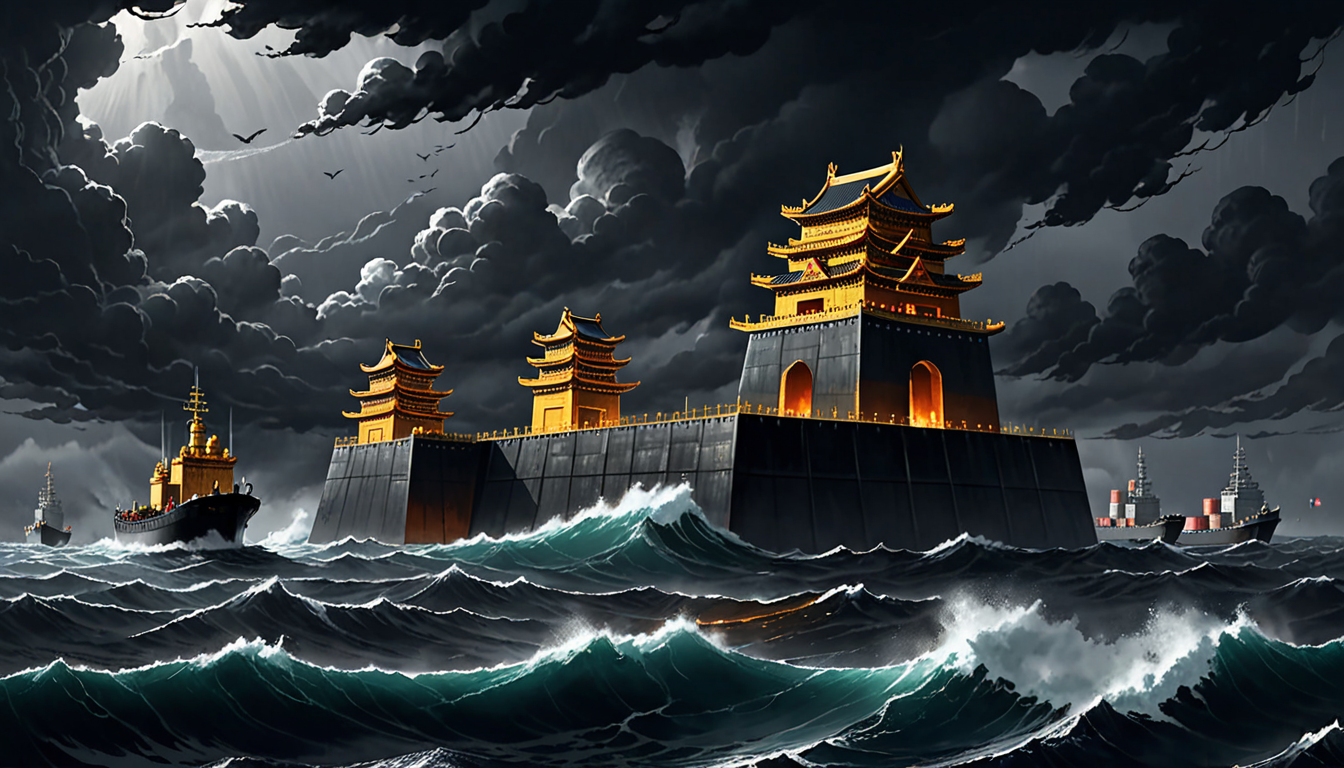
While neighbors scramble for fuel, China sits on 1.4 billion barrels and bans refinery exports — creating a two-tier energy order that could reshape Asian geopolitics for a generation
Executive Summary
As the Iran war enters its fourth week, a stark divide is opening across Asia. China — sitting on an estimated 1.4 billion barrels of strategic oil reserves, the largest in the world — has banned refined fuel exports and instructed state refineries to prioritize domestic supply. The result is a two-tier energy crisis: China buffers itself with massive stockpiles and continued Iranian crude imports, while its neighbors — Japan, South Korea, India, Vietnam, and the Philippines — face fuel shortages, flight cancellations, and economic contraction. This is not an accident but the payoff of a decade-long energy security strategy that Xi Jinping began building in 2021, and it is fundamentally redrawing the power map of Asia.
Chapter 1: The Fortress Takes Shape
When Xi Jinping visited the Shengli oilfield in China's Shandong province in October 2021, he delivered a directive that now reads like prophecy: China must secure its energy supply "in its own hands." At the time, few outside Beijing's strategic planning circles grasped the scale of what would follow.
Over the next four years, China quietly executed the most ambitious energy security buildup in modern history. The strategy operated on three pillars simultaneously.
First, stockpiling. China amassed an estimated 1.4 billion barrels of crude oil reserves, according to Columbia University's Center on Global Energy Policy — surpassing the United States' Strategic Petroleum Reserve, which stood at roughly 400 million barrels before the Iran war began. Beijing never officially disclosed the size of its reserves, but satellite imagery of its tank farms at Zhoushan, Dalian, Huangdao, and Dushanzi told the story. The Oxford Institute for Energy Studies estimates China's total reserves could cover approximately 90 days of imports — a cushion that most Asian economies can only dream of.
Second, supply diversification. While Japan sourced 95% of its crude from the Middle East and South Korea depended on Qatar for 65% of its helium imports, China systematically reduced its Middle Eastern dependency. Russian crude via the ESPO pipeline surged to 2.1 million barrels per day by early 2026. Chinese-flagged tankers developed alternative loading routes through the Red Sea, bypassing the Strait of Hormuz entirely. The Kai Jing supertanker, which loaded Saudi crude at a Red Sea port in early March, symbolized this logistical agility.
Third, the energy transition. More electric and hybrid vehicles were sold in China in 2025 than across the rest of the world combined, according to the International Energy Agency. Wind, solar, and hydropower generated 31% of China's electricity by 2024, per Ember energy data. This wasn't just climate policy — it was strategic insurance against exactly the kind of fossil fuel shock now gripping the planet.
The result: when the Strait of Hormuz effectively closed on February 28, China had buffers that no other Asian economy possessed.
Chapter 2: The Export Ban — Pulling Up the Drawbridge
The most consequential decision came quietly. Within days of the war's outbreak, Beijing instructed its refineries — the world's largest refining sector — to halt exports of refined petroleum products. China and Thailand simultaneously cut off jet fuel exports to Southeast Asia.
The impact was immediate and devastating for China's neighbors.
Vietnam, where petrol prices had already risen 30% and diesel 40% since the war began, faced the prospect of flight reductions from April onward. The Philippines shifted to a four-day work week to conserve fuel. Indonesia's Pertamina scrambled to secure alternative supplies from as far as West Africa. India's rupee crashed to 93.24 against the dollar — an all-time low — as its energy import bill exploded.
The numbers tell a brutal story of asymmetry:
Asian Energy Vulnerability Matrix (March 2026)
| Country | Middle East Oil Dependency | Strategic Reserve (Days) | Fuel Price Increase | Economic Impact |
|---|---|---|---|---|
| China | ~50% of imports | ~90 days | Controlled | Manageable |
| Japan | ~95% of imports | ~200 days (IEA member) | +25% | Severe |
| South Korea | ~70% of imports | ~90 days (IEA member) | +30% | Severe |
| India | ~60% of imports | ~10 days | +35% | Critical |
| Vietnam | ~35% of imports | ~5 days | +40% diesel | Critical |
| Philippines | ~100% imported | ~3 days | +45% | Emergency |
China's refinery export ban was not merely self-preservation. It was a strategic signal: in a crisis, Beijing will prioritize its 1.4 billion citizens over its neighbors' fuel needs. The implicit message to ASEAN capitals was unmistakable — alignment with China carries energy security benefits that Washington cannot match.
Chapter 3: The Iranian Crude Paradox
Perhaps the most striking element of China's energy fortress is its continued importation of Iranian crude — even as American bombs fall on Iranian territory.
According to maritime tracking firm Kpler, China's imports of Iranian crude declined only marginally, from 1.57 million barrels per day in February to 1.47 million in March. Iranian tankers continued sailing to Chinese ports, their transponders dark, through shipping lanes that Western navies chose not to interdict.
This created a geopolitical paradox of extraordinary proportions. The United States was simultaneously waging war on Iran and tacitly permitting its primary adversary to continue purchasing Iranian oil. When Washington issued a temporary sanctions waiver on March 20 allowing Iran to sell 140 million barrels of crude to "calm jittery markets," it effectively legitimized what China had been doing for years through its shadow fleet.
The waiver exposed a fundamental contradiction in American strategy: the US could not destroy Iran's nuclear and military capabilities while also preventing the energy crisis from spiraling out of control. China, by maintaining its Iranian crude pipeline throughout, positioned itself as the pragmatic actor — and the indispensable buyer that even Washington needed to keep in business.
Indian refiners immediately announced plans to resume Iranian crude purchases following the waiver. South Korean and Japanese refiners explored similar moves. The sanctions architecture that had constrained Iranian oil exports for over a decade was collapsing in real time — and China, which had been systematically circumventing it for years, emerged as the model, not the outlier.
Chapter 4: The Deflation Cure Nobody Wanted
The war delivered China an unexpected macroeconomic gift — though one laced with poison.
Before the conflict began, China's producer prices had been falling for three and a half years, the longest deflationary streak in the country's modern economic history. Most economists expected the trend to continue well into 2026. Then oil surged above $100.
Bloomberg Economics analysts noted that surging energy costs could snap China's PPI deflation "as soon as this month," with Citigroup projecting PPI would turn positive by April — months ahead of the mid-2026 timeline previously expected. The war was doing what trillions of yuan in stimulus had failed to achieve: ending deflation.
But this was the economic equivalent of curing a headache with a hammer. While rising input costs would technically end the deflation narrative, they would also squeeze margins for manufacturers, raise costs for consumers, and potentially derail the fragile consumption recovery Beijing had been nurturing. China's independent refiners — the "teapot" refineries that were the biggest importers of Iranian crude — were the most vulnerable, even as they pivoted to Russian supply.
The paradox deepened: China's energy fortress insulated it from the worst of the crisis, but the second-order effects — higher input costs, disrupted supply chains, reduced export demand from crisis-hit neighbors — created a new set of risks. The fortress had walls, but it was not a vacuum.
Chapter 5: The Bond Market Revolution — and What It Means
While the energy crisis dominated headlines, a parallel revolution was unfolding in global bond markets that could prove equally consequential.
The 10-year US Treasury yield surged from 3.97% before the war to 4.38% by March 20 — a 41 basis point move in three weeks that represented a fundamental repricing of the global interest rate outlook. The two-year yield jumped to 3.92%, its highest since summer 2025. Traders fully erased expectations for Federal Reserve rate cuts in 2026 and began pricing in a 50% probability of rate hikes.
"The Treasury market appears to be worried about further inflationary pressures as the conflict in Iran both escalates and drags on," said Gennadiy Goldberg, head of US rates strategy at TD Securities. Macquarie openly called for the next Fed move to be upward — a hawkish call that would have been considered extreme just weeks earlier.
The implications cascaded across asset classes. Mortgage rates were expected to surge toward 7.35%, effectively freezing the US housing market. The S&P 500, Dow, and Nasdaq all fell as the rate cut trade — the consensus position entering 2026 — unwound violently. The Saudi stock market, after initially declining sharply, had recovered to above pre-conflict levels, as investors priced in sustained high oil revenues.
For China, this interest rate divergence created a unique opportunity. While the Fed faced pressure to raise rates to combat energy-driven inflation, the People's Bank of China retained room to ease further — its inflation problem was the opposite. The resulting interest rate differential could accelerate capital flows toward Chinese bonds, strengthen the yuan relative to crisis-hit Asian currencies, and enhance Beijing's financial leverage across the region.
Chapter 6: Scenario Analysis
Scenario A: Short War, Quick Normalization (25%)
Premise: The conflict ends within 4-6 weeks. Hormuz reopens. Oil returns below $80.
Evidence against: Trump has explicitly ruled out a ceasefire. Iran refuses to negotiate on Hormuz. Ground operation planning continues with 2,500 additional Marines deployed. No diplomatic backchannel has produced results. Historical precedent: the 1980-88 Iran-Iraq tanker war lasted eight years.
Trigger conditions: Iran capitulates on nuclear program AND reopens Hormuz simultaneously — an outcome that requires regime change or near-total military defeat.
If it occurs: China's fortress strategy looks like expensive overinsurance. Stockpiles decline in value. Asia recovers quickly. Bond yields retreat.
Scenario B: Protracted Conflict, Managed Crisis (45%)
Premise: War continues for 3-6 months. Hormuz partially reopens via Iran's "toll" system or multinational convoy operations. Oil stabilizes at $90-110.
Evidence for: Iran's selective passage system (allowing Japan, China, India through while blocking US-allied vessels) shows willingness to negotiate commercially. The 22-nation joint statement signals coalition-building for convoy operations. The 1987 Operation Earnest Will precedent — US Navy escorted reflagged Kuwaiti tankers during the Iran-Iraq war for 14 months. Trump's "winding down" rhetoric suggests desire for exit, even without victory.
Trigger conditions: Iran agrees to selective Hormuz passage for non-combatant nations. US shifts to "over the horizon" posture. Coalition escorts begin.
If it occurs: China's energy advantage becomes structural. Two-tier energy pricing persists. Asian realignment accelerates. PBOC eases while Fed holds or hikes. Yuan strengthens. Southeast Asian nations increasingly accept Chinese energy dependency.
Scenario C: Escalation — Ground War and Global Recession (30%)
Premise: US occupies Kharg Island. Iran retaliates with asymmetric attacks on Gulf energy infrastructure, global terror threats. Oil spikes above $150. Global recession.
Evidence for: Axios reported Washington is actively considering Kharg Island occupation. 2,500 Marines deployed to the region with amphibious assault capability (USS Boxer). Netanyahu has signaled interest in ground component. Iran's threat to target "parks, recreational areas, tourist destinations" globally indicates willingness to escalate asymmetrically. Bahrain has intercepted 143 missiles and 242 drones — the pace of Iranian retaliation is accelerating.
Trigger conditions: Failed negotiation on Hormuz + domestic political pressure on Trump to "win" before midterms.
Historical precedent: The 2003 Iraq invasion began as "shock and awe" with promises of quick resolution. Ground operations expanded for eight years. The 1956 Suez Crisis demonstrated that even successful military operations can produce strategic defeats when economic consequences overwhelm military gains.
If it occurs: China's fortress strategy proves prescient but insufficient for a prolonged global recession. Even 1.4 billion barrels runs out in months at current consumption rates. Everyone loses — but China loses least.
Chapter 7: Investment Implications
The HALO Trade Evolves: The existing Hard Assets, Logistics, and Operations trade extends to include an explicit "China hedge" component.
Winners:
- Chinese energy companies (PetroChina, CNOOC, Sinopec): Domestic pricing power + reduced competition + potential to export refined products at premium when ban lifts
- Chinese EV manufacturers (BYD, NIO): Every dollar increase in petrol prices accelerates EV adoption across Asia
- Chinese renewable energy (LONGi, JA Solar): Crisis validates energy independence thesis
- US defense contractors (RTX, LMT): Sustained Gulf deployment + Patriot/THAAD restocking
- Gold: Classic geopolitical hedge, already at all-time highs
- Short-duration US Treasuries: Rate hike expectations favor short end
Losers:
- Asian airlines (ANA, Korean Air, IndiGo): Jet fuel shortages + flight cuts
- Import-dependent Asian manufacturers: Input cost squeeze
- US homebuilders: 7.35% mortgage rates freeze demand
- Long-duration bonds: Rate hike pricing destroys long-duration bets
- European utilities: Gas-dependent economies (Italy, Eastern Europe) face highest electricity price increases
Key metric to watch: The WTI-Dubai crude spread, currently at $60 — an extraordinary divergence that captures the two-tier energy market in a single number. If this spread persists above $40 for more than 60 days, it signals a structural shift in global energy pricing that could last years.
Conclusion
China's energy fortress was not built for this war specifically — it was built for any war, any disruption, any moment when the global energy system fractured along geopolitical lines. Xi Jinping's 2021 directive to keep energy supply "in China's own hands" looks less like policy guidance and more like strategic foresight.
But the fortress creates its own dangers. China's refinery export ban has inflicted collateral damage on the very Southeast Asian nations Beijing has courted through the Belt and Road Initiative. The implicit message — that Chinese energy security comes at its neighbors' expense — could push ASEAN nations toward deeper US alignment or accelerate their own energy independence efforts.
The deeper lesson is structural: in a world where energy weaponization is now a proven strategy (by Iran via Hormuz, by Russia via gas pipelines, by China via export bans), every nation that lacks energy self-sufficiency is strategically vulnerable. The Iran war hasn't just disrupted oil markets. It has demonstrated that the post-1945 assumption of open global energy trade was always a geopolitical luxury — one that required American naval supremacy and a rules-based order that no longer exists.
The two-tier energy crisis of March 2026 may be remembered not as a temporary disruption, but as the moment when energy sovereignty became the defining metric of national power in the 21st century.
Sources: The Guardian, Al Jazeera, Bloomberg, Reuters, CNN, Axios, CNBC, Oxford Institute for Energy Studies, Columbia University Center on Global Energy Policy, Kpler, IEA, TD Securities
Leave a Reply