
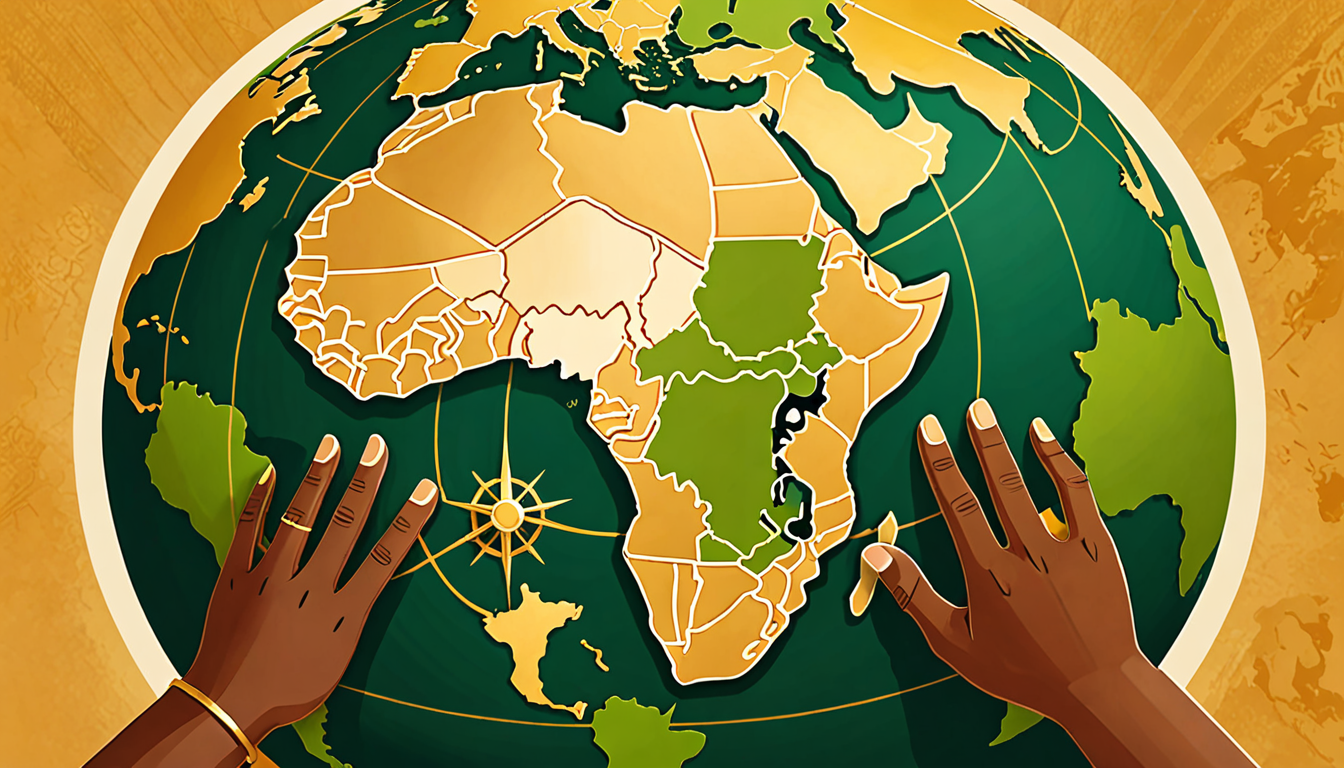
33 Latin American and Caribbean nations meet the African continent as the old order crumbles
Executive Summary
- The 10th CELAC Summit and first-ever CELAC-Africa High-Level Forum in Bogotá (March 18-21) represents the largest South-South diplomatic gathering in years, covering 2+ billion people across two continents
- Against the backdrop of the Iran war, Hormuz blockade, and US strategic overstretch, Latin America and Africa are building parallel institutions: trade corridors, reparations frameworks, and technology partnerships that bypass traditional Western gatekeepers
- Ghana's forthcoming UN resolution declaring the transatlantic slave trade "the gravest crime against humanity" (tabling March 25) signals that the reparatory justice movement has graduated from rhetoric to institutional action — with investment implications for $777 trillion in claimed reparations
Chapter 1: The Bogotá Moment
On March 21, 2026, as Israeli jets strike Tehran and British gilt yields hit their highest since 2008, something quieter but arguably more consequential is unfolding at the Ágora Convention Center in Colombia's capital. The CELAC-Africa High-Level Forum — the first meeting of its kind — is concluding four days of negotiations that bring together representatives from 33 Latin American and Caribbean nations and delegations from across the African Union.
The timing is not accidental. Colombia's Vice President Francia Márquez, the first Black woman to hold the office in the country's history, has spent two years engineering this diplomatic moment. Her strategy of reconnecting Colombia with Africa and its own diaspora has evolved from symbolic gesture into hard geopolitics.
The forum operates on three pillars: South-South cooperation for development, historical reparations and ethnic-racial justice, and trade and investment. But the subtext is unmistakable — in a world where the US is consumed by a Middle Eastern war, where energy supply chains are fracturing, and where the old multilateral order is visibly crumbling, the Global South is building its own.
The numbers tell the story. At least 145 Colombian companies already export to Africa, with bilateral trade between CELAC and Africa growing 112% over the past three years. Brazil's President Lula, who arrived in Bogotá on March 21, has made South-South cooperation the centerpiece of his foreign policy, fresh from a 260-company delegation to India in February. The Bogotá forum is the next node in a rapidly forming network.
Chapter 2: The Reparations Escalation
The most explosive dimension of the Bogotá gathering is the reparations agenda. On March 25 — four days after the forum closes — Ghana's President John Mahama will table a historic UN General Assembly resolution declaring the transatlantic slave trade "the gravest crime against humanity." A wreath-laying ceremony at the African Burial Ground in New York will precede a High-Level Event on Reparatory Justice at the UN.
This is not new rhetoric. What is new is the institutional architecture being assembled behind it.
At the AU summit in February 2026, African nations adopted a formal reparations resolution. CARICOM, the Caribbean community, has been the most aggressive advocate, with its Reparations Commission estimating the total at $777 trillion — a figure that is more political weapon than accounting exercise. The Bogotá forum explicitly links CELAC, the AU, and CARICOM into a unified front.
Historical context matters. Between 1500 and 1900, an estimated 12.5 million enslaved Africans were transported to the Americas. The economic legacy of this forced labor built the wealth of colonial and post-colonial Western powers. The reparations movement argues that current global inequality is a direct consequence of this extraction.
Previous efforts at reparatory justice have been symbolic — the UK's 2015 apology for slavery, France's 2001 recognition, and various museum initiatives. The Bogotá-to-New York trajectory is qualitatively different: it aims to embed reparations into international law and multilateral institutions.
Why now? Three converging forces explain the timing:
-
US moral authority deficit. The Iran war, with civilian casualties including the Minab school bombing (170+ schoolgirls killed), and the Hormuz blockade affecting developing nations disproportionately, has weakened Washington's ability to lecture others on justice.
-
China's diplomatic offensive. Beijing's zero-tariff policy for 53 African nations (effective May 1, 2026) and the $400 billion Belt and Road Initiative provide the Global South with economic alternatives to Western-dominated institutions.
-
Institutional maturity. The CELAC-Africa Forum demonstrates that Southern institutions are no longer aspirational — they are operational. Colombia's pro tempore CELAC presidency passes to Uruguay at the summit's close, ensuring continuity.
Chapter 3: The Trade Architecture
Beyond the symbolism, the Bogotá forum is building hard economic infrastructure.
Colombia's Minister of Commerce, Diana Marcela García, announced that Colombian exports to Africa have grown 112% during the Petro government's tenure. Nine thematic dialogue tables at the forum cover food sovereignty, energy transition, biodiversity, and technology transfer. The goal is concrete agreements, not communiqués.
The broader pattern is striking. In the past 12 months:
- Brazil-India signed 10 critical minerals MOUs (February 2026)
- China granted zero tariffs to 53 African nations (announced December 2025, effective May 2026)
- CELAC-Africa launched its first integrated cooperation framework (March 2026)
- CARICOM deepened its reparations coalition with African and Latin American partners
This is not random. It is the construction of a parallel global economic system. The combined GDP of CELAC and African Union member states exceeds $8 trillion. Their combined population exceeds 2 billion. They control a disproportionate share of the world's critical minerals, agricultural land, and biodiversity.
The energy dimension is critical. With the Hormuz blockade entering its third week and IEA issuing its first-ever demand-side emergency directive, energy-importing developing nations are being hit hardest. Pakistan, Bangladesh, the Philippines, and much of Sub-Saharan Africa face fuel rationing. The CELAC-Africa Forum's energy transition dialogue takes on existential urgency — nations that depend on fossil fuel imports are the most vulnerable to great-power conflicts over chokepoints.
Latin America's oil exporters — Brazil, Guyana, Mexico, Venezuela — and Africa's — Nigeria, Angola, Algeria — find themselves in a uniquely powerful position. They can supply energy outside the Hormuz-dependent system. The Bogotá forum is where these complementarities are being mapped.
Chapter 4: The Geopolitical Realignment
The CELAC-Africa Forum occurs at a moment when the traditional global order is under extraordinary stress.
The United States is fighting a war in Iran while simultaneously managing the SCOTUS IEEPA tariff ruling, the DHS shutdown (Day 35), and a Section 301 trade investigation against 16 countries. Trump's "America First" doctrine has systematically alienated the Global South. USAID has been dismantled. PEPFAR is being restructured into transactional bilateral agreements. The US withdrew from the IEA and threatened to leave NATO. For developing nations, the message is clear: you are on your own.
China is filling the vacuum. The 15th Five-Year Plan (2026-2030), announced at the NPC on March 4-5, commits to expanding CIPS (China's alternative to SWIFT), deepening BRI investments in Africa and Latin America, and accelerating de-dollarization. Wang Yi's "two sessions" press conference explicitly rejected the G2 concept while positioning China as a champion of the developing world.
Europe is distracted. The EU is simultaneously managing the Turnberry trade agreement ratification (March 26 vote), the Iran war's energy shock (gas storage at 30%, a five-year low), and its own rearmament program (€800 billion ReArm Europe). European development aid is being slashed — the UK alone cut Africa bilateral aid by 56%.
In this vacuum, the Bogotá gathering represents something historically significant: the Global South organizing itself not as a protest movement against the existing order, but as a parallel institutional framework.
The Non-Aligned Movement 2.0? The comparison is imperfect but instructive. The original NAM, born in Bandung in 1955, was a Cold War phenomenon — nations seeking to avoid being crushed between the US and USSR. The CELAC-Africa coalition emerges from a different context: not bipolarity but multipolarity, not ideological competition but resource competition, not nuclear standoff but energy chokepoint warfare.
The key difference is economic weight. In 1955, the Non-Aligned Movement represented economically marginal nations. In 2026, CELAC and Africa together control:
- 60%+ of the world's cobalt reserves
- 50%+ of the world's copper reserves
- 70%+ of the world's cocoa production
- 30%+ of the world's arable land
- Critical lithium, rare earth, and platinum group metal deposits
This is not the periphery organizing against the center. This is a resource-rich coalition finding its leverage at precisely the moment when those resources are most contested.
Chapter 5: Scenario Analysis
Scenario A: Institutional Deepening (35%)
The CELAC-Africa framework evolves into a permanent South-South cooperation mechanism with dedicated trade facilitation, joint commodity pricing, and coordinated positions in multilateral forums. Ghana's UN reparations resolution passes the General Assembly, creating a legal and moral framework that reshapes North-South negotiations.
Triggers: Successful CELAC-Africa trade agreements, strong UNGA vote on reparations, continued US strategic distraction.
Historical precedent: The G77+China bloc's evolution from symbolic to operational, particularly in climate negotiations (COP framework).
Scenario B: Fragmented Ambition (45%)
Internal divisions — between left-wing and right-wing Latin American governments, between resource-exporting and resource-importing African nations, between China-aligned and Western-aligned states — prevent the coalition from achieving structural coherence. The Bogotá Declaration becomes another communiqué gathering dust.
Triggers: Uruguay's CELAC presidency proves less activist than Colombia's. Milei's Argentina and other right-wing governments resist the reparations agenda. Chinese investment comes with strings that divide recipients.
Historical precedent: The Bandung Conference's ambitious vision was never fully realized due to the NAM's internal contradictions (India-China split, Egypt's shifting alignments).
Scenario C: Counter-mobilization (20%)
Western powers, particularly the US and EU, perceive the CELAC-Africa axis as a threat and respond with a combination of bilateral pressure, competitive investment, and institutional opposition. The reparations resolution is blocked or watered down at the UNGA.
Triggers: US midterm election dynamics push Washington toward confrontation with the Global South. EU rejects reparations framework to protect fiscal sovereignty. Pro-Western Latin American governments actively undermine the coalition.
Historical precedent: The US response to the New International Economic Order (NIEO) proposals of the 1970s — initial engagement followed by systematic opposition.
Chapter 6: Investment Implications
Resource Nationalism Acceleration
The CELAC-Africa coalition strengthens the hand of resource-rich nations in negotiations with multinational corporations. DRC's cobalt export restrictions, Zimbabwe's lithium ban, Chile's copper royalties — these are not isolated events but part of a coordinated trend. Watch: First Quantum Minerals, Glencore, Freeport-McMoRan, Albemarle.
South-South Trade Infrastructure
New payment systems (CIPS expansion), trade corridors (Lobito Corridor, Trans-African Highway), and bilateral agreements reduce dependence on dollar-denominated trade. Watch: Brazilian exporters (JBS, BRF, Vale), Nigerian infrastructure plays (Dangote), Colombian trade facilitators.
Reparations Risk Premium
While the $777 trillion figure is symbolic, even partial reparations mechanisms — debt forgiveness, concessional finance, technology transfer — would shift capital flows. European colonial-era corporations face reputational and potentially legal exposure. Watch: UK financial institutions with slavery-era origins, French luxury brands with colonial supply chains, Dutch trading companies.
Energy Transition Beneficiaries
The Hormuz crisis accelerates the Global South's pivot to renewables. Pakistan's 41GW solar shield, China's 50% EV penetration — nations that reduce fossil fuel import dependence gain strategic autonomy. Watch: LONGi, JinkoSolar, BYD, Tata Power.
Conclusion
The Bogotá gathering will not make the front pages. It competes for attention with the Iran war's third week, the FOMC's stagflation trap, and Tesla's Terafab launch. But measured against the arc of history, it may prove more consequential than any of them.
What is being constructed in Bogotá is not a revolution but a rearrangement — the slow, steady building of institutions, trade networks, and political coalitions that redistribute power from the traditional centers to the margins. The transatlantic slave trade created the modern global economy. The CELAC-Africa Forum is an attempt, 500 years later, to renegotiate its terms.
Francia Márquez, opening the forum, put it simply: "We are not here to beg. We are here to build." In a world where the Strait of Hormuz is blocked, where NATO allies refuse to send warships, and where the IEA is asking citizens to stay home to save fuel, that distinction matters more than ever.
The Global South is not waiting for permission.
Leave a Reply