
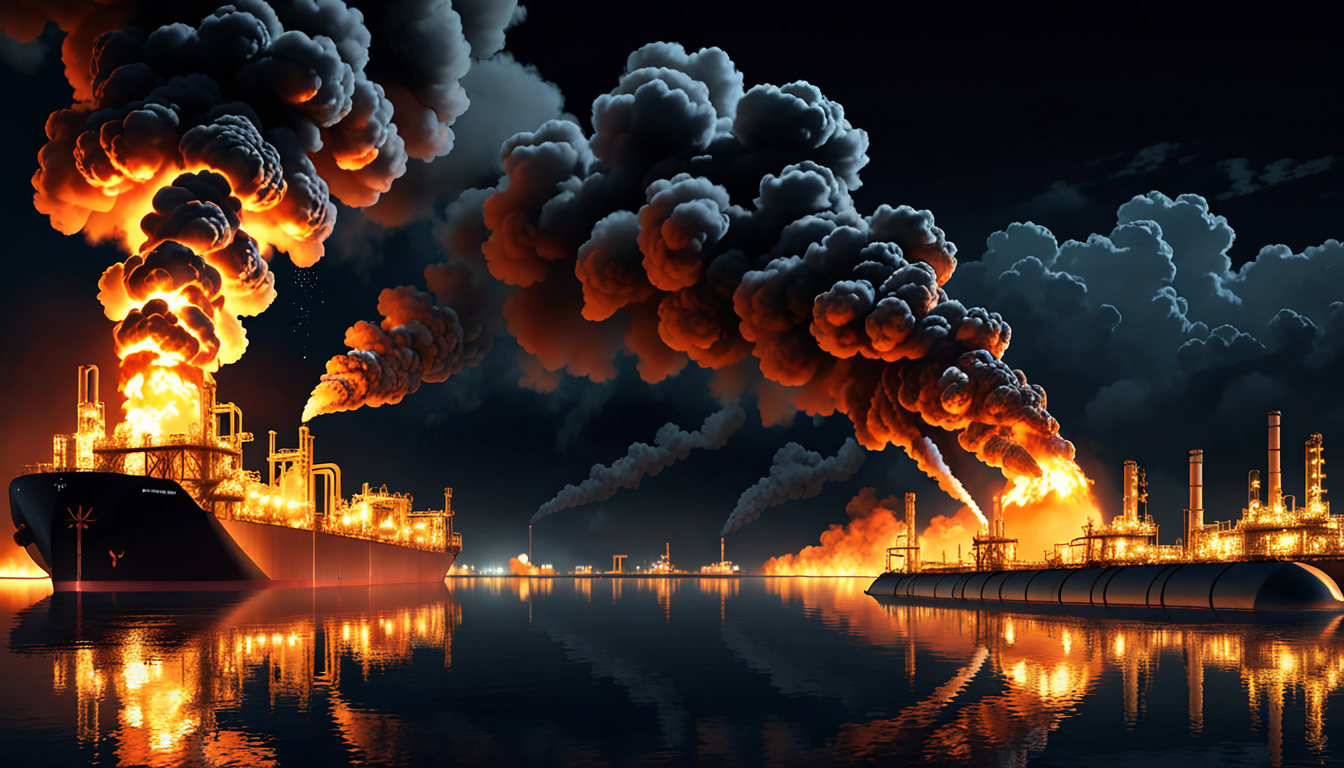
The destruction of 17% of Qatar's LNG capacity isn't just a war story — it's a structural rupture in the global energy architecture that will shape markets, alliances, and climate policy for the rest of the decade
Executive Summary
- Iranian strikes on Qatar's Ras Laffan hub have knocked out 12.8 million tons per year of LNG capacity for 3-5 years — the single largest structural disruption to global gas supply since Russia's invasion of Ukraine
- The $20 billion annual revenue loss transforms Qatar from the world's swing LNG supplier into a constrained producer, triggering force majeure declarations on long-term contracts with Italy, Belgium, South Korea, and China
- Three central banks — the Fed, ECB, and Bank of England — simultaneously froze rates this week in response to the energy shock, ending the global easing cycle and trapping monetary policy in a stagflationary vise
- The cascading damage extends far beyond gas: condensate exports down 24%, LPG down 13%, helium down 14% — creating supply crises across semiconductors, healthcare, and aerospace
Chapter 1: The Weekend That Changed Everything
QatarEnergy CEO Saad al-Kaabi's voice carried a mixture of disbelief and fury when he spoke to Reuters on Thursday. "I never in my wildest dreams would have thought that Qatar would be — Qatar and the region — in such an attack, especially from a brotherly Muslim country in the month of Ramadan."
The numbers he disclosed were devastating. Two of Qatar's 14 LNG trains and one of its two gas-to-liquids (GTL) facilities sustained damage from Iranian strikes on the Ras Laffan Industrial City — the nerve center of the world's largest LNG export operation. The damaged units had cost approximately $26 billion to build. Repairs will take three to five years.
To grasp the scale: Qatar exported roughly 77 million tons of LNG in 2025. Losing 12.8 million tons per year is equivalent to removing the entire LNG export capacity of Nigeria from global markets. And unlike a pipeline disruption or a sanctions regime, this damage is physical. Steel must be fabricated, trains must be rebuilt, and safety systems must be recertified. There are no shortcuts.
ExxonMobil, which holds a 34% stake in the damaged S4 train and 30% in S6, now faces multi-year revenue impairment on assets it had counted as among its most reliable cash generators. The ripple effects through ExxonMobil's portfolio — and through every LNG buyer who had contracted Qatari molecules — are only beginning to be priced.
Chapter 2: The Cascading Supply Crisis
The damage at Ras Laffan isn't just an LNG story. Qatar's integrated gas processing architecture means that a hit to LNG trains simultaneously disrupts the production of multiple co-products:
- Condensate exports: Down 24%. Condensate is a key feedstock for Asian refineries, particularly in South Korea and Japan, where it substitutes for light crude oil
- LPG: Down 13%. This directly affects cooking fuel supply across South Asia, where India is already rationing LPG under emergency Essential Commodities Act provisions due to the Hormuz blockade
- Helium: Down 14%. Qatar produces roughly one-third of global helium supply. Helium is irreplaceable in MRI machines, semiconductor manufacturing (where it cools EUV lithography systems), and aerospace applications. Unlike natural gas, helium that escapes to the atmosphere is permanently lost
- Naphtha and sulphur: Both down 6%. Naphtha is a critical petrochemical feedstock; sulphur is essential for fertilizer production
The helium dimension deserves particular attention. ASML's extreme ultraviolet lithography machines — the €200 million devices that produce every advanced chip on the planet — require helium for cooling. With Qatar's helium output falling 14% and no near-term alternative at scale, the semiconductor industry faces yet another constraint layered atop the HBM memory shortage and energy cost inflation that NVIDIA's GTC 2026 highlighted just days ago.
Chapter 3: The Central Bank Freeze
The Qatar damage disclosure landed in the same week that three of the world's most important central banks delivered identical verdicts: hold rates, prepare for the worst.
The Federal Reserve (March 17-18): Held at 3.50-3.75%, with Chair Powell deploying the word "temporary" to describe energy-driven inflation — an echo of Arthur Burns' catastrophic misjudgment in 1973. The dot plot showed only one rate cut for 2026, down from three projected in December. Markets now price zero cuts through 2027.
The European Central Bank (March 19): Held the deposit facility rate at 2.0%, raising its 2026 inflation forecast from just under 2% to 2.6%. President Lagarde pointedly walked back her February assessment that the eurozone was "in a good place," replacing it with the tortured formulation that the ECB was "well-positioned and well-equipped to deal with the development of a major shock that is unfolding." Traders immediately began pricing rate hikes later this year.
The Bank of England (March 19): Voted 9-0 to hold at 3.75% — a unanimous result that stunned markets expecting two dovish dissents. Before the Iran war began, the BoE had been expected to cut at this meeting. Instead, Governor Bailey's MPC declared itself "alert to the increased risk of domestic inflationary pressures through second-round effects." Bloomberg reported that a rate hike as soon as April is now under consideration.
The synchronicity is historically unusual. The last time the Fed, ECB, and BoE simultaneously froze rates in response to an exogenous energy shock was never — because the ECB didn't exist during the 1973 oil crisis. The closest parallel is the coordinated inaction of 1979-80, when Paul Volcker was still months away from his historic rate shock and European central banks were individually grappling with the second oil crisis.
What makes 2026 different — and potentially worse — is the dual nature of the shock. Central bankers face not just energy inflation but also AI-driven labor displacement (the February NFP reading was -92,000), a $3 trillion private credit market showing cracks, and a US government shutdown entering its 35th day. The policy toolkit assumes you can fight one fire at a time. The world is handing central banks four simultaneous blazes.
Chapter 4: Who Fills the Gap? Nobody, Quickly
Qatar's force majeure declarations will hit contracts with Italy, Belgium, South Korea, and China. Each of these buyers must now source replacement molecules in a market where:
- The Hormuz Strait remains under Iranian selective blockade, with only shadow fleet vessels transiting
- US LNG export capacity is running at maximum utilization
- Australia's LNG complex, the other major non-Qatari supplier, faces its own workforce constraints and seasonal maintenance schedules
- Russia's Arctic LNG 2 remains under Western sanctions (though the US waiver on Russian fuel oil is already driving record Asian imports — 3 million tonnes in March alone, according to Reuters shipping data)
The structural math is unforgiving. Global LNG supply was approximately 420 million tons in 2025. Removing 12.8 million tons (3% of global supply) for 3-5 years in a market that was already tight creates a seller's market that will persist far beyond any ceasefire.
European gas storage, already at a five-year low of 30%, now faces the near-impossibility of reaching the EU's mandated 90% fill level by December. The EU had planned to source replacement gas partly through expanded US LNG imports under the proposed Turnberry trade deal with Washington. But the Turnberry agreement — which includes $750 billion in US energy purchases — faces a contentious ratification vote on March 26, just days away.
Historical comparison: When Russia cut gas flows to Europe in 2022, the EU managed to replace Russian pipeline gas over roughly 18 months through a combination of LNG imports, demand destruction, and renewable deployment. But that transition started from a position of 90%+ storage and abundant global LNG liquefaction capacity. Neither condition holds today.
Chapter 5: Scenario Analysis
Scenario A: Managed Energy Transition (25%)
Premise: Ceasefire within 4-6 weeks, Hormuz reopens, Qatari reconstruction begins immediately.
Why 25%: The dual-power crisis in Tehran (Mojtaba Khamenei vs. President Pezeshkian issuing contradictory directives) makes coherent Iranian negotiation difficult. IRGC operational autonomy continues expanding. Netanyahu's stated three war goals — nuclear dismantlement, regime change, and energy infrastructure preservation — are internally contradictory.
Trigger conditions: A credible Chinese or Omani mediation proposal; IRGC acceptance of Mojtaba's authority; US domestic political pressure from the upcoming midterms.
Market impact: Brent falls to $85-90; European gas prices decline 30-40% from current levels but remain elevated; rate cut expectations cautiously return for H2 2026.
Scenario B: Protracted Low-Intensity Conflict (45%)
Premise: Hostilities continue at reduced tempo through summer 2026. Hormuz partially reopens under bilateral transit agreements. Qatar repairs proceed slowly.
Why 45%: This mirrors the pattern of the 1984-88 Tanker War, where the conflict settled into a grinding status quo neither side could escalate further or resolve. The current war is already showing signs of attrition — Iran's missile stocks are depleted by an estimated 86% for missiles and 73% for drones, per Pentagon assessments. But US munitions are also strained, with THAAD and PAC-3 production far below consumption rates.
Historical precedent: The Iran-Iraq War's tanker phase lasted four years. The Korean War's static phase lasted two years after initial movement. Both conflicts demonstrated that modern states can sustain low-intensity warfare far longer than markets initially price.
Trigger conditions: Neither side achieves a decisive military advantage; international mediation efforts fail but prevent further escalation; energy markets adapt to a "new normal" of constrained supply.
Market impact: Brent stabilizes at $95-110; European gas remains 2-3x pre-war levels; central banks remain frozen; the HALO trade (Heavy Assets, Low Obsolescence) continues outperforming; gold fluctuates between $4,500-5,200.
Scenario C: Escalatory Spiral (30%)
Premise: Israeli strikes on additional Iranian energy infrastructure, or Iranian attacks on Saudi/UAE oil production facilities, trigger a broader regional conflict.
Why 30%: Netanyahu has already attacked South Pars — a field shared with Qatar — demonstrating willingness to strike targets with consequences for US allies. Iran's "zero restraint" warning, combined with the IRGC's demonstrated ability to strike multiple GCC countries simultaneously, suggests the risk of further escalation remains high.
Trigger conditions: Israeli attack on Kharg Island oil terminal; Iranian mining of Strait of Hormuz shipping channels; Hezbollah full-scale engagement from Lebanon.
Market impact: Brent spikes above $150; global recession; central banks face impossible choice between rate hikes to fight inflation and rate cuts to prevent financial crisis; private credit market contagion accelerates.
Chapter 6: Investment Implications
Energy infrastructure: The war has demonstrated that Gulf energy assets, once considered among the safest in the world, are vulnerable to military disruption. This reprices the entire energy infrastructure complex:
- US LNG exporters (Cheniere, NextDecade) benefit from the structural gap
- Non-Gulf E&P companies with no Hormuz exposure gain a security premium
- Pipeline operators serving European markets (Equinor, TotalEnergies' non-Gulf assets) see re-rating
Helium and specialty gases: Qatar's 14% helium output decline creates acute shortages in semiconductor manufacturing and healthcare. ASML, which depends on helium for EUV cooling, may face production constraints. Linde and Air Liquide, as alternative helium suppliers, could see pricing power expand.
Defence: The THAAD/Patriot interceptor shortage (production at 6-7 missiles per month vs. consumption rates far exceeding that) validates the multi-year defence spending supercycle. Lockheed Martin, RTX, and Kongsberg are structural beneficiaries.
Bonds and gold: The 60/40 portfolio is functionally dead. Bonds are failing as safe havens — the Bloomberg Global Aggregate has given back all 2026 gains. Gold, despite a 6% two-day decline following the hawkish Fed hold, remains structurally supported by central bank purchases and de-dollarization. TIPS and inflation-linked securities offer better protection than nominal bonds.
Conclusion
Saad al-Kaabi's admission that Ras Laffan will take 3-5 years to fully repair transforms the Iran war from a geopolitical crisis into a structural energy event. Markets have spent three weeks pricing this conflict as a temporary disruption. The Qatar data forces a reckoning: some of this damage is permanent, or at least generational.
The simultaneous freezing of three major central banks underscores the policy trap. Energy prices are rising, economies are slowing, and the tools designed to address one problem worsen the other. This is the textbook definition of stagflation — and unlike the 1970s, today's central bankers must navigate it alongside AI-driven labor displacement, a private credit overhang, and the most fragmented global alliance structure since the interwar period.
For investors, the message is increasingly clear: physical assets, energy security, and defence capabilities are being repriced upward. Software, leverage, and geographic concentration risk are being repriced downward. The Great Rotation — from bits to atoms — has found its most powerful accelerant yet.
Leave a Reply