
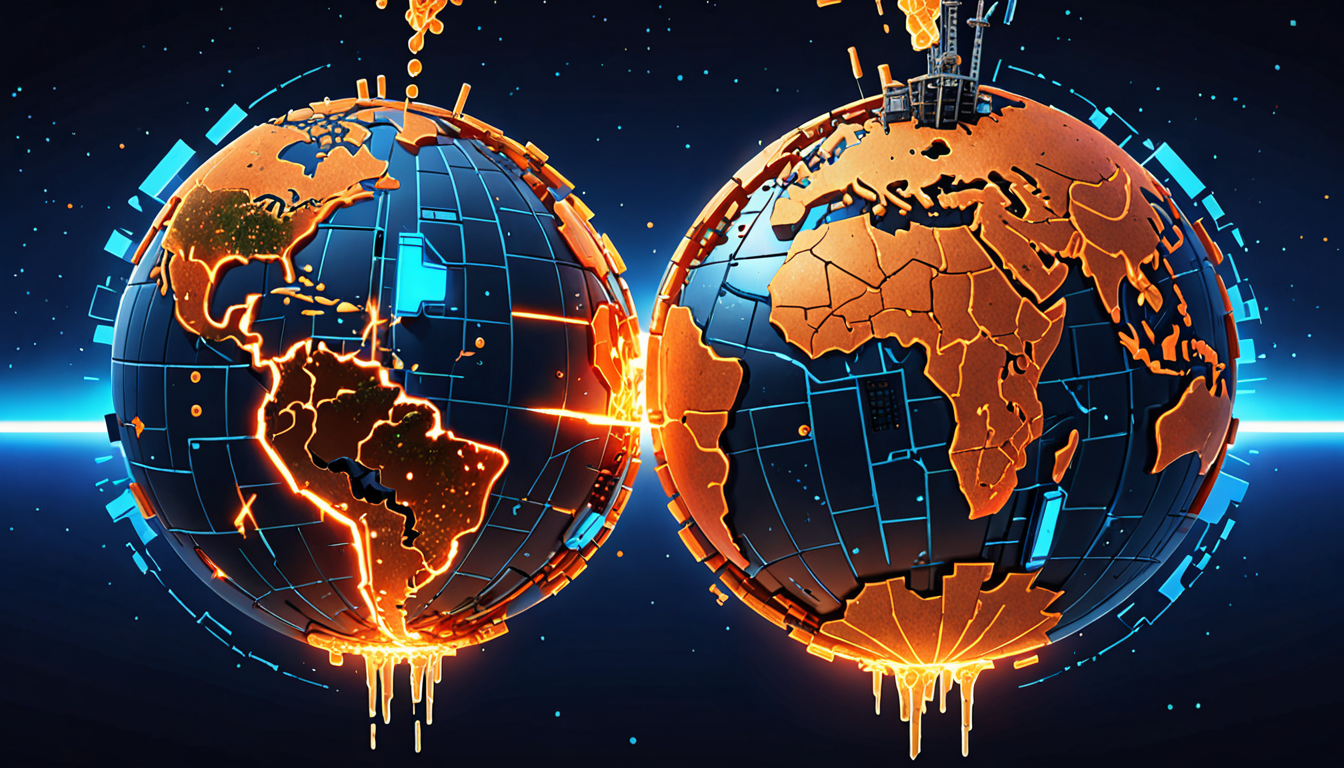
The WTO's starkest warning since 2020: merchandise trade growth will plunge from 4.6% to 1.9% — but the real story is what the headline number hides
Executive Summary
- The WTO's March 2026 Global Trade Outlook reveals a dangerous bifurcation: AI-related goods trade surged 21.9% in 2025 to $4.18 trillion, accounting for 42% of all trade growth — while traditional merchandise trade is fracturing under the weight of war, tariffs, and supply chain weaponization
- McKinsey's simultaneous "Geometry of Global Trade: 2026 Update" maps the architectural rewiring: advanced economies and China are pulling away from geopolitically distant partners, while "connector economies" in ASEAN, India, and the Middle East are absorbing redirected flows
- If the Hormuz blockade persists and energy prices remain elevated, the WTO warns trade growth could fall further to just 1.4% — a level not seen outside pandemic years since the 2009 global financial crisis
Chapter 1: The Illusion of Resilience
When the WTO released its 2025 trade data showing 4.6% merchandise volume growth, the headline invited cautious optimism. Global trade had defied the skeptics: despite IEEPA tariffs, SCOTUS constitutional battles over presidential trade authority, and the early tremors of the Iran war, goods kept flowing.
But the number was a mirage.
The WTO's March 19 Global Trade Outlook dissects the underlying mechanics. Nearly half of 2025's trade expansion came from two transient forces: a 21.9% explosion in AI-related goods (semiconductors, data infrastructure, networking equipment) worth $4.18 trillion, and widespread frontloading as importers raced to stockpile goods ahead of anticipated tariff hikes under the Section 122 bridge tariff and 301 investigations.
Strip those two factors away, and underlying trade growth was closer to 2.5% — barely keeping pace with GDP.
Now both tailwinds are fading. AI hardware investment is plateauing as hyperscalers confront the "power wall" — physical constraints on data center construction, energy availability, and memory supply. And the frontloading impulse has reversed into inventory digestion. The result: the WTO projects merchandise trade growth will crater to 1.9% in 2026, the weakest since the pandemic recovery.
WTO Director-General Ngozi Okonjo-Iweala framed the outlook with unusual directness: "Trade values may stay high, but the system behind them is becoming more fragile and increasingly shaped by geopolitics rather than economics."
Chapter 2: The AI Trade Singularity
McKinsey Global Institute's simultaneous report — "Geopolitics and the Geometry of Global Trade: 2026 Update" — provides the structural anatomy that the WTO's aggregate numbers obscure.
The most striking finding: AI-related trade has become the single most substantial engine of global commerce. Semiconductors, AI accelerators, networking equipment, and data center infrastructure now represent a trade category growing at ten times the rate of traditional manufactured goods. In 2025, these products accounted for $4.18 trillion in cross-border flows, up from $3.43 trillion the year before.
This concentration creates a paradox. Global trade appears healthy in aggregate, but the growth is hyper-concentrated in a narrow band of products flowing between an even narrower set of countries. The United States, Taiwan, South Korea, Japan, and the Netherlands dominate the supply side. The United States, China (despite restrictions), and a handful of hyperscale cloud operators dominate demand.
McKinsey identifies what it calls "geometric distortion": the physical distance of trade is increasing (India shipping smartphones 13,000 kilometers to the US), but the product diversity is narrowing. The world is trading more across longer distances, but in fewer categories with fewer partners.
This creates acute vulnerability. A disruption to TSMC's advanced packaging facilities, a further tightening of semiconductor export controls, or an escalation of the memory shortage could simultaneously crater the single category propping up global trade statistics.
The semiconductor industry is now projected to surpass $1 trillion in revenue in 2026, according to SEMI. But as WSTS data shows, this growth is overwhelmingly concentrated in AI chips and HBM memory — categories where supply is already constrained. The broader semiconductor market, serving automotive, industrial, and consumer electronics, is actually contracting as wafer capacity is redirected toward AI workloads.
Chapter 3: The Hormuz Fracture
The WTO's baseline 1.9% forecast assumes energy markets stabilize. This assumption, three weeks into Operation Epic Fury and with the Strait of Hormuz effectively blockaded, looks increasingly detached from reality.
Under the WTO's "energy shock scenario," persistently high crude oil and LNG prices push merchandise trade growth down to just 1.4%. Services trade slows from 4.8% to 4.1%. Global GDP growth is trimmed by 0.3 percentage points.
But even these downside estimates may understate the damage. The WTO notes that Hormuz traffic has collapsed from 138 vessels per day to near zero. Twenty percent of global oil supply normally transits this corridor. The disruption extends far beyond energy:
Fertilizer: Roughly one-third of global fertilizer exports transit the Strait. With the spring planting season underway in the Northern Hemisphere, nitrogen fertilizer prices have surged 40% since the blockade began. India, Brazil, and Thailand — major agricultural producers — face acute input shortages that could reduce yields by 20-40%, according to the AFBF.
Petrochemicals: The Gulf accounts for a significant share of global ethylene, propylene, methanol, and ammonia production. Automotive manufacturing, which depends on 150-200 kg of plastics per vehicle, faces cascading supply disruptions.
LNG: Qatar's Ras Laffan facility — the world's largest LNG export terminal — has declared force majeure after Iranian strikes caused $20 billion in damage requiring up to five years to repair. European gas prices have roughly doubled in a month, threatening the continent's already fragile industrial base.
Helium: A less noticed but critical casualty. Qatar supplies roughly one-third of global helium, essential for semiconductor manufacturing (ASML's EUV systems), MRI machines, and aerospace. There is no strategic helium reserve. Once released, helium is permanently lost to the atmosphere.
The compounding nature of these disruptions — energy, fertilizer, petrochemicals, helium — creates what trade economists call "cascading chokepoint failure." Each bottleneck amplifies the others, producing economic damage far exceeding the sum of individual disruptions.
Chapter 4: Connector Economies and the Great Rewiring
McKinsey's geometry analysis reveals a structural transformation accelerating beneath the war's chaos. Since 2017, advanced economies and China have been gradually reorienting trade away from geopolitically distant partners. The US-China bilateral trade relationship has contracted significantly, but total trade volumes have been maintained through intermediary routing.
The beneficiaries are what McKinsey terms "connector economies" — nations positioned at the intersection of competing blocs, able to trade with both sides while adding enough value to satisfy rules of origin requirements.
Vietnam stands out: its exports to the US have surged 44% since 2024, driven by redirected Chinese manufacturing. But Vietnam's imports from China have risen nearly as fast, raising questions about whether this represents genuine industrial development or sophisticated trade circumvention.
India has emerged as the most geographically versatile trader, with the marked increase in distance reflecting smartphone shipments to the US (13,000 km), energy imports from Russia (via newly diversified routes), and deepening trade with both the Gulf and ASEAN. India's multi-alignment strategy is being tested by the Hormuz crisis, which has exposed its 75-85% LPG import dependence on Gulf supply.
Mexico remains the largest connector economy for US trade, but faces mounting pressure from the USMCA review (due July 1) and Trump's investigation of "Chinese backdoor" manufacturing. The Sinaloa cartel's escalating violence adds operational risk that no tariff schedule can price.
Turkey and the UAE had been building positions as trade intermediaries, but both are now directly affected by the Iran war — Turkey through refugee pressure and NATO tensions, the UAE through physical attacks on its territory and the collapse of its "safe haven" premium.
The WTO data confirms this rewiring: Asia will lead merchandise import growth in 2026 at 3.3%, with exports up 3.5%. Africa follows at 3.2% import growth and 1.2% export growth. North America and Europe will lag, weighed down by tariff uncertainty and energy costs.
Chapter 5: The Three Scenarios
Scenario A: Managed Deceleration (40%)
Premise: The Iran war de-escalates within 4-8 weeks. Hormuz partially reopens. AI investment maintains momentum despite energy headwinds. Section 301 investigations produce negotiated outcomes rather than punitive tariffs.
Trade outcome: Merchandise growth recovers to 2.4% (WTO upside case). Services trade holds at 4.8%. Global GDP growth remains at 2.8%.
Historical parallel: The 2019 US-China trade war created similar uncertainty but was ultimately managed through Phase 1 negotiations. Trade growth slowed but didn't collapse.
Trigger conditions:
- Iran's dual power structure (Mojtaba Khamenei vs. Pezeshkian) produces a negotiating track
- Trump-Xi summit (rescheduled to May) yields a framework on chips, rare earths, and energy
- European gas storage reaches minimum 60% by October through accelerated US LNG exports
Investment implications: Gradual rotation back toward quality growth stocks. Connector economy equities (Vietnam, India, Mexico ETFs) outperform. Commodity supercycle moderates but doesn't reverse.
Scenario B: Two-Speed Stagnation (45%)
Premise: The Hormuz blockade persists in modified form (selective passage). Energy prices remain elevated ($90-110 Brent). AI trade continues growing but cannot compensate for broader deceleration. Tariff fragmentation accelerates as Section 301 investigations and Section 122 bridge tariffs create a patchwork of bilateral rates.
Trade outcome: Merchandise growth falls to 1.4-1.9%. Services trade weakens to 4.1%. Global GDP growth drops to 2.5%.
Historical parallel: The 1973-74 oil embargo created a two-speed economy where energy exporters boomed while importers stagnated. The current situation is more complex because the AI trade layer didn't exist in the 1970s, creating unprecedented bifurcation.
Trigger conditions:
- Iran maintains selective Hormuz blockade (Chinese/friendly vessels pass, Western vessels blocked)
- FOMC holds rates through 2026 as stagflation persists (already priced by markets post-March meeting)
- Section 301 investigations drag on, creating prolonged uncertainty across 16 target economies
- Private credit contagion remains contained but weighs on risk appetite
Investment implications: HALO trade (Heavy Assets, Low Obsolescence) continues to outperform. Energy, materials, and defense sectors lead. Software and SaaS multiples remain compressed. Gold maintains $4,700-5,200 range as safe haven despite rate headwinds. Asian markets underperform due to energy vulnerability.
Scenario C: Trade System Fracture (15%)
Premise: The Iran war escalates further (direct US ground involvement or nuclear threshold breach). Hormuz remains fully closed for 6+ months. China retaliates against Section 301 with expanded rare earth export controls and entity list expansions. EU-US Turnberry agreement collapses. Multiple emerging markets face debt crises as energy costs overwhelm fiscal positions.
Trade outcome: Merchandise growth turns negative (-0.5 to 0.5%). Services trade collapses. Global recession (GDP growth below 1%).
Historical parallel: The 2008-09 global financial crisis saw trade volumes plunge 12%. The current scenario would be less severe in volume terms but more damaging structurally because it would accelerate bloc formation — permanently splitting the global trading system into competing spheres.
Trigger conditions:
- Iran or Israel crosses a nuclear threshold (IAEA verification gaps make this impossible to rule out)
- China imposes helium/rare earth embargo targeting semiconductor production
- Multiple EM defaults (Senegal, Pakistan, Egypt already showing stress)
- Private credit market seizure spreads to investment-grade corporate debt
Investment implications: Cash, short-duration treasuries, and gold. Avoid all risk assets. Energy infrastructure becomes a national security asset class. Defense spending accelerates globally but equity valuations may not benefit during acute crisis.
Chapter 6: Investment Implications — The Atoms-Over-Bits Thesis Validated
The convergence of the WTO's trade deceleration warning, McKinsey's geometry shift, and the ongoing Hormuz crisis validates the structural rotation thesis that has been building since early 2026.
The core insight: Global trade is splitting into two layers. The digital layer (AI chips, data infrastructure, cloud services) continues to grow rapidly but is concentrated in a handful of players and vulnerable to chokepoint disruption (TSMC, memory, helium, energy). The physical layer (energy, agriculture, materials, manufactured goods) is fragmenting along geopolitical lines, creating persistent friction costs.
Key metrics to monitor:
| Indicator | Current | Watch Level | Significance |
|---|---|---|---|
| Brent crude | ~$115/bbl | >$120 sustained | Triggers WTO downside scenario |
| Hormuz daily transits | Near zero | <50 vessels | Structural supply chain damage |
| US 10-year yield | 4.26% | >4.5% | Stagflation pricing intensifies |
| LNG Europe (TTF) | ~€65/MWh | >€80 | Industrial shutdown risk |
| Urea (FOB Egypt) | $625/ton | >$750 | Spring planting failure locked in |
| Fed funds rate | 3.50-3.75% | Any movement | Policy error either direction |
| MSCI EM vs DM spread | -6% YTD | >-10% | Emerging market crisis threshold |
Sector positioning:
- Overweight: Energy infrastructure, defense, materials, utilities, agricultural inputs (CF Industries, Nutrien, Mosaic)
- Selective: AI physical layer (Nvidia, TSMC, memory makers) — strong fundamentals but energy vulnerability
- Underweight: Software/SaaS, consumer discretionary, travel/hospitality, emerging market debt
- Hedge: Gold, TIPS, energy commodity exposure, short Gulf real estate/hospitality
The WTO's warning is clear: the system that sustained global prosperity for three decades — open, rules-based, efficiency-optimized trade — is being replaced by something messier, more fragmented, and structurally inflationary. The AI boom has bought time by creating a new growth engine, but it cannot indefinitely compensate for the erosion of the physical trade infrastructure that feeds, fuels, and connects the world.
Conclusion
The two reports released this week — from the WTO and McKinsey — tell the same story from different angles. Global trade is being reshaped by three simultaneous forces: the gravitational pull of AI-related commerce, the centrifugal force of geopolitical fragmentation, and the acute shock of war.
The danger isn't that trade will collapse. It won't. The danger is that the headline numbers will continue to look adequate — buoyed by $4+ trillion in AI goods flowing between a dozen countries — while the underlying infrastructure of global commerce rots. Fertilizer doesn't reach fields. LNG doesn't reach power plants. Helium doesn't reach fabs. Ships don't transit straits.
The two-speed trade world isn't a forecast. It's already here. The question is whether the gap between the two speeds will narrow — or become permanent.
Sources: WTO Global Trade Outlook and Statistics (March 19, 2026); McKinsey Global Institute "Geopolitics and the Geometry of Global Trade: 2026 Update" (March 19, 2026); CNBC; AP News; gCaptain; Reuters; Livemint; Financial Express; EY Geostrategic Analysis March 2026
Leave a Reply