
Executive Summary
- Netanyahu proposes building oil and gas pipelines across the Arabian Peninsula to Israeli Mediterranean ports, bypassing the Strait of Hormuz permanently and positioning Israel as the indispensable transit node for global energy flows.
- The vision leverages the Hormuz crisis as proof-of-concept: with 20% of global oil and LNG supply still disrupted three weeks into the war, the vulnerability of existing chokepoints has become undeniable — and Netanyahu is betting that the pain will be severe enough to make the geopolitical impossible suddenly feasible.
- The plan would integrate Saudi Arabia's existing East-West pipeline with Israel's Eilat–Ashkelon corridor, creating a continuous land bridge from Gulf production to European markets — but it requires a Saudi-Israeli normalization that the Abraham Accords never completed and a post-war regional order that doesn't yet exist.
Chapter 1: The Pitch — Energy Corridors as Strategic Architecture
On March 19, as Iranian missiles rained down on Jerusalem and northern Israel in five separate salvos, Prime Minister Benjamin Netanyahu held an English-language press conference that was remarkable not for what it said about the war, but for what it said about the peace he envisions after it.
"What's needed are oil pipelines, gas pipelines going west through the Arabian Peninsula right up to Israel, right up to our Mediterranean ports," Netanyahu declared. "And you've just done away with the chokepoints forever."
The statement represented the first time an Israeli leader has articulated a post-war regional energy architecture during active hostilities. It was also, unmistakably, a sales pitch — directed simultaneously at Washington, Riyadh, Abu Dhabi, and the commodity markets that have been in turmoil since Operation Epic Fury began on February 28.
The logic is seductive in its simplicity. The Strait of Hormuz, through which roughly 20 million barrels per day of crude oil and 20% of global LNG supplies flow, has been functionally closed for three weeks. The IRGC declared it a war zone on Day 2. Some 3,200 commercial vessels are stranded. Insurance markets have collapsed. Energy prices have spiked — Brent crude hit $119 on March 19 before settling around $107 — and the global economy is absorbing an inflationary shock that the IMF estimates will shave 1-2 percentage points off world GDP growth.
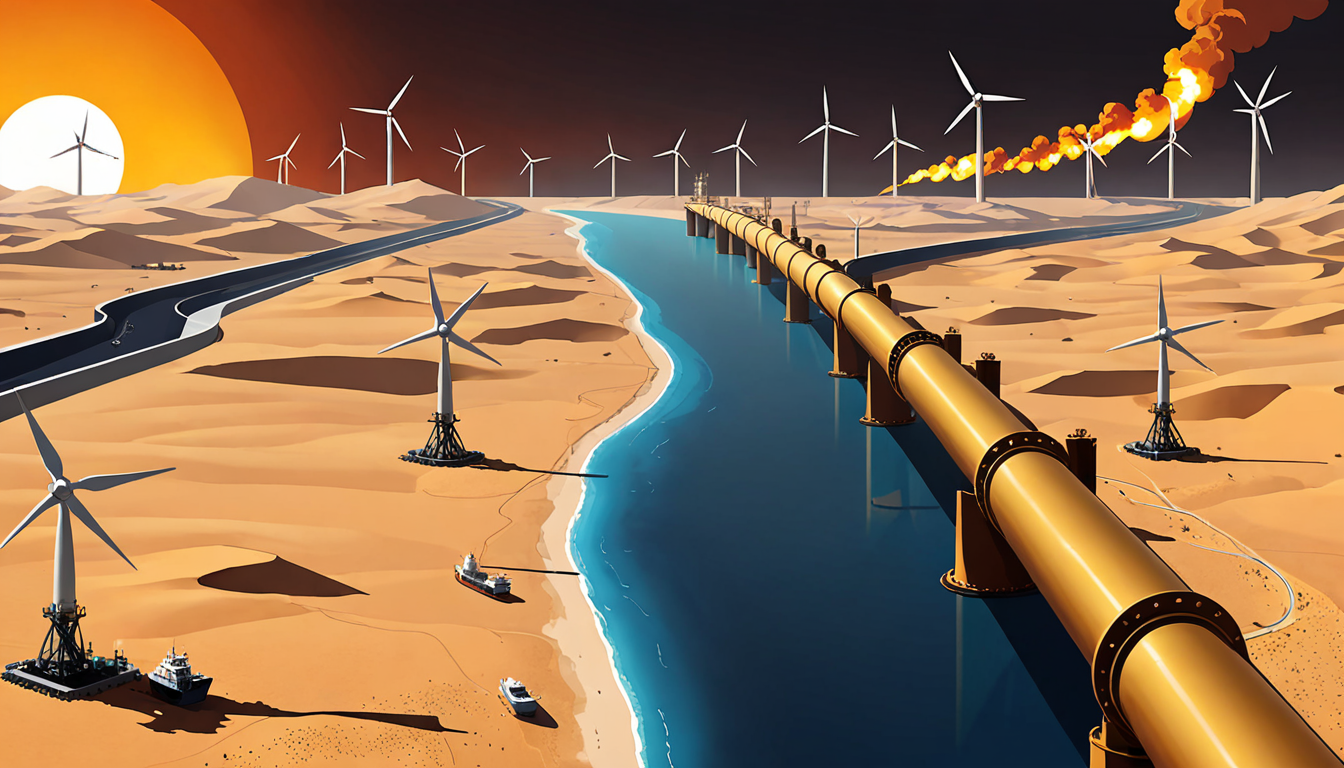
Netanyahu's proposal: make Hormuz irrelevant. Route Gulf energy westward through overland pipelines across Saudi Arabia, then down to Israel's Red Sea port of Eilat, through the existing Eilat–Ashkelon pipeline, and out to Mediterranean tanker terminals. Europe gets its energy. Asia can access it via the Suez Canal. And Israel — a country of 10 million people with minimal natural resources — becomes the indispensable chokepoint replacement.
The Existing Infrastructure
The proposal isn't built from scratch. Saudi Arabia's East-West Pipeline (Petroline) already runs 1,200 km from oil fields in the Eastern Province to the Red Sea port of Yanbu, with a capacity of roughly 5 million barrels per day. It was reactivated during the current crisis to bypass Hormuz, providing some relief to global markets.
Israel's Eilat–Ashkelon Pipeline Corporation (EAPC) — originally built in the 1960s as a joint Israeli-Iranian venture under the Shah — runs 254 km from the Red Sea to the Mediterranean. Though its current capacity is modest (around 600,000 bpd), it could theoretically be expanded.
The missing link is the connection between Yanbu and Eilat — roughly 300 km across the Gulf of Aqaba. And, of course, the political architecture: Saudi Arabia and Israel have no formal diplomatic relations, though the Abraham Accords framework and the pre-war normalization track had brought them closer than ever.
Chapter 2: The Three Goals and Their Contradictions
Netanyahu's press conference outlined three goals for Operation Roaring Lion:
- Removing Iran's nuclear threat — Netanyahu claimed Iran "no longer has uranium enrichment capacity" and that most nuclear infrastructure has been destroyed
- Eliminating Iran's ballistic missile production capability — "We are not only acting to destroy the remaining ballistic missiles… but also the industries that enable the production of these programmes"
- Creating conditions for Iranians to "grasp freedom" — effectively, regime change
The third goal is the most relevant to the energy corridor vision. A post-war Iran that is either a failed state, a friendly regime, or a permanently weakened adversary would, in Netanyahu's calculus, make the Hormuz threat permanent — justifying the massive investment needed to build alternative routes.
But the contradictions are immediate. Netanyahu himself acknowledged that "airstrikes alone are insufficient" and that a "ground component" is necessary — his most explicit hint yet at a potential ground invasion. A war that expands rather than concludes would delay any post-war reconstruction, let alone infrastructure megaprojects.
Moreover, the very countries Netanyahu needs as partners — Saudi Arabia, UAE, Qatar, Kuwait — are the ones whose energy infrastructure Iran has been attacking in retaliation for the war. Qatar's Ras Laffan LNG facility suffered 17% capacity damage worth an estimated $20 billion. Kuwait's Mina al-Ahmadi refinery was set ablaze. Saudi SAMREF facilities were hit. The Gulf states are currently less inclined toward grand visions than toward survival.
Chapter 3: The Central Bank Barricade — Stagflation's Shadow
Netanyahu's energy pitch landed in a week that demonstrated just how deeply the Hormuz crisis has penetrated the global financial system.
In an extraordinary convergence, central banks of the G7 nations — the US Federal Reserve, Bank of Japan, Bank of England, Bank of Canada, European Central Bank, and Swiss National Bank — all convened within the same week. Their collective message: rates are frozen, and the specter of stagflation is real.
The Federal Reserve held rates at 3.50-3.75% on March 18, with Chair Jerome Powell introducing what markets are already calling the "temporary" doctrine — his insistence that the energy shock's inflationary effects will prove transient. The parallel to Arthur Burns' catastrophic misjudgment in 1973, when he dismissed OPEC oil shock inflation as temporary, was lost on nobody.
Key data points from the central bank week:
| Central Bank | Decision | Key Signal |
|---|---|---|
| US Fed (FOMC) | Hold 3.50-3.75% | Dot plot: 1 cut in 2026 (down from 2); inflation outlook raised |
| Bank of Japan | Hold 0.75% | Hawkish signal; energy import costs straining economy |
| Bank of England | Hold | Inflation concerns from energy shock |
| ECB | Repricing from cuts to hikes | 80% probability of rate hike by year-end |
| Swiss National Bank | Cautious hold | Global growth likely to "temporarily slow" |
| Bank of Canada | Hawkish hold | Job losses 84,000 from tariff shock compound energy crisis |
| RBA (Australia) | Hiked to 4.10% | 5-4 vote; first G10 hike since cycle ended |
| China PBOC | Hold LPR unchanged | 10th consecutive month; strategic patience |
The global easing cycle that began with Switzerland's first cut in March 2024 appears to be officially dead. The SNB's own assessment noted that "higher energy prices will raise inflation in many countries in the short term" and global growth "is likely to temporarily slow" — the polite central banker's way of describing stagflation.
Markets responded brutally. India's Sensex crashed 2,500 points (3.3%) on March 19, erasing ₹12 lakh crore in market value. MSCI's global stock gauge fell 0.88% to 996.62. The pan-European STOXX 600 dropped 2.39%, its biggest daily fall since March 3. Oil prices continue to whipsaw between $90 and $120, driven by headlines about Hormuz reopening attempts and fresh Iranian retaliatory strikes.
The Powell Paradox
Powell's assertion that the current situation doesn't constitute stagflation — "I would reserve the term stagflation for a much more serious set of circumstances" — rings hollow when examined against the data:
- GDP growth: 0.7% and falling
- Core PCE inflation: 3.1% and rising
- Non-farm payrolls: -92,000 (February), worst since the pandemic
- Oil prices: $107/barrel Brent, up 35%+ since the war began
- Michigan consumer sentiment: 55.5, with inflation expectations at 3.9%
The last time a Fed chair dismissed an energy-driven inflationary shock as "temporary" was Burns in 1973-74. The result was the Great Inflation that lasted until Volcker's brutal rate hikes in 1979-82.
Chapter 4: The Renewable Energy Paradox
Even as Netanyahu pitches a fossil fuel transit empire, the Hormuz crisis is accelerating the very energy transition that could make his vision obsolete before the first pipeline is laid.
An Associated Press analysis published on March 20 highlights a striking paradox: countries with greater renewable energy adoption have been significantly more insulated from the Hormuz shock.
China, which leads the world in renewable energy with 18% of generation from solar and wind, is weathering the crisis better than expected. Its 12 billion barrels of strategic petroleum reserves, accumulated when prices were low, provide a buffer. More importantly, the electrification of its economy — one in ten cars is now electric — has structurally reduced oil import dependence.
Pakistan, despite its economic fragility, has preempted more than $12 billion in fossil fuel imports since 2020 through its solar boom, with an additional $6.3 billion in potential savings in 2026 at current prices. Its 41 GW solar capacity is acting as a partial energy shield.
South Korea's President Lee Jae-myung called the crisis "a good opportunity" to accelerate the shift to renewable energy — a remarkable statement from a leader whose country imports 60% of its energy through Hormuz.
Europe, by contrast, learned what one analyst called "the wrong lesson" from Russia's 2022 gas cutoff. Rather than accelerating renewables, Germany rushed to build LNG terminals to replace Russian gas with American fuel. Europe's excess spending on fossil fuels since the Russia-Ukraine war amounted to roughly 40% of the investment needed to transition its power system entirely to clean energy, according to a 2023 study. Now, with Qatar LNG offline and TTF gas prices surging, that strategic error is compounding.
The renewable energy paradox creates a fundamental tension with Netanyahu's pipeline vision. If the Hormuz crisis is indeed the "wake-up call" that drives a generational acceleration in renewable energy deployment — as the International Renewable Energy Agency's data showing 90%+ of new renewables are cheaper than fossil fuels suggests it should — then building a multi-billion-dollar fossil fuel transit corridor may be investing in the energy system of the past.
Chapter 5: Scenario Analysis — The Post-War Energy Order
Scenario A: The Israeli Energy Corridor (20%)
Preconditions: War ends with Iranian regime collapse or fundamental weakening; Saudi-Israeli normalization accelerates; massive infrastructure investment ($50-100B+) materializes; Gulf states accept Israeli transit dependency.
Trigger: A grand bargain linking Abraham Accords completion with energy infrastructure co-investment, backed by US guarantees and Gulf sovereign wealth fund capital.
Historical precedent: The Trans-Arabian Pipeline (Tapline), built in 1947-50 from Saudi Arabia through Jordan, Syria, and Lebanon to the Mediterranean — destroyed by regional politics within two decades. The Baku-Tbilisi-Ceyhan pipeline (2006), which successfully bypassed Russian-controlled routes, offers a more optimistic parallel.
Investment implications: Israeli infrastructure companies, pipeline engineering firms, Mediterranean port operators, Saudi Aramco (expanded transit role). Risk: project may never materialize.
Scenario B: Hormuz Reopens, Status Quo Restored (35%)
Preconditions: War ends within 2-3 months; IRGC accepts ceasefire under pressure; Hormuz reopens with enhanced international naval presence; insurance markets normalize over 6-12 months.
Trigger: Exhaustion of both sides' military capabilities, combined with Chinese/European diplomatic pressure and US domestic political pressure ahead of midterm elections.
Historical precedent: The Iran-Iraq tanker war (1984-88) — Hormuz was threatened but never fully closed; shipping resumed with naval escorts.
Investment implications: Energy prices normalize to $70-80 range; oversold Asian equities recover; Gulf real estate and tourism begin slow recovery. The energy corridor vision fades as urgency diminishes.
Scenario C: Prolonged Disruption Accelerates Energy Transition (45%)
Preconditions: War continues for 4-6+ months; Hormuz remains contested even after formal hostilities end; insurance markets permanently reprice Gulf shipping risk; renewable energy deployment accelerates dramatically.
Trigger: The structural realization — similar to Europe's 2022 Russia shock — that fossil fuel chokepoint dependency is an existential risk, combined with renewables now being cheaper than fossil alternatives in most markets.
Historical precedent: The 1973 OPEC embargo, which launched a generation of energy diversification including nuclear power, efficiency standards, and strategic petroleum reserves. This time, the diversification technology (solar, wind, batteries, EVs) is already mature and cost-competitive.
Investment implications: Clean energy equities (solar, wind, battery storage, EV manufacturers) outperform; fossil fuel infrastructure investment peaks and declines; countries with strong domestic renewable capacity (China, parts of Asia) gain structural advantage. Netanyahu's pipeline vision becomes a stranded asset before construction begins.
Conclusion: The Geography of Energy Is Being Rewritten
Netanyahu's press conference on March 19 was a masterclass in crisis exploitation — attempting to transform a catastrophic military escalation into a generational strategic opportunity. The vision of Israel as the world's energy crossroads is audacious, historically grounded (the EAPC pipeline was literally built for this purpose in the 1960s), and responsive to a genuine structural vulnerability that the Hormuz crisis has exposed.
But it also reveals a fundamental misreading of where the world is heading. The same crisis that makes the Israeli corridor seem necessary is simultaneously proving that the countries least dependent on fossil fuel transit — those that invested most aggressively in domestic renewable energy — are the most resilient. China's partial insulation, Pakistan's solar shield, South Korea's pivot rhetoric all point in the same direction.
The Hormuz crisis of 2026 may ultimately be remembered not as the event that created a new fossil fuel geography, but as the event that ended the old one — the final, devastating demonstration that an energy system dependent on a single 33-km-wide strait between Iran and Oman was never sustainable, and that the alternative was always domestic, renewable, and distributed.
Netanyahu is offering the world a better chokepoint. The world may be ready, finally, to reject chokepoints altogether.
Sources: Reuters, AP News, CNN, BBC, The Hindu, Financial Express, CNBC, Bloomberg, International Renewable Energy Agency, Centre for Research on Energy and Clean Air
Leave a Reply