
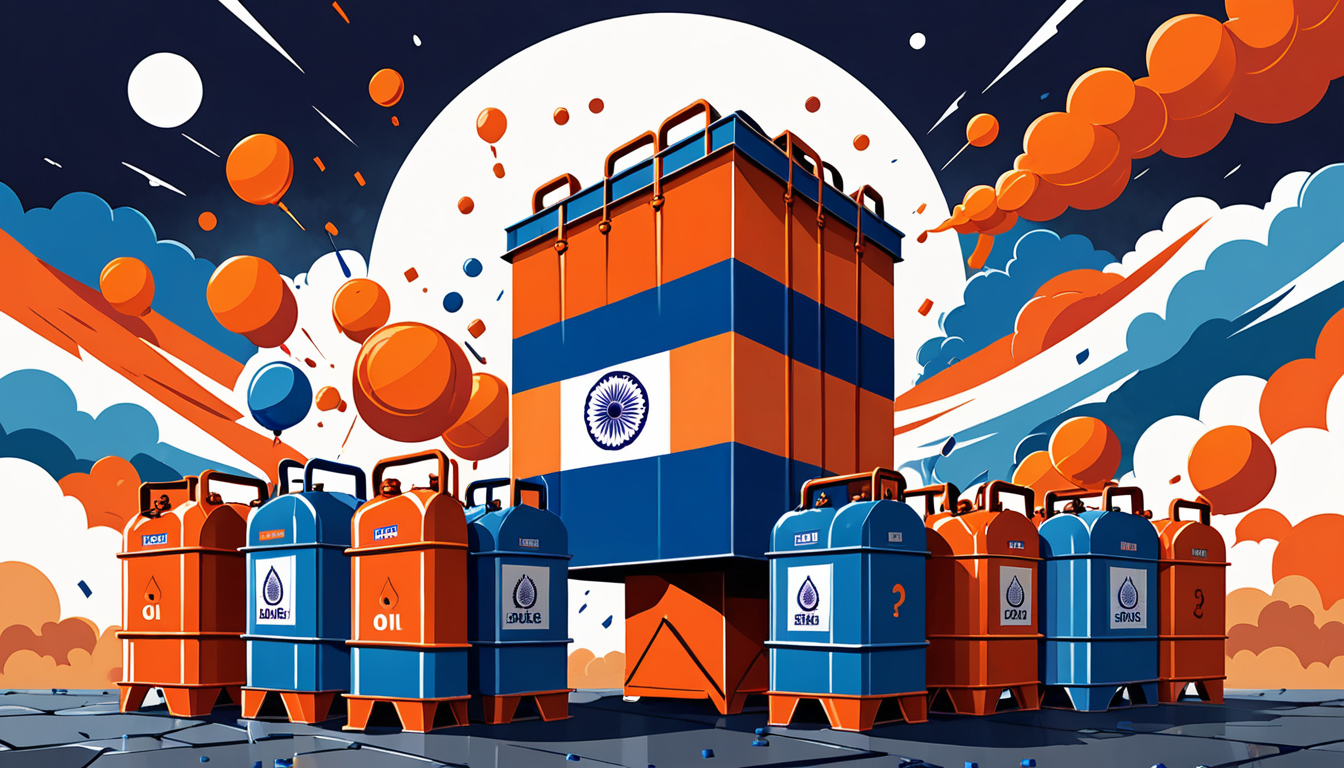
Five state elections collide with the worst energy crisis since 1973 — testing Modi's mandate and reshaping Asia's largest democracy
Executive Summary
- India's Election Commission has announced assembly elections across five states — West Bengal, Tamil Nadu, Kerala, Assam, and Puducherry — from April 9-29, with results on May 4, placing over 400 million eligible voters at the ballot box during the Hormuz crisis.
- The LPG shortage triggered by Iran's Strait of Hormuz blockade has become the single most potent campaign issue, with cooking gas prices doubling on the black market and the Essential Commodities Act invoked for the first time.
- The results will serve as a critical referendum on the BJP's national governance during wartime and a bellwether for Modi's multi-alignment foreign policy, with direct implications for India's $3.5 trillion economy and its positioning between Washington and Moscow.
Chapter 1: The Collision of Democracy and Crisis
On March 15, 2026, India's Election Commission announced what would have been, under normal circumstances, a routine democratic exercise: assembly elections in four states and one union territory. But nothing about the circumstances is routine. As campaign machinery whirs into action across the subcontinent, India confronts a convergence of crises that has no modern precedent.
The Strait of Hormuz — through which India imports roughly 50% of its crude oil and 80-85% of its liquefied petroleum gas — remains under effective Iranian blockade, now entering its third week. Operation Epic Fury, the US-Israeli military campaign against Iran, has created the most severe energy disruption since the 1973 OPEC embargo. The Essential Commodities Act has been invoked for the first time in Indian history specifically to manage cooking gas shortages, with Mumbai restaurants shutting at a 20% rate and Bengaluru cafés reduced to serving only tea and coffee.
Into this maelstrom, 400 million voters across West Bengal (294 seats), Tamil Nadu (234 seats), Kerala (140 seats), Assam (126 seats), and Puducherry (30 seats) will go to the polls. The schedule is tight: Assam, Kerala, and Puducherry vote on April 9; Tamil Nadu and West Bengal begin on April 23, with Bengal's second phase on April 29. Results arrive May 4.
The election machinery itself faces logistical challenges unprecedented in Indian democratic history. Fuel rationing constrains campaign vehicles. LPG shortages affect the community kitchens that are a staple of Indian political rallies. The Rupee's decline past 92 against the dollar — driven by India's yawning energy import bill — has pushed inflation into territory that makes every household feel the pinch of geopolitics at their kitchen stove.
Chapter 2: Five Battlefields, One Energy Crisis
West Bengal: Mamata's Kitchen Gambit
The fiercest contest unfolds in West Bengal, where Chief Minister Mamata Banerjee seeks a fourth consecutive term for her Trinamool Congress (TMC) against an aggressive BJP challenge. The BJP has fielded Suvendu Adhikari — the leader of opposition — against Banerjee herself in Kolkata's Bhabanipur constituency, making it a direct leadership showdown.
The LPG crisis has become Banerjee's most potent weapon. "There is no gas, but the BJP is sitting with cash to manipulate polls," she declared on March 17. With black market gas cylinder prices at ₹1,800 — double the subsidized rate — and 300 million households affected nationally, the BJP faces a challenge of attribution: voters may punish the ruling national party for an energy crisis triggered by a war they did not start but whose diplomatic consequences they must manage.
Yogendra Yadav, the political analyst, flags that only around 3% of investment proposals from West Bengal's business summits have materialized, turning the state into a "labour-exporting economy." The combination of chronic economic underperformance and an acute energy crisis creates a politically volatile cocktail.
Tamil Nadu: Stalin's Alliance Calculus
Tamil Nadu presents the most complex alliance dynamics. Chief Minister M.K. Stalin's DMK leads a broad front including Congress and smaller regional parties. The opposition AIADMK, allied with BJP, is recalibrating its strategy. The wildcard is actor-politician Vijay's Tamilaga Vettri Kazhagam (TVK), which adds a third front that could fragment votes unpredictably.
Tamil Nadu's industrial economy — automobiles, IT services, textiles — is acutely sensitive to energy costs. The state's petrochemical corridor around Chennai, already reeling from Hormuz-related input shortages, faces the prospect of factory shutdowns during election season. The DMK has framed the election as a defense of Tamil Nadu against "BJP-RSS attacks," but the energy crisis cuts through ideological lines when cooking gas runs dry in every household.
Kerala: Left Front's Uphill Battle
Kerala's election is a classic three-front contest between the ruling Left Democratic Front (LDF) led by CPI(M), the Congress-led United Democratic Front (UDF), and a growing BJP-NDA front. The LDF faces significant anti-incumbency. A resurgent Congress-led UDF sees its best opportunity in years.
Kerala's unique vulnerability lies in its remittance economy. With the Gulf states — the source of roughly 36% of Kerala's GDP through expatriate remittances — themselves reeling from the Iranian missile strikes that hit Dubai, Bahrain, Kuwait, and Qatar, the estimated $310 billion global remittance disruption hits Kerala harder than any other Indian state. The 900,000+ Keralites in the Gulf face employment uncertainty, with some already returning home.
Assam: Identity Politics Meets Inflation
In Assam, Chief Minister Himanta Biswa Sarma's BJP seeks to retain power against a Congress-led challenge. Sarma has attempted to frame the contest around identity politics — the Citizenship Amendment Act and the National Register of Citizens remain divisive issues — rather than as a governance referendum.
But the energy crisis intrudes. Assam's tea industry, which accounts for more than half of India's tea production, depends on fuel for processing and transportation. Disruptions to diesel supply through the Essential Commodities Act rationing system threaten harvest logistics precisely during the crucial spring flush season.
Puducherry: The Bellwether Union Territory
Puducherry, with just 30 seats, is nonetheless watched closely as a bellwether for bipolar national politics. The ruling All India NR Congress, allied with BJP, faces a Congress-DMK-Left-VCK coalition in what amounts to a straight NDA-vs-INDIA bloc fight in miniature.
Chapter 3: The Modi Mandate Under Stress
These elections are not merely state contests. They are the first major democratic exercise since Operation Epic Fury began, making them an unavoidable referendum on the BJP's national stewardship during wartime.
Prime Minister Modi faces a unique dilemma. His multi-alignment foreign policy — simultaneously maintaining a $500 billion trade deal with the US, receiving a 30-day Russian oil sanctions waiver, and attempting to navigate the Hormuz crisis through bilateral passage negotiations — is sophisticated diplomacy. But voters don't grade foreign policy nuance at the ballot box. They grade the price of cooking gas.
The BJP's challenge is structural. The party controls the Union government and thus bears responsibility for energy policy, pricing, and crisis management. But the energy crisis is exogenous — triggered by a war between the US-Israel and Iran that India neither initiated nor endorsed. The BJP must somehow claim credit for diplomatic maneuvering while deflecting blame for its economic consequences.
The Rajya Sabha elections on March 16 — in which the BJP-led NDA outperformed expectations, with Nitish Kumar winning a seat from Bihar — suggest the party's organizational machinery remains potent. But Rajya Sabha votes are cast by legislators, not citizens queuing for gas cylinders.
Historical Precedent: 1973 and the Congress Lesson
The closest historical parallel is India's 1974 Gujarat and Tamil Nadu elections, held in the aftermath of the 1973 OPEC oil shock. The Congress party, then under Indira Gandhi, faced severe anti-incumbency driven by inflation that the oil crisis had amplified. The Gujarat Navnirman movement, triggered by price rises, ultimately contributed to the sequence of events that led to the Emergency of 1975.
The current situation differs in important ways — India's economy is far more diversified, its foreign reserves more substantial, and its political system more pluralistic. But the fundamental mechanism is identical: an external energy shock transmitting through domestic prices to kitchen tables to ballot boxes.
Chapter 4: The Investment Calculus
Market Impact Scenarios
India's equity markets have already endured severe punishment from the Hormuz crisis. The Sensex has declined roughly 80% from its 2024 peaks (when measured in purchasing-power-adjusted terms for the affected sectors), with the Nifty IT index falling 5% in a single session during the broader SaaSpocalypse wave. Foreign institutional investors (FIIs) have turned net sellers, while domestic institutional investors (DIIs) — buoyed by systematic investment plan (SIP) flows — have provided a partial cushion.
The election outcomes will directly influence several investment themes:
Scenario A: BJP Gains Ground (25% probability)
If the BJP performs strongly — winning Assam, making significant gains in West Bengal, and establishing beachheads in the southern states — markets would likely interpret this as a mandate for continuity in economic reforms and the multi-alignment foreign policy. Defence stocks (HAL, BEL) and infrastructure plays would benefit from perceived policy stability. The Rupee could stabilize.
Why 25%: The energy crisis creates a powerful anti-incumbency headwind for the party holding the Union government. Historical pattern shows ruling national parties lose state elections during severe inflationary episodes — Congress lost Gujarat 1974, and the BJP lost Madhya Pradesh and Rajasthan in 2018 amid farm distress. The LPG crisis is more viscerally felt than either precedent.
Scenario B: Status Quo — Regional Incumbents Hold (50% probability)
The most likely outcome: Mamata retains Bengal, DMK retains Tamil Nadu, results split in Kerala and Assam. This would signal that regional political dynamics remain dominant over national narratives, limiting market impact. The energy crisis punishes national parties but doesn't uniformly benefit any single challenger.
Why 50%: India's "anti-incumbency federalism" tends to insulate strong state-level leaders. Mamata's track record of weaponizing crises against the Centre is well-established (she turned the 2021 Bengal election into a sovereignty narrative). Similarly, Stalin's DMK benefits from solid organizational depth. The precedent is 2004, when state-level anti-incumbency (against Congress in MP, Rajasthan) coexisted with national-level anti-incumbency (against Vajpayee), producing a complex patchwork result.
Scenario C: Opposition Sweep (25% probability)
If the INDIA bloc performs strongly across multiple states, markets would price in heightened political uncertainty ahead of the 2029 general elections. The opposition's stance on energy policy, defense spending, and foreign alignment could create sectoral volatility. Disinvestment-linked stocks and defense contractors might face selling pressure.
Why 25%: The opposition lacks a unified national narrative and suffers from coordination failures. Congress's decision to contest solo in Bengal (breaking from the Left) fragments anti-TMC votes. The TVK's entry in Tamil Nadu similarly splits opposition votes. Coalition arithmetic favors messier outcomes over clean sweeps.
Sectoral Implications
Energy & Utilities: Regardless of outcome, the elections will pressure all parties to commit to energy diversification. GAIL (India) — which benefits from domestic piped gas infrastructure — stands to gain from any administration's pivot away from LPG import dependency. Indian Oil Corporation and Bharat Petroleum face margin pressure from administered pricing during election season.
Defense: India's ₹8.6 billion Israeli defense deal and ₹3.25 lakh crore Rafale mega-deal reflect bipartisan consensus on military modernization. HAL, Bharat Electronics, and Bharat Dynamics remain structurally supported regardless of election outcomes.
IT Services: The election-season pause in domestic policy reform could paradoxically benefit IT exporters by keeping the Rupee weak, improving their competitiveness. However, the global SaaSpocalypse and AI-driven disruption remain the dominant headwind.
Chapter 5: The Multi-Alignment Test
Beyond domestic politics, these elections carry implications for India's positioning in the emerging multipolar order. The Hormuz crisis has exposed the fragility of India's multi-alignment diplomacy:
-
The US Angle: India secured a 30-day Russian oil sanctions waiver from Washington, demonstrating diplomatic leverage. But the waiver's expiry creates a cliff edge that the next government must navigate.
-
The Russia Angle: Russian oil, flowing at $62/barrel (up from $40 pre-crisis), provides a lifeline but deepens a dependency that Washington views with growing suspicion. The election outcome will determine whether India doubles down on this relationship or attempts to diversify.
-
The China Factor: Beijing's 15th Five-Year Plan, announced at the ongoing Two Sessions, explicitly targets India as a market for Chinese goods under preferential terms. The incoming state governments' stance on Chinese FDI — recently liberalized through the Press Note 3 amendment allowing 10% non-controlling stakes — will shape the next phase of the Sino-Indian economic relationship.
-
The Gulf Dimension: Kerala's remittance economy and India's broader LPG dependency on the Gulf make the resolution of the Hormuz crisis existential for whichever parties take power. The estimated $100 billion annual remittance flow from the Gulf to India is now at risk of structural disruption.
Conclusion
India's five-state elections are being held under conditions that would have seemed fantastical even months ago: a regional war disrupting global energy markets, cooking gas shortages invoking emergency commodity laws, and a democratic exercise involving more voters than the total population of the United States — all unfolding simultaneously.
The results on May 4 will not merely determine who governs these states. They will signal how the world's largest democracy processes the economic pain of geopolitical conflict at the ballot box. In an era when democratic resilience is being tested globally — from Hungary's contested elections to Turkey's judicial crackdowns to America's own institutional strains — India's ability to conduct free, fair, and peaceful elections amid a genuine energy crisis may prove to be democracy's most powerful advertisement.
For investors, the key variable is not which party wins, but whether the election process itself remains stable and legitimate. India's democratic premium — the governance discount that democracies theoretically enjoy in capital markets — is being stress-tested in real time. The answer will determine whether India remains the preferred destination for the Great Rotation's capital flows, or whether the energy crisis permanently scars investor confidence in the world's fifth-largest economy.
Risk Factors & Monitoring Points
- April 9 first phase: Assam, Kerala, Puducherry — early turnout data will signal voter enthusiasm and energy-crisis mobilization
- FOMC March 18 decision: Fed rate guidance will impact Rupee trajectory during election season
- Hormuz status: Any resolution of the blockade before April 9 fundamentally changes campaign dynamics
- LPG price trajectory: Black market gas prices serve as the single best real-time indicator of voter sentiment
- Gulf remittance data: Kerala and Tamil Nadu results will correlate closely with diaspora economic conditions
- Chinese FDI signals: Any Beijing moves on trade or investment during election season could influence voter calculus in industrial states
Leave a Reply