
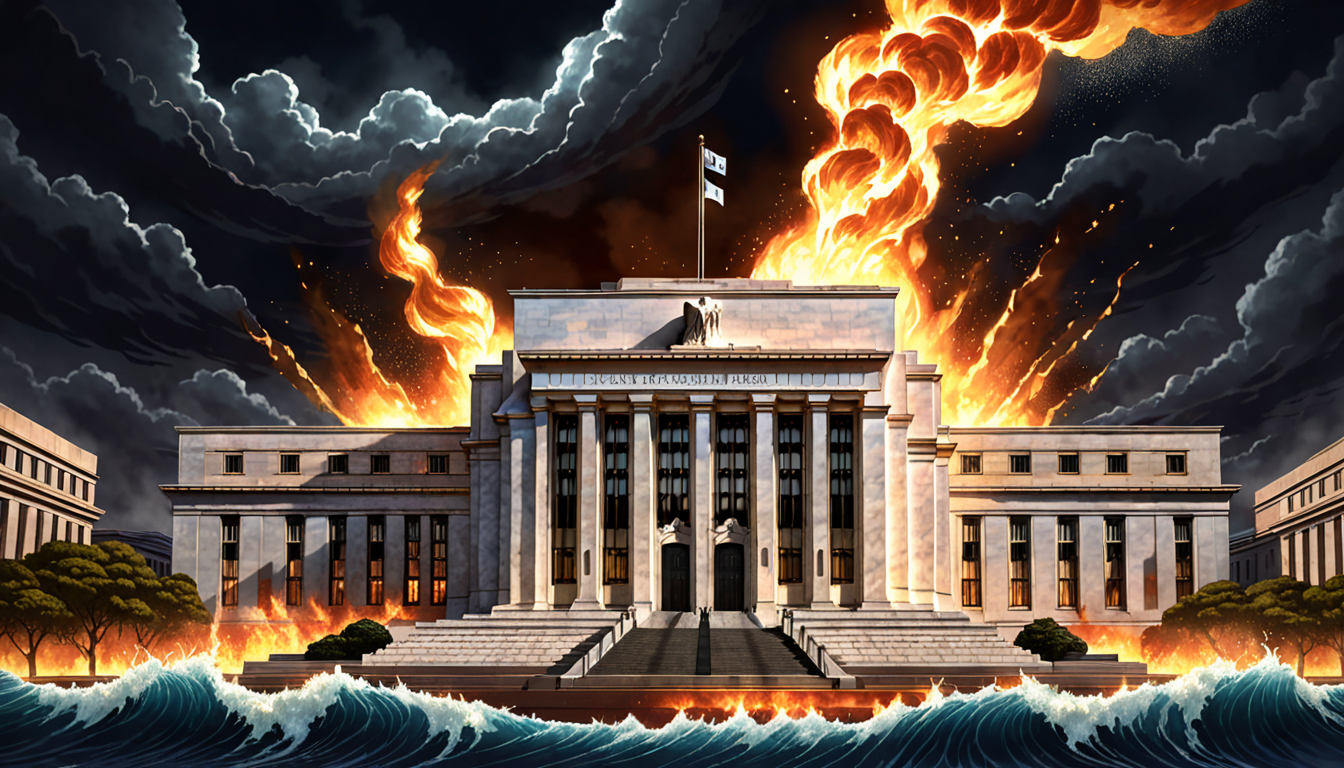
Three central banks, one week, zero cuts — how a war in the Persian Gulf killed the most anticipated monetary pivot in a generation
Executive Summary
- The Reserve Bank of Australia hiked rates for a second consecutive month to 4.10% on March 17 in a razor-thin 5-4 vote, making it the first G10 central bank to reverse course and actively tighten in response to the Iran war energy shock
- The Federal Reserve is virtually certain to hold at 3.50–3.75% on March 19, with its updated dot plot expected to eliminate any remaining 2026 rate cuts — market pricing has collapsed from three cuts to zero since February
- The Bank of Japan will hold at 0.75% on March 19 but Governor Ueda signaled inflation is "gradually accelerating toward 2%," setting the stage for an April hike as yen weakness compounds imported energy costs
- This single week marks the definitive death of the global easing cycle that began with Switzerland's surprise cut in March 2024 and spread across 40+ central banks — the broadest synchronized loosening since the post-GFC era
Chapter 1: The Canary Hikes Again — RBA's Split Decision
On March 17, Reserve Bank of Australia Governor Michele Bullock delivered what markets had already priced in but borrowers dreaded: a 25-basis-point hike to 4.10%, the second consecutive increase in as many months. What made the decision remarkable was not the outcome but the margin — five members voted to raise, four voted to hold. A single vote separated Australia from the rest of the developed world.
The slim majority laid bare the central banking dilemma of 2026: how to respond when a supply-side shock collides with demand-side overheating. Deputy Governor Andrew Hauser had tipped the bank's hand a week earlier, calling inflation "toxic" and signaling the board's determination to crush it regardless of origin. His hawkish posture reflected a deeper institutional conviction: that Australia's COVID-era strategy of shallower rate hikes had left the economy running hotter than peers, making it more vulnerable to external shocks.
The numbers justified the concern. Australian headline inflation was running at 3.8% annually before the war began on February 28. Brent crude's surge from $70 to above $116 per barrel had already pushed domestic fuel prices sharply higher, with NAB economists warning inflation could breach 5% next quarter if the conflict persisted. Treasury officials estimated that sustained $100 oil would add 0.5 percentage points to headline CPI, and $120 oil a full point.
But what made Australia's position unique among G10 economies was timing. The RBA had already been pivoting hawkish before the first bomb fell on Iran. Domestic demand was stronger than expected, the labor market had tightened, and capacity pressures were greater than previously assessed. The war simply accelerated a trajectory that was already forming — transforming a gradual policy normalization into an emergency response.
The 5-4 split vote, however, revealed the genuine uncertainty within the board. The four dissenters likely argued that raising rates to combat an external energy shock would do nothing to lower oil prices while crushing domestic demand. This is the textbook criticism of monetary tightening during supply shocks — a critique that echoes through every oil crisis since 1973. But the majority concluded that with inflation already above target and domestic demand running hot, the risk of entrenching inflationary expectations outweighed the risk of overtightening.
Historical Comparison: RBA as First Mover
| Central Bank | Feb 2026 Direction | March 2026 Action | Key Constraint |
|---|---|---|---|
| RBA (Australia) | Hiking | Hiked to 4.10% | Inflation 3.8%, demand overheating |
| Fed (US) | Holding | Expected hold 3.50–3.75% | Stagflation trap — NFP -92K, PCE 3.1% |
| BOJ (Japan) | Holding/hawkish | Expected hold 0.75% | Yen weakness, imported inflation |
| ECB (Eurozone) | Repricing | Expected hold/hike debate | Energy shock, TTF gas +86% |
| BOE (UK) | Holding | Expected hold | Gilt market stress, fiscal squeeze |
Australia has now hiked twice in 2026 while every other G10 central bank has either held or is debating whether to reverse from cuts to hikes. The RBA is the canary in the coal mine — and the coal mine is on fire.
Chapter 2: The Fed's Impossible Silence
When Chair Jerome Powell steps to the podium on Wednesday afternoon, he will face perhaps the most constrained communications challenge of his tenure — and the second-to-last of his chairmanship. The FOMC is all but certain to hold rates at 3.50–3.75%, a decision so widely expected that the rate itself barely matters. What markets will obsess over is the Summary of Economic Projections (SEP) and the infamous dot plot.
The macro backdrop is brutal. Q4 GDP was revised down to just 0.7%. The February jobs report showed an outright decline of 92,000 — the worst since the pandemic. Core PCE inflation sits at 3.1%, stubbornly above target. Oil prices are hovering near $100. The University of Michigan consumer sentiment index has collapsed to 55.5, with inflation expectations jumping to 3.9%.
This is the textbook definition of stagflation: growth stalling while prices accelerate. The Fed's dual mandate offers no escape — cutting rates would risk entrenching inflation expectations, while hiking would crater an already weakening labor market.
Before the Iran war, markets were pricing three rate cuts in 2026, with the first expected in June. That expectation has been annihilated. CME FedWatch now shows zero probability of a cut before September, with growing odds that the Fed won't cut at all this year. Some traders are even pricing a non-trivial probability of a hike by year-end.
The Dot Plot as Stagflation Map
The December 2025 dot plot showed a median expectation of one 25bp cut in 2026, already a significant downgrade from the four cuts projected in September 2025. The March update is expected to:
- GDP growth: Revised down from 2.1% to 1.0–1.5%, reflecting the energy shock and consumer pullback
- Core PCE inflation: Revised up from 3.0% to 3.2–3.3%, incorporating early war-driven price pass-through
- Unemployment: Revised up from 4.5% to 4.6–4.8%, acknowledging the labor market deterioration
- Dot plot: The median dot may show zero cuts for 2026, with a meaningful minority of participants penciling in a hike
For Powell, the communications challenge is acute. He cannot appear complacent about inflation without spooking bond markets. He cannot appear alarmed about growth without triggering a sell-off. And he must navigate the political minefield of a president who has publicly demanded rate cuts, a Department of Justice criminal investigation into his leadership, and the knowledge that his successor — Kevin Warsh — will inherit whatever framework he leaves behind.
"Powell's ability to guide markets depends on the extent to which they perceive his comments as representing the committee's consensus rather than his own views," Bank of America analysts noted. Even setting aside the lame-duck dynamic, "Powell will have his work cut out for him."
Chapter 3: Tokyo's Hawkish Patience
The Bank of Japan's March 18-19 meeting completes the trifecta. Governor Kazuo Ueda is widely expected to hold the policy rate at 0.75%, but his pre-meeting comments on March 17 were unmistakably hawkish: "Underlying inflation is gradually accelerating toward our 2% target," he declared, adding that convergence was expected "sometime from the latter half of fiscal 2026 through 2027."
Japan's predicament is a mirror image of Australia's, but with uniquely Japanese characteristics. The yen has weakened sharply as the dollar strengthened on safe-haven flows, pushing imported energy costs even higher for a country that depends on the Middle East for 75% of its oil and virtually all of its LNG. Food prices — particularly rice, which has surged 90% — have become a political crisis under Prime Minister Takaichi.
Yet the BOJ cannot easily hike. Takaichi's fiscal expansion — a record ¥122.3 trillion budget — is already straining JGB markets, with 30-year bond yields at 27-year highs. A rate hike would increase government borrowing costs at a time when Japan's debt-to-GDP ratio exceeds 260%. The yen carry trade, estimated at $1–4 trillion in leveraged positions, remains a systemic risk: an August 2024-style unwind triggered by a BOJ surprise could cascade through global markets.
The Japan Times captured the dilemma: "Though a rate hike is unlikely this month, if the yen's depreciation continues, pressure on the bank to act will likely grow at the next meeting in April." The BOJ is trapped between fiscal fragility and currency weakness, with no good options.
The Three-Way Monetary Divergence
What makes this week historically significant is not any single decision, but the pattern they form together. In a normal world, central banks facing the same global shock would move in broadly similar directions. Instead, March 2026 reveals a three-speed world:
-
The Hikers: RBA (4.10%), with ECB potentially joining. These banks see inflation as the primary threat and are willing to accept growth damage to maintain credibility.
-
The Frozen: Fed (3.50–3.75%), BOJ (0.75%), BOE. These banks are paralyzed by competing signals — stagflation for the Fed, fiscal-monetary conflict for the BOJ, gilt market stress for the BOE.
-
The Ghost Rate Cutters: Central banks that cut aggressively in 2024–2025 and now face the consequences of having eased into an inflationary shock — essentially every emerging market central bank that followed the Fed down.
This divergence has not been seen since 1973, when the OPEC oil embargo fractured the Bretton Woods monetary consensus and sent central banks scrambling in different directions. The result then was a decade of policy confusion, stagflation, and the eventual Volcker shock. The parallel is uncomfortably precise.
Chapter 4: How the Easing Cycle Died
The global easing cycle that is being interred this week had a specific birth certificate: March 21, 2024, when the Swiss National Bank surprised markets with a 25bp cut. Over the following 18 months, more than 40 central banks joined the cutting parade:
- March 2024: SNB first mover
- June 2024: ECB begins cutting
- September 2024: Fed delivers jumbo 50bp cut
- October 2024: BOC, RBNZ, Riksbank accelerate
- December 2024: ECB at 3.0%, Fed at 4.25–4.50%
- 2025: Cuts continue globally, Fed reaches 3.50–3.75% by December
- February 2026: RBA reverses, hiking to 3.85%
- March 2026: RBA hikes again; Fed, BOJ, ECB all frozen or reversing
The cause of death was not one factor but a convergence: the Iran war and Hormuz blockade created a supply-side energy shock; sticky services inflation proved more persistent than models predicted; fiscal expansion in Japan, the US (OBBBA), and Europe (rearmament) added demand-side heat; and the AI capital expenditure boom of $690 billion created a parallel inflationary impulse through energy and resource competition.
The Easing Cycle Timeline
| Date | Event | Significance |
|---|---|---|
| Mar 2024 | SNB cuts 25bp | Easing cycle begins |
| Sep 2024 | Fed cuts 50bp | Cycle's apex moment |
| Dec 2025 | Fed at 3.50–3.75% | Terminal rate reached |
| Feb 2026 | RBA hikes to 3.85% | First G10 reversal |
| Feb 28, 2026 | Iran war begins | Energy shock catalyst |
| Mar 17, 2026 | RBA hikes to 4.10% | Second consecutive hike |
| Mar 19, 2026 | FOMC zero-cut dot plot (exp.) | Easing cycle officially dead |
Chapter 5: Scenario Analysis — What Comes Next
Scenario A: Stagflationary Paralysis (50%)
Central banks remain frozen through 2026, unable to cut (inflation too high) or hike (growth too weak). The Fed holds at 3.50–3.75% for the rest of the year. BOJ delays its next hike until Q3. ECB reverses its cut trajectory but doesn't hike. Markets oscillate in a volatility corridor without trend.
Trigger conditions: Hormuz partially reopens within 6 weeks, oil settles at $85–95, inflation peaks at 3.5–4.0% in the US
Historical precedent: 1973–74, when the Fed under Arthur Burns held rates steady for months as stagflation worsened, ultimately losing credibility and requiring the Volcker shock five years later
Investment implications: Gold and commodities outperform. TIPS beat nominal bonds. Equities grind lower in the technology sector but HALO stocks (Heavy Assets, Low Obsolescence) — energy, industrials, utilities — outperform. The 60/40 portfolio continues to fail.
Scenario B: Emergency Tightening (25%)
The energy shock proves more persistent than expected. CPI breaches 4% in the US by Q2. The Fed is forced into a "Volcker lite" moment — a surprise 25bp hike — to re-anchor expectations. BOJ hikes to 1.0% in April. ECB follows with a 25bp hike. Global bond markets sell off sharply.
Trigger conditions: Hormuz remains blocked through May, oil sustains above $110, wage-price spiral begins in services
Historical precedent: Volcker's September 1979 emergency meeting, when the FOMC raised rates by 200bp in a single session after inflation expectations de-anchored
Investment implications: Long-duration bonds face significant losses. Equities enter correction territory, especially growth stocks. Dollar strengthens sharply, crushing emerging markets with dollar-denominated debt. Gold initially sells off (margin call liquidation) before rallying as the policy is seen as credibility-restoring.
Scenario C: War Resolution → Delayed Cuts (25%)
A ceasefire or de-escalation allows oil to retreat below $80 by Q2. The inflationary impulse fades. The Fed resumes its cutting path in September with a 25bp reduction, eventually reaching 3.0% by year-end. BOJ holds. RBA pauses but doesn't reverse.
Trigger conditions: Iran accepts ceasefire or IRGC collapses, Hormuz reopens, oil drops 30%+
Historical precedent: 1991 Gulf War, where oil spiked briefly then collapsed as the conflict proved short, allowing the Fed to cut through the year
Investment implications: Growth stocks recover. Bond rally resumes. Rotation back from HALO to technology. Emerging market equities surge on dollar weakness and lower energy costs.
Chapter 6: Investment Implications — The Great Repricing
Bond Markets: The Death of Duration
The simultaneous hawkish pivot across central banks has devastated bond portfolios. Bloomberg's Global Aggregate Bond Index has given back all its 2026 gains. US 10-year yields have risen to 4.26%, 30-year yields to 4.88%. The long end of the curve is pricing in both higher inflation expectations and a term premium that reflects fiscal uncertainty.
For the first time since the Volcker era, government bonds are failing to serve as a safe haven during a geopolitical crisis. This is the structural break that defines the current regime: when war pushes energy prices higher and fiscal deficits wider simultaneously, duration becomes a liability rather than a hedge.
Currency Markets: The Dollar Paradox
Despite all the talk of de-dollarization, the dollar has strengthened during the crisis — the classic safe-haven reflex. DXY has rebounded from its 2025 lows. But this strength is a double-edged sword: it crushes emerging market borrowers, tightens financial conditions globally, and makes US exports less competitive, worsening the trade deficit that triggered the SCOTUS IEEPA ruling.
The yen is the most vulnerable G10 currency. If BOJ fails to hike, further yen depreciation toward 160 could trigger intervention or a carry trade unwind. The Australian dollar, paradoxically, could strengthen as the RBA's hawkish stance attracts yield-seeking capital.
Equity Strategy: Atoms Over Bits
The sectoral implications are stark. The Great Rotation — from technology to physical assets — that began in January has accelerated. Energy is up 25% year-to-date. Materials are up 17.8%. Technology is down 3.7%. This is the mirror image of the 2020–2024 regime, when software ate the world. In 2026, the world is eating software.
HALO trade winners: Exxon Mobil, Chevron, Caterpillar, Deere, Nucor, Southern Company, NextEra Energy, Newmont, Barrick Gold, Rheinmetall, Hanwha Aerospace
Vulnerable: High-multiple SaaS stocks, consumer discretionary exposed to energy costs, airlines, emerging market importers
Gold: The Only Honest Asset
Gold at $5,169 per ounce tells a simple story: when governments print money, wage wars, and destroy institutional credibility simultaneously, the only asset without counterparty risk is the one that has served as money for 5,000 years. Central bank purchases — 16 consecutive months from the PBOC — confirm that the stewards of fiat currency trust metal more than paper.
Conclusion: The End of an Era
The week of March 17–19, 2026, will be remembered as the moment the post-pandemic monetary experiment ended. The global easing cycle that began with such hope in March 2024 — the promise that central banks had threaded the needle, defeating inflation without causing recession — has been killed by the oldest force in economics: a war over energy.
The RBA's lonely hawkishness, the Fed's paralysis, the BOJ's careful hedge — each response is rational in isolation. Together, they paint a picture of a monetary system that has lost its compass. In the absence of a clear global consensus, each central bank will chart its own course, and the divergence will widen.
For investors, the message is blunt: the era of cheap money is over, and the era of cheap energy may be too. What replaces them — stagflation, a new Volcker moment, or an improbable peace — will be determined not in central bank boardrooms but in the Strait of Hormuz, on the battlefields of Iran, and in the political calculations of leaders who have bet everything on the wrong side of history.
Sources: CNBC, Reuters, ABC Australia, Yahoo Finance, Bank of America, Russell Investments, SBS News, Japan Times, Investing.com, MarketPulse
Leave a Reply