
The deadliest urban attack in five years exposes the failure of a 16-year counterinsurgency — and the cost of global attention deficit
Executive Summary
- Multiple suicide bombings struck Maiduguri on March 16, killing dozens and wounding over 200 in the worst attack on the city since 2021 — shattering years of fragile calm in the Borno State capital
- The bombings followed a month-long escalation: over 100 soldiers killed in coordinated base assaults, jihadist regrouping after Sambisa Forest operations, and the deadliest Ramadan offensive in a decade
- The attacks expose a fundamental paradox: 200 US AFRICOM troops deployed just weeks ago have not deterred escalation, and global attention consumed by the Iran war creates a strategic window for Boko Haram and ISWAP to reclaim urban territory
Chapter 1: The Attacks — Three Bombs, One Message
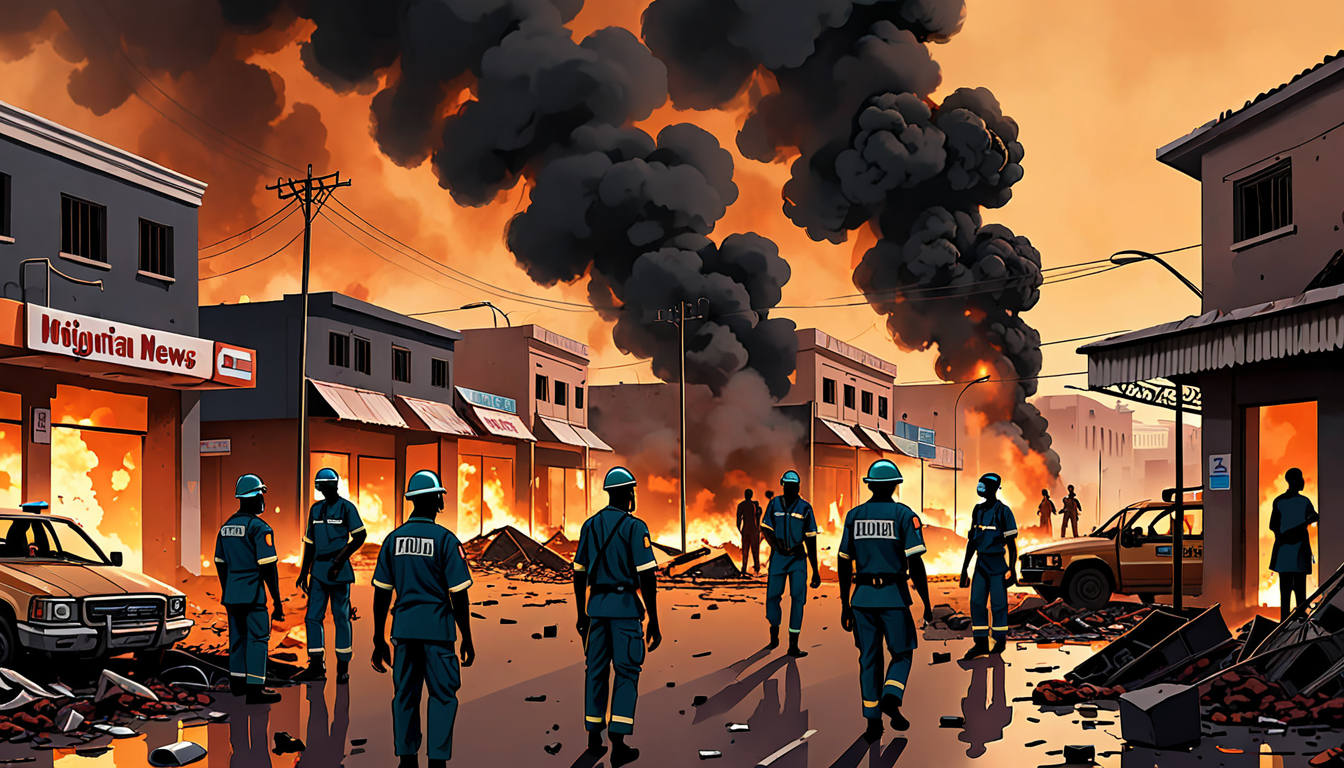
On the evening of Monday, March 16, 2026, Maiduguri — the capital of Borno State and the symbolic epicenter of Nigeria's 16-year jihadist insurgency — was rocked by at least three near-simultaneous explosions. The targets were deliberately chosen for maximum civilian impact: the Monday Market, one of the city's largest commercial hubs; the entrance to the University of Maiduguri Teaching Hospital (UMTH), where victims would naturally seek treatment; and the Post Office area, another busy commercial district.
Witnesses described scenes of carnage. Bagoni Alkali, who helped evacuate victims, told the Associated Press that "over 200 people have been injured and are receiving care in the accident and emergency department." Mohammed Hassan, a member of a civilian volunteer group that assists security forces, said he personally evacuated 10 bodies from the market sites alone. "This attack's been one of the deadliest in Maiduguri in years," he said.
The bombings were not isolated. They came on the heels of an overnight assault on a Nigerian military post in Ajilari Cross district, a southwestern suburb just kilometers from the airport, as well as a separate attack in Damboa local government area south of the city. Borno State police confirmed they had deployed explosives clearance teams to three locations following "suspected suicide bomb events" — the characteristic signature of Boko Haram operations.
No group immediately claimed responsibility. But the tactical pattern — coordinated suicide bombings against soft civilian targets, timed to coincide with military base assaults on the city's outskirts — bears the hallmarks of Boko Haram rather than its rival ISWAP, which has historically preferred military-on-military engagements.
Chapter 2: The Escalation — A Month of Blood
The Maiduguri bombings did not emerge from a vacuum. They represent the culmination of a dramatic month-long escalation across northeastern Nigeria that has shattered the illusion of progress in the counterinsurgency.
The Sambisa Blowback. In early March, the Nigerian military launched intensified operations in the Sambisa Forest, a vast woodland south of Maiduguri that has served as Boko Haram's primary stronghold since 2013. Governor Babagana Zulum explicitly linked the bombings to these operations, saying "the recent surge in attacks is not unconnected with intense military operations in the Sambisa forest." This is a pattern well-documented in counterinsurgency literature: aggressive clearing operations that dislodge fighters without destroying them often simply redirect violence toward softer urban targets.
The Bloodiest Week. In the first week of March, coordinated attacks on multiple Nigerian military bases across Borno State killed over 100 soldiers in what one analysis called "Nigeria's bloodiest week." On the night of March 5, ISWAP fighters launched simultaneous assaults on several bases, killing at least 14 people including 10 soldiers. The military confirmed these as "coordinated attacks" — suggesting a level of planning and intelligence capability that undermines claims of jihadist decline.
The Ramadan Factor. The attacks fall during Ramadan, with the end-of-fast Eid celebrations expected this week. Historically, jihadist groups in the Sahel and Lake Chad Basin have intensified operations during Ramadan, framing violence as religiously meritorious. The 2015 Maiduguri mosque bombing during Ramadan prayers killed over 50 people. The timing of the March 16 attacks — striking markets where Ramadan preparations were underway — is consistent with this pattern of maximizing both casualties and psychological impact.
The December Warning. A December 2025 mosque bombing in Maiduguri killed seven people, the first significant urban attack in years. That should have been treated as a warning signal that the city's security perimeter was degrading. Instead, it appears to have been dismissed as an isolated incident.
Chapter 3: The US Deployment Paradox
The Maiduguri bombings carry an additional layer of significance: they occurred just weeks after the United States began deploying troops to northeastern Nigeria. In February 2026, an advance team of approximately 100 US soldiers arrived in the northeastern area of Bauchi, with AFRICOM indicating that 200 troops were expected to join the deployment overall. The mission was described as providing "technical and training support" — not direct combat operations.
This deployment followed a December 2025 US air strike in Sokoto State, conducted in coordination with Nigerian authorities, and was framed by the Trump administration through the lens of "Christian persecution" — a characterization disputed by Nigeria's government and independent analysts who note that both Christians and Muslims are victims of the country's security crises.
The immediate policy question is uncomfortable: has the US military presence, intended to strengthen Nigerian counterinsurgency capability, inadvertently provided an additional propaganda target for jihadist recruitment? Boko Haram's founding ideology explicitly opposes Western education and Western military influence. The arrival of American soldiers — regardless of their actual role — provides a powerful narrative tool.
More fundamentally, the deployment was predicated on the assumption that Nigeria's insurgency was a "training problem" — that Nigerian forces lacked the technical capacity to defeat a degraded insurgency. The March escalation suggests otherwise. The problem is not that Nigerian soldiers cannot fight; it is that the underlying conditions driving recruitment, radicalization, and community support for armed groups remain unaddressed after 16 years of military operations.
Historical Parallel: The Mali Template. France's Operation Barkhane in the Sahel (2014-2022) provides a cautionary precedent. Despite deploying thousands of troops and conducting thousands of strikes, France failed to contain the jihadist insurgency, which actually expanded during the intervention. The US deployment to Nigeria, though far smaller in scale, risks replicating the same pattern: military assistance that addresses symptoms while leaving root causes — governance failures, economic marginalization, and the collapse of livelihoods around Lake Chad — untouched.
Chapter 4: The Attention Arbitrage
The timing of the Maiduguri bombings is impossible to separate from the broader global context. The attacks occurred on Day 17 of the US-Israel war on Iran, as the FOMC opened its March 17-18 meeting, and as Nvidia's GTC 2026 keynote dominated technology coverage. Global media bandwidth for African security stories was, to put it bluntly, close to zero.
This phenomenon — what security analysts call "attention arbitrage" — is not accidental. Armed groups have historically exploited periods of reduced international scrutiny to escalate operations. ISIS expanded rapidly in 2014 while the world focused on the Ukraine crisis. Al-Shabaab stepped up attacks during the early COVID-19 pandemic. The Iran war, which has consumed virtually all diplomatic and media oxygen since February 28, creates an ideal strategic window for Nigeria's jihadist groups.
The consequences are practical, not just theoretical. Intelligence-sharing between Western agencies and Nigerian forces may be degraded as assets are redirected toward the Iran theater. The 200 US troops in Nigeria's northeast are drawing from the same AFRICOM command structure that is simultaneously managing evacuations and security across the Middle East and North Africa. And the diplomatic attention needed to pressure neighboring countries — Chad, Cameroon, Niger — to maintain their own counterinsurgency contributions around Lake Chad has evaporated.
Chapter 5: Nigeria's Structural Security Crisis
The 16-year Boko Haram insurgency has killed more than 40,000 people and displaced roughly 2 million — numbers that rival the human toll of many conflicts that receive far greater international attention.
| Indicator | Data |
|---|---|
| Insurgency duration | 16 years (2009-present) |
| Total deaths | 40,000+ |
| Displaced persons | ~2 million |
| Active jihadist groups | 2 (Boko Haram + ISWAP) |
| Nigerian military killed (March 2026) | 100+ |
| US troops deployed | ~200 |
| Borno State poverty rate | ~70% |
| Youth unemployment (NE Nigeria) | ~50% |
The structural drivers of the insurgency have not fundamentally changed. Borno State remains one of Nigeria's poorest regions. The Lake Chad Basin, which once sustained millions of farmers and fishermen, has shrunk by approximately 90% over the past six decades due to overuse and climate change. Youth unemployment in northeastern Nigeria hovers around 50%. The Civilian Joint Task Force (CJTF) — volunteer militias that helped push Boko Haram out of Maiduguri in 2013-2015 — are aging, under-resourced, and increasingly reluctant to serve without adequate compensation.
Meanwhile, the Boko Haram-ISWAP split, which occurred in 2016, has paradoxically made the threat more complex. ISWAP, which swore allegiance to the Islamic State, has pursued a more strategically sophisticated approach — providing governance services in areas it controls, taxing local populations, and preferentially targeting military rather than civilian targets. Boko Haram under Abubakar Shekau's successor leadership has continued its campaign of mass-casualty civilian attacks. Nigerian forces must fight two distinct organizations with different tactics, while both compete to demonstrate capability through spectacular operations.
Chapter 6: Scenario Analysis
Scenario A: Contained Flare-Up (30%)
Premise: The Maiduguri bombings represent a retaliatory surge following Sambisa operations that subsides as military pressure continues.
Evidence: Previous surges (2017, 2019) followed a similar pattern of dramatic urban attacks followed by military response and return to rural guerrilla warfare. The Nigerian military's immediate response — repelling the overnight infiltration attempt — suggests the security cordon is damaged but not collapsed.
Trigger: Successful Nigerian military operations in coming weeks that disrupt the cell responsible for the bombings.
Timeline: 4-8 weeks to return to pre-March security baseline.
Scenario B: Sustained Urban Campaign (45%)
Premise: The March attacks signal a strategic shift by Boko Haram/ISWAP toward reclaiming urban reach, exploiting the Iran war's distraction effect.
Evidence: The escalation has been systematic: rural base attacks → December mosque bombing → March triple bombing. Each step has tested and found weaknesses. Governor Zulum's admission that "intense military operations" drove the attacks suggests a displacement effect, not a degradation of capability. With Ramadan concluding and displaced fighters regrouping, the operational tempo may increase.
Historical Parallel: The 2014-2015 Boko Haram urban campaign, during which the group seized and held territory including 20+ local government areas, began with a similar pattern of probing attacks before a full offensive.
Trigger: Additional attacks on urban targets in Maiduguri, Yola, or other northeastern cities within the next 30 days.
Timeline: Escalating violence through Q2 2026.
Scenario C: Wider Regional Contagion (25%)
Premise: Nigeria's security deterioration triggers cross-border effects in the Lake Chad Basin, particularly as neighboring states reduce counterinsurgency contributions.
Evidence: Niger, which expelled French forces in 2023 and US forces in 2024, has seen its own jihadist violence intensify. Chad's military, historically the most capable force in the region, has been distracted by political transition and economic pressures from rising fuel costs linked to the Iran war. Cameroon's Far North region faces persistent Boko Haram incursions. The Multinational Joint Task Force (MNJTF) has been ineffective for years.
Trigger: A major cross-border attack or the collapse of security cooperation in one of the four MNJTF contributing nations.
Timeline: 3-6 months.
Chapter 7: Investment and Strategic Implications
Defense and Security. The Nigerian government's defense spending, already strained, will face upward pressure. The 2026 budget allocated ₦4.91 trillion ($3.1 billion) to defense, but supplementary appropriations are likely if the escalation continues. International defense contractors with Nigeria relationships — including Turkey (Bayraktar drones), China (armored vehicles), and the US (training and intelligence) — may see expanded orders.
Oil and Gas. Nigeria is Africa's largest oil producer and OPEC member. While the northeastern insurgency does not directly threaten southern oil infrastructure, the broader security environment affects investor confidence. The Dangote Refinery, which recently exceeded design capacity, provides some insulation from the Iran war-driven energy crisis, but infrastructure attacks — even far from the Niger Delta — raise the overall country risk premium.
Agriculture and Food Security. Northeastern Nigeria is already one of the world's most food-insecure regions. The UN estimates that 4.4 million people in the northeast face crisis-level food insecurity. Disruption to farming cycles from the insurgency, combined with global food price inflation from the Hormuz blockade and fertilizer supply disruption, creates a compounding humanitarian emergency.
The Broader Sahel Pattern. The Maiduguri bombings fit within a wider pattern of security deterioration across West Africa's Sahel belt: military coups in Mali, Burkina Faso, and Niger; expanding jihadist influence; declining Western military presence; and growing Russian and Chinese engagement. For investors in West African markets, the escalation serves as a reminder that the region's security challenges are structural, not cyclical.
Conclusion
The explosions that tore through Maiduguri's markets and hospital entrance on March 16 were not merely acts of terror against civilians. They were a strategic message: after 16 years of military operations, billions of dollars in spending, and the recent arrival of American troops, Nigeria's jihadist insurgency retains the capability and willingness to bring devastating violence to urban centers.
The world's attention is elsewhere — consumed by the fires of the Iran war, the deliberations of the FOMC, and the spectacle of Nvidia's GTC. But for the people of Maiduguri, preparing for Eid celebrations under the shadow of suicide bombers, the attention deficit is itself a security threat. In the economy of global crises, some tragedies are simply not expensive enough to matter.
Sources: AFP, Associated Press, Al Jazeera, France 24, Washington Post, NEMA, Ujasusi Intelligence
Leave a Reply