
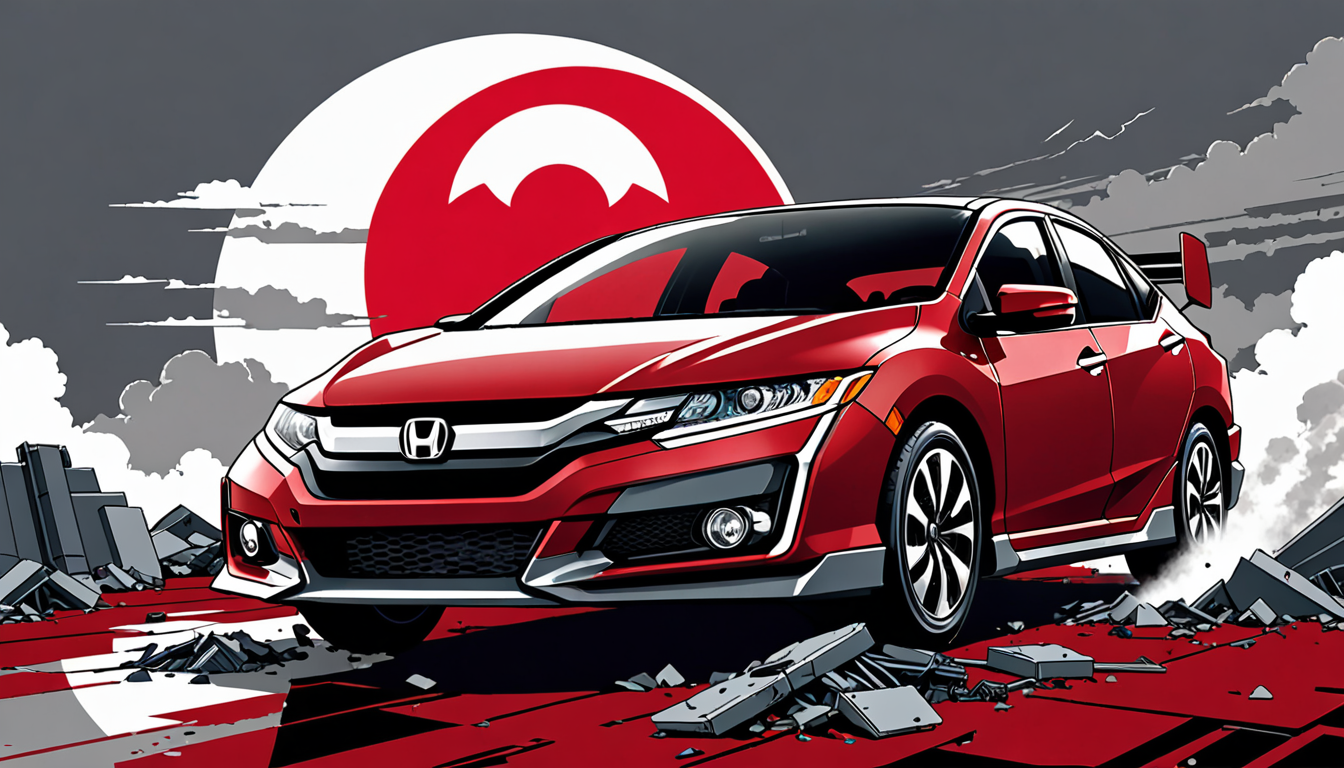
How Japan's second-largest automaker became the latest casualty of the EV transition—and why the real crisis is in China
Executive Summary
- Honda has announced a $15.7 billion (¥2.5 trillion) writedown of its EV business, triggering its first annual loss in nearly 70 years as a listed company—the most dramatic strategic reversal by a legacy automaker since the EV era began.
- Three flagship EV models—the Honda 0 Saloon, Honda 0 SUV, and Acura RSX—have been cancelled outright, just months before their planned U.S. launch, marking the death of Honda's "0 Series" vision first unveiled at CES 2024.
- The damage extends well beyond EVs: Honda's China operations face a separate existential crisis, with domestic competitors like BYD delivering vehicles with superior technology at lower prices, leaving Honda with just 17,000 EV sales in the world's largest auto market last year.
Chapter 1: The Scale of the Collapse
Honda Motor Co. has done something it has never done in its 70-year history as a publicly traded company: reported an annual loss. The numbers are staggering. The Japanese automaker expects operating losses between ¥270 billion and ¥570 billion ($1.7–3.6 billion) for the fiscal year ending March 2026, driven by a massive restructuring of its electric vehicle strategy. Total financial impact, including asset impairments, supplier compensation, development write-offs, and equity-method losses from China joint ventures, could reach ¥2.5 trillion—approximately $15.7 billion.
The immediate trigger was the cancellation of three vehicles that were supposed to be Honda's EV future: the Honda 0 Saloon, Honda 0 SUV, and Acura RSX. These models, first showcased at the Consumer Electronics Show in January 2024 as part of the ambitious "Honda 0 Series," were designed to signal Honda's transition into the electric age. Mass production was supposed to begin this year.
Instead, on March 12, Honda pulled the plug. "This decision was taken at an extremely delicate stage, just before mass production, after substantial budgets had already been committed—suggesting that it was a very tough call," noted Seiji Sugiura of Tokai Tokyo Intelligence Laboratory. The cash outflows will largely go toward compensating suppliers who had already tooled up for production that will now never happen.
Battery-powered cars accounted for just 2.5% of Honda's 3.4 million global vehicle sales last year—approximately 84,000 units. For a company that invested billions in bespoke EV platforms, this is a damning verdict from the market.
Chapter 2: The Triple Squeeze—Tariffs, Demand, and China
Honda's retreat is not a failure of engineering ambition alone. Three forces converged simultaneously to make the EV strategy untenable.
Force 1: Trump's tariff regime. The U.S. administration has imposed punishing duties on imported vehicles and parts, while simultaneously pulling back the tax credits (under the Inflation Reduction Act) that once incentivized consumers to buy EVs. Honda's gasoline and hybrid vehicle business—the profitable core that was supposed to subsidize the EV transition—has itself come under margin pressure from tariff-inflated supply chain costs. The company described its automotive division as operating in "an extremely challenging earnings environment."
Force 2: The hybrid backlash. Consumer preferences in the United States have shifted decisively toward hybrids. High EV sticker prices, range anxiety, and still-inadequate charging infrastructure have slowed adoption below what automakers projected just two years ago. Toyota, Honda's crosstown rival, looks prescient for having maintained its hybrid-centric strategy even as critics called it behind the times. Honda is now pivoting to mirror Toyota's approach, planning to expand its hybrid lineup aggressively in the U.S. market.
Force 3: China's EV juggernaut. This is the most structurally threatening force of all. In China—the world's largest auto market and the epicenter of EV innovation—Honda sold just 17,000 electric vehicles last year out of approximately 677,000 total units. That is a 2.5% EV share in a market where domestic champions like BYD, NIO, and XPeng are setting the pace with shorter development cycles, superior software integration, and aggressive pricing. Honda admitted openly that it "was unable to deliver products that offer value for money better than that of newer EV manufacturers."
China joint venture losses alone are projected at ¥110–150 billion ($700 million–$940 million). This is not merely a product problem. It is a structural competitive disadvantage. Chinese EV companies have built vertically integrated supply chains—BYD manufactures its own batteries, chips, and even semiconductor components—while Honda remains dependent on external suppliers and slower development timelines inherited from the internal combustion era.
Chapter 3: The Broader Industry Reckoning
Honda is not alone. Its writedown joins a growing list of legacy automaker capitulations:
| Automaker | EV Writedown/Loss | Year |
|---|---|---|
| Stellantis | $26.5 billion | 2025–26 |
| Ford | $19.5 billion | 2024–26 |
| Honda | $15.7 billion | 2026 |
| Volkswagen | $6 billion | 2025 |
| GM | $6 billion | 2025 |
| Lamborghini | Cancelled first EV | 2026 |
| Aston Martin | 20% workforce cut | 2026 |
The cumulative toll now exceeds $75 billion in EV-related losses and restructuring charges across the traditional auto industry—a figure that continues to climb. Lamborghini recently scrapped its first-ever EV launch, calling development an "expensive hobby."
The pattern is consistent: legacy automakers invested heavily in bespoke EV platforms during the 2021–2023 period of peak EV hype, only to find that consumer adoption—especially in the U.S.—lagged far behind projections. The vehicles were too expensive, the charging infrastructure too sparse, and the software too primitive compared to purpose-built EV companies.
Meanwhile, BYD sold 4.27 million vehicles globally in 2025, surpassing all legacy automakers to become the world's largest EV manufacturer. Its average selling price in China is roughly $15,000—a price point that no Western or Japanese automaker can match.
Chapter 4: Scenario Analysis—What Comes Next for Honda
Scenario A: Successful Hybrid Pivot (35%)
Rationale: Honda possesses world-class hybrid technology. The Civic Hybrid and CR-V Hybrid are already among the best-selling vehicles in the U.S. market. If the company can rapidly expand its hybrid lineup while controlling costs from the writedown, it could stabilize profits within 12–18 months.
Historical precedent: Toyota maintained its hybrid-first strategy throughout the EV hype cycle and now enjoys superior profitability. Honda could follow this path, albeit from a weaker starting position.
Trigger conditions: U.S. hybrid demand remains strong; tariff regime stabilizes; Honda controls supplier compensation costs within ¥1.5 trillion.
Scenario B: Protracted Margin Compression (45%)
Rationale: The $15.7 billion hit destroys Honda's balance sheet flexibility at precisely the wrong moment. With the Iran war driving energy costs higher, consumer spending weakening, and the FOMC signaling higher-for-longer rates, Honda faces a prolonged period of below-trend profitability. China joint ventures continue bleeding cash as BYD and Geely gain market share.
Historical precedent: Nissan's 2019–2023 "performance recovery plan" under cost-cutting CEO Makoto Uchida—a multi-year slog of factory closures, model cancellations, and margin rebuild that still hasn't restored the company to peak profitability.
Trigger conditions: U.S. auto demand slows due to stagflation; China EV competition intensifies; the cancelled Nissan merger leaves Honda without scale advantages.
Scenario C: Existential Threat—Honda Retreats from China (20%)
Rationale: Honda's China sales have collapsed from a peak of 1.56 million in 2020 to approximately 677,000 in 2025. If this trajectory continues—and there is every reason to think it will as Chinese domestic brands push deeper into the $15,000–$25,000 segment—Honda may face the same decision Mitsubishi made when it effectively exited the Chinese market. A full retreat from China would reduce Honda's global scale by 20%, undermining its ability to amortize R&D costs across a large vehicle base.
Historical precedent: Suzuki's 2018 exit from China, Mitsubishi's 2023 effective withdrawal. Both companies became more niche and lower-margin as a result.
Trigger conditions: China sales fall below 500,000 units; joint venture losses exceed ¥200 billion annually; Chinese government imposes additional restrictions on foreign automakers.
Chapter 5: Investment Implications
Losers:
- Honda (7267.T / HMC): Stock already down ~7% on the announcement. The writedown destroys near-term earnings, and the pivot to hybrids—while strategically sound—will take 2–3 years to fully execute. Dividend maintained for now, but free cash flow will be severely constrained.
- Legacy automaker EV suppliers: Companies that tooled up for Honda's cancelled vehicles face their own write-offs. Panasonic (6752.T), which supplies batteries for multiple Japanese OEMs, faces demand headwinds.
- Japanese auto parts sector: Denso, Aisin, and other keiretsu suppliers are exposed to Honda's restructuring and the broader retreat from aggressive EV timelines.
Winners:
- Toyota (7203.T / TM): Every Honda retreat validates Toyota's hybrid-first strategy. Toyota's operating margins are among the highest in the industry precisely because it refused to over-invest in bespoke EV platforms.
- BYD (1211.HK / BYDDY): The structural winner of the global EV transition. BYD's 5-minute MegaWatt charging network, vertical integration, and sub-$15,000 vehicles make it the company that Honda openly admits it cannot compete with.
- Chinese EV supply chain: CATL (300750.SZ), BYD components, and companies supplying the Chinese auto ecosystem benefit as market share transfers accelerate.
- Hybrid component makers: Companies supplying hybrid powertrains—transmissions, power electronics, small battery packs—benefit from the industry's renewed hybrid focus.
Conclusion
Honda's $15.7 billion writedown is more than a financial footnote. It is the clearest signal yet that the EV transition will not be led by the companies that dominated the internal combustion era. Japan's second-largest automaker, with seven decades of unbroken profitability behind it, has been forced to admit that it cannot build electric vehicles that consumers want to buy—not in America, and especially not in China.
The tragedy is one of timing and miscalculation. Honda invested billions in a bespoke EV platform during the peak of electrification optimism, only to discover that consumers weren't ready and that Chinese competitors had already seized the technological high ground. The company now finds itself pivoting back to hybrids—the very technology it should have doubled down on from the start.
For global investors, the lesson is stark: in the EV era, vertical integration and software capability matter more than brand heritage. The companies winning this transition—BYD, Tesla, CATL—built their supply chains from scratch. The companies losing it—Honda, Stellantis, Ford—tried to bolt electric drivetrains onto organizations designed for a different century.
Honda will survive. It remains the world's largest motorcycle manufacturer, its hybrid technology is genuinely excellent, and its balance sheet, while wounded, retains sufficient reserves to weather the storm. But the dream of Honda as an EV leader died on March 12, 2026—buried under $15.7 billion in write-offs and the wreckage of three vehicles that will never be built.
Sources: Reuters, Fox Business, Serrari Group, Japan Industry News, Tokai Tokyo Intelligence Laboratory, Honda Motor Co. investor relations.
Leave a Reply