
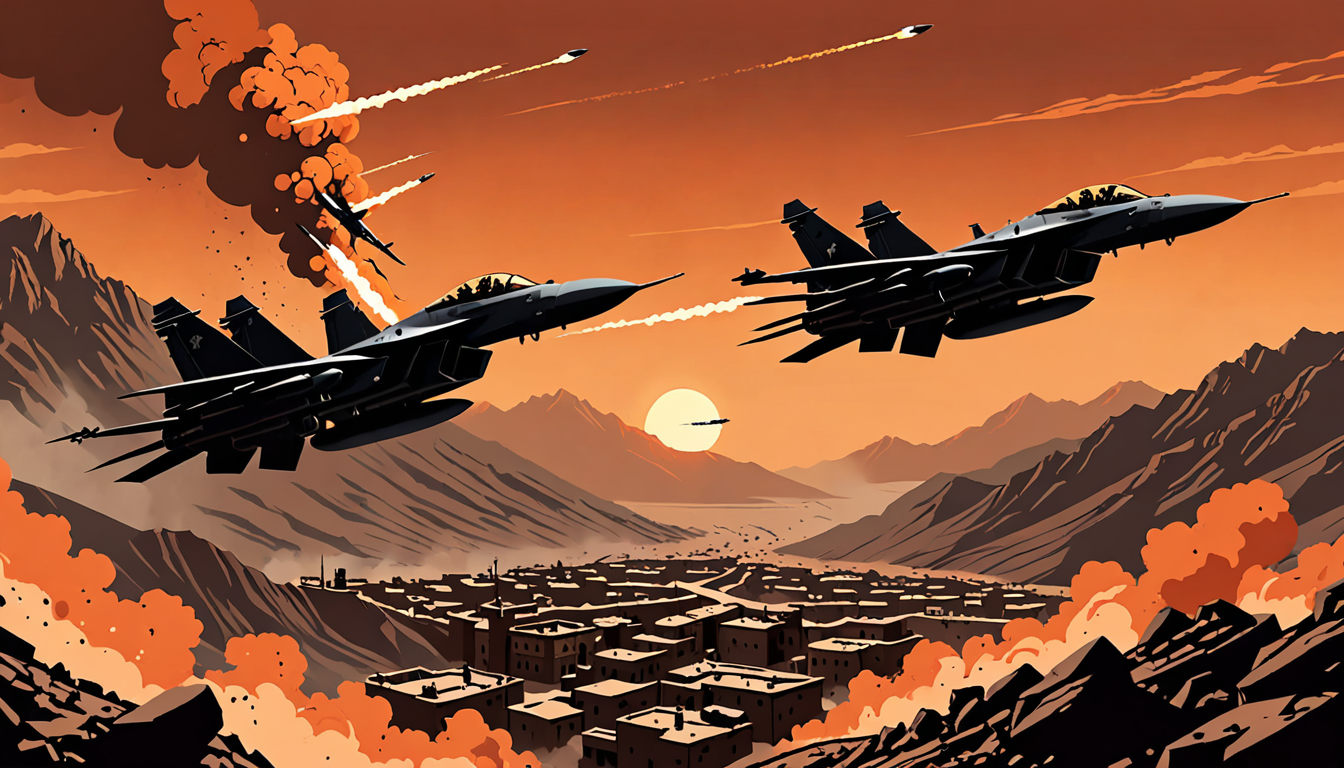
A precision raid on Camp Gecko marks the most significant leadership assassination attempt in South Asia since Bin Laden — with implications that could reshape the entire region
Executive Summary
- Pakistan's Air Force launched a precision strike on Camp Gecko in Kandahar on March 14, reportedly targeting Taliban Supreme Leader Haibatullah Akhundzada — the most significant leadership decapitation attempt in the region since the 2011 Bin Laden raid
- The strike killed at least 22 of Akhundzada's elite "Red Unit" security detail and destroyed surface infrastructure, but the Taliban leader's subterranean bunker may have shielded him — his status remains unconfirmed as both sides wage parallel information warfare
- The operation represents a deliberate escalation in the 18-day Afghanistan-Pakistan war unfolding in the shadow of the Iran conflict, raising the specter of a nuclear-armed state in open war with its neighbor while its primary ally, the United States, is consumed by a separate Middle Eastern conflagration
Chapter 1: The Strike — Camp Gecko and the Ghost of Kandahar
In the predawn hours of March 14, 2026, Pakistani F-16 fighter jets crossed into Afghan airspace and unleashed a series of precision munitions on Camp Gecko, a high-security compound in Kandahar province that has served as the operational nerve center for Taliban leadership since the movement's founding. The facility, originally constructed during the Taliban's first rule in the 1990s and later repurposed as a U.S. Special Forces base during the 20-year occupation, had reverted to its original owners after the American withdrawal in 2021.
Camp Gecko is no ordinary military installation. Located roughly one kilometer from the personal residence of Haibatullah Akhundzada — the Taliban's reclusive Supreme Leader who has governed Afghanistan since 2016 — the compound houses the movement's most sensitive command-and-control infrastructure. Intelligence reports indicate that Akhundzada had been maintaining a temporary residence within the facility for several weeks prior to the strike, making it the most high-value target Pakistan has ever attempted to hit.
The initial results were devastating on the surface. At least 22 personnel were killed, most believed to be members of the Taliban's elite "Red Unit," the special security apparatus tasked with protecting the supreme leader's inner sanctum. More than 50 others were wounded. Local residents reported seeing jet planes circling the mountain where the military facility sits, followed by explosions and visible flames.
Pakistan's state-run television confirmed the operation, stating that forces "effectively destroyed technical support infrastructure and an equipment storage facility" used by the Taliban for cross-border attacks. In a separate strike, Pakistani forces targeted a tunnel complex in Kandahar housing Taliban technical equipment and infrastructure linked to Fitna al-Khawarij — Islamabad's designation for the Pakistani Taliban (TTP).
But the critical question — whether the strikes actually killed or wounded Akhundzada — remains unanswered. The Taliban's defensive architecture includes deep underground bunkers specifically designed to withstand conventional aerial bombardment. While surface structures at Camp Gecko suffered "catastrophic damage," security analysts suggest the subterranean levels may have protected the primary target.
Former CIA officer Sarah Adams publicly claimed that Pakistan's military launched a "targeted strike on the hiding location" of Akhundzada, lending credibility to the decapitation thesis. Yet the Taliban issued a fierce denial within hours, dismissing the reports as "fabricated psychological warfare" and asserting that "Alhamdulillah, nothing has happened." The Taliban spokesperson mocked Pakistan's military capabilities, stating that "if the United States failed to eliminate their leadership over two decades, its regional neighbors would similarly fail no matter if a hundred years pass."
Chapter 2: The Road to Camp Gecko — How Pakistan-Afghanistan Reached Open War
The Camp Gecko strike did not emerge from a vacuum. It represents the culmination of an 18-day military escalation that has transformed the historically fraught Pakistan-Afghanistan relationship into outright interstate war — a development largely overshadowed by the simultaneous Iran conflict that erupted just two days later.
The immediate trigger came on February 22, 2026, when Pakistan launched airstrikes on targets in Afghanistan's Nangarhar and Paktika provinces, claiming to target TTP and ISKP (Islamic State Khorasan Province) hideouts sheltering on Afghan soil. Afghanistan's Taliban government condemned the strikes as sovereign violations and launched retaliatory operations, including drone attacks on Pakistani territory.
The escalation followed a pattern of increasingly violent border clashes along the Durand Line — the 2,640-kilometer colonial-era boundary that neither Afghanistan nor any of its governments has ever formally recognized. Pakistan launched "Operation Ghazab Lil Haq" (Wrath of Justice) in response, marking the first time Islamabad formally declared military operations against the Taliban government as an institution, rather than merely non-state actors.
The casualty toll has mounted rapidly. According to UN data, 185 civilian casualties — including 56 deaths from indirect fire and aerial strikes — were reported in Afghanistan between February 26 and March 5 alone. Some 99 people from both sides, including soldiers and civilians, have been killed in direct clashes. The UNHCR estimates approximately 115,000 people have been displaced.
The strategic context is crucial. Pakistan accuses the Taliban government of harboring TTP fighters who conduct attacks inside Pakistani territory, as well as providing sanctuary for ISKP operatives. The Taliban denies both charges. But the deeper driver is Pakistan's existential frustration with a neighbor that has become an ungovernable source of cross-border terrorism — precisely the role Afghanistan played for decades, only now under a Taliban government that Pakistan itself helped create.
The timing is no coincidence. With American attention consumed by the Iran war — Operation Epic Fury is now in its 16th day — Pakistan faces what analysts call an "attention arbitrage" opportunity. Washington's diplomatic bandwidth is stretched to breaking, creating space for Islamabad to pursue aggressive military options that would normally draw immediate American intervention or condemnation.
Chapter 3: The Decapitation Doctrine — Historical Precedents and Strategic Logic
Pakistan's apparent targeting of Akhundzada places it in a long and controversial tradition of leadership decapitation as a military strategy. The track record of such operations is decidedly mixed, offering both cautionary tales and occasional success stories.
The most obvious parallel is the U.S. raid that killed Osama bin Laden in Abbottabad, Pakistan in May 2011. That operation succeeded in eliminating al-Qaeda's founder but did not destroy the organization, which fragmented into regional affiliates that arguably became more diffuse and harder to combat. The irony is not lost on analysts that Pakistan — which was both humiliated and implicated by the bin Laden raid — is now attempting its own version of the same strategy.
| Historical Precedent | Target | Outcome | Organizational Impact |
|---|---|---|---|
| Abbottabad 2011 | Osama bin Laden (al-Qaeda) | Killed | Organization fragmented, affiliates multiplied |
| Qasem Soleimani 2020 | IRGC Quds Force commander | Killed | Iran escalated, then negotiated; successor less capable |
| Abu Bakr al-Baghdadi 2019 | ISIS caliph | Killed | ISIS weakened but not destroyed; insurgency continued |
| Ahmed Yassin 2004 | Hamas founder | Killed | Hamas radicalized, eventually took Gaza |
| Yahya Sinwar 2024 | Hamas leader | Killed | Hamas maintained operational capability |
| Akhundzada 2026 (alleged) | Taliban Supreme Leader | Unconfirmed | — |
The strategic logic behind targeting Akhundzada specifically reflects Pakistan's assessment that the Taliban's governance model is uniquely dependent on a single charismatic-religious authority. Unlike secular insurgent organizations where leadership succession follows bureaucratic or military logic, the Taliban's governing philosophy — Velayat-e Faqih's Sunni equivalent — concentrates religious, political, and military authority in the Supreme Leader (Amir al-Mu'minin). Removing Akhundzada could theoretically trigger a succession crisis that fractures the Taliban into competing factions, weakening its ability to project power across the border.
However, the Taliban has survived leadership transitions before. When founder Mullah Omar's death was revealed in 2015 (he had actually died in 2013), the movement initially fractured but ultimately coalesced around Akhundzada within a year. The Taliban's institutional resilience and tribal coalition structure provide redundancy that pure decapitation strategies struggle to overcome.
Chapter 4: The Nuclear Shadow — Why This Conflict Terrifies the World
What distinguishes the 2026 Afghanistan-Pakistan war from previous border conflicts is the nuclear dimension. Pakistan maintains an estimated arsenal of 170 nuclear warheads — the world's sixth-largest stockpile — and its nuclear doctrine explicitly contemplates use against existential threats.
While no analyst seriously suggests nuclear use in the current conflict, the escalation ladder is dangerously compressed. Pakistan's military has been fighting on what amounts to five simultaneous fronts: the Afghan border, Baluchistan separatists (BLA), ISKP attacks in urban centers, the Indian standoff on the eastern border, and managing spillover from the Iran conflict along its western frontier.
The Camp Gecko strike represents a qualitative escalation that crosses several thresholds. Targeting a head of state — even one as reclusive and unrecognized as Akhundzada — violates fundamental norms of interstate relations. If confirmed as a deliberate assassination attempt, it would mark the first time a state with nuclear weapons has attempted to kill the leader of a neighboring state since India allegedly considered targeting Pakistani leadership during the 1999 Kargil crisis.
Pakistan's domestic situation adds another layer of volatility. Former Prime Minister Imran Khan remains imprisoned, having reportedly lost 85% of his vision due to what his supporters call institutional medical neglect. The military establishment under Army Chief General Munir effectively controls national security policy, with civilian oversight reduced to a formality. The IMF's 24th bailout program — Pakistan's economic lifeline — is now at risk as defense expenditures balloon.
India has been quick to exploit the situation diplomatically. New Delhi condemned the Pakistani strikes on Afghan territory, calling for respect of Afghanistan's "sovereignty and territorial integrity" — a rhetorical position that aligns India with the Taliban government against Pakistan's military establishment, a remarkable reversal of historical alignments.
Chapter 5: Scenario Analysis — What Happens Next
Scenario A: Controlled Escalation and Mediation (30%)
Rationale: China, Saudi Arabia, and Iran (to the extent its post-Khamenei leadership functions) have strong interests in preventing the conflict from spiraling. China's Belt and Road investments in Pakistan ($62 billion CPEC) and its strategic relationship with the Taliban government provide unique leverage. Beijing's special envoy has already been dispatched to the region.
Trigger conditions: Akhundzada confirmed alive; Taliban restrains from symmetric retaliation targeting Pakistani leadership; third-party mediators establish ceasefire framework within 7-10 days.
Historical parallel: The 2019 India-Pakistan Balakot crisis, where both sides struck the other's territory but pulled back from the brink through a combination of deterrence and diplomatic intervention.
Scenario B: Grinding Attritional Conflict (45%)
Rationale: This is the most likely trajectory. Neither side has the capability or political will to achieve decisive military victory, but both face domestic pressures that make de-escalation politically costly. Pakistan's military has staked institutional credibility on Operation Ghazab Lil Haq; the Taliban cannot be seen surrendering to external pressure.
Trigger conditions: Akhundzada's status remains ambiguous for weeks; tit-for-tat strikes continue at current intensity; international community remains distracted by the Iran war; economic costs mount but remain below breaking point.
Historical parallel: The 2025 October-November border clashes that preceded this conflict, which saw limited fighting followed by a fragile ceasefire that ultimately collapsed — suggesting the pattern may repeat at a higher baseline of violence.
Scenario C: Regional Conflagration (25%)
Rationale: If Akhundzada's death is confirmed, the Taliban response could be unprecedented — potentially including mass infiltration of Pakistani territory, activation of TTP sleeper cells in major cities, and appeals to transnational jihadist networks. Pakistan's response to such escalation could draw in India (through opportunistic military pressure on the eastern border) and China (through threats to CPEC infrastructure).
Trigger conditions: Confirmed death of Akhundzada; Taliban declares jihad against Pakistan; major terrorist attack in a Pakistani city; India mobilizes forces on the Line of Control.
Historical parallel: The 1971 Bangladesh Liberation War, when Pakistan's internal security crisis and war with a neighbor drew in India and resulted in the country's dismemberment — the nightmare scenario that haunts every Pakistani strategic planner.
Chapter 6: Investment Implications — The Forgotten War's Market Impact
The Afghanistan-Pakistan conflict has been almost entirely overshadowed by the Iran war in market pricing, creating a potential blind spot for investors.
Defense stocks: Pakistan's conflict is consuming military resources at a rate that will require restocking. K-defense companies — particularly Hanwha Aerospace (272210.KS) and Korea Aerospace Industries (047810.KS) — stand to benefit as Pakistan seeks to replenish depleted munitions from non-Western sources.
Frontier market risk: Pakistan's KSE-100 faces continued pressure. The Pakistani rupee has weakened significantly, and CDS spreads have widened. IMF program continuity is at genuine risk if defense spending crowds out fiscal consolidation targets.
Supply chain disruption: The CPEC corridor — China's flagship Belt and Road project connecting Gwadar port to Xinjiang — runs through some of the most unstable territory in the conflict zone. Any disruption to CPEC could ripple through Chinese infrastructure stocks and copper supply chains (Gwadar is a key node for mineral transport).
Energy spillover: Pakistan's proximity to the Hormuz crisis means the country faces a double energy shock — the global oil price surge compounded by potential disruption of gas pipelines from Iran and Gulf states. LPG shortages are already affecting millions of households.
Conclusion
The Camp Gecko strike represents a point of no return in Pakistan-Afghanistan relations. Whether or not Akhundzada survived, Islamabad has demonstrated both the capability and the willingness to target the Taliban's most senior leadership — a precedent that permanently alters the strategic calculus in South Asia.
The tragedy is that this conflict — potentially the most consequential border war between a nuclear-armed state and its neighbor since the 1999 Kargil crisis — is unfolding in the shadow of a larger Middle Eastern conflagration that commands virtually all global diplomatic attention. The "attention arbitrage" that enabled Pakistan's escalation may also prevent the international community from intervening before the conflict reaches a point where mediation becomes impossible.
For the Taliban, the message from Camp Gecko is unmistakable: Pakistan's patience with cross-border terrorism has exhausted, and the days when Kandahar was a sanctuary beyond Islamabad's reach are over. For Pakistan, the question is whether the fog of the Iran war provides enough cover to achieve its security objectives — or whether it has opened a second front that its already-strained military and economy cannot sustain.
The ghosts of Camp Gecko will haunt both nations for years to come.
Leave a Reply