
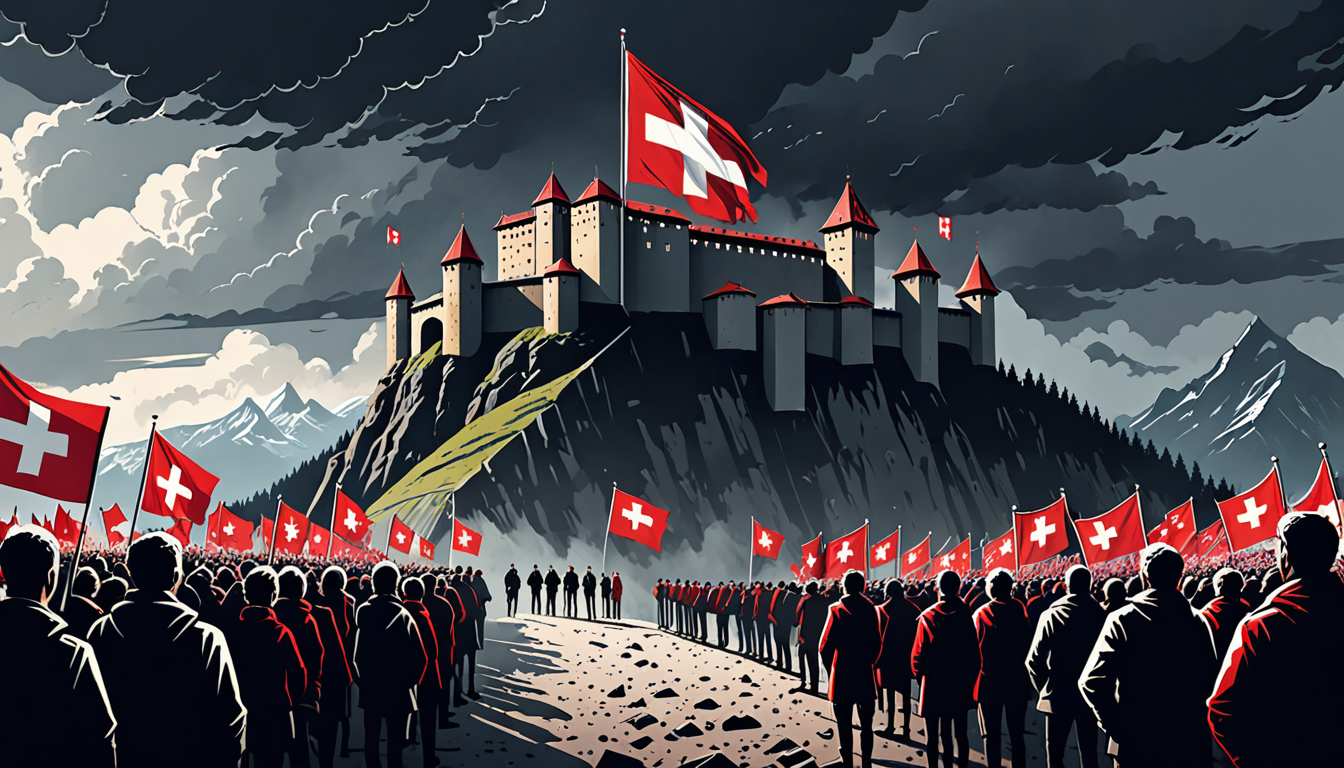
A far-right population cap initiative threatens to blow up Swiss-EU relations, upend the labor market, and set a precedent for demographic protectionism across the continent
Executive Summary
- Switzerland's June 14 referendum on capping the population at 10 million would constitutionally mandate immigration restrictions, potentially terminating the free movement agreement with the EU — the country's largest trading partner absorbing half its exports.
- With polling showing 48% support, the government launched an unprecedented counter-campaign on March 16, warning of economic devastation; the initiative arrives as Europe grapples with the Iran war energy shock, rising populism, and a continent-wide reckoning with immigration.
- The outcome will determine whether Switzerland remains integrated into the European economic architecture or retreats into a demographic fortress — and whether other European nations follow suit with their own population-control mechanisms.
Chapter 1: The Initiative and Its Mechanics
Switzerland's population stands at approximately 9 million. About 27% of residents are non-citizens, predominantly EU nationals drawn by high wages, low taxes, and a business-friendly environment. Around 40% of residents over age 15 have a foreign background. At current growth rates, the population will reach 9.5 million by mid-century.
The "No to a 10 Million Switzerland" initiative, pushed by the Swiss People's Party (SVP) — the country's largest political bloc since 1999 — would amend the Swiss constitution to hard-cap the permanent resident population at 10 million by 2050. Crucially, the mechanism kicks in well before that ceiling: once the population hits 9.5 million, the government would be compelled to ban new asylum seekers, foreign workers, and prospective permanent residents from entering the country. In subsequent years, the cap would be adjusted annually to account only for the birth surplus.
The initiative explicitly includes a provision to terminate Switzerland's agreement with the EU on the free movement of persons — a cornerstone of the bilateral relationship that governs Swiss-EU commercial integration. This is not a side effect. It is a deliberate feature.
Thomas Matter, an SVP lawmaker, summarized the party's position bluntly in a parliamentary debate: "Our citizens have had enough. The Swiss have spoken and don't want 10 million Swiss."
Chapter 2: Why Now — The Convergence of Crises
The initiative did not emerge in a vacuum. Three forces have converged to make it viable:
Economic stagnation. GDP per capita has not grown in three years. Real wages have declined. Stefan Legge, a professor at the University of St. Gallen, told Bloomberg: "Quite a few people are worse off now than they were three years ago. And then you look for someone to blame." Housing costs have surged, rents have climbed in major cities, and infrastructure strain is visible in overcrowded public transport and healthcare bottlenecks.
The Iran war energy shock. Since the US-Israeli strikes on Iran began on February 28, Brent crude has surged past $100 a barrel. For Switzerland — which imports virtually all its energy — this compounds the cost-of-living squeeze that feeds anti-immigration sentiment. The SVP has deftly linked resource scarcity to population growth, arguing that fewer people means less pressure on finite supplies.
European populism's continental march. The SVP initiative arrives amid a broader wave: Marine Le Pen's National Rally expanded in French municipal elections on March 15; Viktor Orbán and challenger Péter Magyar staged rival mass rallies in Budapest on the same day ahead of Hungary's April 12 election; Germany's AfD hit 25-27% as the largest opposition party. The Swiss vote is being watched as a potential template for demographic protectionism across the continent.
Comparative Context: Europe's Immigration Dilemma
| Country | Foreign-Born Pop. | Key Tension | Political Response |
|---|---|---|---|
| Switzerland | 27% | Housing, wages, infrastructure | Population cap referendum |
| Germany | 18.8% | AfD rise, economic decline | Merz firewall strategy |
| France | 13% | RN municipal expansion | Double cordon sanitaire |
| Hungary | 6.4% | Orbán anti-Ukraine/anti-migration | April 12 election |
| Netherlands | 25.2% | PVV collapse, D66-VVD minority | Post-populist governance |
Chapter 3: The Economic Stakes — What a Yes Vote Means
The business community's alarm is not performative. Economiesuisse, Switzerland's leading business lobby, has labeled the initiative the "chaos initiative" for a reason.
The EU relationship. Switzerland is not an EU member but has integrated its economy into the bloc's single market through a web of bilateral agreements. About half of Swiss exports — worth roughly CHF 150 billion annually — go to EU countries. The free movement of persons agreement underpins the entire bilateral architecture. Switzerland recently negotiated a "safeguard clause" allowing temporary restrictions during emergencies as part of the Bilateral III package. The SVP initiative would override this carefully calibrated compromise by constitutionally mandating the termination of free movement.
If free movement falls, the EU has signaled that the entire package of bilateral agreements — including mutual market access, research cooperation, and aviation rights — could unravel under the so-called "guillotine clause." The Swiss government warned on March 16 that this would leave the country "isolated" precisely when geopolitical instability demands reliable partnerships.
The labor market. Switzerland's unemployment rate hovers around 2.3% — essentially full employment. Key sectors face chronic labor shortages:
- Healthcare: 13,000+ unfilled nursing positions
- Technology: Swiss multinationals like Nestlé, Roche, Novartis, and ABB rely heavily on foreign talent
- Construction and hospitality: dominated by cross-border workers from France, Germany, and Italy
Deputy Jean Tschopp of the Social Democratic Party warned that "accepting the initiative would further exacerbate the labor shortage in certain sectors, particularly healthcare." Centre Party deputy Benjamin Roduit added that approval "would lead to the termination of bilateral agreements with the EU."
The fiscal trap. Switzerland's pension system depends on a growing working-age population to fund obligations for retirees. A population freeze would accelerate the demographic crunch, compounding a problem that Swiss voters themselves acknowledged when they backed a new wealth tax on the richest residents (in a March 8 vote) specifically to fund military spending and pensions.
Chapter 4: The SVP's Strategy and the Politics of Scarcity
The SVP has run previous anti-immigration initiatives — most notably the 2014 "Against Mass Immigration" initiative, which passed with 50.3% support but was never fully implemented due to EU backlash. The party's playbook is well-rehearsed: frame immigration as an elite project that enriches corporations while impoverishing ordinary citizens.
An SVP social media post depicted wealthy figures raising champagne glasses while workers suffered, captioned: "A small economic elite profits from excessive immigration — the majority of the Swiss population suffers."
This narrative has particular resonance in 2026. The Iran war has driven energy prices to levels that squeeze middle-class households. Housing in Zurich and Geneva is unaffordable for many Swiss-born residents. And the global "Great Rotation" away from financial assets toward hard assets and physical infrastructure has reinforced the sense that tangible resources — land, housing, energy — are finite in ways that matter.
Polling. A December 2025 survey by 20 Minuten/Tamedia showed 48% in favor, 41% against. The Swiss government's March 16 counter-campaign suggests the establishment recognizes the gap is dangerously narrow. However, Swiss referendums historically see a late shift toward the status quo — a pattern that saved the bilateral framework in 2020 when the "Limitation Initiative" (which also targeted free movement) was rejected 61.7% to 38.3%.
The critical difference this time: the cost-of-living crisis is sharper, populism is stronger across Europe, and the Iran war has introduced a resource-scarcity narrative that aligns with the SVP's argument.
Chapter 5: Scenario Analysis
Scenario A: Rejection (55%)
Rationale: Historical Swiss referendum pattern strongly favors the status quo on EU-related votes. The government, business community, and most political parties (SP, Greens, Centre, FDP) are united in opposition. The 2020 Limitation Initiative precedent — rejected by a 23-point margin — provides a template. Late-deciding voters tend to break against constitutional changes that threaten economic stability.
Trigger conditions:
- Government counter-campaign gains traction through spring
- Iran war de-escalation reduces energy price pressure
- Business community effectively communicates job-loss risks
Investment implications: Swiss franc stability, continued bilateral framework, Nestlé/Roche/Novartis maintain talent pipeline. Real estate pressure persists.
Scenario B: Narrow Passage (25%)
Rationale: Unprecedented cost-of-living squeeze, 48% baseline support, and pan-European populist momentum create conditions for an upset. The 2014 initiative passed against expectations. Energy shock from Iran war sustains resource-scarcity narrative through voting day.
Trigger conditions:
- Oil prices remain above $100 through June
- Housing crisis worsens — spring rental season reveals further price increases
- SVP successfully links EU free movement to cost-of-living pain
Historical precedent: The 2014 "Against Mass Immigration" vote passed 50.3% despite establishment opposition. Brexit — another vote framed around sovereignty and immigration — defied polling and expert consensus.
Investment implications: Swiss franc volatility spike, SMI index sell-off (particularly pharma/banking), EU bilateral framework enters crisis. CHF may initially weaken on economic uncertainty before safe-haven flows resume. Swiss government bonds rally on flight-to-safety within Switzerland.
Scenario C: Decisive Rejection >60% (20%)
Rationale: The combination of Iran war uncertainty and institutional credibility makes voters risk-averse. The government's framing of isolation during geopolitical crisis resonates. Business community's "chaos" messaging proves effective.
Investment implications: Relief rally in Swiss equities, bilateral framework strengthened, potential acceleration of Bilateral III ratification.
Chapter 6: The Continental Precedent
The Swiss vote matters beyond Switzerland because it tests a specific proposition: Can a wealthy, stable democracy constitutionally mandate population limits?
If passed, the model would be immediately studied by:
- Germany's AfD, which has called for "remigration" policies
- France's RN, which expanded in March 15 municipal elections
- Italy's Fratelli d'Italia, which has imposed immigration restrictions
- Hungary's Fidesz, whose April 12 election campaign centers on anti-migration messaging
The mechanism is novel. Previous European immigration restrictions have been administrative — visa policies, asylum processing changes, border controls. A constitutional population cap is something qualitatively different: it creates a hard legal ceiling that binds all future governments regardless of economic conditions.
Green Party MP Raphaël Mahaïm warned that implementing the SVP initiative would lead to "programmed chaos." Centrist politician Jürg Grossen said a yes vote would plunge Switzerland "into chaos and isolation."
But isolation is precisely what a growing segment of European voters appears to want. The Swiss vote will reveal whether that desire is strong enough to override economic self-interest — and whether the resource-scarcity narrative born from the Iran war has permanently reshaped the immigration debate.
Conclusion
The June 14 referendum is the most consequential Swiss vote in a decade. It sits at the intersection of every major force reshaping European politics: energy insecurity, populist resurgence, demographic decline, and the tension between economic integration and national sovereignty.
The Swiss government's March 16 intervention — describing the initiative as a threat to prosperity, security, and international partnerships — signals genuine alarm. With 48% support and three months of campaigning ahead, the outcome is genuinely uncertain.
For investors, the key variable is whether the Swiss status-quo bias holds in a world where the status quo itself — $100 oil, 16-day Iran war, collapsing middle-class purchasing power — feels increasingly untenable. The answer will echo far beyond the Alps.
Related Reading
- Swiss government warns population cap threatens economy — Reuters
- Swiss Voters to Decide Whether to Cap Population at 10 Million — GlobalPost
- Opponents warn of devastating consequences — SWI swissinfo.ch
Leave a Reply