
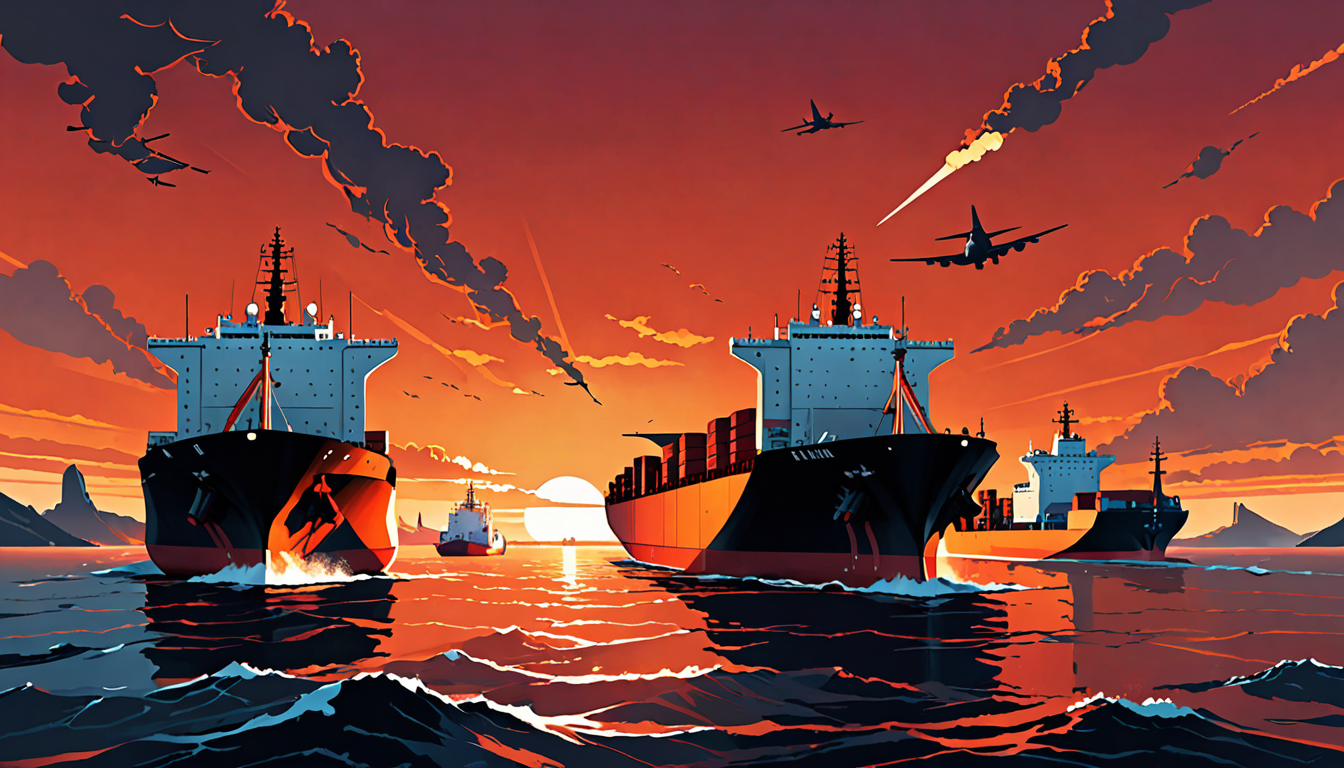
As the US-Israel war on Iran enters its third week, individual nations are bypassing Washington to cut their own passage deals with Tehran — creating a new hierarchy of maritime access that could outlast the conflict itself
Executive Summary
- Two Indian LPG tankers successfully crossed the Strait of Hormuz on March 14 after New Delhi negotiated directly with Tehran for safe passage, marking the first significant commercial transit since Iran's IRGC declared the strait a war zone on March 2
- France, Italy, and India are now conducting bilateral negotiations with Iran to secure energy supplies — bypassing the US-led coalition framework entirely
- War risk insurance has returned to Hormuz at a staggering 1% of hull value per seven days (renewable weekly), creating a de facto economic barrier that costs approximately $3-4 million per VLCC transit
- Trump's March 14 call for multinational naval escorts has been met with silence from key allies — no nation has committed warships to a US-led Hormuz convoy operation
- The emerging bilateral transit regime is creating a two-tier maritime system: nations with direct Iran relationships gain access, while those aligned strictly with Washington face energy starvation
Chapter 1: The Passage That Changed Everything
On the morning of March 14, two Indian-flagged tankers carrying liquefied petroleum gas crossed the Strait of Hormuz and turned southeast toward Indian ports. The transit was unremarkable by peacetime standards — LPG carriers cross the strait thousands of times each year. But on Day 15 of Operation Epic Fury, with the IRGC maintaining its war zone declaration and over 1,000 commercial vessels stranded across the Persian Gulf, the successful passage represented a seismic diplomatic event.
India's External Affairs Ministry confirmed the crossing but was careful not to elaborate on the diplomatic mechanics. Iranian state media, however, was more forthcoming: "Iran allowed passage of two Indian vessels carrying essential cooking fuel," Fars News Agency reported, framing the transit as a humanitarian gesture from Tehran. The reality was more complex — and far more consequential for the global maritime order.
Behind the successful passage lay weeks of backchannel negotiations between New Delhi and Tehran. India's National Security Advisor Ajit Doval had been in contact with Iranian counterparts since the early days of the conflict, leveraging India's historically balanced relationship with Iran. India imports approximately 80-85% of its LPG through the Strait of Hormuz, and the sudden cutoff had triggered a genuine domestic crisis — commercial LPG sales were restricted nationwide, restaurants in Mumbai shuttered by the thousands, and the political opposition seized on the shortage as evidence of the Modi government's vulnerability.
The LPG passage was not merely a logistical achievement. It was the first visible crack in what had been presented as a total Hormuz blockade — and it immediately raised a question that no one in Washington wanted to answer: if India could negotiate bilateral passage, why couldn't everyone else?
Chapter 2: The Anatomy of Bilateral Transit
The concept of selective passage is not new to naval warfare. During the 1984-88 Tanker War between Iran and Iraq, both belligerents attacked commercial shipping but maintained informal agreements allowing certain flagged vessels to transit. Iran's current approach, however, is far more sophisticated — and far more politically calculated.
Since declaring the strait a war zone on March 2, Iran has operated what analysts call a "loyalty filter." The IRGC Navy maintains patrol boats and shore-based anti-ship missile batteries along the strait's narrowest passages, with the ability to selectively challenge or permit transiting vessels. In the first two weeks of the blockade, the only vessels that transited without incident were Chinese-flagged tankers carrying Iranian crude — a shadow fleet operating outside the Western insurance framework entirely.
India's successful passage introduced a new category: nations that are not aligned with Iran but are willing to engage in direct bilateral negotiations. The framework appears to involve several conditions, though neither side has publicly confirmed the terms. Based on diplomatic sources cited by Al Jazeera and Bloomberg, the emerging template includes:
Safe passage notification: Vessels must be pre-registered with the IRGC Navy's coastal command, providing flag state, cargo manifest, and destination at least 72 hours in advance.
Flag state neutrality certification: The requesting government must provide diplomatic assurances that it is not participating in military operations against Iran. India's position — condemning violence on "all sides" while refusing to join any coalition — provided the necessary ambiguity.
Cargo restrictions: Military materiel, dual-use technology, and shipments destined for US military facilities in the Gulf are excluded. LPG and food staples receive priority.
Transit corridors: Vessels follow prescribed routes through Iranian territorial waters under IRGC escort, rather than the standard Traffic Separation Scheme.
France and Italy moved quickly to replicate the Indian model. By March 14, Al Jazeera reported that "key nations, including India, France, and Italy, are now bypassing Washington and reaching out directly to Iran to negotiate safe passage for their vessels." The French approach was particularly notable — Paris maintained diplomatic channels with Tehran even while participating in the E3 military threat against Iranian missile sites. The cognitive dissonance was striking: France was simultaneously threatening to bomb Iran and negotiating energy supply deals with it.
Chapter 3: The Insurance Barrier — Harder Than Missiles
Even as bilateral passage deals proliferated, a second and arguably more powerful blockade mechanism remained in force: the insurance market.
On March 5, Protection and Indemnity (P&I) clubs withdrew war risk coverage for the Persian Gulf, making commercial transit economically impossible regardless of military risk. Without P&I insurance, vessels cannot enter ports, access financing, or be loaded. The insurance withdrawal was more effective than any minefield — it created an invisible but absolute barrier to commercial shipping.
On March 15, insurance market conditions began to shift. International insurers started writing new war risk contracts for Hormuz transit, but at prices that represented a revolution in maritime economics. According to Caixin, reported via The Business Times, the new rate was 1% of a vessel's hull replacement value, renewable every seven days.
For a modern VLCC valued at $120 million, this translates to $1.2 million per week in war risk insurance alone — roughly $170,000 per day. For a round trip through the strait requiring approximately 3-4 days, the insurance cost alone adds $500,000-$680,000 per voyage. On top of this, P&I clubs were imposing additional war risk surcharges of their own.
The insurance mathematics created a brutal hierarchy:
| Vessel Type | Hull Value | Weekly War Risk Premium (1%) | Daily Cost |
|---|---|---|---|
| VLCC (crude) | $120M | $1.2M | $171K |
| Suezmax | $75M | $750K | $107K |
| LNG carrier | $200M+ | $2M+ | $286K+ |
| Container (8,000 TEU) | $100M | $1M | $143K |
These costs dwarfed normal war risk premiums by a factor of 100-1,000x. Before the conflict, war risk insurance for Gulf transit ran at approximately 0.01-0.05% of hull value. The new 1% rate, renewable weekly, represented an extraordinary repricing of risk — and a de facto tax on any nation wanting to access Gulf energy supplies.
The insurance barrier had a perverse distributional effect. Nations with bilateral passage deals (India, France, Italy) still had to pay the exorbitant insurance premiums, but at least their vessels could transit. Nations without such deals faced both the military risk AND the insurance cost — making Hormuz access effectively impossible.
China, operating its shadow fleet outside Western insurance frameworks entirely, was uniquely positioned. Chinese-flagged tankers carrying Iranian crude continued to transit using Chinese state-backed insurance, at rates that were never publicly disclosed but were assumed to be a fraction of the Lloyd's market price.
Chapter 4: Trump's Empty Convoy — The Coalition That Wasn't
Against this backdrop of bilateral deal-making, President Trump's March 14 call for nations to "send warships to keep the Strait of Hormuz open" landed with a thud. The proposal — reminiscent of the 1987-88 Operation Earnest Will, in which the US Navy escorted reflagged Kuwaiti tankers through the strait — faced a fundamentally different strategic landscape.
In 1987, the US was a neutral party mediating between two belligerents (Iran and Iraq). In 2026, the US was an active combatant conducting daily airstrikes on Iranian territory. Asking nations to join a US-led naval convoy was asking them to take sides in a war that most wanted no part of.
The response was silence. As of March 15:
- Japan — declined, citing constitutional constraints and its dependence on Iranian goodwill for LNG supplies
- South Korea — expressed "concern" but committed no naval assets
- United Kingdom — already participating in the conflict via RAF Fairford and HMS Prince of Wales, but refused to dedicate escort vessels to commercial convoys
- France — pursuing bilateral deals with Iran instead; deployed the Charles de Gaulle carrier group for "defensive" operations only
- India — explicitly rejected any coalition participation, preferring its bilateral channel
- China — did not respond publicly, continued using its shadow fleet
The contrast with Earnest Will was instructive. In 1987-88, the US escorted 259 convoys through the strait over 14 months, with 11 nations contributing naval assets. The operation succeeded because the US was perceived as a neutral protector of freedom of navigation. In 2026, the US was perceived as the aggressor — making any coalition inherently an act of belligerency rather than peacekeeping.
The failed coalition call also revealed a deeper structural weakness: the US had been the guarantor of maritime freedom in the Gulf for 45 years, but its dual role as guarantor and combatant was a logical impossibility. You cannot simultaneously bomb a country and guarantee safe passage through its territorial waters.
Chapter 5: Historical Parallels — When Empires Lost Control of Chokepoints
The fragmentation of Hormuz access into bilateral deals has uncomfortable historical parallels.
The Ottoman Capitulations (16th-19th centuries): European powers negotiated individual trade agreements (capitulations) with the Ottoman Empire, each securing preferential access to ports and markets. The system created a hierarchy of access based on diplomatic leverage rather than universal rules — eerily similar to the emerging Hormuz bilateral framework.
The Suez Crisis of 1956: When Nasser nationalized the Suez Canal, Britain and France discovered that their military intervention actually reduced their influence over the waterway's management. The parallel to 2026 is direct — the US attack on Iran has diminished, not enhanced, its ability to guarantee Hormuz transit.
The Tanker War (1984-88): Both Iran and Iraq selectively attacked shipping, but maintained informal transit arrangements with allied states. The key lesson: selective blockades create winners and losers, and the winners tend to be nations with the most flexible diplomacy — not the strongest military.
The Red Sea Crisis (2024-25): Houthi attacks on Red Sea shipping demonstrated how non-state actors could disrupt global trade routes. The US-led Operation Prosperity Guardian struggled to assemble a coalition, foreshadowing the empty Hormuz convoy of 2026.
The common thread across these episodes is a single insight: military force alone cannot guarantee maritime access through contested chokepoints. Diplomatic relationships, insurance frameworks, and commercial incentives are equally — if not more — important.
Chapter 6: Scenario Analysis — Three Futures for Hormuz Transit
Scenario A: Managed Bilateral Regime (45%)
Core thesis: The bilateral passage framework stabilizes and expands. More nations negotiate individual deals with Iran, creating a de facto managed transit system.
Why this probability? India's successful passage creates a template that other nations can replicate. Iran has incentives to allow selective transit — it demonstrates Tehran's ability to control (rather than merely block) the strait, and it generates diplomatic leverage with each bilateral deal. The insurance market adapts, with dedicated war risk products for "pre-approved" transits at lower premiums than the current 1% rate.
Triggers: Additional successful bilateral transits by France, Italy, Japan. IRGC publishes formal transit notification procedures. Lloyd's creates a dedicated Hormuz Bilateral Transit risk category.
Historical precedent: Ottoman capitulation system persisted for centuries because it served all parties' interests, despite being inherently unequal.
Investment implications: Energy importers with strong Iran relationships (India, Turkey) gain structural advantages. Shipping companies with diverse flag registrations benefit from regulatory arbitrage. Gold and energy commodities maintain war premium. LNG spot prices stabilize at elevated levels as bilateral deals restore partial flow.
Scenario B: Escalation and Full Closure (30%)
Core thesis: The bilateral framework collapses as the war intensifies, leading to complete Hormuz closure.
Why this probability? Trump's March 15 threat to strike Kharg Island "just for fun" and the IRGC's warning to Gulf residents to evacuate near oil ports suggest both sides are preparing for escalation. If the US strikes Iran's oil infrastructure directly, Tehran's incentive to maintain bilateral passage deals disappears — the diplomatic goodwill that underpins selective transit evaporates.
Triggers: US/Israeli strike on Iranian oil export terminals. IRGC mine deployment in the strait's shipping lanes. Major incident involving a transiting vessel from a bilateral-deal nation.
Investment implications: Brent crude surges above $130-150. Asian energy importers face economic crisis. Defense stocks surge. Gold exceeds $6,000. Global recession probability rises sharply.
Scenario C: Ceasefire and Reopening (25%)
Core thesis: Diplomatic efforts produce a ceasefire, and the strait gradually reopens to universal traffic.
Why this probability? Despite Trump's claim that Iran is "ready to negotiate" but terms "aren't good enough," the dual power structure in Tehran (Mojtaba Khamenei's hardline stance vs. Pezeshkian's openness to talks) creates space for a diplomatic off-ramp. The FOMC meeting (March 17-18) and growing US stagflation fears add economic pressure for de-escalation.
Triggers: Chinese mediation succeeds (Xi-Trump summit March 31). Iran's interim leadership offers conditional Hormuz reopening. US accepts partial deal.
Historical precedent: The 1988 Tanker War ended with UNSC Resolution 598, which both sides accepted after exhaustion — not military victory.
Investment implications: Oil prices drop 20-30% rapidly. Insurance premiums normalize over 3-6 months. Asian markets rally. Defense stocks correct. Shipping capacity overhang creates freight rate pressure.
Chapter 7: Investment Implications — The Passage Premium
The bilateral transit framework creates a new investable concept: the passage premium. Nations and companies with secured Hormuz access enjoy a structural advantage over those without.
Winners:
- Indian energy companies (Reliance, GAIL, ONGC): India's bilateral deal secures LPG and crude supplies. Reliance's Jamnagar refinery — the world's largest — can continue operating while competitors face feedstock shortages.
- Chinese state-owned refiners (Sinopec, PetroChina, CNOOC): Shadow fleet access to Iranian crude provides both supply security and discounted pricing.
- Alternative route beneficiaries: Saudi Aramco's East-West Pipeline (1,200 km Petroline), UAE's Habshan-Fujairah bypass pipeline, and Iraqi-Turkey Kirkuk-Ceyhan pipeline all gain strategic value.
- Turkish logistics: Istanbul's rapid emergence as an alternative aviation and shipping hub benefits Turkish Airlines, DP World's Yarımca terminal, and Turkish banks.
Losers:
- Japan and South Korea: 75% and 60% Hormuz-dependent respectively, with no bilateral deals and declining diplomatic leverage.
- Gulf aviation and tourism: Dubai's model as a global hub faces structural damage. Emaar Properties, Dubai Financial Market constituents.
- Global reinsurers: The April 1 renewal date approaches with Hormuz war risk exposures creating Solvency II stress. Munich Re, Swiss Re face unprecedented claims potential.
- Container shipping lines: Hapag-Lloyd, Maersk, MSC face dual-chokepoint disruption (Hormuz + Red Sea Houthi attacks). Blank sailings increase.
Conclusion: The End of Universal Maritime Access
The bilateral transit regime emerging at Hormuz represents something more profound than a wartime expedient. It signals the end of the post-1945 assumption that global maritime chokepoints operate on universal, rules-based access.
For 80 years, the US Navy guaranteed freedom of navigation as a public good — available to all nations regardless of political alignment. The Iran war has shattered this framework. The US is now simultaneously the world's maritime guarantor and an active combatant at the most critical chokepoint on earth. The logical contradiction is irreconcilable.
In its place, a new system is emerging: bilateral, transactional, and hierarchical. Access to Hormuz — and by extension, to 20% of global oil supply — is now determined not by international law but by diplomatic relationships with Tehran. India's successful passage on March 14 was not merely a logistical achievement. It was the founding act of a new maritime order.
The question is whether this order will be temporary — a wartime anomaly that dissolves when the guns fall silent — or permanent: the beginning of a world where chokepoint access is negotiated rather than guaranteed.
History suggests the latter. Once universal access is broken, it is rarely restored to its previous form. The Ottoman capitulations lasted centuries. The Suez Canal has never fully returned to pre-1956 norms. The rules of the sea, once rewritten, tend to stay rewritten.
For investors, policymakers, and citizens alike, the message is the same: the era of assumed maritime access is over. What replaces it will be decided not by navies alone, but by diplomats, insurers, and the cold logic of bilateral negotiation.
Sources: Al Jazeera, Reuters, Bloomberg, The Business Times/Caixin, The Hindu, CNBC, Khaleej Times, Economic Times, Wikipedia (2026 Strait of Hormuz crisis), Insurance Journal, Gulf News
Leave a Reply