
Why deliberately sparing Iran's most valuable target may be the war's most consequential strategic decision
Executive Summary
- On March 13, the U.S. "obliterated every military target" on Kharg Island — Iran's oil lifeline handling 90% of its crude exports — while explicitly sparing the oil infrastructure. This was not mercy; it was a calculated ultimatum tying Hormuz passage to the survival of Iran's last revenue source.
- Trump's conditional threat — "should Iran do anything to interfere with free passage through the Strait of Hormuz, I will immediately reconsider" — transforms Kharg from a military target into a hostage. The island's $70+ billion annual revenue stream now exists at Washington's discretion, creating a coercive dynamic without precedent in modern energy warfare.
- Brent crude closed above $100/barrel for the second consecutive day, up 40%+ since the war began, yet the deliberate restraint on Kharg signals that oil prices could go dramatically higher — or dramatically lower — depending on Iran's next move. This binary outcome makes current energy markets a pure geopolitical bet.
Chapter 1: The Anatomy of a Calculated Strike
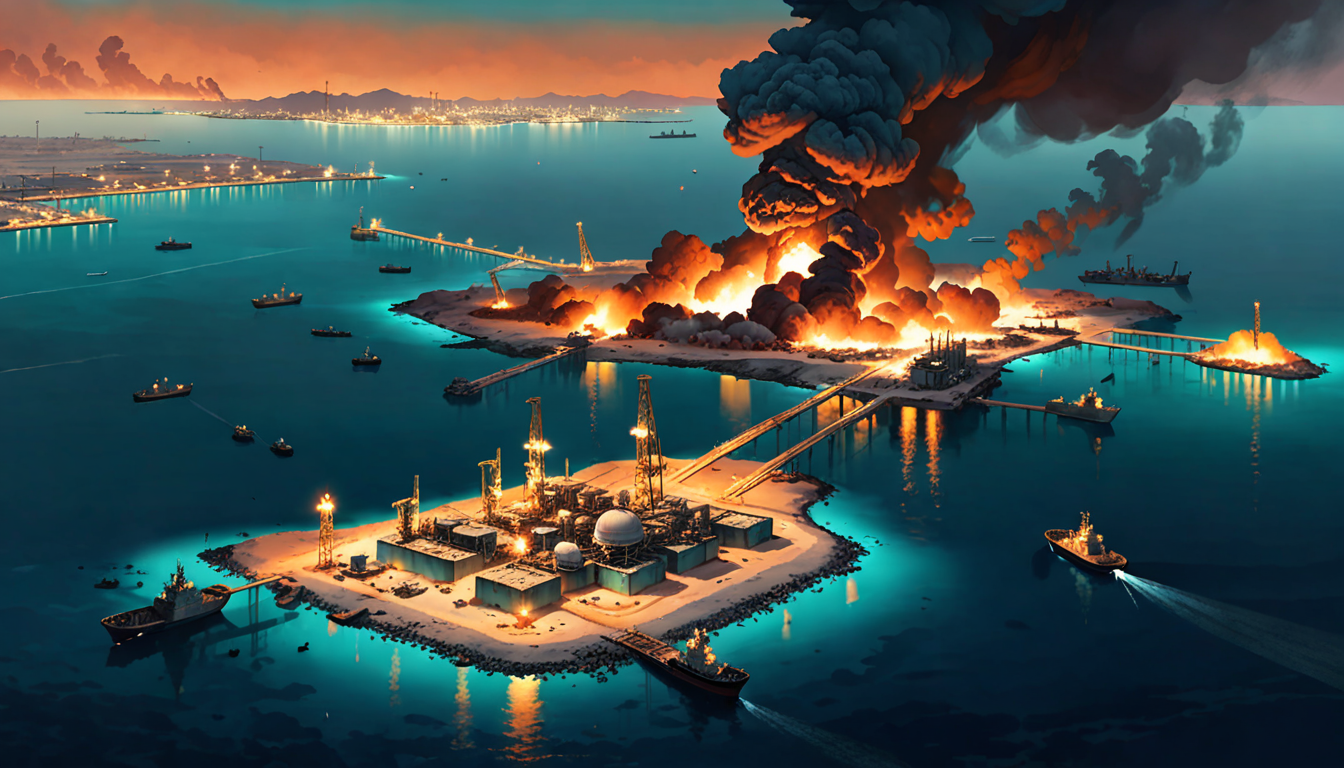
At approximately 8:00 PM EST on March 13, 2026 — the 14th day of Operation Epic Fury — U.S. Central Command executed what Trump called "one of the most powerful bombing raids in the History of the Middle East" against Kharg Island. The five-mile-long coral island, located 15 miles off Iran's southern coast in the northern Persian Gulf, was hit across every identified military installation.
What makes this strike extraordinary is not what was destroyed, but what was deliberately left standing.
Kharg Island is home to one of the world's largest oil export terminals, with a loading capacity of roughly 7 million barrels per day. Before the war, it handled approximately 90% of Iran's crude exports — the country's economic jugular. At current prices, the oil flowing through Kharg represents over $70 billion in annual revenue, the lifeblood of a regime now fighting for survival on multiple fronts.
Trump's Truth Social post was remarkably explicit: "For reasons of decency, I have chosen NOT to wipe out the Oil Infrastructure on the Island." But the next sentence removed any ambiguity about the nature of this "decency": "However, should Iran, or anyone else, do anything to interfere with the Free and Safe Passage of Ships through the Strait of Hormuz, I will immediately reconsider this decision."
This is not restraint. This is coercive diplomacy in its purest form — what political scientists call "compellence," the use of threatened force to change an adversary's behavior, as distinct from "deterrence," which aims to prevent action. The distinction matters enormously for understanding what comes next.
Chapter 2: The Oil Hostage Paradigm
The strategic logic is deceptively simple: by demonstrating the capability to destroy Kharg's oil infrastructure while choosing not to, Washington has created a permanent threat that costs nothing to maintain but would cost Iran everything to test.
Consider the asymmetry. Iran's mining of the Strait of Hormuz — confirmed by U.S. officials and documented extensively over the past two weeks — has disrupted global oil flows, sent prices soaring, and caused cascading damage from European gas stations to Indian kitchens. But Iran's own oil exports through Kharg have already been severely curtailed by the war itself. The island's military installations — radar, anti-ship missile batteries, air defense systems, command centers — were what protected the oil terminal from potential attack. With those obliterated, the oil infrastructure is now defenseless.
This creates a paradox that Iran's fractured leadership must now navigate: the Hormuz blockade was Tehran's primary retaliatory weapon, its asymmetric answer to American air superiority. But the Kharg ultimatum turns that weapon against its wielder. Every mine Iran lays in the Strait now brings its last revenue source closer to destruction.
The historical precedent closest to this dynamic is not from the Middle East but from the Cold War concept of "mutual assured destruction" — except here, the destruction is entirely one-sided. The U.S. can destroy Kharg at will; Iran cannot rebuild its military defenses on the island under ongoing air operations. The "hostage" cannot be rescued.
Chapter 3: The Dual Power Problem
The Kharg ultimatum arrives at a moment of maximum internal fragility for Iran. As documented in the "dual power" crisis that emerged this week, the Islamic Republic is operating under two competing authority centers: Mojtaba Khamenei, the newly installed Supreme Leader who has issued his first public statements promising continued resistance and threatening to open "other fronts," and President Pezeshkian, who has signaled openness to negotiation.
This internal split is critically relevant to the Kharg calculus. Compellence strategies require a rational, unified decision-maker who can weigh costs against benefits and make binding commitments. Iran's dual power structure undermines this prerequisite in several ways:
The IRGC problem. The Islamic Revolutionary Guard Corps controls the mining operations in the Strait of Hormuz. The IRGC reports to the Supreme Leader, not the president. If Mojtaba Khamenei orders continued mining — as his first public statement strongly implied — Pezeshkian has no institutional mechanism to countermand that order, even if he recognizes the existential risk to Kharg.
The succession legitimacy deficit. Mojtaba Khamenei's authority rests on a hasty succession process that many within the regime view as constitutionally questionable. His first public statements have been maximalist — promising "more pain for Gulf states" and threatening new fronts — precisely because he cannot afford to appear weak during the consolidation phase. This makes rational cost-benefit analysis a luxury he may not possess.
The audience cost trap. Having publicly committed to keeping the Hormuz blockade, any Iranian climbdown would carry enormous domestic and regional credibility costs. The regime has spent two weeks framing the blockade as proof of Iran's ability to punish the entire global economy for the attack. Dismantling it under an American ultimatum would validate the narrative of capitulation.
The historical parallel is instructive. During the Falklands War of 1982, Argentina's military junta faced a similar dynamic: having committed to a course of action for domestic political reasons, the costs of reversal were perceived as higher than the costs of continuation, even as the military situation deteriorated. The result was escalation to the point of defeat. Japan in 1944-45 offers an even starker example — the internal dynamics between military hardliners and peace-seekers paralyzed decision-making until the atomic bombs forced resolution.
Chapter 4: Scenario Analysis
Scenario A: Iran Blinks — Hormuz Reopens (25%)
Premise: Iran's pragmatic faction, led by Pezeshkian, gains enough internal leverage to halt or scale back the Hormuz mining campaign, either through a unilateral gesture or through back-channel negotiations (potentially mediated through the Bessent-He Lifeng talks happening this weekend in Paris, where China's role as Iran's closest major-power partner makes it a natural intermediary).
Why 25%: The probability is constrained by three factors. First, Mojtaba Khamenei's maximalist first statements make a quick reversal politically lethal for the new leader. Second, the IRGC's operational autonomy means that even a political decision to de-escalate may not translate to military compliance — the 1987-88 Tanker War ended only after the U.S. directly engaged Iranian naval assets, not through political accommodation. Third, the 320+ mines already deployed in the Strait cannot simply be "turned off"; they require active clearance operations that would take weeks to months, meaning even a good-faith Iranian decision to reopen Hormuz would not produce immediate results.
Trigger conditions: Back-channel ceasefire discussions (Paris talks could serve as cover), IRGC internal fracture, or a dramatic escalation (such as actual destruction of Kharg oil infrastructure) that forces capitulation.
Market impact: Brent crude drops 20-30% within days. Defense stocks sell off. Gulf reconstruction plays rally. Dollar strengthens on reduced risk premium.
Scenario B: Calculated Ambiguity — The Frozen Conflict (45%)
Premise: Iran neither fully complies nor fully defies the ultimatum. The Hormuz mining campaign continues at a reduced pace or is reframed as "defensive," while Kharg remains standing in a perpetual state of suspended destruction. The war enters a phase of attritional stalemate where neither side achieves its stated objectives.
Why 45%: This is the most likely outcome because it requires the least decision-making from either side. The U.S. has demonstrated capability but faces significant political and economic costs from actually destroying Kharg — not least the further spike in oil prices that would result from removing Iran's remaining export capacity from global markets. Trump's own administration has said it expects oil prices to fall "dramatically" once the war ends; destroying Kharg would make that promise impossible to fulfill. Iran, meanwhile, can maintain a posture of defiance through continued low-level Hormuz disruption (mines, GPS jamming, shadow fleet operations) while avoiding the specific "red line" of a full blockade that would trigger Kharg's destruction.
Historical precedent: The Korean Armistice of 1953, where military stalemate was formalized without peace. The Iran-Iraq War ceasefire of 1988, where exhaustion rather than resolution ended hostilities. The current situation along the Line of Contact in Ukraine, where neither side can achieve decisive victory.
Trigger conditions: Mutual exhaustion, U.S. domestic political pressure as midterm posturing begins, international mediation (UN, China, or Gulf states). The Bessent-He Lifeng Paris talks this weekend (March 15-16) are a critical indicator — if the agenda expands beyond trade to include Iran mediation, this scenario's probability increases.
Market impact: Oil remains elevated ($90-110 range) but volatility decreases. Insurance premiums stabilize at historically high levels. Energy sector outperforms; airlines, shipping, and emerging market importers underperform. Gold maintains strength on geopolitical uncertainty.
Scenario C: Escalation — Kharg Burns (30%)
Premise: Iran's hardliners, led by Mojtaba Khamenei and the IRGC, interpret the Kharg ultimatum as a bluff or as an unacceptable humiliation that demands escalatory response. The Hormuz blockade intensifies, or Iran opens "other fronts" as promised in Mojtaba's first public statement. The U.S. follows through on the threat and strikes Kharg's oil infrastructure.
Why 30%: The probability is elevated for several reasons. First, compellence historically has a poor success record — academic studies show that coercive threats succeed only 30-40% of the time, and the success rate drops further when the target regime faces internal audience costs from compliance (as Iran does). Second, the IRGC's institutional culture valorizes resistance and martyrdom over pragmatic calculation; the organization was built to fight asymmetric wars against superior powers, and the Kharg ultimatum fits neatly into its self-narrative of resistance. Third, Mojtaba Khamenei's legitimacy depends on proving he is worthy of his father's mantle — and his father's defining moment was the decision to continue the Iran-Iraq War for six years after Saddam offered peace in 1982.
Historical precedent: Saddam Hussein's refusal to comply with the 1991 ultimatum despite overwhelming military inferiority — he calculated that compliance would end his regime faster than resistance. Imperial Japan's decision to fight on after the fall of Okinawa, despite certainty of defeat, because the domestic political costs of surrender were deemed higher than the costs of continued fighting. More recently, Gaddafi's refusal to step down in 2011 despite NATO intervention.
Trigger conditions: A major IRGC retaliatory strike (on U.S. forces, Gulf oil infrastructure, or Israeli targets), intensified Hormuz mining, or the opening of the threatened "new front" that crosses Washington's red line.
Market impact: Oil spikes to $130-150+. Global recession risk jumps to 60%+. Central banks face impossible trade-off between inflation and growth. Safe-haven assets (gold, Swiss franc, U.S. Treasuries) rally sharply, though Treasuries may also sell off on fiscal concerns. Defense stocks surge; consumer discretionary collapses.
Chapter 5: Investment Implications
The Binary Energy Trade
The Kharg calculus creates an unusually binary outcome for energy markets. Current Brent prices ($100+) reflect the ongoing disruption but do NOT price in the destruction of Kharg itself. If Kharg's oil infrastructure is struck, the removal of Iran's remaining export capacity (already reduced but still significant for price formation) would send crude toward $130-150. If the ultimatum succeeds and Hormuz reopens, crude could fall below $80 within weeks. This creates a market structure where option volatility should be historically elevated.
Positioning considerations:
- Long energy volatility (oil options straddles) rather than directional bets
- Defense contractors (LMT, RTX, NOC) — structural winners regardless of scenario
- Gold and real assets — hedge against both escalation and dollar debasement from war spending
- Short airlines, cruise lines, and consumer discretionary if Scenario C materializes
The Paris Wildcard
The Bessent-He Lifeng talks in Paris (March 15-16) deserve close monitoring. If China signals willingness to pressure Iran on Hormuz in exchange for trade concessions from Washington, Scenario A's probability rises materially. China imports significant Iranian oil through the shadow fleet — it has both the leverage and the motivation to broker a de-escalation, particularly with the Trump-Xi summit on March 31 approaching. A breakthrough in Paris would be massively risk-positive for global markets.
The Timing Dimension
| Timeframe | Key Variable | Watch For |
|---|---|---|
| 48 hours | Iran's response to Kharg strike | Mojtaba Khamenei statement, IRGC naval activity |
| This weekend | Paris talks (March 15-16) | Any expansion of agenda to include Iran |
| 2 weeks | Trump-Xi summit (March 31) | Package deal on trade + Iran mediation |
| 1-3 months | Mine clearance timeline | U.S. Navy MCM operations in Hormuz |
| 6+ months | Regime stability | Dual power resolution in Tehran |
Conclusion
The Kharg calculus represents a turning point in the Iran war — not because of what was destroyed, but because of the strategic framework it establishes. By converting Iran's most valuable economic asset into a hostage, Washington has created a coercive dynamic that could either accelerate the war's end or trigger its most destructive phase.
The paradox at the heart of this strategy is that its success depends on the rationality of a regime that may be structurally incapable of rational decision-making. Mojtaba Khamenei's dual power crisis, the IRGC's institutional culture of resistance, and the audience costs of compliance all work against the kind of cool-headed cost-benefit analysis that compellence requires.
For markets, the message is clear: the range of outcomes has widened dramatically. The Kharg ultimatum is either the beginning of the end — the moment when Iran's leadership recognized that continued resistance would cost them everything — or it is the prelude to the war's most destructive escalation. There is very little middle ground, which makes the coming 48 hours among the most consequential of the entire conflict.
Leave a Reply