
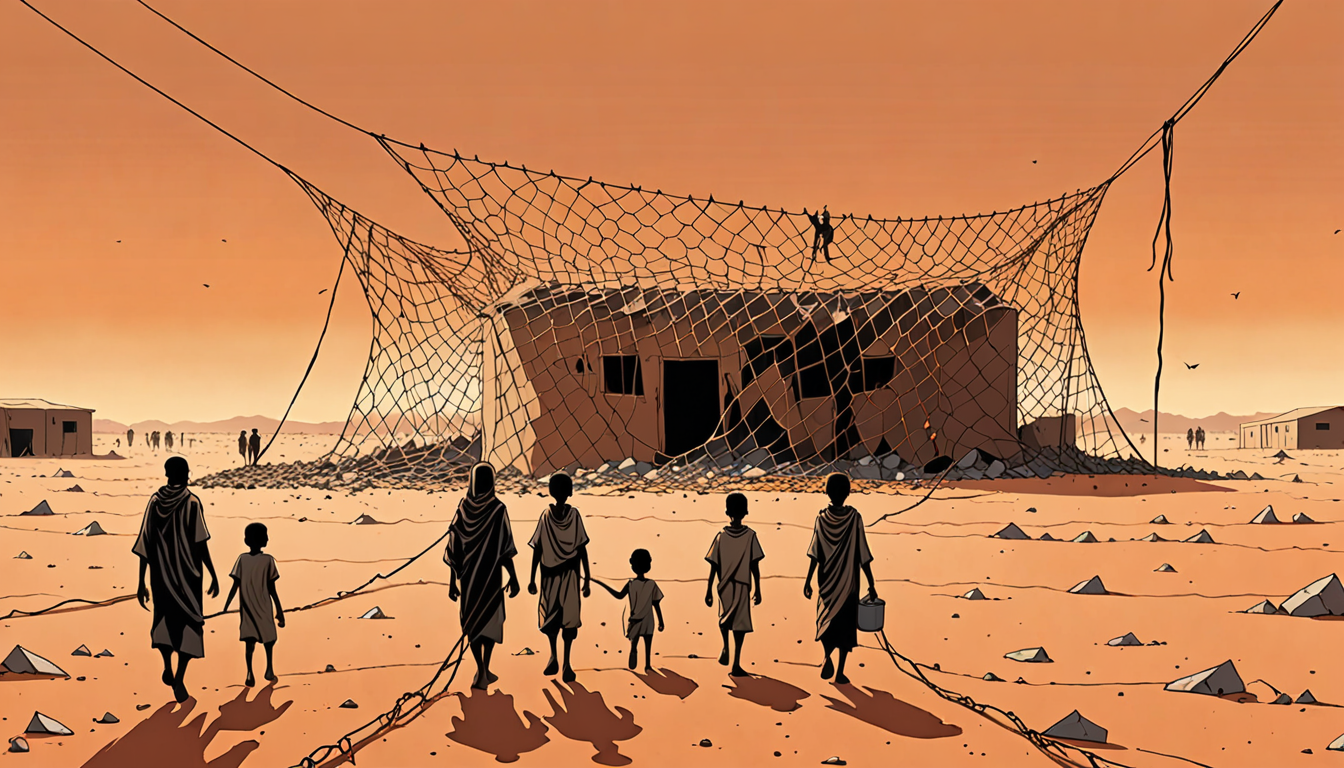
A war layered onto a funding crisis is creating the conditions for the largest displacement catastrophe since World War II
Executive Summary
- The Iran war has displaced 3.2–4 million Iranians in just 14 days, while triggering secondary displacement waves across Lebanon (800,000), Gaza, and Syria — all layered onto a region already hosting 25 million displaced people before the first bomb fell.
- The global humanitarian system was already gutted before the war began: the Trump administration cut 60–70% of U.S. funding to UNHCR and fired most State Department refugee experts in 2025, while Congress's $5.5 billion emergency appropriation remains locked inside the State Department, unspent.
- The Strait of Hormuz closure has paralyzed Dubai's International Humanitarian City — the world's largest aid logistics hub — severing supply lines not just for the Middle East but for East Africa, South Asia, and beyond, turning a regional war into a global humanitarian systems failure.
Chapter 1: The Scale of Displacement — 14 Days, 4 Million People
On March 12, UNHCR estimated that 3.2 million Iranians — between 600,000 and one million households — had been forcibly displaced since Operation Epic Fury began on February 28. By March 13, The New Humanitarian revised the figure upward to 4 million. Most are fleeing Tehran and major urban centers toward northern Iran and rural areas.
To grasp the speed: this is roughly the equivalent of emptying the entire city of Los Angeles in two weeks. Iran's population of 90 million means even modest cross-border outflows could dwarf recent refugee crises. German Chancellor Friedrich Merz publicly warned that "Iran cannot become another Syria," a reference to the 2015–2016 crisis when 1.3 million asylum seekers reached Europe from a country one-quarter Iran's size.
So far, approximately 100,000 people have fled Tehran, with no significant cross-border movement reported. But UNHCR's own assessment is blunt: "This figure is likely to continue rising as hostilities persist." Iran already hosted 1.65 million refugees — 750,000 Afghans among them — before the war. These people are now displaced for a second or third time, a cruel recursion that aid workers call "re-displacement."
| Displacement Crisis | Population | Timeframe | Peak Displaced |
|---|---|---|---|
| Syria (2011–2015) | 21M | 4 years | 13.5M (internal + external) |
| Ukraine (2022) | 44M | 3 months | 14M |
| Iran (2026) | 90M | 14 days | 4M (and counting) |
| Iraq (2003–2007) | 26M | 4 years | 4.7M |
The comparison is ominous. Syria's displacement crisis unfolded over years. Iran's is compressing a similar trajectory into weeks.
Chapter 2: The Cascading Collapse — Lebanon, Gaza, and the Region
The war is not displacing people only inside Iran. It has triggered a cascading chain of secondary crises across the region.
Lebanon was already in the grip of what the World Bank called one of the worst economic collapses in modern history — GDP contracted by more than 60% between 2019 and 2023. Into this broken country, the Second Front (Hezbollah-Israel escalation beginning March 4) has now poured 700,000–800,000 newly displaced people in barely a week. Mercy Corps projected up to 500,000 displaced even in a short-duration scenario; reality has already exceeded that estimate. Some 440 shelters — schools, public buildings — are operating beyond capacity. People are sleeping in streets.
The cruelest irony: Syrian refugees who fled to Lebanon for safety are now fleeing back to Syria, with UNHCR reporting more than 30,000 departures in the past week. Syria, a country still shattered by its own civil war, is becoming a destination of last resort.
Gaza faces compounding catastrophe. Israel's closure of all border crossings following the Iran escalation has depleted aid stocks. Only the Karem Abu Salem crossing has reopened; Rafah remains shut. Medical evacuations are suspended. The UN can now bring in only half the fuel needed for basic operations. Two-thirds of Gaza's population — roughly 1.5 million people — already live in displacement camps.
The regional total: before February 28, the Middle East hosted 25 million displaced people. The Iran war is adding millions more onto a system that was already failing.
Chapter 3: The Funding Void — A System Gutted Before the Storm
The global humanitarian system entered this crisis in its weakest state in decades, and the reason is largely American.
In 2025, the Trump administration cut U.S. funding to UNHCR by 60–70%. The United States had been the world's largest humanitarian donor by a wide margin — in some years providing 40% of UNHCR's total budget. The administration simultaneously fired nearly all experts in the State Department's Bureau of Population, Migration, and Refugees (PRM), the primary U.S. government office responsible for managing refugee crises.
The result is a dual failure: the international system lacks money, and the U.S. government lacks the institutional expertise to respond even if the political will existed.
Congress, recognizing the gap, recently appropriated $5.5 billion for humanitarian aid through the State Department — earmarked for WFP, UNHCR, and NGOs working in the region. But as of March 13, the State Department has not released those funds. The money sits in bureaucratic limbo while people sleep in streets.
Even if released immediately, $5.5 billion is less than half of what the United States historically spent on international humanitarian response annually. It arrives at a moment when need is not merely growing but exploding.
| U.S. Humanitarian Funding | Amount | Year |
|---|---|---|
| Peak annual contribution | ~$12B | 2022 |
| Post-cut contribution | ~$3.5B | 2025 |
| Emergency appropriation (unreleased) | $5.5B | 2026 |
| Estimated regional need (Iran war alone) | $8–12B | CFR/UN est. |
Chapter 4: The Logistics Collapse — When the Hub Goes Dark
The Strait of Hormuz closure has created a humanitarian problem that most people haven't considered: it has paralyzed the world's largest aid logistics hub.
Dubai's International Humanitarian City (IHC) is the nerve center of global emergency response. For decades, the UN and NGO community built their logistics infrastructure around Dubai's geographic centrality — equidistant from East Africa, South Asia, and Central Asia, with world-class port and air cargo facilities. When a tsunami hits Indonesia or a famine strikes Yemen, the supplies flow through Dubai.
Today, it has ground to a halt. Port operations are disrupted by the Hormuz closure. Flying from Dubai's runways is, as one aid worker put it, "extremely dangerous" given ongoing drone and missile threats (the airport itself was struck by an Iranian drone on March 11). Supplies cannot move out. And within the region, vendors who hold stocks of basic humanitarian goods — tarps, mosquito nets, water purification tablets — are reportedly refusing to sell, anticipating price increases.
This is not merely a Middle Eastern problem. Aid pipelines to East Africa (Somalia, Sudan, Ethiopia), South Asia (Afghanistan, Pakistan), and even parts of Southeast Asia rely on Dubai-based logistics. The Hormuz closure is creating a humanitarian supply chain failure that radiates outward across three continents.
The dollar's wartime strengthening compounds the crisis. For the world's poorest countries — those that import food staples priced in dollars — the currency shift makes wheat, rice, and cereals more expensive precisely when supply disruptions are reducing availability.
Chapter 5: Scenario Analysis
Scenario A: Managed Response (25%)
Premise: The State Department releases the $5.5 billion within days; a ceasefire or de-escalation occurs within 3–4 weeks; Hormuz partially reopens.
Rationale: This mirrors the 2006 Lebanon war timeline (34 days to ceasefire) and assumes diplomatic pressure from Europe and Gulf states forces a pause. The 25% probability reflects the absence of any visible diplomatic channel and the escalatory trajectory of both sides.
Trigger: A back-channel ceasefire mediated by Oman or Turkey, combined with Congressional pressure on the State Department to release funds.
Outcome: Displacement peaks at 5–6 million regionally; aid systems strained but functional; no mass cross-border refugee flows.
Scenario B: Protracted Crisis with Partial Adaptation (45%)
Premise: War continues for 2–3 months; humanitarian system adapts around Dubai by rerouting through Turkey (Istanbul) and Kenya (Mombasa); funding trickles out slowly.
Rationale: This is the most common pattern in modern conflicts — the system bends but doesn't break, at enormous human cost. The 2022 Ukraine crisis followed a similar trajectory: initial chaos → partial adaptation → chronic underfunding. The 45% probability reflects historical base rates: of the last 10 major displacement crises since 2000, approximately 5 followed this trajectory.
Trigger: Hormuz remains closed but alternative logistics corridors emerge; State Department releases partial funding under political pressure.
Outcome: Displacement reaches 8–12 million regionally; significant cross-border flows into Turkey, Pakistan, and Iraq; chronic aid shortfalls; secondary mortality from disease and malnutrition rises sharply.
Scenario C: Systemic Humanitarian Failure (30%)
Premise: War escalates further; Hormuz remains fully closed for 3+ months; U.S. funding remains blocked by political gridlock; UNHCR and WFP face operational collapse in the region.
Rationale: The combination of unprecedented displacement scale (90M population), gutted funding, and logistics hub destruction has no modern precedent. The closest analog is the post-WWII European refugee crisis (1945–1947), when 60 million people were displaced across a continent with destroyed infrastructure. The 30% probability reflects the genuine possibility that the current trajectory — escalating strikes, no diplomatic off-ramp, paralyzed U.S. government (DHS shutdown at day 28, State Department not releasing funds) — continues without interruption.
Trigger: A mass cross-border outflow from Iran into Turkey or Pakistan exceeding 500,000; collapse of the Lebanese state; famine conditions in Gaza.
Outcome: Largest displacement crisis since WWII; European political crisis as refugee flows materialize; global food insecurity spike in dollar-importing developing countries; humanitarian system restructured away from U.S.-centric funding model.
Chapter 6: Investment Implications
The humanitarian crisis is not merely a moral catastrophe — it has measurable economic and market consequences.
Defense and security spending acceleration. European governments responding to refugee flows will increase border security and defense budgets. Frontex, the EU border agency, is already requesting emergency supplemental funding. Defense contractors with border security portfolios (Airbus Defence, Leonardo, Thales) benefit.
Food and agriculture inflation. The combination of Hormuz-driven fertilizer shortages (covered in our earlier analysis of the "Invisible Famine"), dollar strengthening, and aid logistics collapse points to sustained food price inflation in importing countries. The FAO Food Price Index already rose to 125.3 in February, before the war's full impact. Agricultural commodities (wheat, rice, palm oil) face upward pressure.
Humanitarian and logistics sector reorientation. Turkish airports and ports (Istanbul, Mersin) are emerging as alternative humanitarian logistics hubs. Turkish Airlines already benefits from the aviation rerouting. Companies with logistics exposure in Turkey and East Africa may see increased demand.
Political risk in frontier markets. Countries dependent on Gulf-routed aid — Somalia, Sudan, Yemen, Afghanistan — face heightened instability risk. Sovereign debt in these countries faces further stress.
Insurance and reinsurance. The expanding scope of the crisis — from military to humanitarian to logistics — adds layers of insured loss. Munich Re and Swiss Re face rising exposure.
Conclusion
The Iran war has exposed a structural vulnerability in the global humanitarian system that existed long before the first missile was fired. Years of funding cuts, the concentration of logistics infrastructure in a single geographic chokepoint, and the erosion of institutional expertise within the world's largest donor government created the conditions for catastrophic failure. The war merely provided the trigger.
What is unfolding is not a regional humanitarian crisis. It is a global systems failure — one that connects displaced families sleeping in Beirut streets to food prices in Nairobi to political stability in Ankara. The $5.5 billion sitting unspent in the State Department is not a solution, but its continued absence is an accelerant.
The question is no longer whether the humanitarian system can cope. It cannot. The question is what replaces it.
Sources: CFR, UNHCR, Al Jazeera, NPR, Mercy Corps, The New Humanitarian, IOM, CNBC, FAO
Leave a Reply