
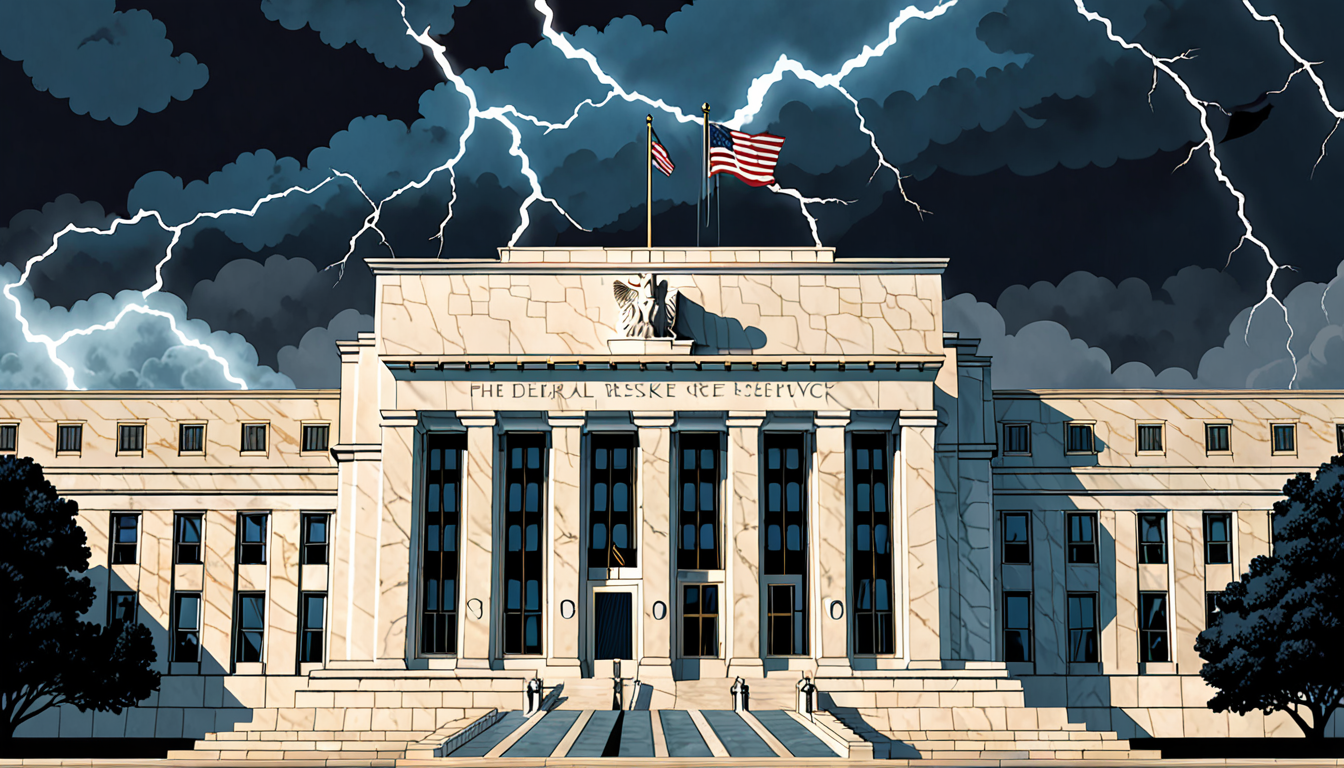
With a criminal probe of the sitting chair, an attempt to fire a governor, and a blocked successor, the Federal Reserve faces its gravest institutional crisis since 1951
Executive Summary
- The Warsh confirmation blockade reveals a paradox: Trump's own party is stalling his Fed chair nominee because the president's assault on Fed independence has alarmed even Republican allies. Sen. Thom Tillis refuses to advance Warsh until the criminal probe of Powell ends—effectively holding Trump's own agenda hostage.
- Three simultaneous attacks on Fed independence are unprecedented: A DOJ criminal investigation of the sitting chair (Powell), a Supreme Court case on presidential power to fire a governor (Cook), and political demands for rate cuts—all occurring during wartime stagflation.
- The market implications are severe: With the FOMC meeting March 17-18, rates stuck at 3.50-3.75%, and a leadership vacuum looming after Powell's May term expiration, the Fed faces a credibility crisis that could amplify the war-driven inflationary shock.
Chapter 1: The Blockade Within
On March 12, 2026, Kevin Warsh walked through the rain-soaked halls of the Hart Senate Office Building, meeting senator after senator in a bid to save his nomination as the next Federal Reserve Chair. The meetings were cordial—Sen. Mike Rounds praised him, Sen. Cynthia Lummis called their conversation "incredibly productive"—but none of it matters.
The problem isn't Warsh himself. By all accounts, he's a qualified nominee with bipartisan respect. The problem is Sen. Thom Tillis, a North Carolina Republican on the Banking Committee, who has drawn a line in the sand: no vote on any Fed nominee until the criminal probe of Jerome Powell is resolved.
"This is not about people, it's about process," Tillis told reporters. "This is bedrock principle of Fed independence."
The arithmetic is brutal. The Senate Banking Committee has a razor-thin Republican majority. A single defection from Tillis means Warsh's nomination cannot advance to the full Senate floor. Even Banking Committee Chair Tim Scott—a Trump ally—publicly wished the Powell investigation would simply "go away."
The result: Trump's own assault on Fed independence has created a self-imposed blockade on his own nominee. The president who wanted to bend the Fed to his will may end up with a leaderless central bank.
Chapter 2: The Three Fronts
What makes this crisis historically unique is its simultaneity. The Federal Reserve is under attack on three separate fronts—all originating from the same White House.
Front 1: The Criminal Probe of Jerome Powell
In January 2026, the Department of Justice opened a criminal investigation into Fed Chair Powell, ostensibly related to the multi-billion-dollar renovation of the Fed's headquarters in Washington. Powell has stated plainly that the real reason is his refusal to cut interest rates as "quickly and drastically" as Trump demanded.
Seven members of the Senate Banking Committee who were present during Powell's testimony about the renovation have said no crime was committed. Tillis called it "a young U.S. attorney with a dream, with a bogus basis for an investigation."
Yet the probe continues. Powell, whose term expires in May, was expected to testify before Congress on February 11 but did not appear, citing concern about the criminal proceeding. The sitting Federal Reserve Chair has been effectively silenced.
Front 2: The Lisa Cook Firing
Trump attempted to fire Fed Governor Lisa Cook, claiming mortgage fraud allegations raised by Bill Pulte, head of the Federal Housing Finance Agency. Cook denies wrongdoing; her defenders say she's being targeted—like Powell—for opposing Trump's rate-cut demands. The case is now before the Supreme Court, which has yet to rule on whether a president can fire a Fed governor.
Tillis called the effort to fire Cook "sophomoric." "Whoever came up with that idea should be fired, too," the senator said.
The legal question at stake—whether Fed governors serve "at the pleasure of the President"—strikes at the core of the Federal Reserve Act of 1913. If the Supreme Court rules in Trump's favor, the practical independence of the Fed would be hollowed out overnight.
Front 3: The Rate-Cut Demands
Even as Warsh's nomination languishes, Trump continues his public campaign for lower rates. On March 12, he posted on Truth Social: "Where is the Federal Reserve Chairman, Jerome 'Too Late' Powell, today? He should be dropping Interest Rates, IMMEDIATELY, not waiting for the next meeting!"
The Fed's current rate of 3.50-3.75% reflects its attempt to balance inflation—CPI at 2.4% in February, the last "clean" reading before war-driven energy costs fully hit—against a weakening labor market (NFP -92K in February). CME FedWatch shows 99% probability of no change at the March 17-18 meeting.
Chapter 3: Historical Precedents—The 1951 Accord and the Nixon-Burns Disaster
The Federal Reserve's independence is not written into the Constitution. It is a norm, painstakingly constructed through crises and confrontations.
The Treasury-Fed Accord of 1951
The closest parallel to today is the Truman era. During and after World War II, the Fed pegged interest rates to keep government borrowing costs low, effectively subordinating monetary policy to Treasury demands. By 1951, with inflation surging during the Korean War, Fed Chairman Thomas McCabe and the Board revolted. The resulting Treasury-Fed Accord formally established the Fed's operational independence—the principle that the central bank sets interest rates based on economic conditions, not political pressure.
The key lesson: it took a wartime inflation crisis to establish Fed independence. Today, a wartime inflation crisis is being used to dismantle it.
The Nixon-Burns Era (1970-1974)
When President Nixon pressured Fed Chair Arthur Burns to keep rates low ahead of the 1972 election, Burns largely complied. The result was the Great Inflation of the 1970s—a decade of stagflation that destroyed household wealth and required Paul Volcker's brutal rate hikes (peaking at 20% in 1981) to finally tame.
The academic consensus is clear: Burns' capitulation to political pressure was one of the most costly policy errors in American economic history. Research by Romer and Romer (2004) estimates the Nixon-era Fed's failure added 2-3 percentage points to average inflation for a decade.
Erdogan's Turkey (2019-2024)
A modern cautionary tale. When Turkish President Erdogan fired central bank governors who resisted his demand for lower rates (three governors in two years), the lira lost over 80% of its value and inflation surged past 80%. Turkey's experience demonstrates that in emerging and developed markets alike, perceived loss of central bank independence triggers immediate currency depreciation and capital flight.
| Precedent | Political Action | Economic Consequence | Recovery Time |
|---|---|---|---|
| Truman 1940s-51 | Rate pegging for war debt | Korean War inflation surge | Accord took 6 years |
| Nixon-Burns 1970-74 | Rate suppression for election | Great Inflation, decade of stagflation | 10+ years (Volcker era) |
| Erdogan 2019-24 | Central bank governors fired | Lira collapse, 80%+ inflation | Ongoing |
| Trump 2026 | Criminal probe + firing attempt + blocked successor | ? | ? |
Chapter 4: The FOMC in the Crosshairs
The March 17-18 FOMC meeting arrives in the worst possible context. The committee must set policy while:
- Its chair is under criminal investigation and has been silenced before Congress
- One governor faces presidential removal, with the Supreme Court yet to rule
- The designated successor is blocked by the president's own party
- A major war is driving energy prices past $90/barrel
- The labor market is weakening with negative payrolls
The Fed's dot plot and Summary of Economic Projections (SEP) from this meeting will be the last under Powell's leadership before his May departure. Markets expect no rate change (99% probability), but the forward guidance and any revision to the inflation/growth outlook will be scrutinized for signs that the Fed is bowing to political pressure—or standing firm.
The Leadership Vacuum Scenario
If Warsh remains unconfirmed by May, the Fed will be led by an acting chair—likely Vice Chair Philip Jefferson. While Jefferson is capable, an acting chair carries less institutional authority and political capital. During wartime stagflation, with oil-driven supply shocks battling demand destruction from a weakening economy, the Fed needs its most authoritative leadership.
The Polymarket probability of "no rate cuts in 2026" stands at 16%, while Warsh is widely expected to deliver rate cuts upon confirmation. The gap between market expectations and institutional reality is widening.
Chapter 5: Scenario Analysis
Scenario A: Resolution and Confirmation (30%)
Premise: The DOJ drops or concludes the Powell probe before May. Tillis lifts his blockade. Warsh is confirmed.
Trigger conditions:
- DOJ announces no charges against Powell (possible if political pressure from Senate Republicans mounts)
- Supreme Court rules against Trump on the Cook firing, establishing clear precedent
- Banking Committee schedules vote within 2 weeks of probe resolution
Historical parallel: The 1951 Accord was ultimately resolved through institutional negotiation, not confrontation. If cooler heads prevail—and Tim Scott's public wish for the probe to "go away" suggests they might—resolution is possible.
Why only 30%: Trump has shown no willingness to back down. The DOJ probe serves his narrative of Fed obstruction. Dropping it would be seen as a political loss.
Market impact: Risk-on rally. Dollar strengthens on institutional clarity. 10-year yield stabilizes. Rate cuts priced in for H2 2026.
Scenario B: Prolonged Standoff (45%)
Premise: The probe continues. Warsh remains unconfirmed. Powell's term expires in May. Jefferson becomes acting chair.
Trigger conditions:
- DOJ neither charges nor clears Powell—the investigation drags on
- Supreme Court delays or issues narrow ruling on Cook
- Tillis holds firm through summer
Historical parallel: The 2013 sequester standoff, where institutional dysfunction persisted not because anyone wanted it, but because no actor had sufficient incentive to break the impasse.
Why 45%: Institutional inertia is the most common outcome in Washington. The probe costs the DOJ nothing to maintain. Tillis faces no electoral penalty for defending Fed independence. Trump can blame the Fed for any economic downturn.
Market impact: Gradual erosion of confidence. Dollar weakens 3-5% on institutional uncertainty. Term premium on long bonds rises 20-40bps. Gold benefits as monetary credibility hedge.
Scenario C: Institutional Capture (25%)
Premise: Trump escalates. Supreme Court rules he can fire Fed governors. Powell is charged or forced out early. A compliant Fed begins cutting rates aggressively despite inflation.
Trigger conditions:
- Supreme Court rules 5-4 (or 6-3) that for-cause removal protection for Fed governors is unconstitutional
- DOJ files charges against Powell
- Trump issues executive order reinterpreting Fed governance
Historical parallel: Nixon-Burns, but more extreme. Erdogan's Turkey is the closest modern analog.
Why 25%: The Supreme Court's recent willingness to expand executive power (curbing nationwide injunctions, birthright citizenship equivocation) suggests this is not impossible. However, the market reaction would be so severe (dollar crash, bond sell-off) that even Trump allies would likely intervene.
Market impact: Severe. Dollar index drops 8-12%. 10-year yield spikes 50-80bps on inflation expectations. Gold surges past $3,500. Emerging market central banks accelerate reserve diversification away from USD.
Chapter 6: Investment Implications
The Fed Independence Trade
The erosion of central bank independence is not a binary event—it's a spectrum. Markets are already pricing in some degree of institutional degradation, visible in:
- Term premium expansion: The gap between short and long rates has widened, reflecting uncertainty about future monetary policy credibility
- Gold's persistent bid: At record highs, gold reflects monetary policy uncertainty as much as geopolitical risk
- Dollar weakness: DXY softness despite high rates signals foreign confidence erosion
| Asset | Scenario A (30%) | Scenario B (45%) | Scenario C (25%) |
|---|---|---|---|
| S&P 500 | +5-8% relief rally | Flat to -5% drift | -10-15% institutional shock |
| 10Y Treasury | Yield falls 20bps | Yield +20-40bps | Yield +50-80bps |
| Gold | Consolidates | +5-10% | +15-25% |
| DXY | Strengthens 2-3% | Weakens 3-5% | Weakens 8-12% |
| TIPS | Fair value | Outperforms | Strong outperformance |
Actionable positions:
- Long gold / TIPS: Asymmetric hedge against all three scenarios. Even Scenario A leaves gold well-supported by war premium.
- Short dollar vs. Swiss franc / Japanese yen: Classic monetary credibility trade. The SNB and BOJ, whatever their flaws, are not under criminal investigation.
- Long volatility (VIX calls): The March 17-18 FOMC + Supreme Court timeline creates a volatility catalyst cluster.
- Underweight long-duration Treasuries: If institutional capture materializes, long bonds are the first casualty of lost inflation credibility.
Conclusion
The Federal Reserve has survived political pressure before—from Truman, from Nixon, from both parties in Congress. But it has never simultaneously faced a criminal probe of its chair, a presidential attempt to fire a governor, a blocked successor nomination, and a wartime stagflationary shock.
The irony is profound: Trump's campaign to control the Fed has, through the Tillis blockade, left him with less influence over monetary policy than if he had simply appointed Warsh quietly. The institution he sought to bend may instead be broken—not by external force, but by the internal contradictions of his own approach.
As Tillis put it: "I have no earthly idea what the market reaction would have been if suddenly the perception is that the Fed chair serves at the pleasure of the President."
We may soon find out.
Leave a Reply