
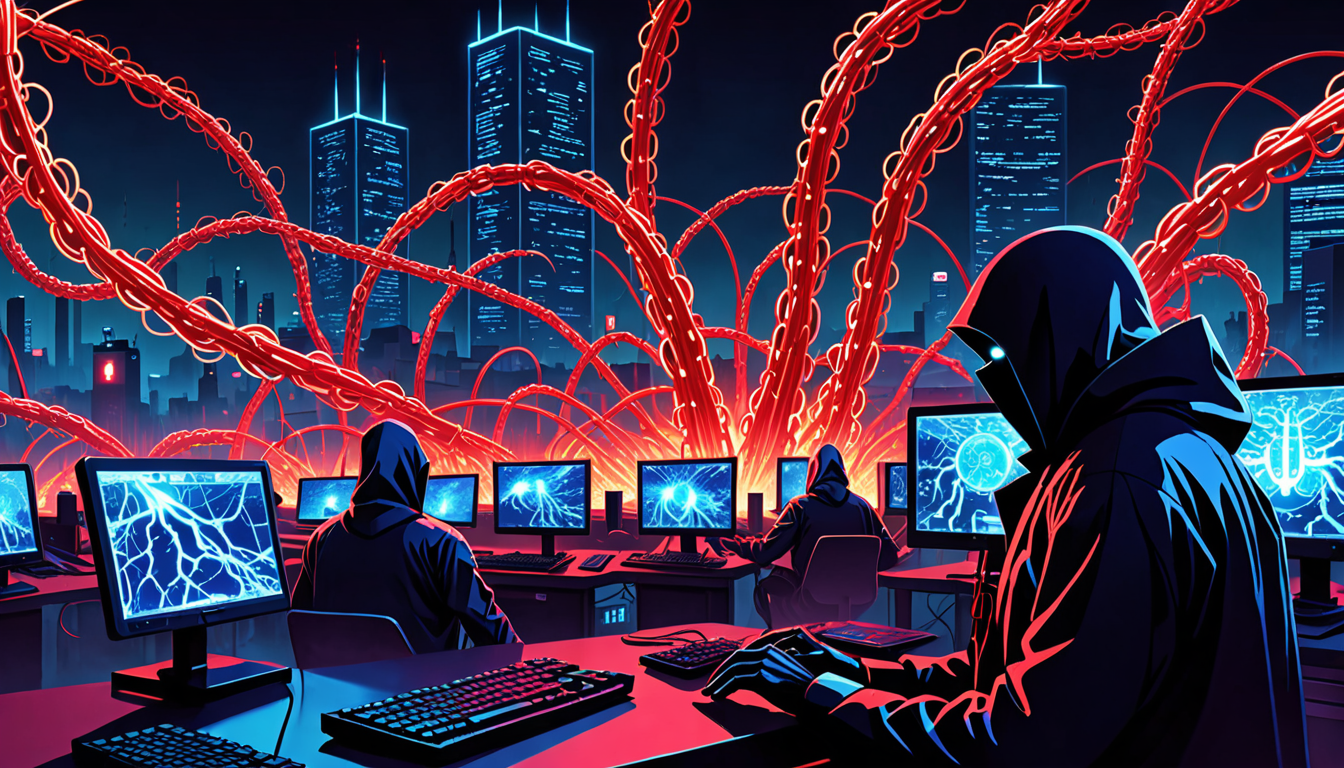
As bombs fall on Tehran, pro-Iran hackers strike U.S. hospitals — exposing the asymmetric cyber battlefield that no missile defense can stop
Executive Summary
- Pro-Iran hacktivist group Handala has wiped 200,000+ systems at U.S. medical tech giant Stryker ($450M Pentagon contractor), disrupting hospital equipment across 79 countries — the first major Iranian cyber retaliation since Operation Epic Fury began February 28.
- The cyber front is fundamentally asymmetric: the U.S. and Israel deployed sophisticated offensive cyber operations alongside kinetic strikes (hacking Iran's prayer app, blacking out state media, disrupting military communications), but Iran's retaliatory capability requires nothing more than a laptop and an internet connection — even as its cities burn.
- With dozens of pro-Iran hacktivist groups launching attacks on critical infrastructure, CISA operating with reduced staffing due to the government shutdown, and healthcare/energy/water systems running on outdated controls, the United States faces a cyber vulnerability paradox: the more it dominates kinetically, the more exposed it becomes digitally.
Chapter 1: The Stryker Strike — A Hospital's Nightmare
On March 11, 2026, as American B-2 bombers continued their sorties over Iranian airspace, a different kind of weapon detonated 6,000 miles away. Handala, a pro-Iran hacktivist group that emerged after Hamas's October 7 attack, announced it had breached the servers of Stryker Corporation — a Michigan-based medical technology company that manufactures everything from defibrillators to ambulance cots and serves over 150 million patients worldwide.
The damage was immediate and tangible. Over 200,000 systems, servers, and mobile devices were reportedly wiped across Stryker's offices in 79 countries. In Maryland, the state's emergency medical services issued an urgent notice: Stryker's Lifenet electrocardiogram transmission system — the tool paramedics use to relay cardiac data to hospitals en route — had gone "non-functional in most parts of the state." Emergency responders were forced to revert to radio communication for patient data, a technological regression measured in decades.
Stryker's connection to the war was not incidental. The company held a $450 million Department of Defense contract to supply medical devices to the U.S. military. For Handala, the link was sufficient justification. The group explicitly framed the attack as retaliation for the Minab school bombing — the strike on Shajareh Tayyebeh primary school in southern Iran that killed over 170 schoolgirls, an incident the Pentagon is still investigating.
The Cybersecurity and Infrastructure Security Agency (CISA) launched an immediate investigation. Acting Director Nick Andersen stated the agency was "working shoulder-to-shoulder with public- and private-sector partners" — a reassuring phrase undercut by the reality that CISA itself has been operating at reduced capacity since the government shutdown began 25 days ago.
Hospitals across the country faced an agonizing dilemma: disconnect Stryker equipment from their networks as a precaution, or maintain connectivity and risk further compromise. "Stryker needs to quickly become more forthcoming as hospitals are faced with the dilemma of whether to cut off Stryker or not," one cybersecurity executive in the health sector told CNN. The company's public statement that the incident was "contained" satisfied no one.
Chapter 2: Offense and Defense — The Asymmetry of Cyber War
The Iran conflict has produced the most visible integration of cyber and kinetic operations in the history of modern warfare. Understanding the asymmetry requires examining both sides of the digital battlefield.
The U.S.-Israeli Offensive
Operation Epic Fury was not merely an air campaign. The Chairman of the Joint Chiefs of Staff publicly confirmed that U.S. Cyber Command and U.S. Space Command "effectively disrupted [Iranian] communications and sensor networks" — an extraordinary admission. The Trump administration's willingness to claim credit for offensive cyber operations broke with decades of precedent. When Trump boasted about causing a blackout in Caracas during the Venezuela operation in January, he shattered an unwritten rule: nations do not publicly acknowledge offensive cyber capabilities.
The Israeli dimension was equally sophisticated. BadeSaba, a widely used religious calendar application with over 5 million downloads in Iran, was hacked to deliver anti-regime messages to users. "Anyone who joins in defending and protecting the Iranian nation will be granted amnesty and forgiveness," the messages read — a psychological operation targeting the regime's base through their own devotional tools. Iranian state news agency IRNA's front page was defaced with anti-government messaging, timed precisely to the opening of airstrikes.
Iran's connectivity plummeted to 4% of normal levels — partly from the regime's own defensive internet blackout (a tactic used during 2019 and January 2026 domestic protests), partly from physical damage to fiber optic infrastructure caused by strikes. The digital fog of war became literal.
Iran's Asymmetric Response
Here lies the strategic paradox. The United States spent billions on cyber offensive capabilities, sophisticated zero-day exploits, and coordination with signals intelligence. Iran's response required none of that.
"Cyber operations don't require much infrastructure," Alex Rose, global head of government partnerships at cybersecurity firm Sophos, observed. "A laptop and an internet connection can be enough."
Palo Alto Networks' Unit 42 identified dozens of pro-Iran hacktivist groups that launched attacks since February 28, mostly targeting critical infrastructure. These groups operate in a gray zone between state direction and independent action — making attribution difficult and plausible deniability easy. Handala, according to IBM X-Force Exchange, "employs a broad and evolving toolkit, including phishing, custom wiper malware, ransomware-style extortion, data theft, and hack-and-leak activity."
The Center for Strategic and International Studies (CSIS) framed the core problem: "Iran lacks symmetric conventional response options against the United States and Israel. Instead, the Iranian regime has historically relied on cyber operations and a dispersed array of proxy actors as its instruments of response." The February 28 strikes, CSIS warned, "are more likely to mark the beginning of a new phase of cyber escalation than its conclusion."
Chapter 3: The Target Map — Where America Is Vulnerable
Iran's cyber targeting is not random. Historical patterns and current intelligence assessments point to specific sectors of maximum vulnerability.
Healthcare
The Stryker hack was not Iran's first foray into healthcare disruption. Iranian-linked actors have previously targeted hospital systems, understanding that medical infrastructure generates immediate public pressure on governments. The health sector's vulnerabilities are well-documented: legacy systems, interconnected medical devices with minimal security, and a culture that prioritizes patient access over cybersecurity. The Department of Health and Human Services scrambled to assess patient care impacts from the Stryker breach — a preview of what a more sophisticated, coordinated healthcare attack could achieve.
Water and Energy
CSIS specifically flagged "financial services, water utilities, and transportation infrastructure, many of which rely on outdated control systems" as attractive targets. Iran demonstrated willingness to attack U.S. water systems as early as 2023, when IRGC-affiliated hackers compromised a water authority in Aliquippa, Pennsylvania. Industrial control systems (ICS) and operational technology (OT) in water treatment, oil and gas, and port infrastructure remain chronically under-protected.
The CISA Gap
The timing could not be worse. The government shutdown — now in its 25th day — has hollowed out the very agency responsible for defending against these attacks. CISA personnel are working without pay; non-essential functions have been curtailed. The cybersecurity firm Tenable identified five specific vulnerabilities being actively exploited by Iranian-linked actors, three of which have been added to CISA's Known Exploited Vulnerabilities catalog. But cataloging vulnerabilities and patching them are very different activities — and the latter requires funded, staffed agencies.
| Sector | Iranian Targeting History | Current Vulnerability Level | CISA Staffing Status |
|---|---|---|---|
| Healthcare | Stryker hack (Mar 2026), previous hospital phishing | Critical — legacy systems, IoT medical devices | Reduced (shutdown) |
| Water/Energy | Aliquippa PA water hack (2023), ICS/OT targeting | High — outdated SCADA systems | Reduced (shutdown) |
| Financial Services | Payment system attacks (post-Oct 7) | Moderate — better funded defenses | Reduced (shutdown) |
| Transportation | Port infrastructure, airport IT | High — fragmented systems | Reduced (shutdown) |
| Defense Industrial Base | Stryker ($450M DoD contract) | High — supply chain exposure | Partially operational |
Chapter 4: Historical Precedents — Cyber Wars Past and Present
Stuxnet: The Original Sin (2010)
The irony is inescapable. The United States and Israel pioneered state-sponsored cyber warfare against Iran with Stuxnet, the malware that destroyed approximately 1,000 Iranian uranium enrichment centrifuges at the Natanz facility. That operation, first revealed in 2010, established the precedent that cyber weapons could cause physical destruction to critical infrastructure. Iran learned the lesson and began building its own capabilities.
The progression from victim to perpetrator took roughly a decade. By 2012, Iran launched Shamoon against Saudi Aramco, wiping 30,000 workstations. By 2023, Iranian hackers were inside U.S. water systems. By 2026, they wiped 200,000 systems at a Pentagon medical contractor. The student has not surpassed the teacher — but in asymmetric warfare, it doesn't need to.
Russia-Ukraine: The Cyber Precedent (2022-Present)
Russia's full-scale invasion of Ukraine was preceded and accompanied by massive cyber operations, including the Viasat satellite hack that disrupted Ukrainian military communications on the first day of the invasion. But the Ukraine experience also revealed cyber warfare's limitations: kinetic destruction proved far more impactful than digital disruption in a conventional conflict. Cyber operations were most effective as force multipliers — degrading command and control, sowing confusion, enabling precision targeting.
The Iran conflict inverts this lesson. For the United States, with overwhelming kinetic superiority, cyber is indeed a force multiplier. For Iran, with no conventional options, cyber is the primary domain of retaliation against the American homeland.
The WannaCry/NotPetya Lesson (2017)
The most dangerous aspect of cyber warfare is collateral damage. NotPetya, launched by Russian military intelligence against Ukraine, caused $10 billion in global damages — hitting Maersk shipping, Merck pharmaceuticals, and FedEx subsidiary TNT Express. Cyber weapons do not respect borders or targets. A wiper malware deployed against a U.S. military contractor can cascade through global supply chains, exactly as Stryker's disruption spread across 79 countries.
Chapter 5: Scenario Analysis — The Cyber Escalation Ladder
Scenario A: Contained Hacktivism (30%)
Description: Pro-Iran hacktivist groups continue opportunistic attacks on soft targets — corporate systems, websites, low-security infrastructure — causing embarrassment and disruption but no catastrophic damage.
Rationale:
- Historical pattern: Iran's hacktivist proxies (Handala, CyberAv3ngers, Moses Staff) have consistently targeted low-hanging fruit rather than hardened systems
- The Stryker attack, while dramatic, was a wiper attack on corporate IT, not an OT/ICS compromise
- U.S. cybersecurity private sector (CrowdStrike, Palo Alto, Mandiant) provides robust commercial defense
- Iran's internet blackout at 4% connectivity complicates coordination between Tehran and external proxy groups
Trigger conditions: Conflict ends within 2-4 weeks; Iran's cyber command structure remains disrupted by kinetic strikes; U.S. patches critical vulnerabilities despite shutdown
Historical parallel: Post-October 7 hacktivist surge — loud, frequent, but limited in strategic impact
Scenario B: Critical Infrastructure Strike (45%)
Description: Iranian state-directed (not just hacktivist) cyber operations successfully disrupt a major piece of U.S. critical infrastructure — a water treatment facility, regional power grid segment, or port operations system.
Rationale:
- CSIS explicitly warns this is the most likely escalation path: "Cyberspace is a key domain where the Iranian regime's response will unfold"
- Iran has demonstrated OT/ICS capability (Aliquippa water authority, Saudi Aramco)
- CISA's reduced capacity during the shutdown creates a window of vulnerability
- The longer the kinetic conflict continues, the stronger the political imperative for Iran to demonstrate it can "reach" the American homeland
- Unit 42 identified dozens of active groups — only one needs to succeed
Trigger conditions: Conflict extends beyond 3 weeks; a major civilian casualty event (like Minab) intensifies Iranian motivation; CISA remains under-resourced; a critical zero-day in ICS/SCADA systems is exploited
Historical parallel: Shamoon 2.0 against Saudi Arabia (2016-2017) — state-directed destructive attacks on critical infrastructure during periods of geopolitical tension
Scenario C: Cyber Escalation Spiral (25%)
Description: A successful Iranian cyber attack on U.S. infrastructure triggers U.S. cyber retaliation against Iranian civilian systems (banking, telecommunications), creating a self-reinforcing escalation cycle that extends the conflict's duration and scope.
Rationale:
- The Trump administration has demonstrated unprecedented willingness to publicly claim credit for offensive cyber operations (Venezuela, Iran)
- Domestic political pressure to "respond" to a visible cyber attack on U.S. soil would be intense
- Iran's 4% internet connectivity means further U.S. cyber attacks would primarily impact civilian populations, generating humanitarian concerns
- Escalation dynamics in cyberspace are poorly understood — there are no established norms, red lines, or arms control frameworks
Trigger conditions: A visible, attributable Iranian cyber attack causes measurable harm to U.S. civilians (hospital disruption, water contamination, power outage); Trump administration frames response as "cyber self-defense"; Iran retaliates further
Historical parallel: No direct precedent — this would represent a novel form of interstate conflict. The closest analogy is the tit-for-tat cyber operations between the U.S. and Iran in 2019-2020 (U.S. cyber strikes on IRGC databases after drone shootdown), but at a dramatically higher intensity
Chapter 6: Investment Implications
The cyber dimension of the Iran conflict creates distinct investment opportunities and risks beyond the well-covered energy and defense themes.
Direct Beneficiaries
Cybersecurity stocks are the clearest play. The Stryker hack — combined with CISA's warnings and the government's reduced defensive posture — will accelerate both government and private sector cybersecurity spending.
- CrowdStrike (CRWD): Market leader in endpoint protection; direct beneficiary of incidents like Stryker's wiper attack
- Palo Alto Networks (PANW): Unit 42 is the leading tracker of Iranian cyber groups; reputation boost drives enterprise sales
- Fortinet (FTNT): Strong in OT/ICS security — the exact segment Iran is targeting
- CyberArk (CYBR): Privileged access management; the DOGE-SSA breach and Stryker hack both highlight identity security failures
- SailPoint (SAIL): Identity governance; enterprises will rush to audit access controls
Indirect Casualties
Healthcare IT stocks face headwinds from the Stryker precedent. Hospitals will demand higher security standards from vendors, increasing costs and slowing procurement cycles.
Cyber insurance premiums are set to spike. Just as war-risk shipping premiums have risen from 0.25% to 1.5% of vessel value, cyber insurance underwriters will reprice policies for organizations with exposure to geopolitically motivated attacks.
| Investment Theme | Tickers | Catalyst | Risk |
|---|---|---|---|
| Cybersecurity leaders | CRWD, PANW, FTNT | Iranian threat escalation, CISA gaps | Valuation already elevated |
| Identity/access management | CYBR, SAIL | Stryker breach, DOGE-SSA incident | Sector rotation risk |
| Healthcare IT vulnerability | SYK (short risk) | Supply chain security mandates | Recovery if conflict ends quickly |
| Cyber insurance | CB (Chubb), AIG | Premium repricing, increased demand | Claims exposure if attacks succeed |
| Federal IT modernization | BAH, LDOS | Post-conflict CISA recapitalization | Dependent on shutdown resolution |
Conclusion
The Stryker hack is a warning shot, not an anomaly. Iran's cyber capabilities were designed for exactly this moment — a conflict where conventional retaliation is suicidal but digital retaliation is both feasible and politically necessary. The United States faces a vulnerability paradox: its kinetic dominance over Iran is absolute, but its digital attack surface — sprawling across healthcare, energy, water, finance, and transportation — is vast and insufficiently defended.
The government shutdown compounds the risk. CISA, the nation's primary cyber defense coordinator, is operating on a skeleton crew as dozens of Iranian-linked threat groups probe American infrastructure. The Stryker incident disrupted hospital equipment in 79 countries; the next attack may target something less forgiving than an electrocardiogram transmission system.
Stuxnet opened Pandora's box sixteen years ago. The worms have come home.
Related Reading
- The Hollowing of Washington — DOGE's impact on federal cybersecurity capacity
- God-Level Access — The DOGE-SSA data breach and federal IT vulnerabilities
- Trade & Tariffs Hub
Leave a Reply