
How Rheinmetall's record €63.8 billion backlog, Brussels' first-ever defense exhibition, and the Readiness 2030 roadmap are forging Europe's defense-industrial revolution
Executive Summary
- Rheinmetall's 2025 results reveal the defense-industrial pivot in action: €9.9B revenue (+29%), record €63.8B backlog (+36%), and a deliberate exit from automotive manufacturing — with former car factories being repurposed for armored vehicle production to meet NATO demand.
- BEDEX, Brussels' inaugural defense exhibition (March 12-14), marks a symbolic watershed: the political capital of Europe and NATO now hosts its own arms fair, with NATO Secretary General Rutte and Belgian PM De Wever opening the event alongside 150+ defense companies.
- The EU's Defence Readiness Roadmap 2030 and €800 billion ReArm Europe framework are converting political rhetoric into industrial targets, while Thales' SkyDefender integrated missile shield, Lithuania's 5-6% GDP defense spending, and EUCOM's "Europe can lead conventional defense by 2035" timeline signal that the continent's rearmament is no longer aspirational — it is operational.
Chapter 1: The Rheinmetall Bellwether — Shedding Civilian Skin
When Rheinmetall CEO Armin Papperger presented the company's 2025 annual results on March 11, the numbers told a story far bigger than one company's balance sheet. With consolidated sales of €9.9 billion — up 29% year-over-year — and an operating profit of €1.8 billion (+33%), the Düsseldorf-based conglomerate delivered perhaps the clearest evidence yet of Europe's defense-industrial metamorphosis.
But the most revealing figure was not revenue growth. It was the backlog: €63.8 billion, a 36% surge from €46.9 billion at year-end 2024. To put this in perspective, Rheinmetall's order book now exceeds the entire annual defense budget of every European country except Germany, France, and the United Kingdom. Notable contracts included Germany's TaWAN digitization program and escalating demand for air defense systems and ammunition — the two capability gaps that the war in Ukraine exposed most painfully.
What makes Rheinmetall's transformation particularly instructive is the deliberate amputation of its civilian identity. In December 2025, the Executive Board formally designated its Power Systems division — which manufactured internal combustion engine components, pistons, and actuators — as a discontinued operation, taking a €350 million non-cash impairment charge. The sale process has narrowed to two final bidders, with closing expected by Q2 2026.
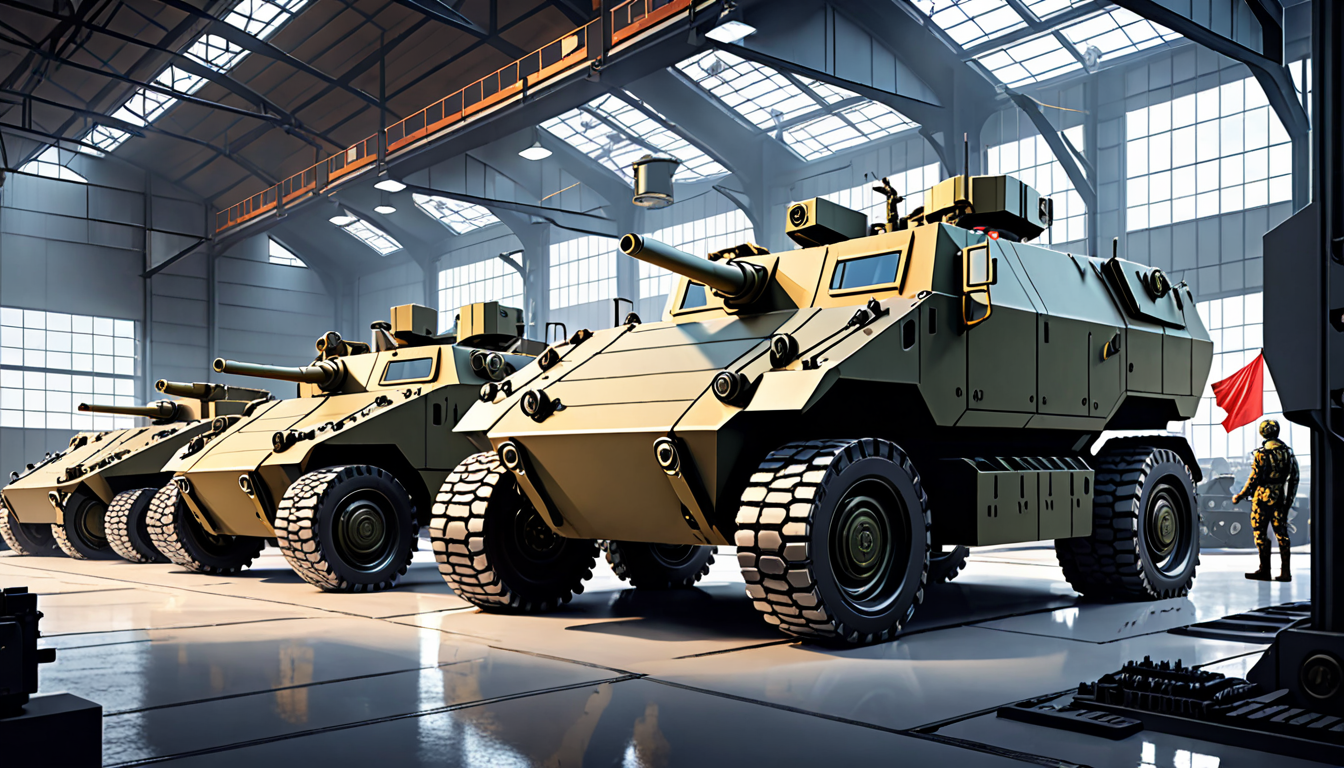
This is not mere corporate restructuring. It is industrial policy made flesh. Rheinmetall is actively exploring the repurposing of former automotive manufacturing facilities for armored vehicle production. In a continent where decades of peace dividends hollowed out defense-industrial capacity, the idea of converting a piston factory into a Panther KF51 main battle tank assembly line captures the scale of transformation underway.
The company's 2026 guidance — sales of €14 billion to €14.5 billion, representing 40-45% growth — would be aggressive in any industry. In defense, where procurement cycles traditionally span years, it is extraordinary. Rheinmetall is simultaneously integrating newly acquired naval shipbuilder NVL, splitting its Electronic Solutions unit into two standalone divisions (Air Defence and Digital Systems), and establishing a fifth segment in Naval Systems. The organizational complexity is immense, but the underlying market, as Papperger noted, "remains strongly supportive."
| Metric | 2024 | 2025 | Change | 2026 Guidance |
|---|---|---|---|---|
| Revenue | €7.7B | €9.9B | +29% | €14-14.5B |
| Operating Profit | €1.4B | €1.8B | +33% | – |
| Backlog | €46.9B | €63.8B | +36% | – |
| Net Income | €717M | €696M | -3% | – |
The decline in net income despite surging revenue reflects the cost of industrial transformation itself: higher interest expenses and massive capital investments in production capacity. Rheinmetall is spending now to build the arsenal that Europe will need for the next decade.
Chapter 2: BEDEX — Brussels Gets Its Arms Fair
On March 12, something happened in Brussels that would have been unthinkable five years ago: the political capital of Europe hosted its first-ever defense exhibition.
BEDEX — the Brussels European Defence Exhibition and Conference — opened at Brussels Expo with NATO Secretary General Mark Rutte, Belgian Prime Minister Bart De Wever, and Defense Minister Theo Francken among the inaugural participants. Over 150 companies, including approximately 50 Belgian firms, filled two exhibition halls. The event was fully booked before opening day.
The symbolism matters more than the commercial activity. Paris has Eurosatory. London has DSEI. Farnborough has its airshow. But Brussels — despite hosting both NATO headquarters and the EU institutions — had never staged a comparable defense-industrial gathering. The absence was itself a statement about European strategic culture: defense was something that happened elsewhere, funded reluctantly, discussed in hushed tones at dinner parties.
BEDEX's arrival signals the definitive end of that era. As the organizers framed it, the exhibition serves "as a gateway to Belgium, Europe, and NATO" — a triple identity that no other city can claim. The professional days (March 12-13) focused on product demonstrations, contract negotiations, and high-level networking between government buyers and defense manufacturers. The public day (March 14), notably, includes recruitment areas, interactive military activities, and direct contact with engineers and cybersecurity specialists — a tacit acknowledgment that Europe's defense-industrial expansion requires not just political will and capital, but human talent.
The timing is deliberate. BEDEX arrives as the European Parliament voted on March 11 to demand a genuine single market for defense, a clearer "buy European" approach in procurement, and faster action on flagship defense projects. MEPs argued that fragmented procurement and dependence on non-EU suppliers weaken Europe's ability to deter threats and sustain prolonged operations — a message that the Iran conflict has made viscerally urgent.
Chapter 3: Readiness 2030 — The Industrial Blueprint
The European Commission's Defence Readiness Roadmap 2030, now the central planning document for continental rearmament, identifies four flagship projects that reveal where the capability gaps are most acute:
- Eastern Flank Watch — surveillance and force posture along NATO's border with Russia
- European Drone Defence Initiative — countering the asymmetric threat demonstrated in Ukraine and now Iran
- European Air Shield — integrated air and missile defense across the continent
- European Space Shield — space-based surveillance and communication resilience
The roadmap sets an ambitious timeline: project launches across all priority areas in the first half of 2026, initial industrial-capacity data collection by mid-2026, and capability shortfalls progressively closed by 2030. Air and missile defense, artillery, ammunition, drones, cyber capabilities, and military mobility are listed as the most urgent gaps.
Thales' March 11 unveiling of SkyDefender — an integrated air and missile defense system combining anti-drone protection, medium-range missile defense, and long-range radar coverage into a single layered architecture — directly addresses the European Air Shield flagship. The system's design philosophy reflects hard-won lessons from Ukraine, where cheap drones and ballistic missiles demand fundamentally different defensive responses that must be networked into a single kill chain.
The financial architecture behind Readiness 2030 is the ReArm Europe framework, which aims to mobilize up to €800 billion in additional defense spending. This includes greater fiscal flexibility for member states (relaxed EU deficit rules for defense investment) and the €150 billion SAFE loan instrument for joint procurement in priority areas. The stated objective is not merely higher spending, but more joint spending and more spending inside Europe's own industrial base — a direct response to SIPRI data showing that 42% of global arms exports still come from the United States.
Chapter 4: The 2035 Horizon — EUCOM's Benchmark
EUCOM Commander General Alexus Grynkewich — simultaneously NATO's Supreme Allied Commander Europe — told reporters on March 12 that Europe could lead its own conventional defense "by 2035", noting that a handful of nations are near or have already met the alliance-wide target to spend 5% of GDP on defense.
Lithuania exemplifies the vanguard: it announced defense spending of 5-6% of GDP from 2026, citing the direct Russian threat. Poland, already at 4.5%, is building what has been described as the EU's largest conventional army. Germany's €550 billion rearmament program, enabled by constitutional amendment to exempt defense from the debt brake, represents the largest single commitment.
The 2035 timeline is significant because it represents the first time a senior American military official has offered a concrete date for European defense self-sufficiency. It is simultaneously reassuring (Europe can do this) and alarming (it will take nearly a decade). The gap between now and 2035 is the danger zone — the period when political commitments have been made but industrial capacity has not yet caught up.
This is precisely why the Rheinmetall story matters. The company's 40-45% growth forecast for 2026, its factory-conversion strategy, and its €63.8 billion backlog are not just corporate metrics. They are leading indicators of whether Europe's defense-industrial base can scale fast enough to close the window of vulnerability.
Chapter 5: Scenario Analysis — Europe's Defense-Industrial Future
Scenario A: Accelerated Autonomy (35%)
Thesis: The Iran conflict, combined with the SCOTUS IEEPA ruling and Trump's transactional approach to alliances, accelerates European defense self-reliance beyond current plans.
Triggers: Continued U.S. strategic distraction in the Middle East; further erosion of Article 5 credibility; successful execution of SAFE bond issuance; Rheinmetall and peers meeting production targets.
Historical precedent: France's post-Suez nuclear program (1956-60), which transformed humiliation into strategic autonomy within four years.
Investment implications: European defense primes (Rheinmetall, Leonardo, Saab, Thales, BAE Systems) outperform; U.S. defense exporters (Lockheed Martin, Raytheon) face European market share erosion; European defense ETFs become core holdings.
Scenario B: Execution Gap (45%)
Thesis: Political ambitions outrun industrial capacity. Labor shortages, supply chain bottlenecks, and fiscal constraints slow the rearmament timeline beyond 2035.
Triggers: Failure to attract skilled workers; critical component shortages (semiconductors, specialty metals); fiscal pushback from voters facing energy-driven inflation; FCAS/SCAF program continued dysfunction.
Historical precedent: NATO's 1952 Lisbon Force Goals, which called for 96 divisions by 1954 but were never achieved, leading to nuclear dependence instead.
Investment implications: Mixed — defense stocks maintain elevated valuations on order books but face delivery risk; maintenance and sustainment companies outperform platforms; ammunition producers (Nammo, KNDS) become bottleneck beneficiaries.
Scenario C: Transatlantic Reconciliation (20%)
Thesis: Post-Iran settlement and/or post-2026 midterm political shift restores U.S.-European defense cooperation, reducing urgency for European autonomy.
Triggers: Iran ceasefire; U.S. midterm results favoring multilateralists; new transatlantic defense-industrial agreement; interoperability requirements override "buy European" impulses.
Historical precedent: Post-Korean War NATO burden-sharing, which settled into a stable (if unequal) pattern for decades.
Investment implications: U.S.-European joint ventures (MBDA, FCAS if revived) benefit; pure "buy European" plays underperform expectations; transatlantic defense integration companies emerge.
Chapter 6: Investment Implications — The Defense-Industrial Complex Reimagined
The defense-industrial metamorphosis creates a distinct investment landscape:
Clear winners:
- Rheinmetall (€14-14.5B 2026 guidance, automotive divestiture, factory conversion)
- Saab (Gripen, Carl Gustaf, submarine demand across NATO)
- Leonardo (Italian defense champion, BEDEX exhibitor, naval systems)
- Thales (SkyDefender, radar/electronic warfare, French nuclear infrastructure)
- Hensoldt (sensors, electronic warfare, German defense electronics)
Ammunition and munitions:
- Nammo (Nordic ammunition consortium)
- KNDS (Franco-German land systems)
- Diehl Defence (IRIS-T air defense, missiles)
Infrastructure beneficiaries:
- Ruag (Swiss MRO and ammunition)
- General Dynamics European Land Systems (Boxer vehicles)
- European steel, specialty metals, and semiconductor companies supplying defense
Risk factors:
- Execution risk on 40-45% growth at Rheinmetall specifically
- FCAS/SCAF program dysfunction could waste billions
- Labor market constraints — Europe faces a structural shortage of defense-qualified engineers and skilled manufacturing workers
- Fiscal sustainability if the Iran conflict drives stagflation, squeezing both defense budgets and consumer spending simultaneously
Conclusion: The Industrial Rubicon
Europe has crossed an industrial Rubicon. The question is no longer whether the continent will rearm — Rheinmetall's €63.8 billion backlog, BEDEX's debut, Readiness 2030's flagship projects, and Lithuania's 5-6% GDP commitment have settled that question definitively. The real question is whether Europe's defense-industrial base can scale fast enough to meet the threat environment.
Converting car factories to tank plants is not a metaphor. It is Rheinmetall's actual business plan. And in that mundane industrial reality — not in the grand speeches at Munich or Brussels — lies the true test of European strategic autonomy.
The 2035 timeline offered by EUCOM is both a promise and a warning. Europe has a decade to build the arsenal of democracy on its own soil. The Iran conflict, consuming American attention, ammunition, and strategic bandwidth, has made that timeline feel both more urgent and more uncertain.
For investors, the message is clear: European defense is no longer a cyclical trade. It is a structural reallocation of continental resources, comparable in scale to the post-war reconstruction or the single market project. The companies and countries that execute fastest will define Europe's strategic position for a generation.
Sources: Rheinmetall AG 2025 Annual Report, BEDEX Brussels, EU Today, Defense Security Monitor, European Commission Defence Readiness Roadmap 2030, European Parliament, EUCOM, Thales, Reuters
Leave a Reply