
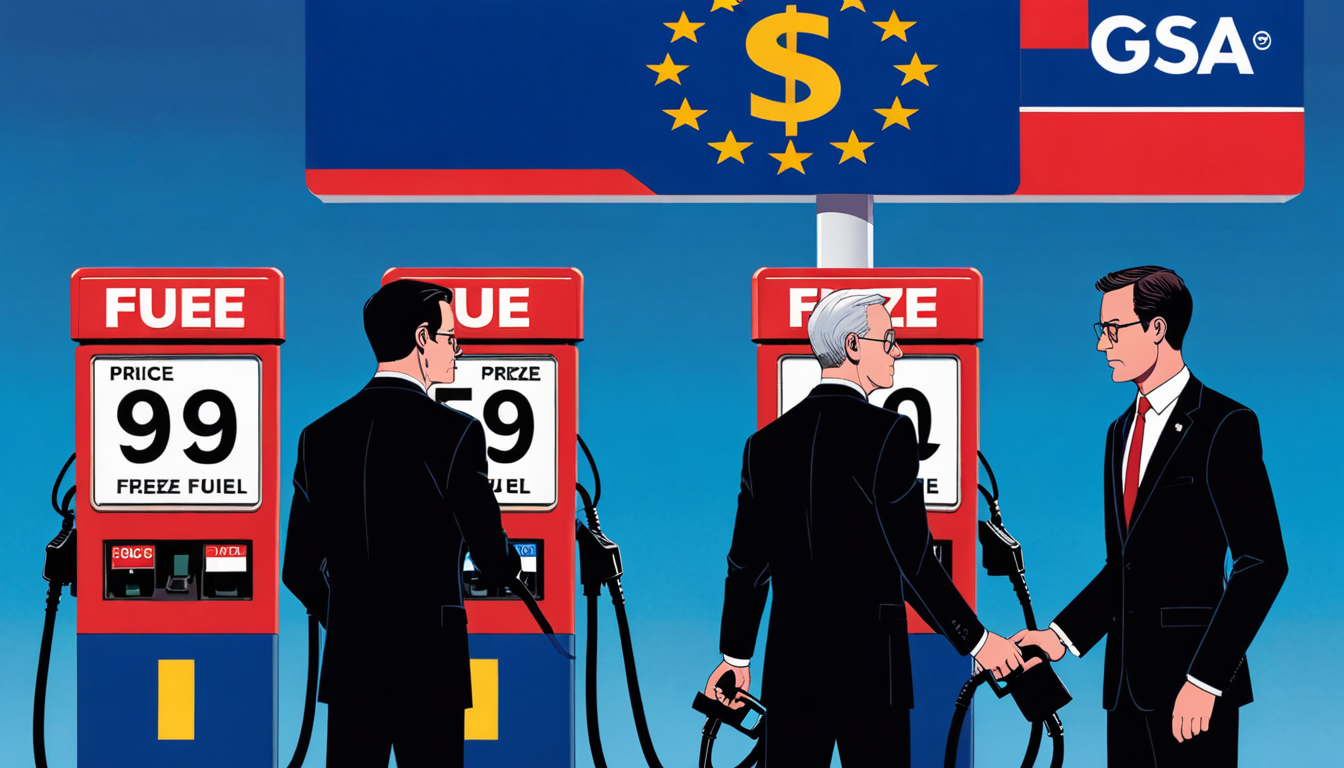
Three EU governments deployed price controls within 24 hours—a desperate gamble that history says rarely ends well
Executive Summary
- Germany, Greece, and Italy simultaneously enacted emergency price control measures on March 11, marking the most aggressive consumer price intervention in the EU since the 2022 energy crisis—and arguably the most interventionist since the 1970s oil shock.
- The coordinated but unplanned nature of these moves—each country acting independently within hours of the others—reveals a continent-wide political panic that transcends ideology, as center-right (Greece, Germany) and center-left (Italy) governments reach for the same blunt instrument.
- While politically expedient, price controls carry a well-documented history of failure: from Nixon's 1971 wage-price freeze to Venezuela's hyperinflationary spiral, they tend to suppress symptoms while worsening the underlying disease—and Europe's energy dependency makes it particularly vulnerable to these second-order effects.
Chapter 1: 24 Hours That Shook the Free Market
On the morning of March 11, 2026, three of Europe's largest economies reached for an economic tool that most Western policymakers had consigned to history's dustbin: direct price controls.
Germany moved first. Economy Minister Katherina Reiche announced that petrol stations would be restricted to a single price increase per day—a measure borrowed from Austria's existing regulatory framework. The rule, which allows unlimited price decreases but only one upward adjustment, was framed as a transparency measure. In practice, it represents the German government's first direct intervention in retail fuel pricing since the post-reunification era.
Hours later, Greece followed with a far more aggressive package. Prime Minister Kyriakos Mitsotakis imposed a three-month cap on profit margins across fuel and essential groceries. The specifics are striking in their granularity: wholesale fuel margins capped at €0.05 per liter, retail station margins at €0.12 per liter, and food products forbidden from carrying higher margins than their 2025 baselines. Violations carry fines of up to €5 million. The measures take immediate effect and run until June 30, 2026.
Italy, meanwhile, took a fiscal approach—redirecting surplus VAT revenue generated by inflated prices back toward consumer relief, while deploying anti-profiteering enforcement teams. Development Minister Theodorikakos captured the political mood across all three capitals with a single sentence: "Profit is legitimate—but profiteering is not."
The backdrop to this synchronized intervention is unambiguous. Since the US-Israel strikes on Iran began on March 1, Brent crude has surged past $120 per barrel. German petrol prices hit €2.045 per liter for Super E10 and €2.188 for diesel—increases of over 20% in less than two weeks. Greek consumers face similar spikes, compounded by the country's island geography and transport costs. Across the EU, headline inflation expectations are being revised sharply upward.
What makes this moment remarkable is not that governments intervened—they always do when fuel prices spike—but that three ideologically diverse governments chose nearly identical tools within the same 24-hour window, without formal coordination.
Chapter 2: The Deeper Architecture of Panic
The national-level price controls are only the most visible layer of a broader European response. At the EU level, a parallel—and potentially more consequential—shift is underway.
According to an internal Council document dated March 9 and seen by Euronews, EU leaders are pushing the European Commission to "urgently present concrete proposals to bring down power costs in the short term." More significantly, the document calls for a review of the EU Emissions Trading System (ETS) by July 2026—a move that could fundamentally alter the bloc's climate architecture.
The ETS, which forces companies to purchase carbon permits for their pollution, has long been a cornerstone of EU climate policy. But as energy prices spike, the carbon price—currently around €70 per tonne—is being reframed not as a climate tool but as an inflationary accelerant. Italy has already called for a full suspension of the carbon market. Seven other EU ministers countered with a letter urging the Commission to maintain the system's integrity.
Even more striking is the discussion of an EU-wide gas price cap. During the 2022 energy crisis, the Commission proposed and eventually implemented a cap on TTF gas futures at €180/MWh—a ceiling so high it was never triggered. Germany and the Netherlands led opposition to the cap, arguing it would impair Europe's ability to compete with Asian buyers for LNG cargoes.
Now, with Qatar's LNG production disrupted by the Iran war and European gas prices spiking once more, the Commission is revisiting the idea. Germany—which previously led the opposition—has gone silent on the matter, consumed by its own domestic pricing emergency. The political landscape that made a meaningful cap impossible in 2022 may have fundamentally shifted.
This is significant because it reveals how quickly a security crisis can override decades of market orthodoxy. The EU's single market was built on the principle of undistorted competition. Price controls—whether at the national level (fuel margins) or the supranational level (gas caps, carbon market suspension)—represent a direct challenge to that founding logic.
Chapter 3: The Stakeholder Calculus
Consumers are the intended beneficiaries but may not be the actual ones. Germany's once-per-day pricing rule has already drawn criticism from analysts who warn that stations will simply set higher morning prices to hedge against intraday market movements. The Austrian model, on which the German rule is based, has produced lower average prices—but Austria also has significantly lower fuel taxes, a factor that explains more of the price difference than the pricing regulation itself.
Oil majors and fuel distributors face margin compression, but their response is predictable. Shell, BP, and TotalEnergies' European refining operations are already running at reduced throughput due to crude quality mismatches (the loss of Middle Eastern medium-sour grades has left European refineries calibrated for feedstock that no longer arrives). Margin caps may accelerate decisions to idle or permanently close marginal refining capacity—worsening the very supply constraints driving the price spikes.
The European Commission faces an institutional dilemma. Approving national price controls risks fragmenting the single market. Opposing them risks political irrelevance during a cost-of-living crisis. The compromise—an ETS review that may weaken climate commitments without meaningfully lowering prices—satisfies nobody.
Climate advocates see the crisis as validation of their argument that renewable energy is the only path to energy independence. Greece's energy minister pointedly noted that over 50% of the country's electricity now comes from renewables. But the crisis is in transport fuels and heating, where electrification remains years away—and the political pressure is for immediate relief, not structural transformation.
Financial markets are reading the controls as a signal of political fragility. The euro has weakened against the dollar since the interventions were announced, and European bank stocks—already under pressure from recession fears—fell further on concerns that margin caps could spread to other sectors.
Chapter 4: Scenario Analysis
Scenario A: Controlled Burn (35%)
The price controls prove to be a short-lived political gesture. The Iran conflict de-escalates within weeks, oil prices retreat below $100, and the controls are quietly withdrawn before their distortionary effects become visible. The ETS review produces cosmetic tweaks—a price corridor rather than a cap—that satisfy political demands without gutting the carbon market.
Why 35%: This scenario requires a rapid resolution of the Iran conflict, which the "Mission Accomplished" rhetoric from Washington suggests is desired but which the military reality on the ground (Hezbollah escalation, Iraqi tanker attacks, Hormuz mine threat) does not support. Historical precedent: the 2022 EU gas price cap was implemented after the worst of the crisis had passed and was never triggered—a "price control" that functioned as pure political signaling.
Trigger conditions: Ceasefire or de-escalation in Iran; Brent below $95 for two consecutive weeks; no further Hormuz disruptions.
Scenario B: Creeping Controls (45%)
The conflict persists, prices remain elevated, and the "temporary" controls become semi-permanent features. Greece extends its margin caps beyond June 30. Germany adds grocery pricing restrictions. Other EU members—Spain, Portugal, Poland—implement their own versions. The ETS is effectively suspended for "review," depressing the carbon price and undermining green investment signals. A two-tier economy emerges: controlled prices for consumers, market prices for industry, with the gap bridged by fiscal transfers that strain already-stretched budgets.
Why 45%: This is the most historically consistent outcome. Nixon's "temporary" price controls of 1971 went through four phases and lasted until 1974. The UK's wartime rationing, introduced as an emergency measure in 1940, persisted until 1954. Once governments discover that removing price controls triggers the very price spikes they were designed to prevent, political incentives strongly favor extension. The Iran war shows no signs of rapid resolution, and the FOMC meeting next week (March 17-18) is expected to hold rates, meaning no monetary policy relief for inflation.
Trigger conditions: Iran conflict continues past April; oil above $100 sustained; EU elections or national polls show ruling parties losing ground on cost-of-living.
Scenario C: Control Failure and Market Backlash (20%)
Price controls create acute supply distortions. Greek fuel stations, unable to earn adequate margins on island routes, begin rationing or closing. German pricing restrictions lead to morning price spikes that exceed pre-regulation averages. The EU gas cap, if implemented, causes LNG cargoes to be diverted to Asian buyers willing to pay market rates—recreating the 2022 dynamic where Europe was outbid for winter supplies. A policy reversal is forced, but not before significant economic damage.
Why 20%: Full control failure requires sustained high prices AND supply constraints simultaneously—a combination that is possible given Hormuz disruption but requires the worst-case energy scenario. Historical precedent: Venezuela's price controls under Chávez (2003 onward) produced shortages within 18 months; the US's Natural Gas Policy Act of 1978 created artificial gas shortages that lasted years. However, EU institutions have more capacity to self-correct than these precedents suggest.
Trigger conditions: Hormuz remains closed beyond 30 days; EU gas storage falls below 15%; LNG cargo diversions to Asia documented; visible shortages at fuel stations.
| Factor | Scenario A (35%) | Scenario B (45%) | Scenario C (20%) |
|---|---|---|---|
| Oil price | Below $95 | $100-120 sustained | Above $120 sustained |
| Iran conflict | De-escalation | Stalemate | Escalation |
| Controls duration | 1-2 months | 6+ months | 3-6 months then collapse |
| ETS impact | Cosmetic review | Effective suspension | Market dysfunction |
| Inflation trajectory | Returns to 2.5% | Rises to 4-5% | Stagflation above 5% |
Chapter 5: Investment Implications
Energy equities remain the dominant trade. The price controls themselves are bearish for downstream margins but bullish for the upstream producers whose product is being price-controlled. Shell, TotalEnergies, and BP face European margin compression but benefit from elevated crude prices globally. The disconnect between controlled European retail prices and uncontrolled global wholesale prices creates a structural arbitrage.
European utilities face a split regime. Companies with high renewable exposure (Iberdrola, Ørsted, EDP Renováveis) benefit from the political narrative that renewables equal energy independence. But if the ETS is weakened, the economic case for green investment deteriorates—a paradox that markets have not yet priced.
The euro is vulnerable. Price controls signal that European policymakers are prioritizing short-term political stability over market credibility. Combined with the ECB's constrained position (unable to raise rates aggressively into a war-driven supply shock), the euro faces continued pressure against the dollar and the yen.
Consumer staples with European exposure face margin risk. If Greece's grocery margin caps spread to other EU members—a scenario with 45% probability—companies like Carrefour, Ahold Delhaize, and Metro AG face government-mandated margin compression. This is a direct earnings risk that current valuations do not reflect.
Gold and real assets benefit from the policy uncertainty. Every major episode of price controls in modern history has been associated with a loss of confidence in nominal assets. Nixon's controls preceded a doubling of the gold price. The current environment—war, controls, carbon market uncertainty—strengthens the case for real asset allocation.
| Historical Precedent | Duration | Outcome | Market Impact |
|---|---|---|---|
| Nixon price controls (1971-74) | 3 years | Inflation doubled after removal | Gold +350%, S&P -40% |
| UK wartime rationing (1940-54) | 14 years | Gradual removal, no price shock | Gilt yields compressed |
| EU gas price cap (2022-23) | 1 year | Never triggered, symbolic | TTF normalized independently |
| Venezuela controls (2003-2015) | 12 years | Hyperinflation, shortages | Bolivar collapsed |
| Argentina Precios Cuidados (2014-) | Ongoing | Chronic shortages, dual pricing | Parallel exchange rate emerged |
Conclusion
Europe's price control moment is less about economics than about politics. The economic literature is clear: price controls suppress symptoms without treating causes, and when removed, they typically produce the very inflation they were designed to prevent. But the political logic is equally clear: no democratic government can survive fuel prices rising 20% in two weeks without appearing to act.
The deeper risk is not the controls themselves—most are modest enough to avoid acute distortions—but the precedent they set. If the Iran war persists, if Hormuz remains contested, if energy prices stay elevated through the European summer, the pressure to expand and deepen these interventions will become irresistible. The ETS review is the canary: if Europe's flagship climate mechanism is sacrificed on the altar of short-term price relief, the signal to global energy markets will be profound.
The 24-hour window of March 11, 2026, may be remembered not as the day Europe saved its consumers from price gouging, but as the day the free market consensus that has governed European economic policy since the Single European Act of 1986 began to visibly crack.
Leave a Reply