
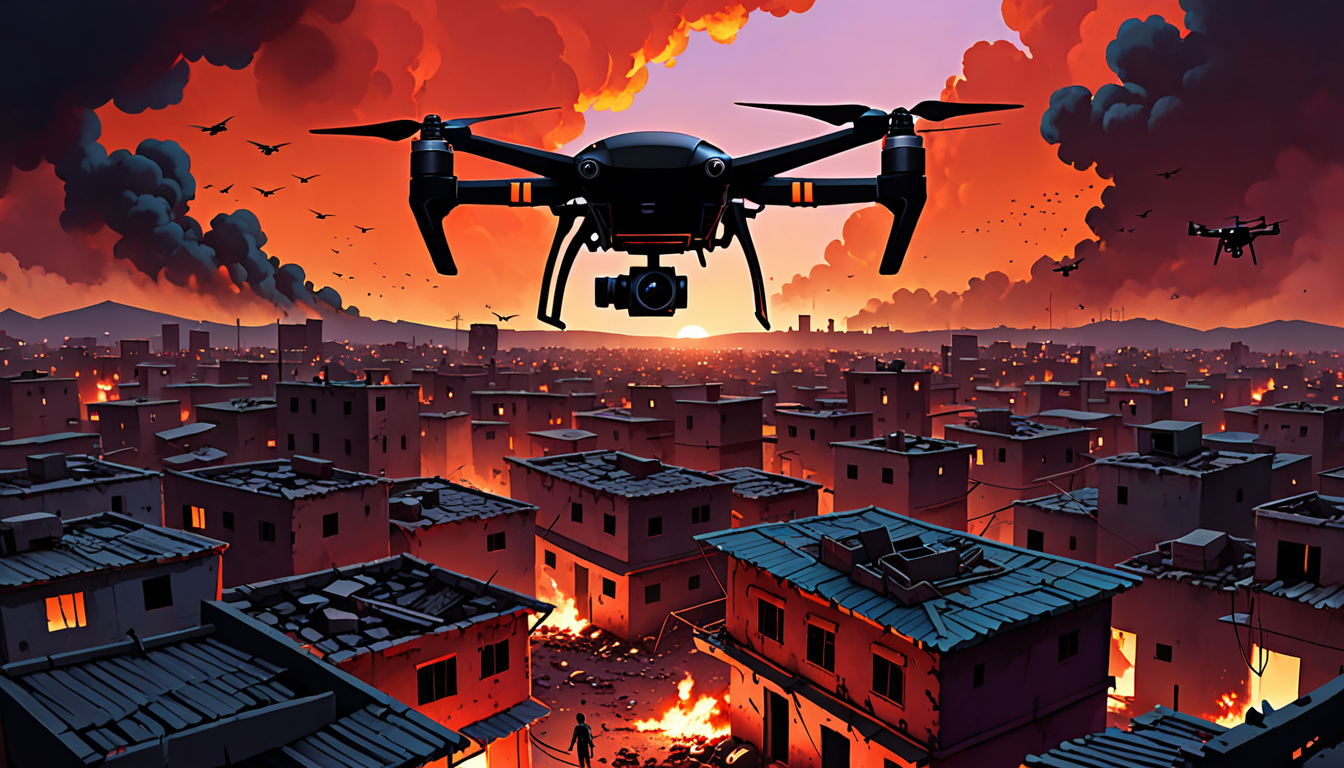
How US-Licensed Killer Drones Turned Port-au-Prince Into a Laboratory of Extrajudicial Execution
Executive Summary
- Human Rights Watch has documented 1,243 people killed and 738 injured by explosive-armed quadcopter drones operated by Haitian security forces and the US-licensed private military contractor Vectus Global between March 2025 and January 2026—making Haiti the world's first case of systematic domestic drone warfare against a civilian population.
- At least 60 civilians including 17 children have been confirmed killed, with drones striking densely populated neighborhoods in Port-au-Prince where 90% of the capital remains under gang control. The most lethal single operation killed 57 people.
- This represents a dangerous new paradigm in state violence: the outsourcing of lethal force to private contractors using commercial drone technology, with zero accountability, no judicial oversight, and explicit US government licensing—raising profound questions about the future of law enforcement, sovereignty, and the weaponization of cheap autonomous technology.
Chapter 1: The Kill Box
Port-au-Prince, a capital city of three million people, has become the world's most disturbing proving ground for a new kind of warfare—one waged not between nations, but by a government against its own urban terrain.
Since March 2025, quadcopter drones armed with explosives have been systematically deployed across nine communes in Haiti's West Department. The drones maneuver between buildings, track moving vehicles and individuals through live video feeds, and detonate on command. The operators sit at remote consoles, watching their targets in real time before triggering the kill.
The scale is staggering. In just eleven months, 141 separate drone operations have killed at least 1,243 people—an average of 8.8 deaths per strike. The tempo has accelerated sharply: 57 strikes were recorded between November 2025 and late January 2026, nearly double the 29 from August through October. Over 40% of all recorded deaths occurred in just seven weeks between December 1 and January 21.
These are not precision strikes in a conventional military sense. They are explosive detonations in densely populated slums where gang members and civilians coexist in the same cramped blocks. On September 20, 2025, a drone struck near the "Nan Pak" sports complex in the Simon Pelé neighborhood as a local gang leader distributed gifts to children. Nine people were killed, including three children aged 3 to 12. Eight more were injured. One witness described how the explosion ripped both feet off a baby.
The mother of a six-year-old girl killed in the strike told investigators: "In the spaces where the gangs are, there are innocent people, people who raise their children, who follow normal paths."
Chapter 2: The Machinery of Death
The drone campaign is the brainchild of Prime Minister Alix Didier Fils-Aimé, who came to power in February 2026 with US backing after Haiti's transitional council handed over authority. But the program predates his tenure. In 2025, the government established a specialized "Task Force" operating outside the oversight of Haiti's National Police—a parallel security apparatus designed specifically for drone operations.
The critical enabler is Vectus Global, a US-based private military company. The US ambassador to Haiti confirmed that the State Department issued an export license for Vectus to provide defense services to Haiti. This makes the US government a direct facilitator of the program: American bureaucrats signed the paperwork that authorized a private company to arm a foreign government with killer drones used against civilian neighborhoods.
The operational model is deceptively simple. Commercial quadcopter drones—the kind available for a few thousand dollars—are modified to carry explosive payloads. They require minimal infrastructure: no runways, no radar networks, no sophisticated command-and-control systems. A handful of operators with laptops and video links can sustain a campaign of targeted killings indefinitely.
Human Rights Watch analyzed seven videos of drone attacks, geolocating four to Port-au-Prince. The footage reveals a disturbing pattern: drones attacking vehicles and individuals who, while sometimes armed, showed no signs of engaging in violent acts or posing imminent threats to life. Under international human rights law, lethal force is permissible only when strictly unavoidable to protect life. Many of these strikes appear to constitute extrajudicial killings—summary executions by remote control.
Neither Prime Minister Fils-Aimé, the Haitian National Police, nor Vectus Global responded to Human Rights Watch requests for comment. The UN Integrated Office in Haiti reported in February that it had no indications the deaths and injuries were being investigated.
Chapter 3: The Accountability Void
Haiti's drone war exposes a triple accountability failure that has implications far beyond the Caribbean.
First, the domestic void. Haiti's judicial system is functionally collapsed. Courts barely operate. The police lack investigative capacity. The Task Force operates outside normal police oversight. There is no independent body reviewing drone strikes, no post-strike damage assessment, and no mechanism for civilian casualties to be documented, much less compensated. Families of those killed reported that the criminal groups controlling their neighborhoods organized and restricted access to funerals—meaning even grief is mediated by the very gangs the drones are supposed to eliminate.
Second, the US export license loophole. The State Department's decision to license Vectus Global for defense services to Haiti effectively outsourced lethal authority to a private company operating in a failed state. Unlike US military operations, which are subject to Congressional oversight, Rules of Engagement, and post-strike review, private military contractors operating under export licenses exist in a legal gray zone. The Arms Export Control Act requires that defense services serve US foreign policy interests, but there is no mandated human rights monitoring after a license is issued.
Third, the international silence. While UN High Commissioner for Human Rights Volker Turk called the strikes "disproportionate and likely unlawful" in October 2025, no concrete action followed. The UN Security Council, consumed by the Iran war and competing crises, has not convened on Haiti. The Multinational Security Support (MSS) mission, already underfunded and understaffed, has proven incapable of restraining the drone campaign it was ostensibly deployed to complement.
The result is a kill-without-consequences paradigm: a government can systematically execute people from the air using private contractors, with explicit US authorization, and face no meaningful legal, diplomatic, or financial repercussions.
Chapter 4: The Drone Proliferation Precedent
Haiti's significance extends far beyond its borders. It represents the first documented case of a government using commercial drone technology for systematic extrajudicial killings against a domestic population—and the implications for global security governance are profound.
The Technology Is Democratized
The quadcopter drones used in Haiti are not the MQ-9 Reapers or Bayraktar TB2s of conventional military drone warfare. They are modified commercial platforms costing a fraction of military-grade systems. The barrier to entry for state-sponsored targeted killing has collapsed from billions of dollars (for a Predator drone program) to tens of thousands (for a fleet of armed quadcopters).
The Model Is Exportable
The Haitian template—government + private military contractor + commercial drones + US export license = sustained extrajudicial killing campaign—is immediately replicable. Countries facing urban insurgency, organized crime, or political opposition need only secure a willing PMC and a permissive export regime. Consider the potential adopters:
- Latin American narco-states already deploying military forces against cartels
- African nations battling jihadist insurgencies in urban areas (Nigeria, Mozambique, Burkina Faso)
- Southeast Asian governments conducting anti-narcotics campaigns (Philippines under Duterte showed the appetite; drones would simply add distance and deniability)
- Authoritarian regimes seeking plausibly deniable methods of eliminating political opponents
The Ukraine Effect
The innovation of armed commercial drones on the Ukraine battlefield has already proliferated to criminal and state actors worldwide. Mexican cartels deployed armed drones against rivals. Myanmar's military used commercial drones against resistance forces. Haiti represents the next evolutionary step: state adoption of battlefield-proven commercial drone tactics for domestic population control.
| Precedent | Technology | Operator | Target | Accountability |
|---|---|---|---|---|
| US Predator/Reaper (2001-) | Military-grade | US military/CIA | Foreign militants | Congressional oversight, post-strike review |
| Turkey TB2 (2016-) | Military-grade | State military | Foreign adversaries | Limited, state self-reporting |
| Ukraine commercial drones (2022-) | Commercial modified | Military/volunteers | Enemy combatants | Wartime rules of engagement |
| Haiti quadcopters (2025-) | Commercial modified | PMC + state police | Domestic population | None |
The table reveals a clear trajectory: from military technology with accountability, to commercial technology with none.
Chapter 5: Scenario Analysis
Scenario A: Containment and Reform (20%)
Premise: International pressure forces Haiti to establish oversight mechanisms for drone operations, and the US tightens export licensing conditions.
Triggers: Major civilian mass casualty event (50+ deaths in single strike documented on video); Congressional investigation into Vectus Global export license; ICC preliminary examination.
Why 20%: Haiti's government has no institutional capacity for reform, and the US has shown minimal interest in constraining its proxy operations in the Western Hemisphere under the current administration. The Trump administration's "Shield of the Americas" doctrine prioritizes security outcomes over human rights processes.
Scenario B: Escalation and Proliferation (50%)
Premise: The drone campaign intensifies as Haiti's government, buoyed by the absence of consequences, expands operations. Other countries adopt the model.
Triggers: Gang acquisition of armed drones (already attempted twice in May 2025); escalation to larger explosive payloads; expansion beyond Port-au-Prince; other nations requesting similar US export licenses.
Historical parallel: The proliferation of armed UAVs after the US Predator program demonstrated their effectiveness mirrors the spread of nuclear technology in the 1950s-60s—each successful use lowered inhibitions against adoption.
Why 50%: This is the path of least resistance. The program is cheap, effective against gang infrastructure (even if devastating to civilians), and faces no meaningful opposition. The export license model allows the US to maintain deniability while enabling the killings.
Scenario C: Blowback and Collapse (30%)
Premise: Drone strikes radicalize the population, gangs acquire counter-drone capabilities or escalate retaliatory violence, and the security situation deteriorates further.
Triggers: Gang-acquired drones used against government targets or the MSS mission; mass civilian protests against drone strikes; international sanctions on Haiti or Vectus Global.
Historical parallel: The Philippines' drug war under Duterte—extrajudicial killings initially suppressed criminal activity but ultimately destabilized governance, empowered vigilantism, and created an ICC case that outlasted the administration.
Why 30%: Gang groups have already attempted (and failed) to acquire armed drones. The technological barrier is falling rapidly. A drone arms race within Port-au-Prince would be catastrophic for a city already 90% gang-controlled.
Chapter 6: Investment Implications and Strategic Significance
Defense and Security
The Haiti case accelerates the market for counter-drone systems (C-UAS), which were already booming from the Ukraine and Iran wars. Companies like Anduril (Anvil interceptor), DroneShield (electronic warfare), and Dedrone (detection/tracking) benefit from the expanding threat envelope. If commercial drones become standard tools of state violence in failed states, every embassy, critical infrastructure site, and international organization will need drone defense.
Private Military Contractors
Vectus Global's role highlights the expanding PMC market. The global private military and security services market is projected to exceed $300 billion by 2028. The Haiti model—PMC + export license + drones—creates a scalable business proposition for companies willing to operate in high-risk environments with minimal oversight.
Insurance and Risk
Haiti's drone campaign adds another layer to the global insurance crisis. Political violence insurance for operations in Haiti will reprice upward. More broadly, the precedent of government drone strikes in urban areas raises questions about war risk coverage in countries that adopt similar models.
Governance Premium
For investors in emerging and frontier markets, Haiti represents the extreme end of a governance discount. Countries that tolerate or enable extrajudicial drone killings signal a breakdown of rule of law that affects contract enforcement, property rights, and repatriation risk across all sectors.
Conclusion
Haiti's drone war is not an anomaly—it is a preview. The convergence of cheap commercial drone technology, privatized military services, permissive export regimes, and collapsed state accountability has created a new template for state violence. The 1,243 dead in Port-au-Prince are the first casualties of a model that will spread.
The fundamental question is not whether other governments will adopt armed commercial drones for domestic operations—they will. The question is whether the international community will establish norms, oversight mechanisms, and accountability structures before the next generation of Vectus Globals arms the next generation of failing states. The Human Rights Watch report is a warning. The silence from Washington, the UN, and the world's capitals will determine whether it becomes an epitaph.
In the words of a shopkeeper in Martissant: "I live with this fear, this anxiety, all the time. I pray that the drones will no longer be in our area."
The drones are not leaving. They are just getting started.
Sources: Human Rights Watch (March 10, 2026), Associated Press, Al Jazeera, UN Integrated Office in Haiti
Leave a Reply