
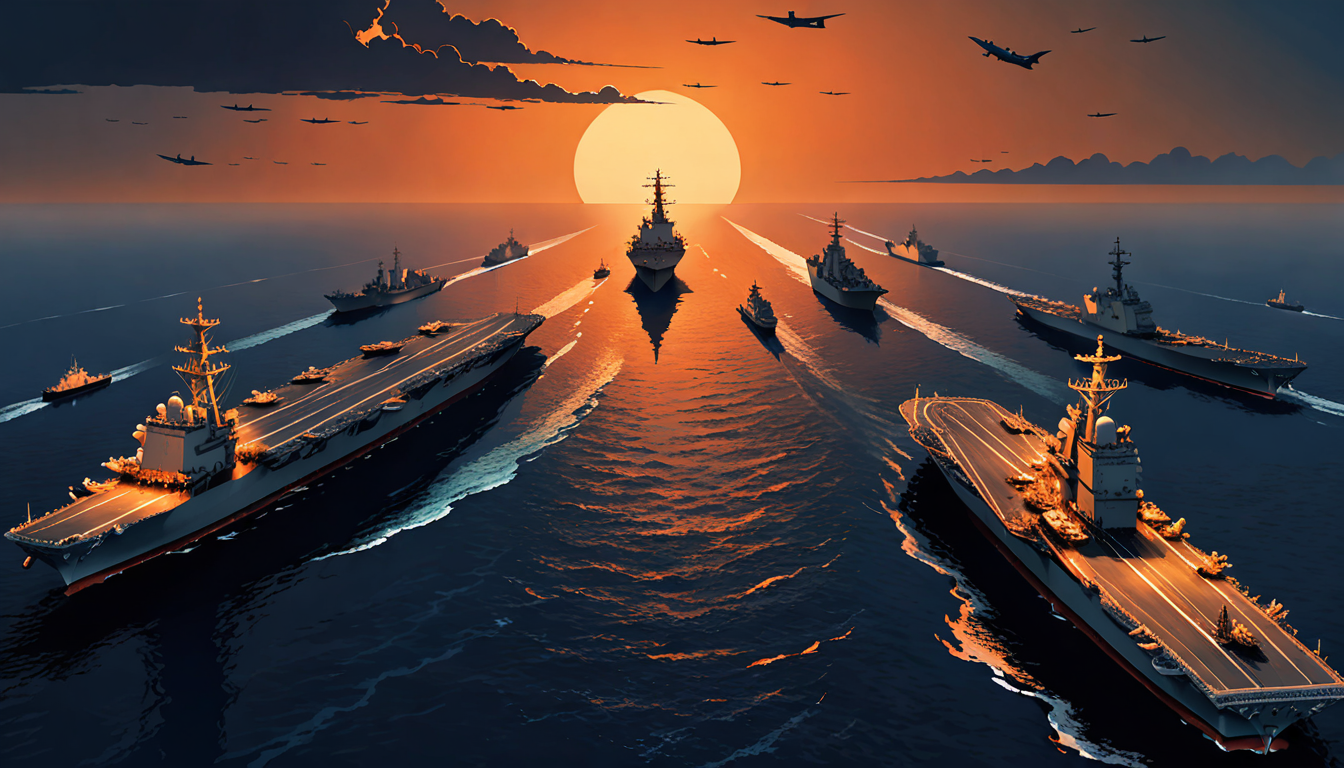
How a casual phone interview from a Florida golf club rewrote 400 years of freedom of navigation
Executive Summary
- President Trump told CBS News on March 9 he is "thinking about taking over" the Strait of Hormuz, triggering an immediate 13.7% drop in oil prices — the market reading it as a guarantee of reopened shipping.
- The statement represents the most radical challenge to international maritime sovereignty since the Suez Crisis of 1956, with implications that extend far beyond the Iran war into the foundational architecture of global trade.
- If implemented, a US military seizure of Hormuz would shatter UNCLOS transit passage rights, establish a precedent for great-power control of chokepoints, and accelerate the fracturing of the rules-based international order that Washington itself built.
Chapter 1: The Golf Club Doctrine
On the afternoon of March 9, 2026, speaking by phone from his Doral, Florida, golf club, President Trump delivered what may be the most consequential off-the-cuff remark of his presidency. "I'm thinking about taking it over," he said of the Strait of Hormuz, the 21-mile-wide passage through which roughly 20% of the world's oil supply flows.
The context was an interview with CBS News' Weijia Jiang. Trump had just declared the war against Iran "very complete, pretty much," noting that Iran had "no navy, no communications… no air force" left. The Pentagon, seemingly unaware of the president's assessment, posted on X the same afternoon: "We Have Only Just Begun to Fight" and "no mercy."
The dissonance between Trump's "pretty much over" and the Pentagon's "just begun" captures the surreal nature of the moment. But markets focused on something else entirely: the Hormuz statement. WTI crude plunged from $94.77 to below $82 within minutes — the sharpest single-statement move in oil market history. Traders read the threat as a de facto guarantee: if America controls the Strait, ships move, and oil flows.
What markets may have failed to price is the geopolitical earthquake such a move would trigger.
Chapter 2: The Chokepoint That Built the World
The Strait of Hormuz separates Iran to the north from Oman and the UAE to the south. It is not merely an oil corridor — it is the jugular vein of the global economy. Every day before the war, approximately 20 million barrels of oil and 25% of the world's liquefied natural gas transited this 21-mile passage. One-third of the world's seaborne crude, 33% of global urea and ammonia trade for fertilizer production, and massive volumes of petrochemicals all flow through these waters.
The legal framework governing the Strait is rooted in the United Nations Convention on the Law of the Sea (UNCLOS), specifically Articles 37-44 governing transit passage through international straits. Unlike innocent passage, transit passage cannot be suspended — all ships and aircraft enjoy the right of continuous and expeditious transit. Both Iran and Oman have sovereignty over the waterway's territorial waters, but neither can close it.
This framework, codified in 1982, reflects centuries of struggle over maritime chokepoints. The Ottomans controlled the Bosphorus. The British held Suez. The Americans built and then relinquished Panama. In each case, the eventual resolution moved toward internationalization, not imperial control.
Trump's statement reverses this trajectory.
Chapter 3: The Precedent Machine
A US military seizure of Hormuz would have no modern precedent. The closest analogies are instructive precisely because they ended badly for the occupying powers:
The Suez Crisis (1956): When Britain and France, along with Israel, attempted to seize the Suez Canal after Nasser's nationalization, the United States — under Eisenhower — forced them to withdraw. The episode ended British imperial pretensions and established the principle that great powers cannot unilaterally control international waterways. Seventy years later, America may be about to violate the very principle it enforced.
The Panama Canal (1903-1999): The US built the Canal and controlled the Zone for 96 years before the 1977 Carter-Torrijos Treaties transferred sovereignty to Panama. The handover, completed in 1999, was seen as a landmark in decolonization. Trump's 2025-26 rhetoric about "taking back" Panama — and now Hormuz — suggests a philosophy of waterway control that pre-dates the Carter era.
The Tanker War (1987-88): Operation Earnest Will, where the US Navy escorted reflagged Kuwaiti tankers through the Strait during the Iran-Iraq War, is the most relevant military precedent. But escort and seizure are categorically different. The US never claimed sovereignty or control over the waterway; it merely provided safe passage.
| Historical Precedent | Duration | Outcome | Key Lesson |
|---|---|---|---|
| Ottoman Bosphorus | ~500 years | Montreux Convention 1936 — internationalized | Sole control unsustainable |
| British Suez | 1882-1956 | Humiliating withdrawal, end of empire | US itself enforced this norm |
| US Panama Canal | 1903-1999 | Carter treaties, sovereignty returned | Decolonization pressure inevitable |
| Earnest Will 1987-88 | 11 months | Escort, not control | Limited mission avoids imperial trap |
Chapter 4: The Stakeholders' Calculus
Oman: The Strait's southern shore belongs to the Sultanate of Oman, America's quiet Gulf ally and the primary mediator in US-Iran negotiations before the war. A US seizure would nullify Omani sovereignty over its own territorial waters — an extraordinary act against an ally. Sultan Haitham bin Tariq has maintained studied silence, but Omani diplomats privately describe the prospect as "unthinkable."
Iran: With its military "down to a scatter" in Trump's words, Tehran cannot physically contest a US takeover. But it retains asymmetric tools — mines, small boat swarms, shore-based cruise missiles — that could make any garrison costly. More importantly, a US occupation of Hormuz would validate every Iranian narrative about American imperialism, potentially rallying a fractured population behind the new Supreme Leader Mojtaba Khamenei.
China: Beijing receives 50% of its crude oil through Hormuz. A US-controlled Strait means America holds a permanent kill switch on Chinese energy security — exactly the vulnerability Beijing has been racing to mitigate through pipelines, strategic reserves, and the energy transition. China's response to a US Hormuz garrison would likely be dramatic: acceleration of the Gwadar-Kashgar pipeline, expansion of the CIPS financial system, and potentially a retaliatory move on the Malacca Strait through increased naval presence.
India and Japan: Both are heavily dependent on Hormuz oil (India ~50%, Japan ~75%). While they might initially welcome resumed tanker traffic, the precedent of US waterway control would deeply alarm both nations. Japan's experience with US-controlled maritime routes in the Pacific carries historical trauma. India's multi-alignment strategy depends on no single power controlling its energy lifeline.
Russia: Putin gains either way. If the US seizes Hormuz, it confirms Moscow's narrative that Washington operates outside international law — useful diplomatic ammunition. Meanwhile, Russian oil bypassing Hormuz through pipelines and northern routes becomes structurally more valuable. Russia's Urals crude has already surged from $40 to $62 during the conflict.
Chapter 5: Scenario Analysis
Scenario A: Rhetorical Bluster — No Seizure (45%)
Rationale: Trump's statement was made casually in a phone interview, not as a formal policy announcement. The administration may use the threat as leverage to pressure Iran into accepting terms while reassuring markets. The G7 energy ministers' meeting on Tuesday and potential SPR release suggest the priority is price management, not territorial expansion.
Historical frequency: Trump has made dramatic territorial claims before — Greenland, Panama — without follow-through. The pattern is threat → negotiation → symbolic concession.
Trigger conditions: Iran ceases Hormuz threats; oil prices stabilize below $90; G7 SPR release succeeds; Congressional pushback intensifies.
Timeline: 1-3 weeks. The statement fades as the war winds down.
Scenario B: De Facto Naval Control — "Earnest Will 2.0" (40%)
Rationale: Rather than formal seizure, the US establishes a permanent naval patrol — effectively controlling transit without claiming sovereignty. The DFC (Development Finance Corporation) maritime insurance program already positions the US as the guarantor of Hormuz shipping. Adding naval escorts makes this official.
Historical precedent: Operation Earnest Will (1987-88) lasted 11 months. A 2026 version could become indefinite, given the scale of disruption. Energy Secretary Wright's statement that traffic will resume "after we've destroyed Iran's ability to threaten tankers" implies ongoing military presence.
Trigger conditions: Iran retains asymmetric capabilities; insurance markets refuse to reopen without military guarantee; Gulf states request US protection.
Timeline: Weeks to months. Gradually normalized.
Scenario C: Formal Seizure — "American Hormuz" (15%)
Rationale: Trump explicitly said "taking it over." If the administration interprets the war outcome as creating a security vacuum requiring permanent US presence, it could establish a military zone encompassing the Strait. This would require overriding UNCLOS and likely face legal challenges.
Historical precedent: US administration of the Panama Canal Zone (1903-1999). Guantánamo Bay (1903-present). Diego Garcia (1966-present via UK). All involve long-term US control of strategically vital territory.
Trigger conditions: Iran attempts post-war mine warfare; Gulf states acquiesce; Congressional authorization under AUMF expansion; UNCLOS withdrawal (which the US never ratified).
Timeline: Months. Would trigger immediate legal and diplomatic crises.
Chapter 6: Investment Implications
Energy: Oil's 13.7% drop on Trump's statement reveals the market's calculus — US control equals resumed flow. If Scenario B materializes, Brent likely settles in the $75-85 range, below current crisis pricing but above pre-war levels due to structural risk premium. US E&P companies (Exxon, Chevron) and LNG exporters benefit from permanent Hormuz uncertainty. Gulf state production normalization takes 3-6 months for damaged infrastructure.
Defense: A permanent US naval presence in Hormuz means expanded maritime patrol spending. Huntington Ingalls, General Dynamics (Bath Iron Works), and Raytheon (naval systems) are primary beneficiaries. Counter-mine warfare capabilities (Textron Systems) gain priority.
Shipping & Insurance: The war risk premium persists even in Scenario B. Lloyd's of London and P&I clubs will demand US government backstop for resumed transit. Marine insurers face structural repricing. Tanker companies operating under US escort face lower premiums than independents.
Currency & Safe Havens: A US-controlled Hormuz reinforces dollar hegemony in energy trade — every barrel transits under American military protection. This reverses the de-dollarization narrative, at least for energy markets. Gold ($5,400+) remains the primary hedge against the institutional uncertainty.
Geopolitical Risk: Companies with exposure to Chinese retaliatory measures face elevated risk. If Beijing accelerates Malacca alternatives, Singapore's role as a maritime hub could be challenged. Infrastructure companies involved in pipeline alternatives (TAPI, Gwadar) gain speculative interest.
Conclusion
Trump's Hormuz statement reveals a fundamental tension in American foreign policy: the US simultaneously claims to uphold the rules-based international order while contemplating the most radical violation of maritime sovereignty in modern history.
The irony is staggering. In 1956, it was America that told the British Empire it could not seize Suez. In 2026, America may be telling the world it can seize Hormuz. The 70-year arc from Eisenhower's internationalism to Trump's neo-imperialism represents not just a policy shift but a civilizational one.
Whether Trump follows through is uncertain. What is certain is that the statement itself has already changed the calculus. Every nation dependent on Hormuz — which is effectively every major economy — must now factor in the possibility that the world's most important waterway could become an American military zone.
The Strait of Hormuz, 21 miles wide, has always been a passage between worlds. It may now become a passage between eras — from one governed by international law to one governed by whoever has the biggest navy.
Leave a Reply