
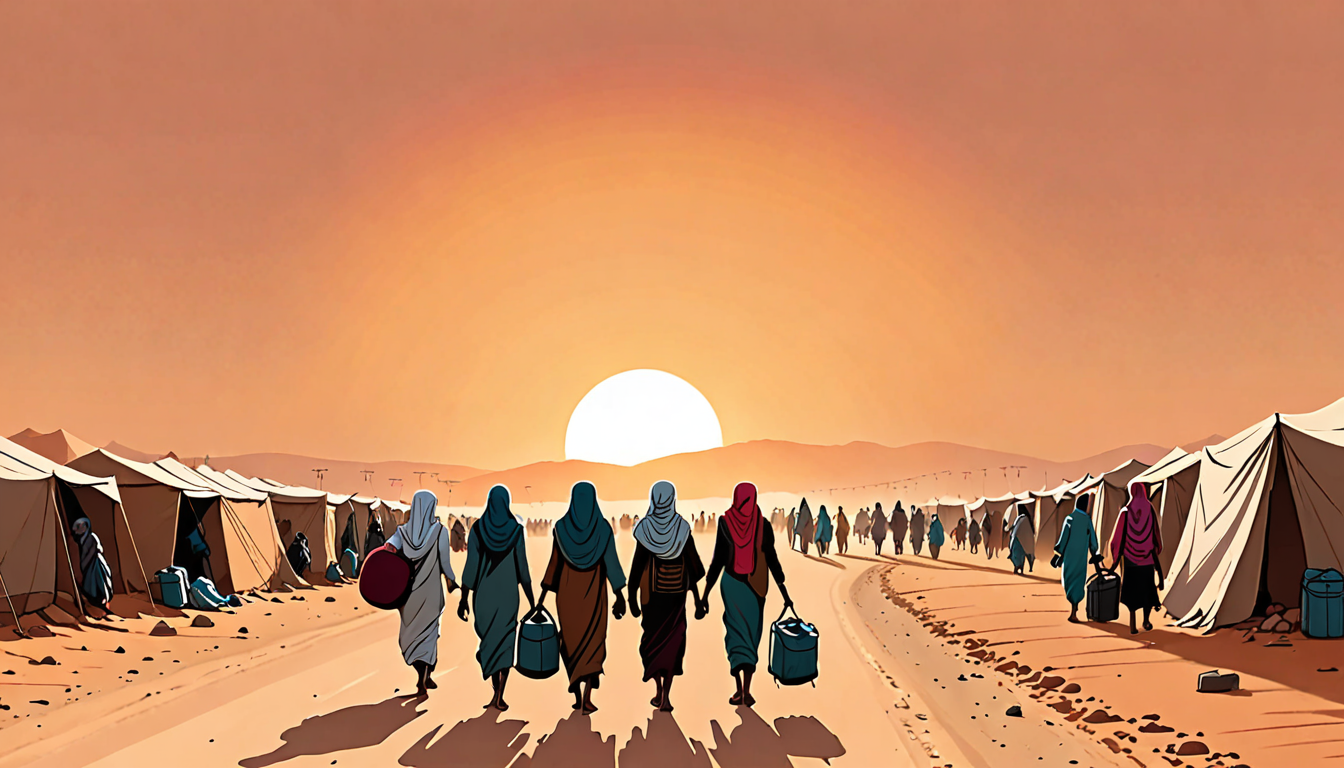
Day 10 of conflict threatens to trigger a displacement crisis of unprecedented magnitude across the Middle East and beyond
Executive Summary
- The Iran war is unfolding in a region already hosting 25 million refugees and displaced people, creating a cascading humanitarian crisis that dwarfs the direct military damage
- With UNHCR preparing to announce programme suspensions in Jordan and Lebanon due to funding shortfalls — even before the war began — the international aid architecture faces structural collapse at the worst possible moment
- The convergence of displacement, severed trade routes, and frozen humanitarian funding creates a "doom loop" that could destabilise states from Afghanistan to Turkey, with Europe facing the spectre of a refugee wave the EU Agency for Asylum has warned could reach "unprecedented magnitude"
Chapter 1: The Fracture Lines Were Already There
When US and Israeli strikes hit Iran on 28 February, they landed on a region that was already the world's largest concentration of humanitarian need. The numbers tell a stark story: Turkey hosts 2.3 million Syrian refugees. Iran shelters 1.6 million Afghans. Iraq has over one million internally displaced. Afghanistan, where the Taliban's return has triggered a slow-motion catastrophe, has 20 million people — nearly half the population — requiring humanitarian assistance according to UNICEF.
These were not abstract figures before the war. They represented a system operating at maximum capacity with minimum funding. The UN Refugee Agency (UNHCR) was preparing, this very week, to announce the suspension of programmes in Jordan and Lebanon due to insufficient funding. The world's humanitarian response was already running on fumes.
Then came the bombs.
Within 48 hours of the first strikes, an estimated 100,000 people fled Tehran. A near-total internet blackout inside Iran has made precise documentation impossible, turning the country's internal displacement into a statistical black hole. What little information filters through paints a picture of panic: families loading cars, heading for the Turkish and Iraqi borders, or simply moving away from major cities that have become targets.
In Lebanon, the picture is clearer — and devastating. Nearly 700,000 people have been displaced, including 200,000 children, according to UNICEF. Israeli evacuation orders covering everything south of the Litani River and Beirut's southern suburbs have uprooted communities for the third time since the war began. At least 294 people have been killed and over 1,000 injured in eight days. Among the displaced are 33,000 Syrian refugees — people who had already fled one war, now running from another.
Chapter 2: The Double Displacement Trap
The most insidious dimension of this crisis is what humanitarians call "double displacement" — when people who have already been uprooted are forced to flee again. This is not a theoretical concern. It is happening now, across multiple borders simultaneously.
Iran's 1.6 million Afghan refugees face an agonising choice. The country they sought refuge in is being bombed. The country they fled — Afghanistan under Taliban rule — offers no safety either. Reports from Iran's eastern border describe thousands of Afghans being pushed back toward Herat, where severe shortages of shelter, water, and medical aid await them. Before the war, Iran had already been conducting mass deportations of Afghans; the conflict has accelerated a process that was already a humanitarian crisis in its own right.
In Lebanon, Syrian refugees who fled Assad's war are now caught between Israeli strikes and Hezbollah's renewed hostilities. Over 3,000 Lebanese and 33,000 Syrians have crossed back into Syria — a country still mired in its own instability. The Norwegian Refugee Council estimates 300,000 people displaced in Lebanon alone since 2 March.
The Gulf states, which absorbed millions of foreign workers, are experiencing their own exodus. As documented in the broader conflict coverage, 28,000 Americans have been repatriated, 52,000 Indians airlifted, and 240,000 British nationals stranded in the UAE. But these evacuations of foreign nationals obscure a quieter crisis: the millions of lower-income migrant workers from South Asia and Southeast Asia who lack the diplomatic clout or financial resources to leave. They are the invisible displaced — trapped in war zones without embassy assistance or evacuation flights.
Chapter 3: The Aid Architecture Is Collapsing
The humanitarian response system was designed for a world that no longer exists. Built in the aftermath of World War II and refined through decades of Cold War proxy conflicts, it assumes that major crises can be addressed one at a time, with sufficient great-power cooperation to fund and coordinate relief. None of these assumptions hold in March 2026.
The funding crisis predates the war. UNHCR's spokesperson Babar Baloch stated plainly: "We are already underfunded in the majority of the eight or nine countries that are impacted now." The UN agency was about to cut programmes in Jordan and Lebanon before a single bomb fell on Tehran. The United States — historically the world's largest humanitarian donor — suspended and then scaled back the US Refugee Admissions Program in 2025, leaving tens of thousands of vetted refugees in limbo. The Lautenberg program, one of the few pathways for persecuted Iranian minorities (Jews, Christians, Baha'is, Zoroastrians), was terminated entirely.
Trade routes are severed. The World Food Programme (WFP), which feeds millions across the region, depends on supply chains that run through the very waters now under fire. The Strait of Hormuz — through which nearly one-fifth of global oil shipments pass — has been effectively closed to commercial traffic. Twenty thousand seafarers are stranded in the Persian Gulf. At least four were killed on 7 March when their vessel was attacked.
WFP's regional director Samer Adel Jaber described the situation bluntly: humanitarian supply routes "are going through strain." The agency is scrambling to reroute through Turkey, Egypt, Jordan, and Pakistan, relying on overland corridors and Egyptian ports. But these alternatives are slower, more expensive, and have limited capacity. Rising insurance costs — war risk premiums have surged tenfold — are driving up the price of moving aid globally.
Gaza is being starved. Aid crossings from Israel have been closed since 8 March. WFP has enough food stocks for two and a half weeks. If delays continue, the agency will have to cut rations to 25% to stretch supplies for 1.3 million people. This is not a hypothetical — it is a countdown.
| Crisis Indicator | Pre-War Baseline | Day 10 Status |
|---|---|---|
| Lebanon displaced | ~90,000 (prior escalations) | ~700,000 |
| Iran internal displacement | N/A | 100,000+ (est., unverified) |
| Lebanon killed | — | 294 |
| Iran civilians killed (Iranian govt claim) | — | 1,330 |
| Gaza food supply runway | Ongoing deliveries | 2.5 weeks remaining |
| Seafarers stranded in Gulf | ~0 | 20,000 |
| UNHCR programme status | Underfunded | Announcing suspensions |
| Afghan refugees in Iran | 1.6 million | At risk of forced return |
Chapter 4: The Stakeholders and Their Calculus
The Belligerents (US, Israel, Iran): Military objectives have overshadowed humanitarian considerations entirely. The US and Israel have not established humanitarian corridors or safe zones inside Iran. Iran's near-total communications blackout prevents independent assessment of civilian harm. The reported killing of 168 schoolgirls in Minab — under review by the US State Department — has become a defining image of the war's human cost.
Host Countries (Turkey, Iraq, Pakistan, Afghanistan): Each faces the prospect of absorbing new refugee flows on top of existing burdens. Turkey, with 2.3 million Syrians already straining public services and fuelling domestic political tensions, has no appetite for Iranian refugees. Iraq's fragile stability could crack under the pressure of returnees and new displaced populations. Pakistan, already fighting its own war on the Afghan border and facing an IMF programme at risk, is the least equipped to absorb additional displacement.
The European Union: The EU Agency for Asylum (EUAA) warned before the war that an Iranian conflict could produce refugee movements of "unprecedented magnitude." The EU is already shifting toward punitive deportation measures. The political dynamics are toxic: the same governments supporting the military campaign are simultaneously fortifying borders against the refugees it creates. Australia's decision to grant visas to five Iranian women's football players while simultaneously blocking other temporary visa holders encapsulates this contradiction.
Humanitarian Agencies: Operating in survival mode. IFRC has released CHF 1.5 million from emergency funds — a rounding error against the scale of need. WHO cannot even verify reports of health facilities being struck due to communications disruptions. The system is not just strained; it is approaching a point where triage becomes the only option.
Chapter 5: Scenario Analysis
Scenario A: Contained Crisis — Short War, Managed Displacement (25%)
Premise: The conflict ends within 2-3 weeks as Trump has signalled, enabling rapid humanitarian access and limiting large-scale cross-border displacement.
Evidence for: Trump's "war is very complete" statement on Day 10. Historical precedent of short air campaigns (Kosovo, 78 days; Libya initial phase, weeks). No ground invasion reduces displacement drivers compared to Iraq 2003.
Evidence against: Iran's IRGC shows no signs of capitulating. Mojtaba Khamenei's appointment as supreme leader signals hardening, not compromise. Lebanon front has reopened. Air campaigns alone rarely produce quick political resolutions.
Trigger conditions: Ceasefire agreement within 1-2 weeks. Iran accepts some form of nuclear/missile constraints. Humanitarian corridors opened.
Displacement estimate: 500,000-800,000 total displaced, mostly internal to Iran and Lebanon. Manageable with existing regional capacity if funding is mobilised quickly.
Scenario B: Protracted Conflict — Regional Displacement Cascade (50%)
Premise: War continues for months, as air campaigns historically do when political objectives remain unmet. Displacement escalates across multiple borders simultaneously.
Evidence for: The 2003 Iraq War produced 4.7 million displaced within three years — and that was a single-country conflict. The Iran war already involves a dozen countries by Day 10. EUAA's pre-war warning of "unprecedented magnitude" displacement. Historical pattern: Kosovo produced 850,000 refugees in weeks; Syria produced 6.6 million over years. Iran's population (88 million) dwarfs both.
Evidence against: Air campaigns produce less displacement than ground invasions. Iran's borders with Turkey and Iraq are mountainous and difficult to cross en masse.
Trigger conditions: No ceasefire by end of March. Continued strikes on civilian infrastructure. Lebanese front remains active. Gulf states restrict entry for Iranian nationals.
Displacement estimate: 2-5 million displaced within 6 months. Turkey, Iraq, and Pakistan face acute pressure. European border tensions escalate. UNHCR requires $3-5 billion emergency appeal — against a backdrop of structural underfunding.
Historical parallel: The 2015 European refugee crisis was triggered by approximately 1.3 million arrivals. Even a fraction of potential Iranian displacement could dwarf that figure, arriving in a Europe far less politically willing to accept refugees than in 2015.
Scenario C: Humanitarian Catastrophe — System Collapse (25%)
Premise: Prolonged conflict combines with aid system collapse, creating famine conditions in Gaza, mass displacement from Iran, and cascading state failures in the region's most fragile countries.
Evidence for: Gaza food supplies at 2.5 weeks and counting down. UNHCR already suspending programmes pre-war. WFP supply routes severed. Afghanistan's 20 million in need receive attention from no one. Sudan crisis already forgotten. The Lautenberg program's termination removes pathways for the most persecuted Iranians.
Evidence against: International pressure for ceasefire is mounting. Egyptian ports and Suez Canal remain functional. Some overland routes viable.
Trigger conditions: War extends beyond two months. Hormuz remains closed. Gaza crossings stay shut. Major donor governments fail to mobilise emergency humanitarian funding. European borders fully sealed against Middle Eastern arrivals.
Displacement estimate: 5-10 million displaced. Famine conditions in Gaza and parts of Yemen. State fragility tipping points in Lebanon, Iraq, and Pakistan. Humanitarian system operates in permanent triage mode, with agencies forced to choose which crises to abandon.
Chapter 6: Investment and Policy Implications
Humanitarian equities: Companies in the disaster relief, water purification, and temporary shelter sectors see demand surges but face the irony of government customers who cannot pay. The IFRC's CHF 1.5 million release highlights the funding gap.
European political risk: Anti-immigration parties gain ammunition regardless of outcome. If refugees arrive, they cite the crisis. If borders hold, they claim credit. European defence stocks benefit from "Fortress Europe" spending; social cohesion pays the price.
Food security: WFP's warning about fertiliser supply disruptions through Hormuz connects directly to the spring planting season. Wheat futures have already surged 3%. Agricultural commodity traders (ADM, Bunge, Cargill) face supply chain disruption alongside price windfalls. Countries dependent on food imports — Egypt, Pakistan, Bangladesh — face the double hit of higher prices and reduced availability.
Insurance and shipping: War risk premiums have increased tenfold. The 20,000 stranded seafarers represent not just a humanitarian concern but a logistics bottleneck. Container shipping rates on alternative routes (via Cape of Good Hope) are surging, with cascading effects on global trade costs.
The "forgotten crises" premium: Sudan, South Sudan, Ukraine, and Myanmar are being pushed further down the priority list. Aid diversion creates secondary instability in already fragile contexts, potentially generating new displacement cycles.
Conclusion
The Iran war did not create the Middle East's humanitarian crisis. It detonated one that was already primed. Twenty-five million refugees and displaced people were already in the region. Aid agencies were already cutting programmes. Trade routes were already under strain from years of Red Sea disruption.
What the war has done is remove every remaining buffer. The UNHCR spokesperson's admission — "we are already underfunded in the majority of countries impacted" — may prove to be the most consequential statement of the conflict. Not because it is dramatic, but because it is structural. The humanitarian system is not failing because of this war; it was already failing. The war simply made the failure visible.
The 2003 Iraq War produced 4.7 million displaced. Iran has five times Iraq's pre-war population, and this conflict has already drawn in a dozen countries. The question is not whether a humanitarian catastrophe will unfold, but how large it will be, and whether the international system retains any capacity to respond.
The lesson of every modern war is the same: the displaced arrive whether borders are open or not. The only question is the human cost of the journey.
Sources: USCRI, Geneva Solutions, UN News, UNICEF, OCHA, IFRC, WFP, EUAA, Norwegian Refugee Council
Leave a Reply