
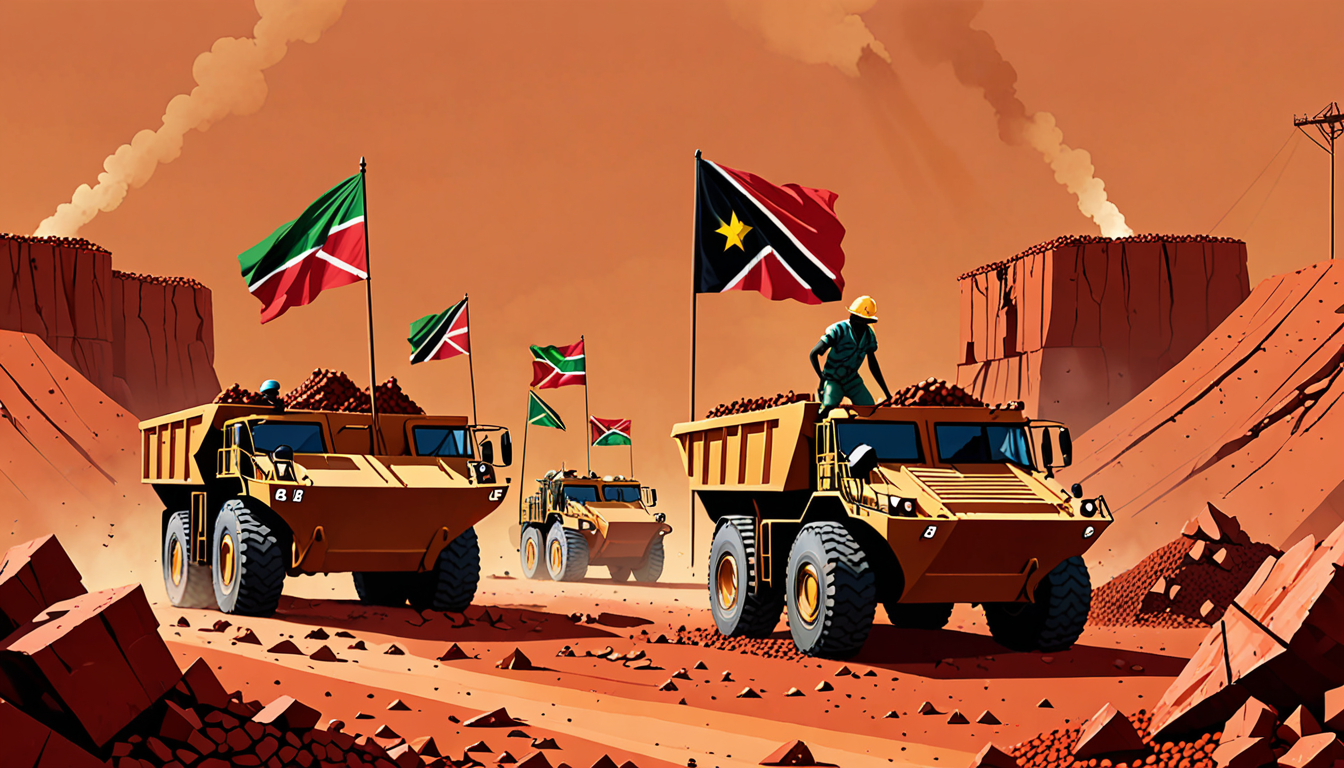
A coup leader's systematic dismantling of political opposition threatens the world's largest bauxite reserves and a $15 billion mining pipeline
Executive Summary
- Guinea's junta-turned-civilian president Mamady Doumbouya dissolved 40 political parties on March 7, including all major opposition groups, in what opposition leader Cellou Dalein Diallo calls "war openly declared" on democratic pluralism
- The purge follows Burkina Faso's total party ban in January 2026, extending the Sahel military belt's authoritarian consolidation to West Africa's most mineral-rich state — home to 26% of global bauxite reserves and the $15 billion Simandou iron ore project
- With 51 mining permits already cancelled under a "process here or leave" ultimatum, Doumbouya is simultaneously wielding resource nationalism and political monopolization — a combustible combination for $40+ billion in foreign mining investment
Chapter 1: The Anatomy of a Constitutional Coup
On March 7, 2026, Guinea's Ministry of Territorial Administration issued a decree dissolving 40 of the country's 120+ registered political parties. The sweep was surgical in its targeting: it eliminated the Union of Democratic Forces of Guinea (UFDG) led by Cellou Dalein Diallo — the main opposition leader now in exile — and the Rally of the People of Guinea (RPG) of deposed former president Alpha Condé. Party headquarters were sealed, logos banned, assets confiscated.
The official justification was bureaucratic non-compliance: failure to submit mandatory financial statements. Several dissolved parties immediately rejected the allegation, insisting they had met all legal obligations. The timing reveals the true intent. Legislative elections are scheduled within two months — the final step in a transition from military rule that began with Doumbouya's September 2021 coup against Condé.
Doumbouya's path from coup leader to civilian president followed a now-familiar playbook in the Sahel region:
| Step | Timeline | Action |
|---|---|---|
| Coup | Sept 2021 | Overthrew Condé, suspended constitution |
| Constitutional referendum | Sept 2025 | New constitution: allowed junta members to run, extended presidential terms from 5 to 7 years |
| Presidential election | Dec 2025 | Won with 86.72% — all major challengers barred |
| Inauguration | Jan 17, 2026 | Sworn in as "civilian" president |
| Party dissolution | March 7, 2026 | 40 parties eliminated, including all major opposition |
| Next: legislative elections | ~May 2026 | With opposition legally destroyed |
This is not democratic transition. It is democratic theater — the systematic construction of a one-party state through nominally constitutional mechanisms.
Chapter 2: The Sahel Domino — From Military Belt to Authoritarian Arc
Guinea's political purge does not exist in isolation. It represents the latest domino in a cascading collapse of multi-party democracy across West and Central Africa's military-governed belt.
The AES (Alliance of Sahel States) Pattern:
Burkina Faso banned all political parties on January 29, 2026, under Captain Ibrahim Traoré's junta. Mali's Colonel Assimi Goïta has indefinitely postponed elections while consolidating power. Niger's General Abdourahamane Tchiani expelled French military forces and turned toward Russia's Africa Corps (formerly Wagner Group).
Guinea is not formally a member of the AES alliance, but Doumbouya's trajectory mirrors it precisely. The pattern across all four countries follows a consistent sequence:
- Military coup against an elected (often corrupt or term-extending) president
- Initial popular support due to genuine frustration with civilian misrule
- Transition timeline promised, then repeatedly extended
- Constitutional manipulation to legalize junta candidates
- Sham election with credible challengers excluded
- Opposition elimination through party dissolutions or bans
- Resource nationalism as economic legitimation strategy
The geographic implications are stark. The military-governed belt now stretches continuously from the Atlantic coast (Guinea) through the Sahel (Mali, Burkina Faso, Niger), creating a corridor of authoritarian governance across some of Africa's most mineral-rich territory.
ECOWAS (Economic Community of West African States) has been rendered impotent. Guinea, Mali, Burkina Faso, and Niger have all either left or defied the regional bloc. What was once West Africa's primary mechanism for democratic enforcement now covers barely half of its original mandate area.
Chapter 3: The Bauxite Republic — Guinea's $40 Billion Resource Gamble
Guinea's political crisis cannot be understood without grasping the country's extraordinary mineral wealth — and the foreign investment it has attracted.
Guinea's resource profile:
- Bauxite: World's largest reserves, producing ~100 million tonnes/year. Guinea is the world's #1 bauxite exporter
- Iron ore (Simandou): The world's largest untapped high-grade iron ore deposit, 65% Fe content. Joint venture between Rio Tinto/Simfer (42.5%), Winning Consortium Simandou/WCS (42.5%), and Government of Guinea (15%). Expected to produce 95 million tonnes annually at full capacity
- Gold: Significant deposits, including the Mandiana and Siguiri complexes
- Diamonds, graphite, rare earths: Emerging exploration
Total foreign mining investment pipeline: $40+ billion, with Simandou alone valued at $15 billion for infrastructure (670km railway, deepwater port at Morebaya).
Doumbouya has already signaled his resource nationalist intentions. In late February 2026, he cancelled 51 mining permits covering gold, bauxite, diamonds, graphite, and iron ore, declaring "process here or leave" — demanding that foreign companies establish local processing capacity rather than exporting raw materials.
Key mining operators affected or at risk:
| Company | Operation | Value | Status |
|---|---|---|---|
| Rio Tinto (UK/Aus) | Simandou Blocks 1-2 | $15B+ | Proceeding, but regulatory risk rising |
| Winning Consortium (China) | Simandou Blocks 3-4 | ~$10B | Closely tied to government |
| Compagnie des Bauxites de Guinée (CBG) | Sangaredi bauxite | $5B+ | Alcoa/Rio Tinto/Dadco JV |
| Emirates Global Aluminium (UAE) | Guinea Alumina Corp | $3B | Expansion plans uncertain |
| Nordgold (Russia) | Lefa gold mine | ~$1B | Russian ties may provide political cover |
The Chinese Winning Consortium's close relationship with Doumbouya's government is notable. China purchases roughly 60% of Guinea's bauxite exports. Beijing's infrastructure-for-resources model aligns naturally with Doumbouya's demands for local processing — potentially giving Chinese firms preferential access as Western companies face heightened political risk.
Chapter 4: Scenario Analysis
Scenario A: Controlled Consolidation (45%)
Doumbouya successfully builds a de facto one-party state with manageable international pushback.
Rationale:
- Historical precedent: Paul Kagame's Rwanda demonstrates that authoritarian resource management can attract investment when governance is perceived as stable and efficient
- China's willingness to invest regardless of democratic credentials provides a financial backstop
- The Iran war has consumed international attention, leaving little diplomatic bandwidth for West African democracy concerns
- Major mining companies (Rio Tinto, Alcoa) have $15B+ sunk costs in Guinea, creating strong incentives to accommodate rather than confront
Trigger conditions:
- Legislative elections proceed with token opposition parties
- Simandou first ore shipment achieved (targeted 2026-2027)
- No mass violence or civilian casualties
Investment implications: Mining operations continue with higher political risk premium but functional stability. Bauxite supply uninterrupted.
Scenario B: Resource Nationalist Escalation (35%)
Doumbouya escalates resource nationalism, forcing contract renegotiations and threatening existing investments.
Rationale:
- The 51 permit cancellations signal willingness to use resource leverage aggressively
- Indonesia's nickel export ban (2020) and DRC's cobalt restrictions (2026) provide a template for resource-rich nations extracting greater rents
- Doumbouya needs revenue to maintain military loyalty and fund patronage networks
- Global aluminium prices at 4-year highs due to Russian sanctions and Gulf production disruptions make timing favorable for Guinea to demand better terms
- Simandou's unique iron ore quality (65% Fe) gives Guinea leverage — there is no substitute deposit of comparable scale
Trigger conditions:
- Demand for increased government equity stakes beyond 15%
- Local processing mandates with unrealistic timelines
- Selective enforcement against Western companies while favoring Chinese/Russian operators
Historical precedent: Bolivia's nationalization under Evo Morales (2006) — hydrocarbon sector renegotiation that increased state revenue but deterred new investment. Guinea's mineral exports ($5.7B in 2025) could follow a similar pattern.
Investment implications: Mining equities de-rate, supply chain disruption for aluminium feedstock, potential 10-20% bauxite price increase.
Scenario C: Instability and Resistance (20%)
Opposition leader Diallo's "direct resistance" call triggers civil unrest, disrupting mining operations.
Rationale:
- Guinea has a history of mass protests — the 2009 stadium massacre (157 killed under Dadis Camara), 2020 constitutional crisis protests
- Ethnic tensions (Fulani/Peul opposition vs. Malinke military elite) run deep
- Youth unemployment exceeds 60%
- Regional contagion: protests in one Sahel country have historically inspired movements in neighbors
Trigger conditions:
- Security forces use lethal force against protesters
- Mining operations physically disrupted (road blockades to Simandou railway construction)
- International sanctions or targeted measures against junta leadership
Historical precedent: 2019 Sudan revolution — popular uprising toppled military leader Omar al-Bashir after 30 years. However, Sudan's subsequent military coup (2021) and civil war (2023-present) illustrate the risks of incomplete transitions.
Investment implications: Supply disruption for 26% of global bauxite, aluminium price spike 15-30%, Simandou delays of 2+ years.
Chapter 5: Investment Implications — The Aluminium Supply Chain at Risk
Guinea's political crisis intersects with an already stressed global aluminium market:
- EU sanctions have banned Russian aluminium imports. Rusal, the world's second-largest producer, is increasingly shut out of Western markets
- Gulf production disruption: The Iran war and Hormuz blockade have forced Qatalum (Qatar) to declare force majeure and disrupted Alba (Bahrain) operations
- China's production cap: Beijing's 45-million-tonne smelting capacity ceiling constrains the world's largest producer
- U.S. tariffs: 50% aluminium tariffs under Section 232 have pushed domestic premiums to record levels
Guinea sits at the base of this supply chain. If bauxite exports are disrupted — whether through political instability, resource nationalist policies, or infrastructure failures — the downstream effects would cascade through:
- Alumina refineries (primarily in China, Australia, Brazil) that depend on Guinean feedstock
- Aluminium smelters globally, already operating at reduced capacity
- End-use industries: automotive (150-200kg per vehicle), aerospace, packaging, construction, defence
Beneficiaries of Guinea risk premium: Australian bauxite producers (South32, Rio Tinto Weipa), Brazilian alumina (Norsk Hydro Alunorte), integrated producers with non-Guinea supply (Alcoa's Australia operations).
Exposed companies: CBG joint venture partners, EGA Guinea operations, Winning Consortium (concentration risk), downstream aluminium fabricators with thin margins.
Conclusion
Guinea's dissolution of 40 political parties is not merely a domestic political event. It represents the completion of an authoritarian arc across West Africa's mineral belt, raising systemic risk for the global aluminium supply chain at a moment when alternative supply is constrained by war, sanctions, and production caps.
Doumbouya's simultaneous pursuit of political monopolization and resource nationalism creates a combustible combination. The history of military-led resource states — from Libya under Gaddafi to Venezuela under Chávez to Myanmar post-coup — suggests that short-term stability purchased through political repression eventually collides with the governance demands of complex mining operations.
For investors, the message is clear: Guinea's political risk discount has just widened significantly. The $15 billion Simandou project — potentially transformative for global iron ore markets — now carries not just construction and logistics risk, but the risk of operating in what is rapidly becoming a one-party military state with resource nationalist ambitions. The world's largest bauxite reserves are in the hands of a leader who has demonstrated he will cancel permits, dissolve opposition, and consolidate power without regard for international norms.
The question is no longer whether Guinea will complete its democratic transition. It already hasn't. The question is what kind of authoritarian state Doumbouya intends to build — and what price the global mineral supply chain will pay for it.
Related Reading:
- Sahel's Democratic Death — Burkina Faso's total party ban
- Coltan Buried in Blood — DRC mineral conflict
- Aluminium War — Global aluminium sanctions
Sources: Reuters, BBC, Foreign Policy, Mining.com, Rio Tinto corporate filings, ECOWAS communiqués
Leave a Reply