
How a rebel-held mine, serial disasters, and a collapsing peace deal threaten the tantalum that powers every smartphone on Earth
Executive Summary
- Two catastrophic landslides at DRC's Rubaya coltan mine have killed 600+ people in five weeks, exposing the lethal intersection of conflict, artisanal mining, and the global electronics supply chain. The mine produces 15% of the world's tantalum — the metal inside every smartphone, laptop, and jet engine capacitor.
- The US has sanctioned Rwanda's entire military and four senior commanders for backing M23 rebels who control Rubaya, effectively declaring the Trump-brokered Washington Accords a failure just three months after signing.
- A tantalum supply crisis is emerging at the worst possible moment: the Iran war has already disrupted helium supplies from Qatar (critical for semiconductor manufacturing), and now conflict minerals from Central Africa face new scrutiny that could constrict the other end of the electronics supply chain.
Chapter 1: The Mountain That Eats People
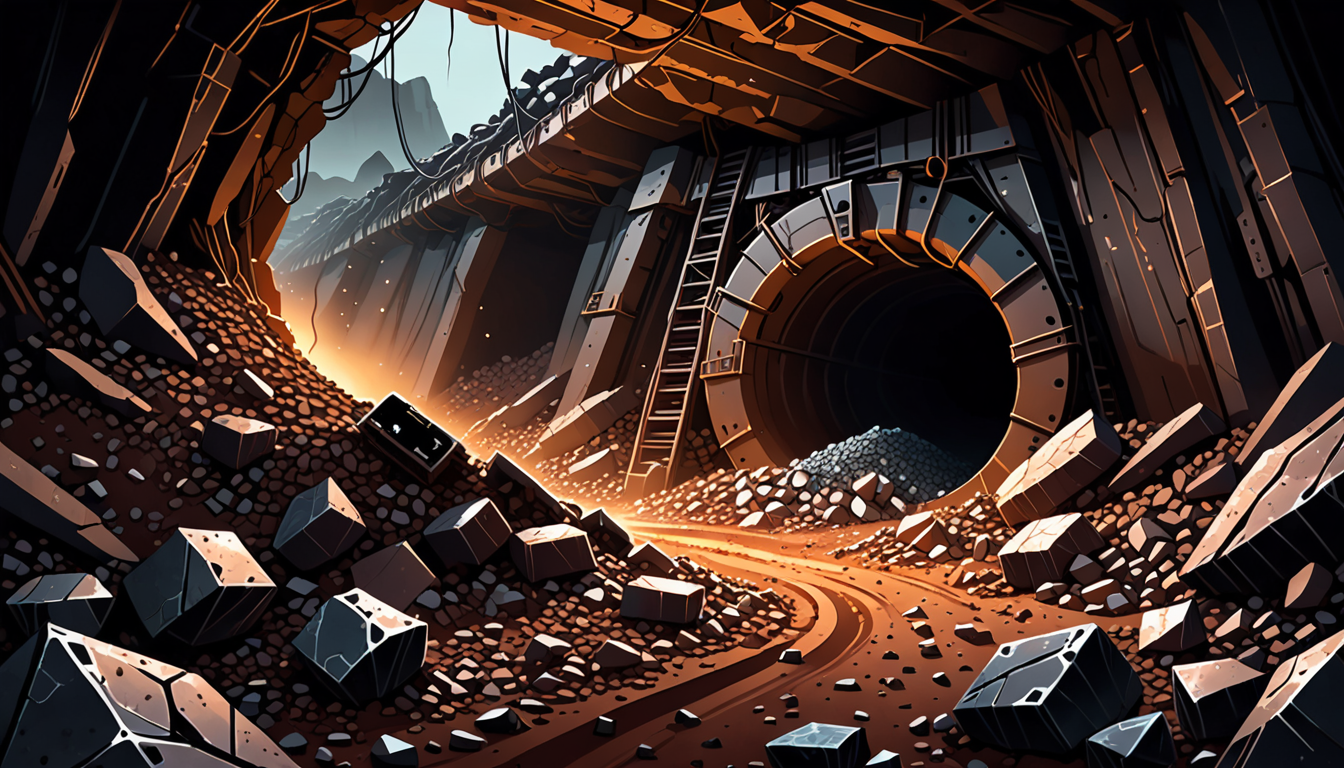
Rubaya sits 70 kilometers west of Goma in North Kivu province, eastern DRC. It is not a mine in any modern sense — it is a hillside honeycomb of hand-dug tunnels where thousands of artisanal miners extract coltan ore with pickaxes and bare hands. There are no reinforced shafts, no ventilation systems, no safety inspections. When the rains come, the tunnels collapse.
On January 28, 2026, heavy rains triggered a landslide that buried multiple mining shafts. At least 400 people died. Many were children — the smallest bodies fit into the narrowest tunnels, making them prized workers in the artisanal mining economy.
Five weeks later, on March 4, it happened again. Another landslide, another 200+ dead, including 70 children. The DRC government blamed M23 rebels who control the site for allowing unregulated mining without safety standards. M23 disputed the toll, claiming government drone strikes caused the collapse and only six people died. The BBC could not independently verify either claim — the area is effectively cut off from humanitarian agencies, telecommunications are intermittent, and the rebels control who enters and exits.
The combined death toll of 600+ in five weeks makes Rubaya one of the deadliest mining sites in modern history. For comparison, the 2010 Copiapó mine disaster in Chile — which captivated global media for 69 days — trapped 33 miners. All survived. In Rubaya, hundreds die and the world barely notices.
The difference is not geological. It is political.
Chapter 2: The M23 Mineral Machine
The March 23 Movement (M23) is a Tutsi-led rebel group that has waged intermittent war in eastern DRC since 2012. After a period of dormancy, M23 launched a major offensive in late 2022, eventually capturing Goma (population 2 million) and Bukavu, the capitals of North and South Kivu provinces. Along the way, they seized Rubaya in May 2024.
Rubaya is not just a mine — it is a revenue engine. According to UN investigators, M23 has imposed taxes on coltan extraction and transport generating at least $800,000 per month. The DRC produces roughly 40% of the world's coltan, and Rubaya alone accounts for 15% of global tantalum supply and half of the DRC's total coltan deposits.
The supply chain works like this: artisanal miners extract coltan ore → M23 taxes every step (extraction, transport, export) → ore is smuggled across the border into Rwanda → Rwandan comptoirs (trading houses) process and re-export → the tantalum enters the global supply chain labeled as Rwandan origin → it ends up in capacitors made by companies like KEMET, Vishay, and AVX → those capacitors go into iPhones, Teslas, F-35 fighter jets, and MRI machines.
This laundering operation is well-documented. The UN Group of Experts has published multiple reports tracking coltan shipments from Rubaya to Rwandan processing facilities. The minerals emerge from Rwanda with clean paperwork, effectively invisible to conflict mineral due diligence programs established under the 2010 Dodd-Frank Act (Section 1502) and the EU's Conflict Minerals Regulation (2021).
The system works because tantalum is fungible. Once refined, its origin is untraceable. And demand is relentless.
Chapter 3: The Washington Accords — Rise and Fall
In December 2025, President Trump brokered what he called a "great miracle" — the Washington Accords, a peace agreement between DRC President Félix Tshisekedi and Rwandan President Paul Kagame. The deal was supposed to end hostilities, withdraw Rwandan forces, and demobilize M23.
It lasted days.
Within a week of signing, M23 captured the strategic city of Uvira near the Burundi border. The rebels showed no sign of stopping. Rwanda, despite signing the accords, continued what the US Treasury later called "direct operational support" to M23.
On March 2, 2026, the US responded with unprecedented sanctions:
| Target | Role | Sanction Type |
|---|---|---|
| Rwanda Defence Force (RDF) | Entire military institution | Full OFAC sanctions |
| Gen. Vincent Nyakarundi | RDF Army Chief of Staff | Individual designation |
| Maj. Gen. Ruki Karusisi | Senior commander | Individual designation |
| Gen. Mubarakh Muganga | Chief of Defence Staff | Individual designation |
| Gen. Stanislas Gashugi | Special Operations Force Commander | Individual designation |
Treasury Secretary Scott Bessent declared: "President Trump is the Peace President and Treasury will use all tools at its disposal to ensure that the parties to the Washington Accords uphold their obligations."
The sanctions are significant for several reasons. First, sanctioning an entire national military is extraordinarily rare — it puts Rwanda in the same category as entities like the IRGC. Second, it represents a remarkable admission: the Trump administration is sanctioning a country for violating a deal Trump personally brokered just three months earlier. Third, Rwanda has been a key US security partner in Africa, providing peacekeeping troops and hosting AFRICOM training programs. The sanctions fracture that relationship.
Rwanda's response was defiant. Government spokesperson Yolande Makolo called the sanctions "unjust" and accused the DRC of conducting "indiscriminate drone attacks." Kigali maintains it has no troops in DRC — a claim contradicted by UN investigators, satellite imagery, and now the US government itself.
Chapter 4: The Tantalum Chokepoint
Tantalum is not a household name, but it is everywhere. The metal's exceptional properties — resistance to corrosion, high capacitance per volume, stability at extreme temperatures — make it irreplaceable in several critical applications:
- Smartphones and laptops: 60-70% of global tantalum demand comes from capacitors in consumer electronics
- Automotive electronics: every modern car contains dozens of tantalum capacitors in engine management, airbag systems, and infotainment
- Aerospace and defense: F-35 fighter jets, satellite systems, and missile guidance require certified-origin tantalum
- Medical devices: MRI machines, pacemakers, and surgical instruments
- 5G infrastructure: base stations and network equipment
Global tantalum production is approximately 2,000 metric tons per year. The DRC and Rwanda together account for roughly 40-50% of global supply. Australia (through Pilbara Minerals' Wodgina mine) and Brazil provide most of the rest, but neither can quickly scale to replace Central African output.
The Rubaya disasters create a dual supply shock:
- Physical disruption: Two collapses in five weeks have halted or severely reduced extraction at a site producing 15% of global supply
- Regulatory constriction: US sanctions on Rwanda's military make it legally risky for downstream buyers to purchase Rwandan-origin tantalum, which is often laundered DRC coltan
This arrives at a particularly vulnerable moment. The Iran war has already disrupted Qatar's helium production (critical for semiconductor cooling and fiber optics), and China's export controls on gallium, germanium, and antimony remain in effect. The electronics supply chain is being squeezed from multiple directions simultaneously.
Tantalum spot prices have already risen approximately 15-20% since January. If Rubaya production remains disrupted and sanctions tighten the Rwandan pipeline, prices could spike 40-60% — echoing the 2000-2001 "coltan boom" when PlayStation 2 demand collided with the Second Congo War, driving tantalum prices from $30/lb to $300/lb.
Chapter 5: Scenario Analysis
Scenario A: Managed De-escalation (25%)
Premise: US pressure forces partial Rwandan withdrawal; M23 enters negotiations; Rubaya mining resumes under some oversight.
Rationale: This is the stated US policy objective, but the track record is poor. The Washington Accords already failed. Rwanda's economic incentive to control Rubaya ($800K/month in taxes alone, plus strategic leverage) exceeds the cost of sanctions that Kigali has shown willingness to absorb. Historical precedent is discouraging: the 2013 M23 defeat led to a temporary peace, but the group remobilized within years.
Trigger: Rwanda calculates that continued defiance risks losing US military aid entirely (~$20M/year), plus diplomatic isolation at the UN Security Council.
Timeline: 6-12 months for meaningful withdrawal, if it happens at all.
Scenario B: Frozen Conflict with Supply Chain Adaptation (50%)
Premise: M23 retains control of Rubaya and eastern DRC. Sanctions remain but are inconsistently enforced. The global supply chain adapts through diversification and recycling.
Rationale: This is the most likely outcome based on historical patterns. Eastern DRC has been in near-continuous conflict since 1996. The international community has imposed sanctions, peace deals, and UN peacekeeping missions (MONUSCO) repeatedly, with limited lasting effect. The 2010 Dodd-Frank conflict minerals provisions reduced some direct DRC mineral exports but shifted laundering routes through Rwanda and Uganda rather than eliminating the trade.
Market adaptation is already underway. Australian and Brazilian tantalum mines are ramping production. Recycling (which provides ~20% of global tantalum) is expanding. But full substitution takes 2-3 years.
Trigger: Western electronics companies quietly resume purchasing Rwandan tantalum after a face-saving "enhanced due diligence" period, as they did after previous cycles of scrutiny.
Timeline: Current state persists 1-3 years until the next crisis cycle.
Scenario C: Regional Escalation (25%)
Premise: Fighting spreads to Burundi (M23 is already on the border), drawing in Uganda and Tanzania. Refugee flows (already 7+ million displaced) destabilize neighboring states. Rubaya production halts entirely.
Rationale: The Burundi risk is real — M23 forces remain near the border despite withdrawing from Uvira. Burundi's military is far weaker than Rwanda's. Uganda has historically both supported and fought M23 at different times. A broader regional war would mirror the 1998-2003 Second Congo War (also called "Africa's World War"), which drew in nine nations and killed an estimated 5.4 million people.
Trigger: M23 incursion into Burundian territory, or a DRC military offensive that Rwanda frames as justifying full-scale intervention.
Timeline: 3-6 months if Burundi border tensions escalate.
Chapter 6: Investment Implications
Direct beneficiaries of tantalum supply disruption:
- Pilbara Minerals (ASX: PLS) — Wodgina mine in Australia, one of the world's largest tantalum deposits outside Africa
- AMG Advanced Metallurgical Group (AMS: AMG) — tantalum processing and recycling
- Global Advanced Metals (private) — major Australian tantalum producer
- Minsur (BVL: MINSURI1) — Peruvian tin/tantalum producer
Downstream risk exposure:
- Apple, Samsung, Sony — consumer electronics with tantalum capacitors in every device
- KEMET (subsidiary of Yageo) — world's largest tantalum capacitor manufacturer
- Vishay Intertechnology (NYSE: VSH) — major capacitor supplier
- Defense contractors (Lockheed Martin, RTX, Northrop Grumman) — F-35 and missile systems require certified-origin tantalum
Broader context:
The tantalum disruption compounds an already severe supply chain stress picture. With helium from Qatar disrupted by the Iran war, gallium/germanium restricted by China, and now tantalum from Central Africa under pressure, the electronics industry faces its most comprehensive raw material squeeze since the 2021 chip shortage — but this time driven by geopolitics rather than COVID logistics.
Gold at $5,139/oz reflects the broader flight to safety, but the specific commodity to watch is tantalum: a market small enough (~$1.5B/year) that supply shocks create extreme price volatility, yet critical enough that no electronics manufacturer can do without it.
Conclusion
The children buried in Rubaya's tunnels mined the metal inside your phone. This is not metaphor — it is supply chain reality. The DRC produces the coltan, M23 taxes it, Rwanda launders it, and the global electronics industry consumes it while maintaining plausible deniability through audit programs designed more for regulatory compliance than actual accountability.
The Washington Accords' collapse and US sanctions on Rwanda represent a rare moment of honesty in this system. But sanctions alone have never stopped the mineral trade in eastern Congo. The economic incentives are too large, the enforcement mechanisms too weak, and the demand too relentless.
What has changed is the convergence of crises. The Iran war's disruption to Gulf energy and industrial gases, China's critical mineral export controls, and now Central Africa's tantalum supply shock are creating a multi-vector squeeze on the global electronics supply chain. For the first time, the human cost of conflict minerals and the economic cost of supply disruption are arriving on the same balance sheet.
The question is whether the world will address the root cause — a three-decade conflict sustained by mineral wealth — or simply find new ways to launder the supply chain. History suggests the latter.
Leave a Reply