
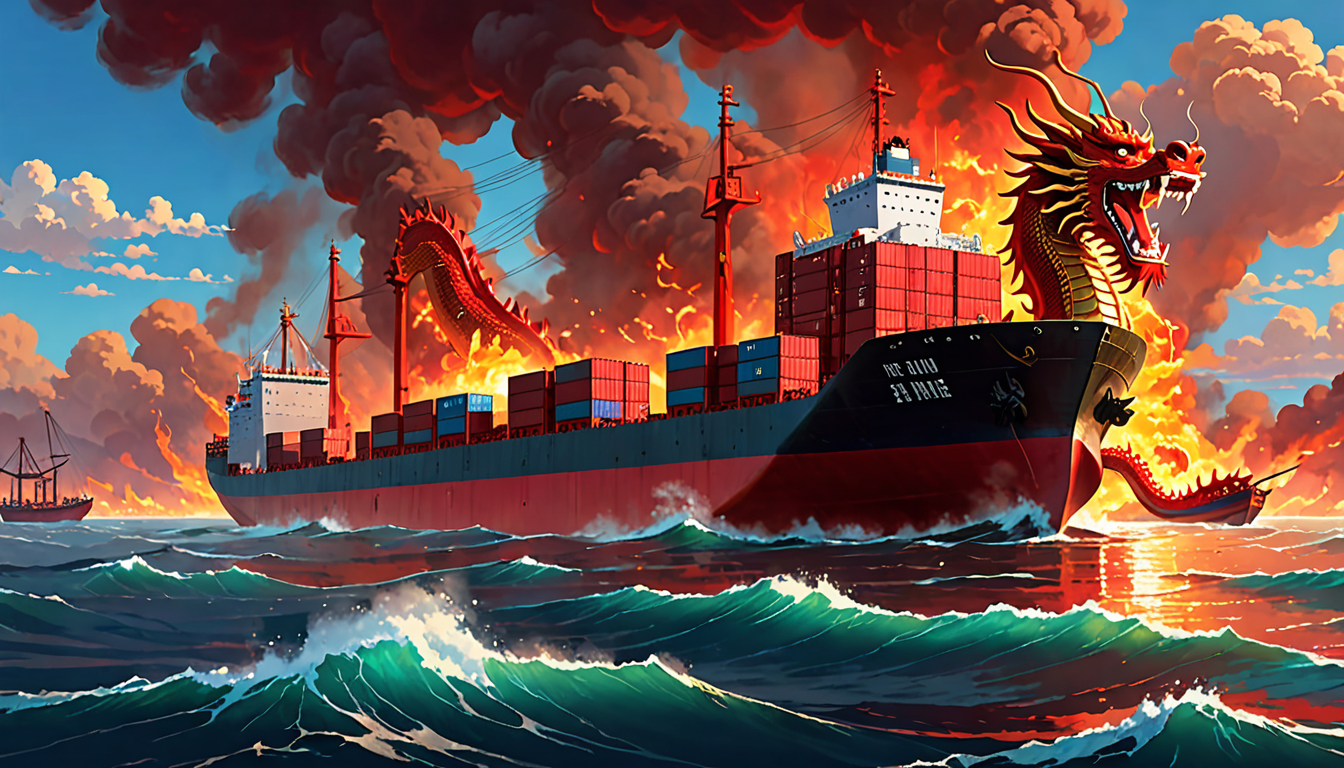
As the world burns, China's factories hum louder — but the export engine that powers Beijing's economy is also the cage that traps it
Executive Summary
- China's Jan-Feb 2026 exports grew 7.1% YoY, with the trade surplus hitting $179.6 billion — on pace to surpass 2025's record $1.2 trillion. The Iran war, counterintuitively, may accelerate China's strategic advantage through its green energy dominance and manufacturing lock-in.
- Yet this triumph masks a structural trap: with real estate collapsed (-30% from peak), consumption stuck at 39% of GDP, and deflation entrenched, Beijing has no viable alternative to exports — making the world's second-largest economy hostage to external demand it cannot control.
- The result is a historic paradox: rising trade power coincides with declining policy autonomy. The bigger China's export engine grows, the less freedom Beijing has to take bold domestic steps or geopolitical risks — including on Taiwan.
Chapter 1: The Numbers That Defy Gravity
On March 9, 2026, a Reuters poll of 23 economists revealed that China's export growth likely accelerated to 7.1% year-on-year in January-February, up from 6.6% in December 2025. The projected trade surplus for just those two months — $179.6 billion — exceeded the $169.2 billion recorded in the same period last year by over 6%.
These figures arrive against a backdrop that would have crippled most exporting nations. The Iran war has sent Brent crude above $119 per barrel. The Strait of Hormuz — through which roughly 20% of the world's oil transits — is effectively closed to commercial shipping. Global equity markets are in freefall, with the KOSPI triggering circuit breakers twice in four days and the Nikkei plunging 6.75%.
Yet China's export machine keeps accelerating.
The 2025 baseline was already extraordinary. China posted a record $1.2 trillion trade surplus, driven by a 5.4% increase in exports despite an active tariff war with the United States. The composition of those exports told an even more significant story: automobile exports surged past 6.5 million units (up from 5.86 million in 2024), semiconductor exports jumped 24.7%, shipbuilding exports rose 26.8%, and high-tech manufacturing value-added grew 9.4%. This is not the China of cheap textiles and plastic toys. This is a high-value manufacturing superpower that has moved decisively up the value chain.
| Indicator | 2024 | 2025 | 2026 (Jan-Feb est.) |
|---|---|---|---|
| Export growth (YoY) | 5.9% | 5.4% | 7.1% |
| Trade surplus | $992B | $1.2T | $179.6B (2-month) |
| Auto exports | 5.86M units | 6.5M+ units | Accelerating |
| Semiconductor exports | — | +24.7% | Continuing |
| GDP growth target | 5% | 5% (met) | 4.5-5% |
Premier Li Qiang's March 5 announcement of a 4.5-5% growth target for 2026 — China's least ambitious since 1991 — appeared to signal restraint. But economists note that 2025's 5% target was met largely through a one-fifth surge in the trade surplus. The export machine is not slowing down; Beijing is simply becoming more honest about how much of its growth comes from flooding global markets.
Chapter 2: The War Paradox — How the Iran Conflict Strengthens China
The conventional wisdom holds that China, as the world's largest oil and LNG importer, should be the Iran war's biggest loser. Beijing imported roughly 90% of Iranian oil production (mostly routed through third countries to evade sanctions) and depends on the Strait of Hormuz for approximately half of its Middle Eastern energy supplies. The government has already ordered refiners to suspend diesel and gasoline exports to protect domestic supplies.
But as Foreign Policy argued on March 6, this framing misses a deeper dynamic: crises reorder energy geopolitics in unexpected ways, and this one may ultimately strengthen China's strategic position.
The Green Energy Shield. China dominates global renewable energy manufacturing with a completeness that has no historical parallel. It produces 80%+ of the world's solar panels, 60%+ of wind turbines, and controls the vast majority of battery and EV supply chains. While the rest of the world scrambles to cope with $119 oil, China's accelerated electrification — already years ahead of schedule — means its economy is structurally less exposed to fossil fuel shocks than its GDP-weighted oil import figures suggest.
The Russian Pipeline Hedge. Unlike Japan, South Korea, or India — which depend almost entirely on seaborne energy imports through vulnerable chokepoints — China receives substantial oil and gas volumes via overland pipelines from Russia and Central Asia. The Power of Siberia pipeline, expanded under post-2022 sanctions arrangements, and the Kazakhstan-China oil pipeline provide a floor of energy security that no maritime-dependent economy can match.
The Manufacturing Lock-In. As oil prices devastate competing economies — India's Sensex has plunged 3,330 points, wiping out $225 billion in market capitalization — China's relative advantage grows. Factories in Vietnam, Indonesia, and India face soaring energy costs that erode their competitiveness against Chinese producers who benefit from subsidized domestic energy prices, superior grid infrastructure, and a more diversified energy mix. The Iran war is not disrupting China's export dominance; it is reinforcing it.
The Diplomatic Windfall. Wang Yi's carefully calibrated NPC press conference — condemning the war without naming the United States, rejecting "great power co-governance" while inviting Trump to Beijing for March 31 — positions China as the responsible stakeholder while America burns its credibility across the Middle East. The collapse of China's own 2023-brokered Saudi-Iran normalization is a setback, but it is dwarfed by the erosion of American influence among Gulf states now publicly reviewing $3.2 trillion in U.S. investments.
Chapter 3: The Structural Trap — Export Dependence as a Cage
The Asia Times identified the core paradox in February: "Rising trade power coincides with declining policy autonomy." The bigger the export engine, the less freedom Beijing has to act independently — on domestic reform, on Taiwan, on anything that might disrupt the trade flows sustaining the economy.
The numbers explain why. Real estate — once 25% of GDP — has collapsed. Home prices are down 30% from their 2021 peak. Private consumption sits at just 39% of GDP, far below the global average of 55%. Infrastructure spending has exhausted its multiplier effect. Deflation has taken hold, with companies slashing prices in what officials call "involution" — a deflationary spiral where competition destroys margins, suppresses wages, and further depresses demand.
This leaves exports as Beijing's only viable growth engine. But export dependence creates a cascading set of vulnerabilities:
Demand Vulnerability. When growth depends on external demand, macroeconomic stability becomes contingent on foreign consumers' willingness to keep buying. A global recession — increasingly likely as $100+ oil threatens to tip overleveraged Western economies into stagflation — would hit China's export engine precisely when no domestic alternative exists.
Political Vulnerability. The tariff walls are closing in from every direction. Trump's revived tariff war failed to slow China in 2025, but Chinese firms succeeded by diversifying into Southeast Asia, Africa, and Latin America. Now those markets are themselves weighing trade curbs. The EU's Industrial Accelerator Act imposes 40% local manufacturing thresholds. Canada, Japan, and France are building alternative mineral supply chains outside U.S.-China blocs. The diversification strategy that saved China's exports in 2025 faces multiplying obstacles.
The Taiwan Constraint. Perhaps the most consequential implication: as the Rhodium Group and Atlantic Council research shows, when exports sustain millions of jobs and complex industrial chains, even the possibility of disruption is paralyzing. Taiwan — whose semiconductor industry is deeply integrated with Chinese supply chains — becomes an issue that Beijing must perpetually defer. The export model that gives China economic power simultaneously denies it the freedom to use that power coercively.
This is the feedback loop: weak domestic traction forces reliance on exports; each year of export-led growth locks the economy further into that vulnerable path; and the political cost of rebalancing rises with every passing quarter, ensuring it never happens.
Chapter 4: Scenario Analysis
Scenario A: Export Acceleration Continues (40%)
Premise: Iran war disrupts competitors more than China; global demand holds despite oil shock; diversification to non-Western markets sustains momentum.
Supporting Evidence:
- 2025 demonstrated resilience against tariffs through market diversification
- China's energy mix (30%+ non-fossil electricity generation) provides relative insulation
- Competing manufacturing hubs (India, Vietnam) face worse energy cost inflation
- Jan-Feb 2026 data already shows acceleration
Historical Precedent: Japan's export surge during the 1973-74 oil crisis. Despite being an oil importer, Japan's more efficient manufacturing (smaller cars, lower energy intensity per unit) gained market share as American and European competitors struggled. Japan's trade surplus with the U.S. tripled between 1973 and 1976.
Trigger: Continued Hormuz disruption for 2+ months; no major new tariff barriers from ASEAN/Latin America; Trump-Xi March 31 summit produces temporary trade truce.
Investment Implication: Chinese export champions (BYD, CATL, LONGi Green) continue outperforming; yuan remains stable or strengthens modestly on trade surplus flows.
Scenario B: Stagflationary Stall (35%)
Premise: Oil shock triggers global recession; Western demand collapses; China's export engine loses its primary fuel — foreign consumers.
Supporting Evidence:
- Brent at $119 and rising; Goldman warns of $100-150 range
- U.S. NFP already at -92,000; stagflation indicators flashing
- ECB repricing from rate cuts to hikes in 7 days
- Private credit crisis (Blackstone, Blue Owl) threatens credit transmission
Historical Precedent: The 2008-09 global financial crisis. China's exports fell 16% in 2009 as global demand collapsed. Beijing responded with a massive 4-trillion-yuan stimulus — but that stimulus created the real estate bubble now weighing on the economy. A second round of debt-fueled stimulus would face sharply diminishing returns.
Trigger: U.S. recession officially declared by Q3 2026; European recession deepens; global trade volumes contract 5%+.
Investment Implication: Chinese equities decline 15-25%; yuan depreciates to 7.5+ against USD; gold and U.S. Treasuries (despite their own problems) attract safe-haven flows.
Scenario C: Protectionist Encirclement (25%)
Premise: China's export success provokes a coordinated global backlash. Multiple governments impose trade barriers simultaneously, creating a "fortress world" scenario.
Supporting Evidence:
- EU Industrial Accelerator Act already passed with 40% local content rules
- Japan-France-Canada "mineral rebellion" forming alternative supply chains
- India imposing retaliatory duties on Chinese steel and solar
- Trump tariffs + allied tariffs = potential 30-60% effective rates
Historical Precedent: The Smoot-Hawley Tariff Act of 1930 and subsequent retaliatory tariffs that collapsed global trade by 65% within three years. While a full Smoot-Hawley repeat is unlikely, the direction of travel — multiple simultaneous trade barriers — echoes the interwar period.
Trigger: EU anti-subsidy duties on Chinese EVs expanded to solar/batteries; India raises duties above 40%; ASEAN countries follow Indonesia's nickel export ban model with their own industrial policies.
Investment Implication: Supply chain reshoring beneficiaries (U.S. industrials, European defense/manufacturing) outperform; Chinese exporters face margin compression; emerging market manufacturers (Mexico, Vietnam) gain selectively.
Chapter 5: Investment Implications — Riding the Paradox
Short-term (1-3 months): China's export data will likely continue impressing, as order pipelines from Q4 2025 work through the system and competitors reel from the oil shock. Chinese industrial ETFs (KWEB, FXI) may see tactical bounces on strong data, but are vulnerable to geopolitical headline risk around the March 31 Trump-Xi summit.
Medium-term (6-12 months): The key variable is whether the global economy tips into recession. If it does, China's export engine faces its first real stress test since 2009 — but with far fewer domestic policy tools available. The property sector cannot be re-inflated, infrastructure stimulus has exhausted returns, and consumer confidence remains shattered. Defensive positioning (utilities, consumer staples, gold) is warranted.
Long-term (2-5 years): The structural paradox resolves in one of two ways. Either China successfully rebalances toward domestic consumption (requiring politically painful reforms that 15 successive Five-Year Plans have promised but never delivered), or the export model eventually hits the wall of protectionist encirclement. In either case, the current trajectory of ever-expanding surpluses is unsustainable. Investors should watch the consumption-to-GDP ratio as the single most important structural indicator.
| Asset Class | Short-term | Medium-term | Long-term |
|---|---|---|---|
| Chinese exporters (BYD, CATL) | ▲ Positive | ◆ Mixed | ▼ Vulnerable |
| Chinese consumer stocks | ◆ Flat | ▼ Weak | ▲ Rebalancing play |
| Gold | ▲ Strong | ▲ Strong | ▲ Structural bid |
| Competing EM manufacturers | ▼ Oil shock pain | ▲ Reshoring beneficiary | ▲ Diversification winners |
| U.S./EU industrials | ◆ Mixed | ▲ Policy support | ▲ Reshoring + protection |
Conclusion
China's $1.2 trillion trade surplus is not just a number — it is a structural condition that now defines Beijing's economic and strategic options. The Iran war, paradoxically, reinforces this condition by devastating competing economies while China's diversified energy mix and dominant green manufacturing provide relative insulation.
But the very success of the export model is what makes it a trap. Each record surplus deepens the dependence. Each year of deferred domestic reform raises the eventual cost of rebalancing. And each new trade barrier erected by alarmed trading partners narrows the runway.
The 15th Five-Year Plan's promise of "notable" consumption growth is, in historical context, the latest iteration of a pledge Beijing has been making since the 12th Plan in 2011. The gap between promise and delivery has only widened. Until China's households — not its factories — become the primary engine of growth, the world's greatest export machine will remain the world's most elegant cage.
Sources: Reuters, Foreign Policy, Asia Times, ThePrint, DW, MarketScreener, Chinese government statistics
Leave a Reply