
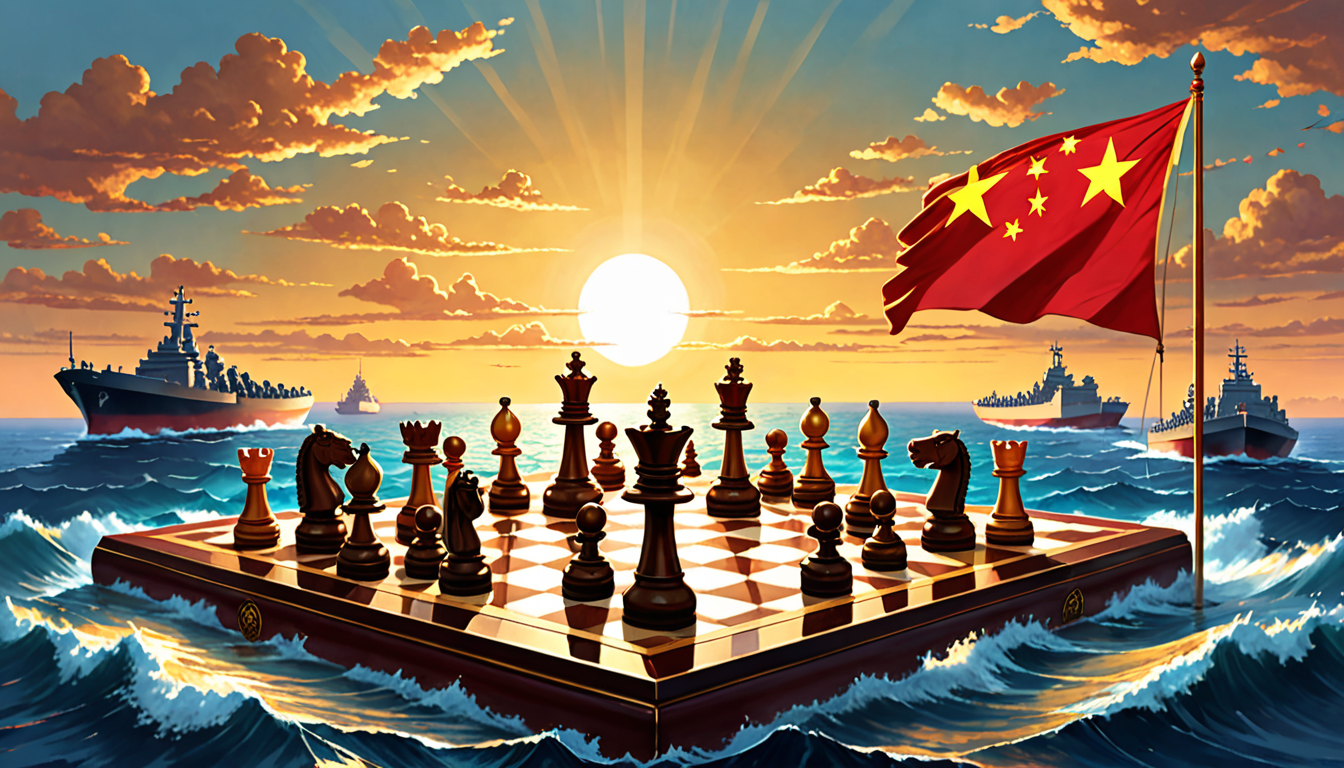
Beijing declares "crunch time" for a 17-year negotiation — but the math doesn't add up
Executive Summary
- Wang Yi declared at China's Two Sessions that South China Sea Code of Conduct negotiations have reached "crunch time," with all parties expecting to conclude consultations within 2026 — a dramatic escalation of diplomatic rhetoric on a framework that has languished for nearly two decades.
- China's own top SCS expert, Wu Shicun, publicly contradicts this optimism, calling a 2026 conclusion "100 per cent not likely" under the Philippines' ASEAN chairmanship — exposing a fundamental disconnect between Beijing's diplomatic messaging and its strategic community's assessment.
- The real game is not the COC itself but what China gains from appearing to pursue it: diplomatic cover while the world is fixated on the Iran crisis, leverage ahead of Trump's March 31 Beijing visit, and a wedge to split ASEAN claimants from non-claimants.
Chapter 1: Seventeen Years in the Waiting Room
The South China Sea Code of Conduct is one of the longest-running diplomatic negotiations in modern history. Formal discussions between ASEAN and China began in 2002 with the Declaration on the Conduct of Parties (DOC) — a non-binding political document that was supposed to be a stepping stone to something with teeth. Twenty-four years later, the stepping stone is still the destination.
The timeline tells the story of strategic delay:
| Year | Milestone | Outcome |
|---|---|---|
| 2002 | DOC signed | Non-binding, no enforcement mechanism |
| 2013 | Philippines files arbitration at The Hague | China refuses to participate |
| 2016 | Tribunal rules against China's nine-dash line | China rejects ruling as "illegal and invalid" |
| 2017 | Framework for COC negotiations adopted | No substantive text |
| 2018 | Single Draft Negotiating Text (SDNT) agreed | Hundreds of brackets (disputed passages) |
| 2023 | China-Saudi-Iran normalization via Beijing | China's diplomatic capital peaks |
| 2024-25 | Scarborough Shoal confrontations escalate | Philippines-China tensions spike |
| 2026 | Wang Yi declares "crunch time" | Expert says "100% not likely" |
The Single Draft Negotiating Text remains riddled with bracketed passages — diplomatic shorthand for fundamental disagreements. The core disputes have barely moved in years:
Geographic scope: Does the COC cover the Paracel Islands (disputed between China and Vietnam) or only the Spratlys? China wants to exclude the Paracels entirely, since it exercises de facto control there.
Legal binding force: The 2002 DOC was explicitly non-binding. ASEAN claimant states — the Philippines, Vietnam, Malaysia, and Brunei — want the COC to be legally binding under international law. China has resisted this, preferring "politically binding" language that carries moral but not legal weight.
Third-party military activities: China wants the COC to restrict military exercises with "outside parties" — a transparent attempt to curtail US, Japanese, and Australian naval operations in the region. ASEAN members with security partnerships with Washington find this unacceptable.
Dispute resolution mechanism: Who arbitrates when the COC is violated? China refuses any mechanism that could reference the 2016 Hague ruling, which it considers illegitimate. The Philippines considers the ruling foundational.
These are not technical details awaiting clever drafting. They are fundamental strategic disagreements that reflect incompatible visions of regional order.
Chapter 2: The Philippine Problem
The Philippines assumed the rotating ASEAN chairmanship in 2026 under the theme "Navigating Our Future, Together." Manila has prioritized peace, security, and prosperity corridors — diplomatic language that barely conceals the centrality of the South China Sea to its agenda.
This is precisely why Wu Shicun, founding president of China's National Institute for South China Sea Studies, declared a 2026 conclusion "100 per cent not likely." His reasoning is blunt: "I believe it cannot be successfully negotiated under the Philippines' watch. They will inevitably bring up the arbitration ruling."
The 2016 ruling is the elephant in every negotiating room. The Permanent Court of Arbitration in The Hague — constituted under the United Nations Convention on the Law of the Sea (UNCLOS) — ruled that China's nine-dash line claim had no legal basis, that several features China occupied were not entitled to exclusive economic zones, and that China had violated the Philippines' sovereign rights.
Beijing's refusal to accept this ruling created a paradox: any COC that Manila signs must, from the Philippines' perspective, be compatible with the ruling. Any COC that Beijing signs must, from China's perspective, render the ruling irrelevant. These two positions are logically irreconcilable.
President Marcos Jr. has taken a harder line on the SCS than his predecessor Rodrigo Duterte, who largely shelved the arbitration ruling in exchange for Chinese economic engagement. Under Marcos, the Philippines has:
- Conducted joint patrols with the US Navy at Scarborough Shoal
- Publicly released footage of Chinese Coast Guard water cannon attacks on Philippine vessels
- Promoted a coastguard officer involved in SCS confrontations — what analysts called a "deliberate signal"
- Strengthened security ties with Japan, Australia, and India
For the Philippines to preside over COC negotiations while simultaneously confronting China operationally is a contradiction that no amount of diplomatic skill can paper over.
Chapter 3: Why Beijing Is Pushing Now
Wang Yi's "crunch time" rhetoric is not accidental. It serves multiple strategic purposes simultaneously, all of which become clearer in the context of the Iran war and the approaching Trump visit.
Diplomatic cover during the Iran crisis. While the world's attention is consumed by the Hormuz Strait blockade, oil price spikes, and the question of whether the US-Iran war will escalate further, China's South China Sea activities receive minimal scrutiny. By loudly declaring its commitment to peaceful resolution and "golden rules," Beijing creates a narrative contrast: reasonable China versus warring America. This is particularly effective in ASEAN capitals that are nervously watching their energy costs spike because of a war they had no part in starting.
Leverage before the Trump visit. Trump is expected in Beijing on March 31. Wang Yi described 2026 as a "big year" for US-China relations, noting that Xi and Trump had brought the relationship "back to an even keel." A COC breakthrough — or even the appearance of one — would strengthen Beijing's hand by demonstrating its ability to deliver regional stability, precisely the kind of outcome Trump could claim credit for without having to do anything.
Wedge strategy within ASEAN. ASEAN's ten members are not a monolith on the SCS issue. Only four — the Philippines, Vietnam, Malaysia, and Brunei — have overlapping claims with China. The other six — Thailand, Indonesia, Singapore, Myanmar, Laos, and Cambodia — have varying degrees of economic dependence on Beijing and less direct stakes in the dispute. China has historically exploited this division, using economic incentives to ensure that ASEAN consensus — which requires unanimity — is never reached on anything that challenges Chinese interests.
Cambodia, China's closest ASEAN ally, blocked a joint ASEAN communiqué on the SCS in 2012 — the first time in ASEAN's 45-year history that the bloc failed to issue a joint statement. Laos, another Chinese-dependent economy, has similarly softened ASEAN language on the SCS. The COC negotiation process, by requiring ASEAN consensus, gives China a structural advantage: it only needs one ally to water down the final product.
Chapter 4: The ASEAN Unity Illusion
The Bangkok Post's recent analysis captures the underlying tension: "Overlapping claims among Brunei, Malaysia, the Philippines and Vietnam continue to stall negotiations on a Code of Conduct, while China's growing assertiveness tests Asean unity."
This is diplomatic understatement. ASEAN unity on the SCS has never existed in a meaningful sense. The bloc's defining feature — consensus-based decision-making — is both its greatest strength (ensuring no member is overridden) and its fatal weakness (ensuring no difficult decision is ever made).
The Iran war has further exposed these fault lines. ASEAN members with heavy energy import dependence (Philippines, Thailand, Vietnam) are being hit by the oil price spike — Brent at $119 — while those with energy exports (Brunei, Malaysia, Indonesia to some extent) benefit from higher prices. This economic divergence makes coordinated foreign policy even harder.
Meanwhile, Australia's relationship with ASEAN is deepening rapidly. Two-way trade reached AUS$195.7 billion in 2024-25, and Canberra's development assistance to Southeast Asia hit AUS$1.28 billion — a 40-year high. The AUKUS framework, while focused on the Indo-Pacific more broadly, has explicit implications for the SCS. Australia's stake in SCS freedom of navigation is not theoretical; it is existential for its trade routes.
The Philippines' growing security partnerships with the US, Japan, Australia, and India create what China calls "external interference" — but what claimant states call essential deterrence. This dual-track approach (negotiate the COC while building security alliances) mirrors exactly the strategy that infuriates Beijing and makes Wu Shicun's pessimism entirely rational.
Chapter 5: Scenario Analysis
Scenario A: Symbolic Framework Agreement (40%)
What it looks like: ASEAN and China announce a "framework" or "guidelines" document by late 2026 that declares shared principles — peaceful resolution, respect for international law (without specifying which law), freedom of navigation. It contains no binding enforcement mechanism, no reference to the 2016 ruling, and no restriction on China's artificial island construction.
Why 40%: This is China's preferred outcome and aligns with the historical pattern. The 2002 DOC was exactly this kind of document — symbolic enough to claim progress, hollow enough to change nothing. China has the diplomatic machinery to push a version of this through, particularly if it can secure support from Cambodia and Laos.
Historical precedent: The 2002 DOC itself. Signed with fanfare, it did nothing to prevent China's massive island-building campaign in 2013-2016, during which Beijing constructed 3,200 acres of artificial land in the Spratlys.
Trigger conditions: Wang Yi personally drives negotiations through back-channel consultations; China offers economic sweeteners to wavering ASEAN members; Philippines accepts vague language to avoid being blamed for collapse.
Scenario B: Negotiation Stalemate Continues (45%)
What it looks like: Negotiations continue through 2026 without conclusion. Both sides issue optimistic statements about "progress" while fundamental disagreements remain unresolved. The process rolls over to the next ASEAN chair (Malaysia in 2027).
Why 45%: This is the default state of affairs and requires no action from any party. The Philippines' hardline position on the arbitration ruling and China's refusal to acknowledge it create an unbridgeable gap. Wu Shicun's "100% not likely" assessment reflects the consensus among SCS scholars on both sides.
Historical precedent: Virtually every year since 2017. The SDNT has accumulated more brackets, not fewer, with each round of negotiations.
Trigger conditions: Philippines insists on arbitration ruling reference; China refuses; ASEAN cannot reach internal consensus; attention remains focused on Iran crisis.
Scenario C: Genuine Breakthrough (15%)
What it looks like: A legally binding or near-binding COC with dispute resolution mechanisms, restrictions on unilateral island-building, and acknowledgment of UNCLOS provisions. Would represent a fundamental shift in regional order.
Why 15%: This would require China to make concessions it has never made in any territorial dispute. Beijing's entire SCS strategy is premised on maintaining strategic ambiguity and fait accompli through island construction. A binding COC would constrain precisely the tools that have worked for China.
Historical precedent: No clear precedent. The closest analogy might be the 1994 UNCLOS ratification process, which took 12 years and excluded the US entirely. Even that did not resolve sovereignty disputes.
Trigger conditions: Dramatic shift in Chinese domestic politics; US-China grand bargain that includes SCS concessions as part of a broader trade deal; Xi Jinping decides SCS stability is worth more than territorial maximalism ahead of some larger strategic objective.
Chapter 6: Investment Implications
The SCS COC outcome has direct implications across several asset classes:
Defense stocks. Continued stalemate (Scenario B) is the baseline that defense contractors have already priced in. A symbolic agreement (Scenario A) could briefly reduce defense spending pressure in ASEAN capitals, but the Philippines, Vietnam, and Japan have structural drivers for military modernization that transcend any COC. Key names: Hanwha Aerospace (Korea), BAE Systems, Lockheed Martin.
Energy and shipping. With the Hormuz Strait blockade already causing havoc, any escalation in SCS tensions would create a second chokepoint crisis. Roughly one-third of global shipping — valued at $3.4 trillion annually — transits the South China Sea. An SCS disruption on top of Hormuz would be unprecedented. Shipping insurers and container lines would be first impacted. War risk premiums for SCS transit remain low relative to the Middle East, but a Scenario B world with rising confrontations could change that.
ASEAN equities. A genuine COC (Scenario C) would be profoundly bullish for ASEAN markets, particularly Philippines (PSEi), Vietnam (VN-Index), and Malaysia (KLCI). The region's "geopolitical discount" — the risk premium investors demand for SCS uncertainty — has been estimated at 50-100 basis points on equity risk premiums. Removal of this discount would unlock significant value, but Scenario C's 15% probability makes this a long-shot bet.
Rare earth and critical minerals. The SCS seabed contains significant hydrocarbon and mineral deposits. Cooperative exploitation under a COC framework could open new supply chains — or, more realistically, the continued legal ambiguity will keep these resources locked up. For investors in the rare earth supply chain, the SCS stalemate reinforces dependence on land-based Chinese production, which remains at 60-70% of global output.
| Asset | Scenario A Impact | Scenario B Impact | Scenario C Impact |
|---|---|---|---|
| ASEAN equities | Neutral-slight positive | Status quo | Strongly bullish |
| Defense stocks | Slight negative | Positive | Negative |
| Shipping/insurance | Neutral | Gradual risk increase | Risk reduction |
| Energy (SCS-linked) | Neutral | Continued uncertainty | Cooperative development |
Conclusion
Wang Yi's "golden rules" rhetoric is precisely that — rhetoric. The structural impediments to a meaningful South China Sea Code of Conduct have not changed: China will not accept legal bindingness, the Philippines will not abandon the 2016 ruling, and ASEAN will not achieve internal consensus on either.
What has changed is the context. The Iran war has reshaped every diplomatic calculation in Asia. China's desire to appear as a stabilizing force — in contrast to the US-led military campaign in the Middle East — gives Beijing a strong incentive to make the COC process look productive, even if the substance remains empty. Trump's March 31 visit adds another layer of performative diplomacy.
The most likely outcome is a continuation of the pattern that has defined SCS diplomacy for 24 years: process without progress, meetings without meaning, and a sea that remains contested, militarized, and legally ambiguous. The "golden rules" will almost certainly turn out to be gilded ones — shiny on the surface, base metal underneath.
For investors and policymakers, the actionable insight is simple: do not price in a COC breakthrough. The SCS remains a structural risk factor for the Indo-Pacific, and no amount of Wang Yi's optimism will change the arithmetic of incompatible sovereignty claims.
Sources: SCMP, Manila Times, Bangkok Post, Asia News Network, MCI Group
Leave a Reply