
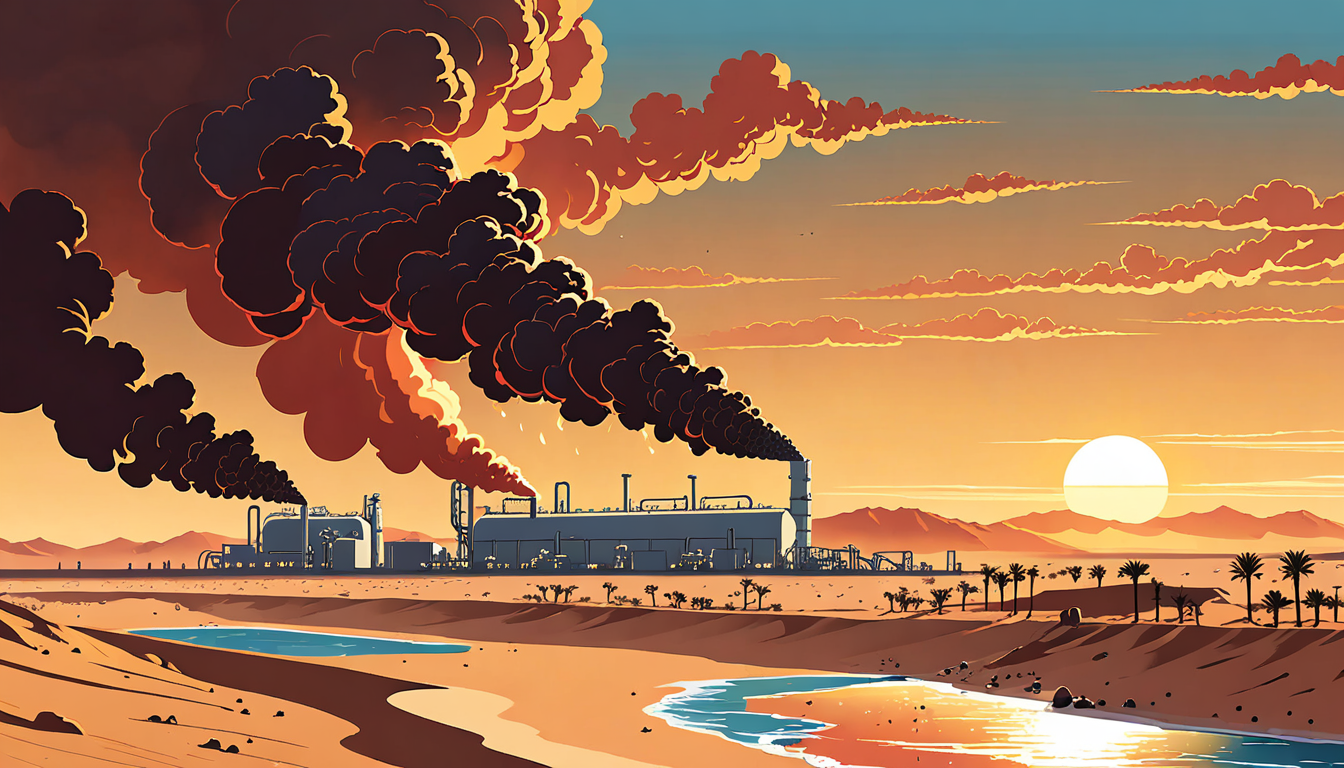
Both sides have now crossed the water line — and the consequences could be catastrophic
Executive Summary
- The US struck Iran's Qeshm Island desalination plant on March 7, cutting water to 30 villages. Within 24 hours, Iran retaliated by droning a Bahrain desalination plant — establishing a dangerous new precedent of targeting water infrastructure as a weapon of war.
- Gulf states depend on desalination for 42–90% of their drinking water, with roughly 400 coastal plants producing 40% of the world's desalinated water — all within Iranian missile range. A leaked 2008 US diplomatic cable warned Riyadh would need evacuation within a week if the Jubail complex were destroyed.
- This mutual escalation transforms the conflict's calculus: oil disruptions raise prices; water disruptions threaten mass civilian crises. International humanitarian law explicitly prohibits attacks on objects indispensable to civilian survival, yet both Washington and Tehran have now violated this norm with minimal consequence.
Chapter 1: The Precedent That Changed Everything
On Saturday, March 7, a US airstrike hit a freshwater desalination plant on Qeshm Island, a 1,500-square-kilometer Iranian island situated in the narrowest point of the Strait of Hormuz. Iran's Foreign Minister Abbas Araghchi condemned the strike as "a blatant and desperate crime," noting that water supply to 30 villages had been disrupted. But his final sentence carried the real weight: "The US set this precedent, not Iran."
Less than 24 hours later, Iran made good on the implicit threat. On Sunday morning, March 8, an Iranian drone struck a water desalination plant in Bahrain, causing material damage. Bahrain's Interior Ministry called it part of Iran's "random bombing of civilian targets." Three people were injured in related attacks, and missile debris damaged a university building in the Muharraq area.
The sequence was unmistakable: tit-for-tat water infrastructure targeting. For the first time in the nine-day conflict, both sides had deliberately struck the systems that keep civilian populations alive in one of the driest regions on Earth.
Chapter 2: The Saltwater Kingdoms
To understand why this escalation is uniquely dangerous, one must grasp a fundamental fact about the Persian Gulf: these are not countries that happen to have desalination plants. They are civilizations that exist because of desalination plants.
The Gulf Cooperation Council states operate approximately 400 desalination facilities along the Persian Gulf coast, producing roughly 40% of the world's desalinated water. The dependency ratios are staggering:
| Country | Desalination Dependency | Key Facilities |
|---|---|---|
| Kuwait | ~90% of drinking water | Doha West, Az-Zour, Subiya |
| Oman | ~86% of drinking water | Barka, Sohar, Sur |
| Saudi Arabia | ~70% of drinking water | Jubail (world's largest), Ras Al-Khair, Yanbu |
| Bahrain | ~60%+ of drinking water | Hidd, Al Dur |
| UAE | ~42% of drinking water | Jebel Ali, Fujairah F1 |
| Qatar | ~99% of drinking water | Ras Abu Fontas, Umm Al Houl |
Michael Christopher Low, director of the Middle East Center at the University of Utah, captured the paradox precisely: "Everyone thinks of Saudi Arabia and their neighbors as petrostates. But I call them saltwater kingdoms. They're manmade fossil-fueled water superpowers. It's both a monumental achievement of the 20th century and a certain kind of vulnerability."
The technology itself — reverse osmosis, which pushes seawater through ultra-fine membranes — is a marvel of engineering. But the infrastructure is sprawling, coastal, and largely undefended against modern precision munitions. Many plants are physically integrated with power stations as co-generation facilities, meaning a strike on electrical infrastructure can simultaneously cripple water production. The cascade effects multiply through interconnected grids.
Chapter 3: Nine Days of Creeping Proximity
The war has been inching toward Gulf water systems since Day 1. The timeline reveals a pattern of deliberate proximity escalating into direct strikes:
March 2 (Day 3): Iranian strikes on Dubai's Jebel Ali port landed approximately 19 kilometers from one of the world's largest desalination plants, which produces much of Dubai's drinking water. At the time, it appeared incidental.
March 3–5 (Days 4–6): Damage reported at the Fujairah F1 power and water complex in the UAE and Kuwait's Doha West desalination plant. Officials attributed both to debris from intercepted drones and nearby port attacks — collateral damage, not deliberate targeting.
March 5 (Day 6): Iran struck a power station in Fujairah that supports one of the world's largest desalination complexes. The line between targeting energy infrastructure and water infrastructure began to blur.
March 7 (Day 8): The US crossed the line explicitly, striking the Qeshm Island desalination plant. Araghchi warned of "grave consequences."
March 8 (Day 9): Iran retaliated against Bahrain's desalination infrastructure within hours. The precedent was established on both sides.
David Michel, senior fellow for water security at the Center for Strategic and International Studies, described the strategic logic: "It's an asymmetrical tactic. Iran doesn't have the same capacity to strike back at the United States and Israel. But it does have this possibility to impose costs on the Gulf countries to push them to intervene or call for a cessation of hostilities."
Chapter 4: The Three-Day Countdown
The vulnerability is not theoretical. Specific assessments by both Gulf governments and Western intelligence agencies have quantified exactly how quickly water crises would develop:
The Riyadh Scenario: A leaked 2008 US diplomatic cable from the Riyadh embassy warned that Saudi Arabia's capital would have to be evacuated within one week if the Jubail desalination complex, its pipelines, or associated power infrastructure were seriously damaged. The Jubail complex supplies more than 90% of Riyadh's drinking water through a pipeline stretching roughly 500 kilometers inland. The Saudi government's administrative structure, the cable noted, could not function without it.
The Qatar Assessment: Qatar's prime minister disclosed that his country had once assessed it could run out of potable water in just three days following a major infrastructure attack. This assessment led Doha to build 15 massive water reservoirs as emergency reserves — but even these provide only limited buffer against sustained disruption.
The CIA Analysis: A 2010 CIA assessment warned that attacks on desalination facilities could trigger national crises in several Gulf states, and that prolonged outages could last months if critical equipment — particularly the specialized membranes used in reverse osmosis — were destroyed. These membranes are manufactured by a small number of global suppliers, and replacement timelines are measured in months, not days.
Ed Cullinane, Middle East editor at Global Water Intelligence, underscored the exposure: "None of these assets are any more protected than any of the municipal areas that are currently being hit by ballistic missiles or drones."
Chapter 5: The Legal Void
Under international humanitarian law, the protection of water infrastructure is explicit. Article 54 of the 1977 First Additional Protocol to the Geneva Conventions prohibits attacks on "objects indispensable to the survival of the civilian population," specifically including "drinking water installations and supplies and irrigation works." Article 56 bans attacking "works or installations containing dangerous forces" such as dams and dykes.
The Geneva List of Principles on the Protection of Water Infrastructure, developed by the Geneva Water Hub, further codifies these protections. The ICRC has repeatedly emphasized that water systems deserve special protection in armed conflict because their destruction causes disproportionate civilian suffering.
Yet both the United States and Iran have now struck desalination facilities with little international outcry beyond the parties themselves. The US justified the Qeshm Island strike as targeting infrastructure supporting military operations. Iran framed its Bahrain attack as retaliatory precedent. Neither argument meets the legal threshold for overriding civilian protections — but in a conflict without functioning enforcement mechanisms, legal frameworks offer scant comfort.
Historical parallels are troubling. During the 1991 Gulf War, coalition airstrikes destroyed Iraq's water treatment infrastructure, contributing to a humanitarian crisis that killed an estimated 100,000–250,000 civilians in the post-war period according to UNICEF estimates. The 2003 Iraq invasion saw similar patterns. In the ongoing conflict in Yemen, the Saudi-led coalition struck water infrastructure multiple times, drawing condemnation but no accountability.
Chapter 6: Scenario Analysis
Scenario A: Deterrence Holds — Water Stays Off-Limits (25%)
Premise: The Qeshm-Bahrain exchange was a one-time signaling exercise. Both sides recognize that systematic water targeting would trigger humanitarian catastrophe and international intervention that neither side wants.
Supporting evidence: Iran's initial restraint over 8 days of conflict, during which it struck airports, ports, oil facilities, and hotels but avoided desalination plants, suggests an implicit understanding of the taboo. Pezeshkian's (quickly reversed) apology to Gulf neighbors indicates elements within Tehran's leadership prefer de-escalation. Bahrain's electricity and water authority confirmed supplies remained online after the strike, suggesting limited damage.
Trigger conditions: Backchanel communication establishing mutual restraint; Arab League emergency meeting (convened March 8) producing explicit warnings to Iran about water escalation.
Why only 25%: The precedent is already established. Once both sides have demonstrated willingness to target water infrastructure, the taboo weakens each subsequent day of conflict. Trump's refusal to negotiate ("We're not looking to settle") and Mohseni-Ejei's promise of "intense attacks" on Gulf targets suggest escalatory pressure from both sides.
Scenario B: Gradual Escalation — Indirect Water Disruption (45%)
Premise: Neither side deliberately targets desalination plants as a primary objective, but strikes on power grids, fuel supplies, and port infrastructure progressively degrade water production capacity. The distinction between "energy strike" and "water strike" becomes meaningless in practice.
Supporting evidence: This is already happening. The Fujairah power station attack disrupted a co-generation facility. Kuwait airport fuel tank strikes threaten the energy supply chain that powers desalination. As Qalibaf warned on March 8, the war's effect on the oil industry will "continue to spiral," making it "harder to both produce and sell oil" — the same oil that fuels desalination.
Historical precedent: During the Iran-Iraq War (1980–1988), Iraq did not deliberately target Iranian water systems, but sustained strikes on power generation and industrial infrastructure in Khuzestan province caused severe water shortages in cities like Ahvaz. The lesson: you don't need to bomb the desalination plant if you destroy its power source.
Trigger: Continued conflict beyond 2–3 weeks; Iranian strikes expanding to target Saudi eastern coast energy infrastructure near the Jubail complex; power grid failures cascading to water production.
Timeline: Water rationing in affected Gulf states within 2–4 weeks; emergency desalinated water imports via tanker within 4–6 weeks.
Scenario C: Deliberate Water Warfare — Humanitarian Catastrophe (30%)
Premise: Iran concludes that direct attacks on Gulf desalination infrastructure are its most effective asymmetric lever to force a ceasefire, reasoning that the humanitarian consequences will compel international intervention. Tehran targets 3–5 major desalination complexes simultaneously.
Supporting evidence: Iran's leadership is fracturing. Mohseni-Ejei's declaration that "intense attacks on these targets will continue" directly contradicted Pezeshkian's conciliatory stance — and Pezeshkian himself reversed course within 24 hours. The IRGC is operating increasingly autonomously, and hardliners may calculate that maximizing civilian pressure on Gulf states is their strongest card. Araghchi's "precedent" framing was explicit preparation for this scenario.
Historical precedent: During the 1991 Gulf War, Iraq launched Scud missiles at Israeli cities specifically to provoke a wider conflict and break the coalition — the same logic Iran would apply by targeting Gulf water infrastructure to fracture US-Gulf cooperation. In the Iran-Iraq "War of the Cities" (1985–1988), both sides deliberately struck civilian infrastructure to break morale.
Trigger: Continued Israeli strikes on Iranian oil facilities (as occurred March 7–8); a major Iranian military or political leader killed; IRGC hardliners gaining full operational control over targeting decisions.
Timeline: Mass evacuation orders in affected cities within 72 hours; UN Security Council emergency session within 48 hours; potential ceasefire pressure within 1–2 weeks but at enormous humanitarian cost.
Chapter 7: Investment Implications
Water technology and infrastructure:
- Desalination equipment manufacturers (IDE Technologies, Veolia, SUEZ, Doosan Enerbility) face contradictory pressures: short-term disruption risk but massive long-term demand for replacement and redundancy investment.
- Emergency water logistics companies and tanker operators stand to benefit from immediate crisis response.
- Water storage and reservoir construction will see accelerated Gulf government spending regardless of scenario.
Energy markets:
- The water-energy nexus means that Gulf production curtailments have a double impact: less oil exported and less energy available for domestic desalination. Oil prices already at $85–90/bbl reflect energy disruption but do not yet price in systematic water infrastructure risk.
- If Scenario C materializes, the resulting Gulf state instability could push oil above the $150 level Qatar's prime minister warned about.
Insurance and reinsurance:
- War risk insurance for Gulf infrastructure was already in crisis (see: April 1 reinsurance renewal). Water infrastructure targeting adds a new category of uninsurable risk.
- Sovereign risk premiums for Gulf states should widen if water security deteriorates.
Humanitarian and agricultural:
- Gulf food imports depend on functioning ports (already disrupted) and fresh water for any domestic agriculture. The intersection with the existing food crisis ("사막의 포위전") compounds vulnerability.
- Global wheat and grain markets face additional upward pressure if Gulf states begin emergency food hoarding alongside water hoarding.
Conclusion
The world's attention remains fixed on oil prices and missile counts. But the March 7–8 desalination exchange may prove to be the most consequential escalation of the entire conflict. Oil disruptions cause economic pain. Water disruptions cause civilizational crises.
The Gulf states spent half a century and hundreds of billions of dollars engineering the impossible — making deserts habitable for tens of millions of people. That achievement rests on a coastal ribbon of desalination plants, every one of them within range of Iranian drones that cost a fraction of what the plants cost to build.
Araghchi's four words — "the US set this precedent" — may be the most dangerous sentence spoken in this war. Precedents, once established in armed conflict, are not easily walked back. The question is no longer whether water infrastructure is a legitimate target. Both sides have answered that question. The question is how far they are willing to go.
Leave a Reply