
How the world's fifth-most-populous country became the forgotten casualty of the 2026 crisis
Executive Summary
- Pakistan faces an unprecedented two-front crisis: a shooting war with Afghanistan along the Durand Line since February 21 and the economic devastation of the Iran war's oil shock, which has triggered the country's largest-ever single fuel price hike of Rs 55 per litre (17-20%) overnight.
- The simultaneous military and economic emergencies threaten to unravel Pakistan's fragile IMF bailout program, with Brent crude approaching $100/barrel while Islamabad spends scarce reserves on both jet fuel for F-16s bombing Kabul and imported petroleum for civilian consumption.
- Pakistan's structural vulnerability — near-total dependence on Hormuz-transiting oil, a $130 billion external debt burden, and a military already stretched thin by the Balochistan and Khyber Pakhtunkhwa insurgencies — makes it the most likely candidate for an economic crisis cascading into state failure among the war's collateral damage nations.
Chapter 1: The Forgotten War on the Durand Line
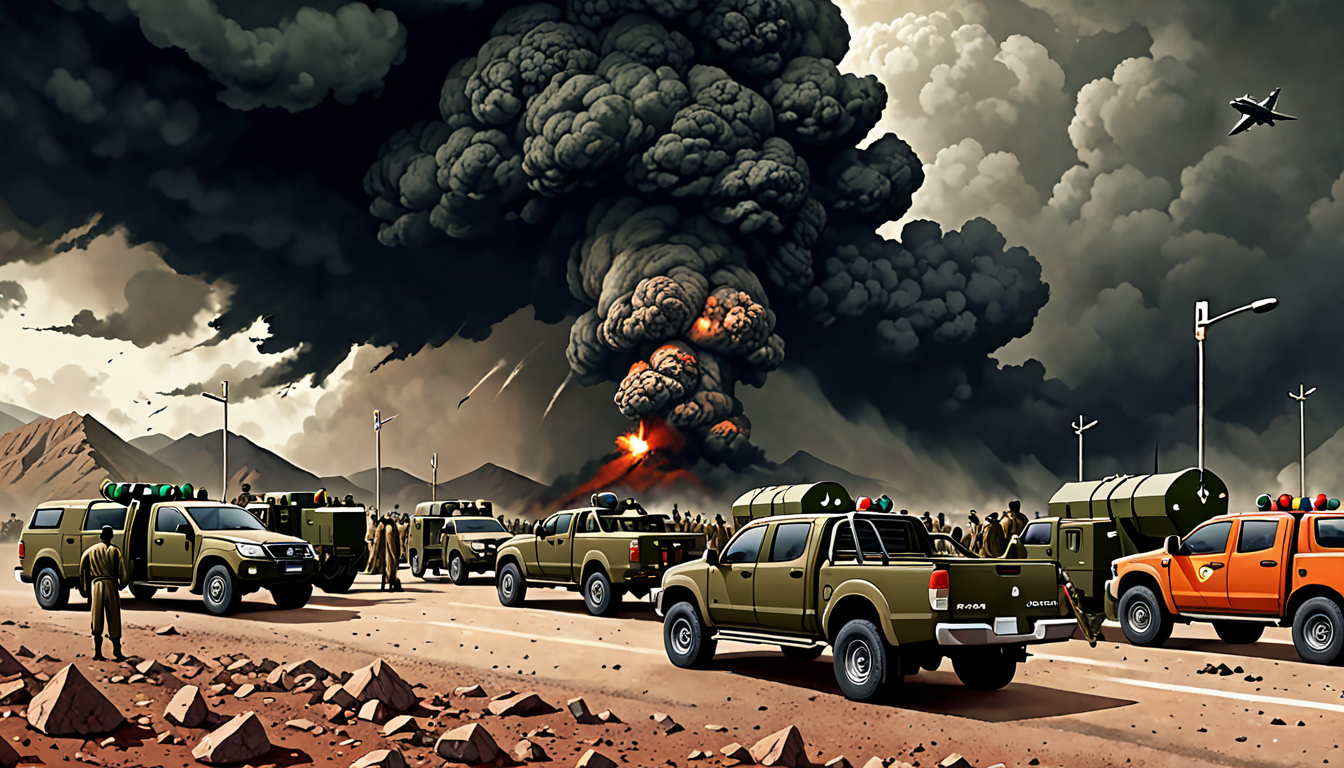
While the world's attention has been consumed by the US-Israel campaign against Iran, a separate but interconnected conflict has been escalating along the 2,670-kilometre Afghanistan-Pakistan border. On February 21, 2026, the Pakistan Air Force launched airstrikes across Nangarhar, Paktika, and Khost provinces in Afghanistan, targeting alleged Pakistani Taliban (TTP) and ISIS-K camps. Afghanistan's Taliban government claimed 18 civilians were killed in Nangarhar alone.
Five days later, the Taliban retaliated. Afghan forces launched drone attacks and border clashes against Pakistani positions, prompting Pakistan's Defence Minister Khawaja Asif to declare a state of "open war." Pakistan responded with Operation Ghazab Lil Haq, expanding strikes to Kabul itself — the first time Pakistan has bombed Afghanistan's capital.
The numbers tell the story of rapid escalation. In just two weeks, the conflict has produced at least 185 confirmed civilian casualty incidents in Afghanistan, displaced 115,000 Afghan civilians and 3,000 Pakistanis according to UNHCR, and involved airstrikes on Panjshir, Kabul, Badakhshan, Herat, and Kapisa provinces. Pakistan claims 80 TTP militants and 527 Taliban fighters killed; Afghanistan claims 327 Pakistani soldiers killed.
This is not a border skirmish. It is an undeclared war between a nuclear-armed state and a battle-hardened insurgent government, fought with F-16s, drones, and artillery across the world's most volatile frontier.
Chapter 2: The Petrol Bomb
On March 7, hours after Prime Minister Shehbaz Sharif publicly assured Pakistanis that fuel supplies were adequate, the government announced a Rs 55 per litre increase in both petrol and diesel prices — the largest single fuel price hike in Pakistani history. Petrol jumped from Rs 266.17 to Rs 321.17 per litre (a 17% increase); diesel from Rs 280.86 to Rs 335.86 (a 20% increase).
The announcement triggered immediate chaos. Long queues formed at petrol stations across Lahore, Karachi, and Islamabad as motorists scrambled to fill tanks before the midnight implementation. Some stations shut their pumps entirely, reportedly hoarding fuel in anticipation of further price increases.
The government simultaneously raised the petroleum development levy on petrol by Rs 20 to Rs 105 per litre — a fiscal move revealing the dual nature of the crisis. Pakistan is not just absorbing higher global oil prices; it is using the crisis to extract more revenue from fuel consumers to plug its budget deficit, a condition of its ongoing IMF Extended Fund Facility.
Petroleum Minister Ali Pervaiz Malik was blunt: "The fire that started in a neighbouring country has spread across the entire region. We do not know how long this crisis will continue, and there is no clear timeline for its end."
Pakistan's vulnerability is structural. The country imports roughly 85% of its crude oil requirements, with the majority transiting through the Strait of Hormuz. With Hormuz traffic effectively suspended, Islamabad has been forced to reroute supplies through Yanbu (Saudi Arabia's Red Sea terminal) and Fujairah (UAE's Indian Ocean port). Two Pakistan National Shipping Corporation vessels are currently en route via these alternative routes — but the longer transit adds $3-5 per barrel in shipping costs, and capacity is severely limited.
The weekly price review mechanism announced by the government signals that officials expect sustained volatility. With Brent crude already above $92 and approaching $100 per barrel, the next round of hikes could push Pakistani fuel prices above Rs 400 per litre — territory that has historically triggered social unrest.
Chapter 3: The Two-Front Squeeze
Pakistan's predicament is historically rare: fighting an active war while simultaneously experiencing an external economic shock of the first order. The last time a comparable situation occurred was in 1971, when Pakistan fought a two-front war against India that ended in the loss of East Pakistan (now Bangladesh) and national humiliation.
The economic dimensions of the current crisis are potentially more dangerous than the military ones.
The Fiscal Trap: Pakistan entered 2026 under a $7.6 billion IMF Extended Fund Facility signed in September 2024, with strict conditions on fiscal consolidation. The program required Pakistan to maintain a primary budget surplus, reduce subsidies, and build foreign exchange reserves. The Afghanistan war now demands increased defence spending — the PAF's operations consume expensive precision munitions and jet fuel — while the oil shock threatens to blow out the current account deficit. If Brent sustains above $90, Pakistan's oil import bill could rise by $8-12 billion annually, potentially exceeding the entire IMF facility.
The Reserve Crisis: Pakistan's foreign exchange reserves stood at approximately $12 billion at the start of March — barely three months of import cover. Higher oil prices and war spending could drain this buffer within weeks, forcing the State Bank of Pakistan to choose between defending the rupee and paying for fuel imports.
The Inflation Spiral: Pakistan's inflation rate had fallen from a peak of 38% in May 2023 to approximately 7% in February 2026 — the centrepiece achievement of the IMF program. The fuel price hike alone will add 2-3 percentage points to headline inflation through direct and indirect channels (transport costs affect food prices, manufacturing inputs, and services). If subsequent hikes follow, Pakistan risks returning to double-digit inflation, potentially triggering an interest rate reversal that would choke the fragile economic recovery.
| Indicator | Pre-Crisis (Feb 2026) | Post-Shock Estimate |
|---|---|---|
| Petrol price (Rs/litre) | 266.17 | 321.17 (+21%) |
| Diesel price (Rs/litre) | 280.86 | 335.86 (+20%) |
| Brent crude ($/barrel) | ~$65 | $92+ |
| Inflation (CPI y/y) | ~7% | 10-12% (projected) |
| Current account deficit | ~$4B annualised | $12-16B (if oil stays at $90+) |
| FX reserves | ~$12B | Declining rapidly |
| PKR/USD | ~280 | Under pressure |
Chapter 4: The Stakeholder Trap
Pakistan's Military Establishment: The army, under Chief of Army Staff General Asim Munir, faces an impossible allocation problem. Pakistan's military is simultaneously managing Operation Ghazab Lil Haq against Afghanistan, the decades-old insurgency in Balochistan (where the Balochistan Liberation Army has intensified attacks), ongoing counter-terrorism operations in Khyber Pakhtunkhwa, and border security along the Indian frontier (which Delhi never allows Islamabad to neglect). Military spending is approximately 3.5% of GDP, but the current multi-front posture likely requires 4.5-5% — expenditure that directly contradicts IMF fiscal targets.
The IMF: The Fund faces a dilemma. Strictly enforcing program conditionality during a war and oil shock risks pushing Pakistan into default and state failure. But relaxing conditions would undermine the credibility of future programs and create moral hazard. The most likely outcome is a quiet renegotiation of fiscal targets, with Pakistan receiving a waiver on the primary surplus condition — but this will come at the cost of deeper structural reforms being delayed indefinitely.
China: Beijing is Pakistan's largest bilateral creditor (approximately $30 billion in CPEC-related debt) and its strategic patron. China has been conspicuously silent on the Afghanistan-Pakistan war, avoiding taking sides between its Taliban-adjacent interests in Afghanistan and its "iron brother" Pakistan. China's Wang Yi, at the NPC press conference on March 8, focused on broader geopolitical framing without addressing the Afghanistan-Pakistan crisis directly. Beijing's reluctance to intervene diplomatically is notable — and ominous.
The Taliban: Afghanistan's Taliban government, under Hibatullah Akhundzada, has demonstrated a military capability that surprised many analysts. The deployment of drones (likely Iranian-supplied Mohajer variants), coordinated border operations, and the involvement of Sirajuddin Haqqani's network suggest a level of organisational sophistication that exceeds Pakistan's pre-war intelligence assessments. The TTP's alignment with the Afghan Taliban adds a domestic terrorism dimension — Pakistan is essentially fighting the same enemy on both sides of the border.
India: Delhi is watching with strategic interest. Every dollar Pakistan spends on the Afghanistan war is a dollar not available for the Indian frontier. India's quiet resumption of Russian oil purchases — enabled by the US 30-day sanctions waiver — gives it an energy advantage that Pakistan lacks. The asymmetry is stark: India has alternatives; Pakistan does not.
Chapter 5: Scenario Analysis
Scenario A: Managed De-escalation (25%)
Premise: A ceasefire along the Durand Line is brokered (possibly by Qatar, which mediated the October 2025 agreement) while oil prices stabilise below $100.
Rationale: Pakistan's military establishment has historically proven pragmatic about withdrawing from overextended positions. The October 2025 Qatar-mediated ceasefire set a precedent, though it ultimately collapsed. The 25% probability reflects the fact that both sides have escalated beyond the previous conflict intensity, making de-escalation politically costly for Pakistan's government (which has framed this as a national security imperative) and for the Taliban (which has framed it as anti-imperialist resistance).
Trigger conditions: TTP leadership decapitation or a major Pakistani military success that provides political cover for ceasefire; simultaneous de-escalation in the Iran theatre that brings oil below $80.
Scenario B: Protracted Two-Front Attrition (50%)
Premise: The Afghanistan war continues at current intensity for 3-6 months while oil prices remain above $85, gradually eroding Pakistan's fiscal position.
Rationale: This is the base case because neither side has the capability to achieve a decisive military outcome. Pakistan cannot occupy Afghanistan (the US tried for 20 years); the Taliban cannot threaten Pakistan's core territories. The conflict settles into a pattern of cross-border strikes, occasional escalation, and diplomatic paralysis. Meanwhile, the Iran war's duration remains uncertain, keeping oil elevated. Historical precedent supports this: the India-Pakistan Kargil conflict of 1999 lasted approximately three months at a similar intensity level, and the 2019 Balakot crisis demonstrated that neither side has the appetite for full-scale war.
Trigger conditions: Status quo continuation; no diplomatic breakthrough; oil stays in the $85-100 range.
Economic impact: Pakistan likely requires an emergency IMF supplementary facility of $3-5 billion by Q3 2026. The rupee depreciates to 310-330 against the dollar. Inflation returns to 12-15%.
Scenario C: Cascading State Crisis (25%)
Premise: Oil breaks above $100, the Afghanistan war escalates further (possibly drawing in India), and Pakistan faces a balance-of-payments crisis.
Rationale: Pakistan has experienced multiple balance-of-payments crises (1998, 2008, 2018, 2022-23), and each time the trigger was some combination of oil shock, political instability, and military spending. The current situation combines all three in a more acute form. The 25% probability reflects the historical pattern: Pakistan has always found a last-minute bailout (from the IMF, China, Saudi Arabia, or the US), but the current geopolitical environment may limit these options. China is economically cautious; Saudi Arabia is dealing with its own Hormuz-related crises; the US is focused on Iran.
Trigger conditions: Oil above $110 for sustained period; an Indian military provocation along the Line of Control; TTP attacks in major Pakistani cities triggering martial law discussions.
Historical precedent: The 1971 crisis, in which Pakistan fought a two-front war while facing economic isolation, resulted in the country losing half its territory. The 1998 nuclear tests triggered sanctions that nearly caused default. In both cases, Pakistan survived but was fundamentally diminished.
Chapter 6: Investment Implications
Pakistani sovereign bonds: Pakistan's Eurobonds have already widened approximately 150 basis points since the Iran war began. In Scenario B, expect further widening to 800-1000bp spreads. In Scenario C, default risk becomes material and bonds could trade at 50-60 cents on the dollar. Pakistan's next major maturity is a $1 billion sukuk in 2027, and the market is already pricing in restructuring risk.
Rupee: The State Bank of Pakistan will attempt to manage depreciation through reserve sales and capital controls. In Scenario B, a 10-15% depreciation is likely (PKR 310-330/USD). In Scenario C, an uncontrolled devaluation of 25-30% is possible.
Equity markets: The KSE-100 index has already fallen approximately 8% since early March. Pakistani banks (which hold large sovereign bond portfolios) and consumer goods companies (squeezed by inflation) are most vulnerable. Energy companies (like Pakistan Petroleum Limited and OGDC) could benefit from higher commodity prices, but rupee depreciation erodes dollar-denominated returns.
Regional spillovers: Bangladesh and Sri Lanka, both Hormuz-dependent oil importers, face similar (though less severe) pressures. The entire South Asian frontier market complex is being repriced for wartime risk.
Commodities: The Pakistan-Afghanistan conflict adds a secondary supply chain disruption to the Iran war's primary shock. Pakistan is the world's fourth-largest wheat producer, and military operations in the western provinces threaten the spring harvest. Wheat futures should be monitored for Pakistan-specific supply disruption signals.
Conclusion
Pakistan's crisis is not a sideshow to the Iran war — it is the most dangerous example of how a regional conflict can cascade into systemic risk for vulnerable states. A nuclear-armed nation of 240 million people is simultaneously fighting a war it cannot afford and absorbing an oil shock it cannot absorb, while its financial lifelines from China, Saudi Arabia, and the IMF are constrained by the same geopolitical turbulence.
The tragedy is that Pakistan chose neither of these crises. The Afghanistan war was triggered by TTP terrorism that Islamabad blames on Taliban hospitality. The oil shock was triggered by a US-Israeli military campaign that Pakistan had no role in designing. Yet Pakistan may end up paying a higher economic price than any of the principal combatants.
For investors and policymakers, Pakistan is the canary in the coal mine — the first nation where the Iran war's secondary effects could produce a sovereign crisis. If Islamabad's balancing act fails, the implications extend far beyond the Indus Valley: a Pakistani economic collapse would send millions of refugees toward Iran, Afghanistan, and the Gulf states, compounding the humanitarian catastrophe already underway.
The world's attention is on Tehran and Washington. It should also be on Islamabad.
Leave a Reply