
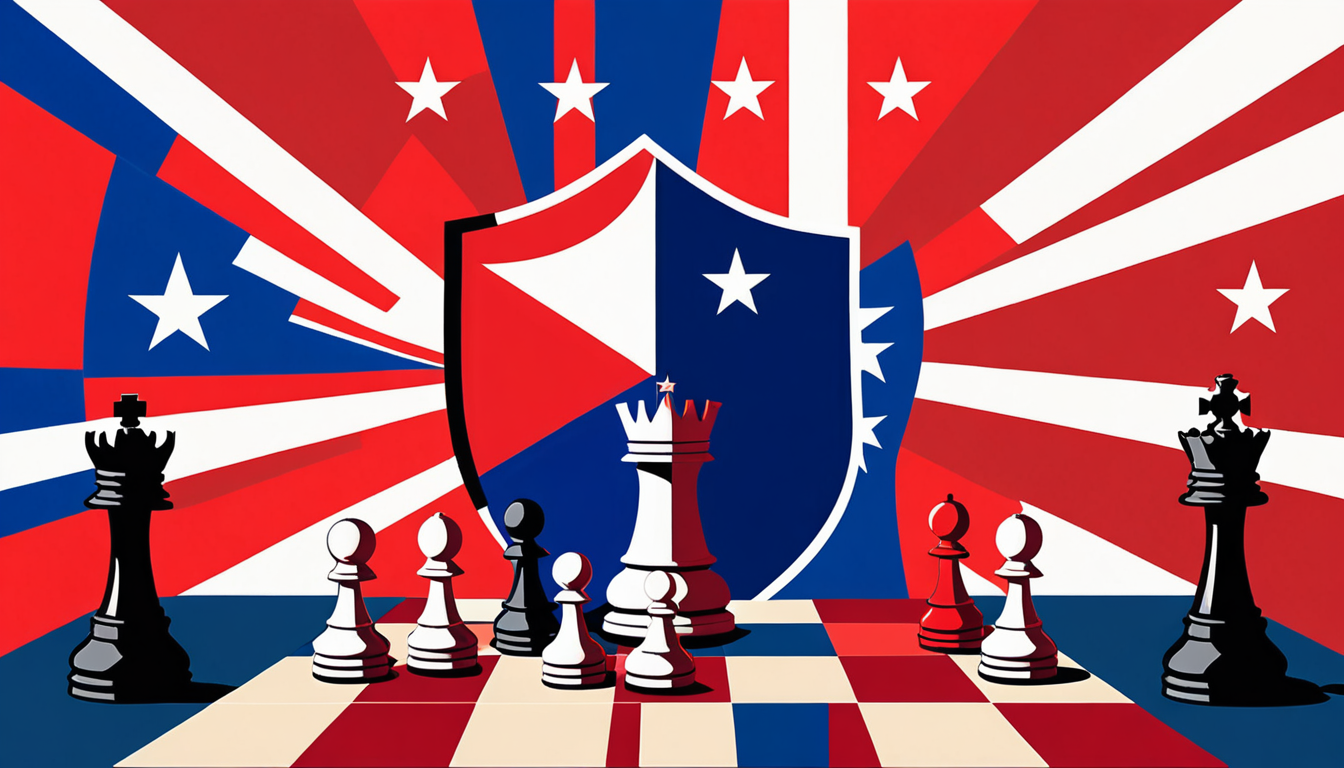
How a golf-course summit is redrawing the geopolitical map of Latin America — and what it means for the contest with China
Executive Summary
- President Trump hosts 12 right-leaning Latin American leaders at the "Shield of the Americas" summit in Doral, Florida on March 7, marking the first major U.S.-organized regional gathering since his return to office and the boldest institutional expression of the "Trump Corollary to the Monroe Doctrine."
- The summit creates a selective alliance — deliberately excluding left-leaning governments in Brazil, Mexico, and Colombia — to counter China's $518 billion trade footprint and 36-port network across the hemisphere, while coordinating on counternarcotics, migration, and the Iran war's regional spillovers.
- The initiative risks fracturing hemispheric solidarity, creating a two-tier Latin America that could accelerate rather than contain Chinese influence among excluded nations, while testing whether ideological alignment can substitute for institutional multilateralism.
Chapter 1: The Guest List as Geopolitical Statement
On March 7, 2026, Donald Trump welcomes 12 Latin American heads of state to his Trump National Doral golf resort outside Miami. The gathering, branded the "Shield of the Americas," is not an ordinary diplomatic summit. It is, by design, a coalition of the willing — a handpicked assembly of right-leaning leaders who share Washington's ideological orientation and, crucially, its adversarial posture toward China.
The attendees read like a roll call of Latin America's conservative wave: Argentina's Javier Milei, El Salvador's Nayib Bukele, Chile's president-elect José Antonio Kast, Ecuador's Daniel Noboa, Paraguay's Santiago Peña, Panama's José Raúl Mulino, the Dominican Republic's Luis Abinader, Costa Rica's Rodrigo Chaves, Honduras's Tito Asfura, Bolivia's Rodrigo Paz, Guyana's Mohamed Irfaan Ali, and Trinidad and Tobago's Christine Kangaloo.
Conspicuously absent are Latin America's three largest left-leaning economies — Brazil under Lula, Mexico under Sheinbaum, and Colombia under Petro. Their exclusion is the point. As Adam Ratzlaff of Florida International University observed, "If you look at who's been invited, it's largely countries that have recently elected right-wing leaders." The summit is not a forum for dialogue; it is an alignment exercise.
The venue itself carries symbolic weight. Trump National Doral — the president's own property — signals that this is a personal diplomatic project, not a State Department production. White House press secretary Karoline Leavitt framed the gathering as forming "a historic coalition to work together to address criminal narcoterrorist gangs and cartels and counter illegal and mass migration." But the deeper agenda, according to CSIS analysis, is far more ambitious: constructing a counter-China architecture across the Western Hemisphere.
Chapter 2: The Trump Corollary to the Monroe Doctrine
The intellectual framework for the Shield of the Americas derives from a concept embedded in the 2025 National Security Strategy: the "Trump Corollary to the Monroe Doctrine." The original Monroe Doctrine (1823) warned European powers against colonizing the Americas. Its 21st-century update targets a different interloper: China.
The Trump Corollary, as articulated by administration officials, concerns itself with two core areas: control and operation of strategic assets in the Western Hemisphere by great-power adversaries, and control of strategic geographies. This explains the sequence of moves that preceded the summit — the forced sale of CK Hutchison's Panama Canal ports to BlackRock ($23 billion), the pressure campaign against Chinese-linked submarine cable projects in Chile, and the series of bilateral trade agreements with anti-China clauses.
China's presence in Latin America has grown dramatically over the past two decades. Trade with the region hit a record $518 billion in 2024. Beijing has extended more than $120 billion in loans to governments across the hemisphere, built a network of three dozen ports, established more space infrastructure in Latin America than anywhere outside mainland China, and embedded Huawei in at least a dozen telecommunications networks. In 2025, trade increased another 7%, much of it driven by Chinese overcapacity dumping.
The Trump administration sees the Shield of the Americas as the institutional vehicle to reverse these inroads. Several attendee nations — Argentina, Ecuador, El Salvador, Guatemala — have already signed reciprocal trade agreements containing strong counter-China clauses. The summit aims to expand this pattern into a coherent regional framework.
Chapter 3: The Policy Architecture — Five Pillars
According to CSIS analysis, the Shield of the Americas is expected to advance partnerships across five strategic domains:
1. Americas Infrastructure Compact ($50–100 billion)
A U.S.-backed alternative to the Belt and Road Initiative, deploying DFC financing for ports, highways, energy grids, and telecommunications. Cofinancing with Japan, South Korea, Taiwan, the EU, and the Inter-American Development Bank would broaden the resource pool.
2. Supply Chain Security Corridors
Constructing pharmaceutical, semiconductor (assembly, testing, packaging), critical mineral, and agricultural supply chains with USMCA-style rules of origin to prevent Chinese transshipment. This builds on Project Vault ($12 billion) for critical minerals.
3. Americas Energy Compact
Increasing U.S. LNG exports to Latin America while reducing China's hold on energy generation and electricity distribution — sectors where Chinese state firms have built extensive portfolios across South America.
4. Digital Infrastructure
Countering Huawei's telecommunications dominance by promoting Western-standard 5G networks and blocking Chinese submarine cable projects.
5. Counter-Cartel and Migration Cooperation
Joint military and law enforcement operations, building on recently launched U.S.-Ecuador counter-drug operations and the broader Southern Spear campaign against narcotrafficking.
The institutional permanence of these initiatives remains uncertain. The summit envisions an "Americas Economic Security Dialogue" — an annual ministerial meeting — but without a treaty framework, the architecture depends on sustained political will from individual leaders.
Chapter 4: The Excluded — A Hemisphere Divided
The summit's selectivity creates an immediate problem: it splits Latin America into two camps, inviting precisely the balkanization it seeks to prevent.
| Included | Excluded |
|---|---|
| Argentina, Chile, Ecuador, El Salvador, Paraguay, Panama, Dominican Republic, Costa Rica, Honduras, Bolivia, Guyana, Trinidad & Tobago | Brazil, Mexico, Colombia, Peru (current government), Cuba, Venezuela, Nicaragua |
Brazil alone accounts for roughly 33% of Latin America's GDP. Mexico, the United States' largest trading partner, is absent. Colombia — the traditional anchor of U.S. counter-drug cooperation — is left out under Petro's leftist government, even as the country faces active armed conflict.
Fernando Estenssoro of the University of Santiago captured the dynamic bluntly: "The presidents of Latin America have no negotiating power with Trump, and that becomes clear when the United States says it will give the orders and whoever does not comply will face the consequences."
The risk is straightforward: excluded nations have every incentive to deepen ties with China. Beijing's Ministry of Foreign Affairs has already established a "task force" to preserve its Latin American gains. China released its third policy paper on Latin America–Caribbean relations in December 2025, signaling no retreat. If the Shield creates a pro-Washington bloc but pushes Brazil, Mexico, and Colombia further toward Beijing, the net effect could be expansion rather than containment of Chinese influence.
Chapter 5: The Kristi Noem Factor — From Secretary to Envoy
The summit carries an unusual personnel subplot. Trump fired DHS Secretary Kristi Noem on March 5, citing a $220 million advertising campaign and undisclosed personal conduct issues, then immediately appointed her as Special Envoy for the Shield of the Americas. The appointment suggests the initiative has enough political importance to serve as a soft landing for a fired cabinet member — or, less charitably, that it is a consolation prize.
Noem's new role touches on familiar territory: undocumented immigration, transnational trafficking, and border security. The appointment of a former DHS secretary as the face of hemispheric engagement reinforces the summit's security-first orientation — migration and cartels, not trade and investment, define the relationship.
This framing has historical echoes. The Organization of American States, the Summit of the Americas, and USAID all attempted to build hemispheric cooperation through development, democracy promotion, and trade liberalization. The Shield of the Americas replaces this tradition with a transactional model: security cooperation in exchange for preferential market access, ideological alignment as a precondition for partnership.
Chapter 6: Scenario Analysis
Scenario A: Institutionalization — The "Western Hemisphere NATO" (25%)
Premise: The summit leads to a formal multilateral security and economic framework with regular meetings, shared intelligence, joint military exercises, and coordinated trade policy.
Evidence for:
- Several attendee nations have already signed bilateral agreements with counter-China clauses
- CSIS advocates an "Americas Economic Security Dialogue" as a permanent institution
- The Trump Corollary to the Monroe Doctrine provides an intellectual framework
- Latin America's rightward shift provides a temporary ideological convergence
Evidence against:
- Latin American political cycles are notoriously volatile — Milei, Bukele, and Kast could all face democratic challenges within 2-4 years
- No treaty framework exists; the summit is informal
- The USMCA renegotiation (July 2026) could alienate key partners
Historical precedent: The Inter-American Treaty of Reciprocal Assistance (Rio Treaty, 1947) attempted a similar security architecture but was rendered largely ceremonial by Cold War power asymmetries.
Trigger: A successful counter-China trade realignment + U.S. commitment of $50B+ infrastructure investment.
Scenario B: Selective Engagement Without Institutionalization (50%)
Premise: The summit produces bilateral deals and photo opportunities but no lasting multilateral framework. The Shield of the Americas remains a brand rather than an institution.
Evidence for:
- Trump's transactional foreign policy style favors bilateral deals over multilateral institutions
- The "Summit of the Americas" format already failed — the scheduled December 2025 gathering in the Dominican Republic never happened
- Latin American leaders attend primarily to secure preferential tariff treatment and avoid punitive measures
- DHS shutdown (Day 21) and the Iran war distract U.S. attention from follow-through
Historical precedent: George W. Bush's "Coalition of the Willing" for Iraq (2003) produced a list of supporters but no enduring institution. The Alliance for Progress (JFK, 1961) promised $20 billion but delivered fragmented results.
Timeline: 3-6 months of momentum, followed by attention drift.
Scenario C: Backlash and Fracture (25%)
Premise: The exclusionary nature of the summit accelerates counter-alignment. Brazil, Mexico, and Colombia deepen ties with China; BRICS+ becomes the primary forum for non-aligned Latin American states.
Evidence for:
- China's 53-nation zero-tariff policy for Africa provides a template for Latin American engagement
- Brazil's Lula has explicitly criticized the summit as "dividing the hemisphere"
- Mexico under Sheinbaum has resisted all U.S. pressure on China-related trade restrictions
- Colombia's Petro recently visited Beijing, signing $3 billion in investment agreements
Trigger: U.S. overreach — trade sanctions against excluded nations or military intervention pressure on Cuba.
Historical precedent: The 2003 Iraq War Coalition of the Willing split rather than unified the Western alliance. France, Germany, and Belgium's refusal to participate did not weaken their global standing — it strengthened the Non-Aligned Movement.
Chapter 7: Investment Implications
Infrastructure and Supply Chain
- U.S. DFC-financed infrastructure projects could benefit engineering firms (Fluor, Bechtel) and Latin American construction companies
- Critical mineral supply chain reshoring from Chile (copper, lithium), Argentina (lithium), and Guyana (oil) supports commodity plays
- Semiconductor OSAT facilities in Latin America (Costa Rica already hosts Intel operations) could accelerate
Defense and Security
- Counter-cartel operations expand the market for surveillance technology, drones, and law enforcement equipment
- Attendee nations may increase defense spending as a quid pro quo — benefiting U.S. defense primes (Lockheed Martin, Raytheon)
Energy
- U.S. LNG export terminals (Cheniere, Venture Global) gain a captive market as Latin American nations shift from Chinese-built energy infrastructure
- Milei's Argentina offers the Vaca Muerta shale basin as a joint development opportunity
Risks
- Chinese retaliatory trade measures against attendee nations (rare earths, critical minerals export restrictions)
- Political instability: Latin America's rightward shift is cyclical, not structural — ideological governments last an average of 4-6 years
- USMCA renegotiation in July could undercut the entire hemispheric trade architecture
Conclusion
The Shield of the Americas represents the most ambitious attempt to construct a formal U.S. sphere of influence in Latin America since the Cold War. Its intellectual honesty — openly framing China as the adversary, selecting allies based on ideological alignment, and hosting the summit at the president's own golf resort — strips away the multilateral pretenses that characterized previous hemispheric initiatives.
Whether it succeeds depends on a question that has haunted every Monroe Doctrine iteration since 1823: Can the United States offer enough carrots to make the stick unnecessary? The $50-100 billion infrastructure compact and supply chain corridors represent a genuine economic proposition. But Latin American leaders have heard these promises before — the Alliance for Progress, Plan Colombia, CAFTA — and learned that U.S. attention spans rarely match the scale of the commitments.
The deeper risk is structural. By dividing the hemisphere into chosen and unchosen, the Shield creates a self-fulfilling prophecy. The excluded nations — which happen to include the continent's three largest economies — face no incentive to resist Chinese engagement and every reason to accelerate it. A shield that protects only half the hemisphere may end up shielding nothing at all.
Sources: UPI, CSIS, U.S. Department of State, Local 10 News, Florida International University analysis
Leave a Reply