
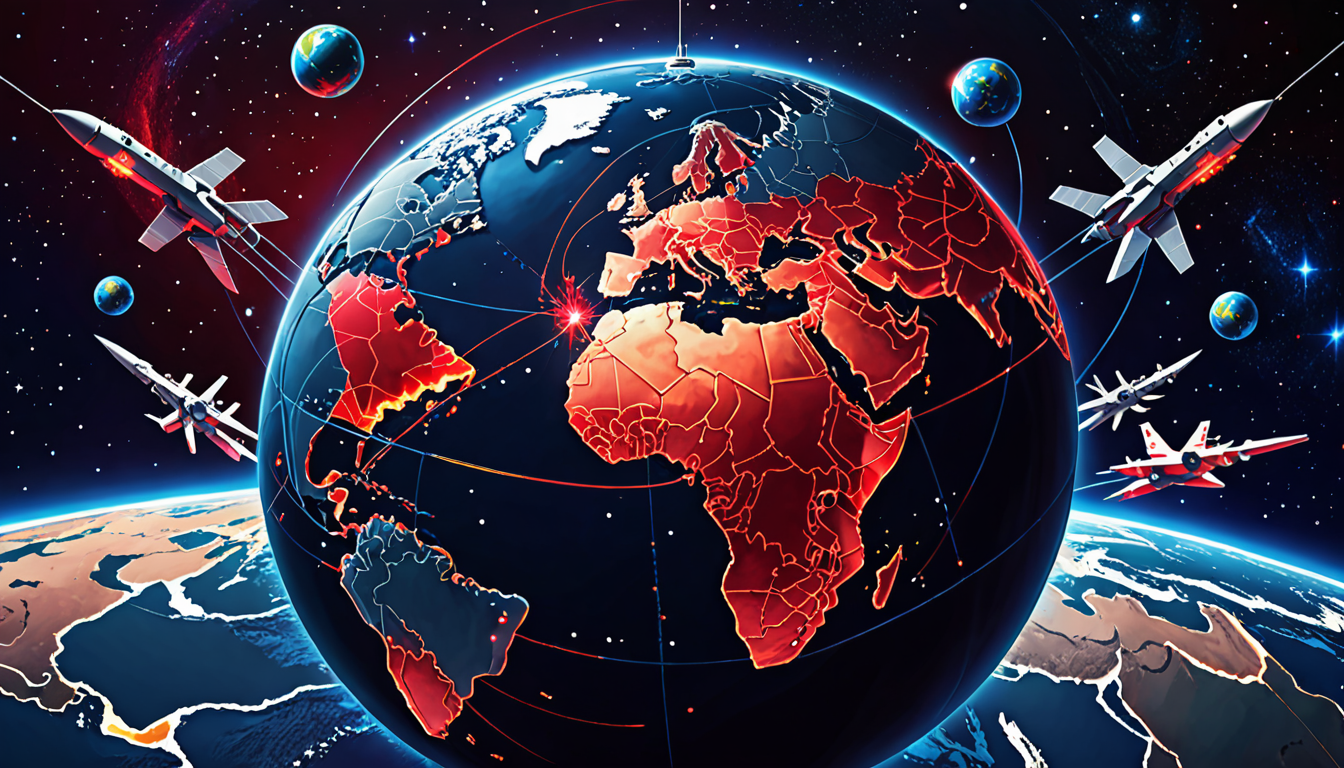
How Moscow's satellite targeting data for Iran transforms a regional conflict into a great power confrontation
Executive Summary
- Russia is providing Iran with satellite imagery and targeting intelligence on the locations of American warships, aircraft, and bases in the Middle East — the first confirmed direct involvement of another major power against US forces in the Iran war.
- China is simultaneously preparing financial assistance, spare parts, and missile components for Iran, creating a two-track great power intervention that mirrors Cold War proxy dynamics but with far higher escalation risks.
- The intelligence sharing has already improved Iranian strike accuracy against US command-and-control infrastructure, raising the specter of American casualties directly attributable to Russian targeting — a scenario that could fundamentally redefine the US-Russia relationship.
Chapter 1: The Revelation
On the seventh day of Operation Epic Fury — the US-Israeli air campaign against Iran — a revelation emerged from Washington that threatened to transform the conflict's entire geopolitical architecture. Multiple US intelligence sources confirmed to the Washington Post, CNN, and NBC News that Russia was providing Iran with targeting intelligence on American military positions throughout the Middle East.
The intelligence, drawn primarily from Russia's sophisticated constellation of overhead satellites, included the locations and movements of American warships, aircraft, radar systems, and communication infrastructure. Iran, which possesses only a handful of military-grade satellites and no satellite constellation of its own, was effectively being given a real-time picture of US force deployment by the world's second-largest military power.
Nicole Grajewski, an expert on Russia-Iran cooperation at Sciences Po in Paris, noted that the types of targets Iran appeared to be hitting — command-and-control nodes, radar sites, and communication posts — suggested enhanced intelligence inputs. "They appear to be going after command and control" for US forces, she told NBC News. The precision of Iranian strikes had demonstrably improved compared to the 12-day war between Iran and Israel in June 2025, when Tehran acted largely on its own targeting capabilities.
The tactical signature was also telling. Iranian attacks increasingly resembled Russia's air campaign in Ukraine: swarms of drones hitting infrastructure followed by ballistic missile attacks — a doctrine refined through years of combat experience. Russia wasn't merely sharing data; it was effectively sharing battlefield methodology.
Defense Secretary Pete Hegseth, confronted with the intelligence at a Pentagon briefing earlier in the week, had dismissed it. "I don't have a message for them. They're not really a factor here," he told reporters. President Trump, when pressed on the matter, called the question "stupid" and insisted the US was scoring "a 12 to a 15" out of 10 in the campaign.
But the six American service members killed by an Iranian drone strike on a makeshift facility in Kuwait on Sunday — a strike whose precision raised immediate questions about how Tehran had located the temporary position — suggested the intelligence sharing was very much a factor indeed.
Chapter 2: The Adversary Entente Goes Operational
Russia's decision to provide targeting intelligence to Iran represents a qualitative escalation in what analysts have termed the "Adversary Entente" — the informal but deepening strategic alignment between Moscow, Beijing, and Tehran. For years, this alignment operated primarily at the political and economic level: arms transfers, diplomatic cover at the UN Security Council, energy trade, and sanctions evasion. The intelligence sharing transforms it into an operational military partnership directed against American forces.
The roots of Russia-Iran military cooperation run deep. Since 2022, Iran has provided Russia with thousands of Shahed drones and short-range ballistic missiles for the Ukraine war, while helping establish a massive drone factory inside Russia to produce Iranian-designed unmanned aerial vehicles. Russia, in turn, has assisted Iran's nuclear program and sold it advanced air defense systems, including the S-300.
But there is a categorical difference between selling arms and providing real-time targeting data on a third party's military forces. The former is standard great power behavior; the latter is an act of belligerence that, under most interpretations of international law, makes the intelligence provider a co-combatant.
The CNN report also revealed a second, potentially even more consequential development: US intelligence suggesting China was preparing to provide Iran with financial assistance, spare parts, and missile components. Beijing's calculus was different from Moscow's — China relied heavily on Iranian oil and had been pressuring Tehran to allow safe passage for vessels through the Strait of Hormuz. "China is more cautious in its support. It wants the war to end because it endangers their energy supply," one intelligence source told CNN.
But the combination of Russian targeting intelligence and Chinese material support created a two-track intervention that complicated every American strategic assumption. The war was no longer simply the United States and Israel versus Iran. It was increasingly a theater in which all three pillars of the Adversary Entente were engaged, each in its own way and for its own reasons, against American military power.
Iranian Foreign Minister Abbas Araghchi, in an NBC News interview on Thursday, confirmed the broad outlines without providing specifics. "They are supporting us politically and otherwise," he said of Russia and China. Asked whether Iran was receiving military assistance, he replied: "I'm not going to give the details of our cooperation with other countries right in the middle of the war."
Chapter 3: The Satellite Asymmetry
Understanding why Russian satellite intelligence matters so much requires grasping the enormous gap between Russian and Iranian space capabilities.
Russia operates one of the world's most sophisticated military satellite constellations. Its Persona electro-optical reconnaissance satellites can photograph objects as small as 30 centimeters from orbit. Its Bars-M cartographic satellites provide precise geodetic data essential for missile targeting. The Lotos-S electronic intelligence satellites can intercept and geolocate radar emissions and communications. Combined, these systems give Russia a near-real-time picture of military activity across any theater.
Iran, by contrast, has launched only a handful of military-grade imaging satellites, most with resolutions measured in meters rather than centimeters. It has no satellite constellation capable of persistent surveillance — meaning it cannot track moving targets like warships or aircraft with any reliability.
| Capability | Russia | Iran |
|---|---|---|
| Military imaging satellites | 20+ operational | 3-5 limited capability |
| Resolution | Sub-30 cm | 1-5 meters |
| Revisit rate | Hours | Days |
| ELINT satellites | Multiple Lotos-S | None confirmed |
| Real-time tracking | Yes | No |
| Battle damage assessment | Rapid, precise | Delayed, imprecise |
This asymmetry meant that Russian intelligence was not merely helpful to Iran — it was transformative. Before the intelligence sharing, Iran's ability to target mobile US assets was limited to what it could observe from commercial satellite imagery (available only with significant time delays), human intelligence networks, and its own modest surveillance capabilities. With Russian overhead imagery, Iran could track carrier battle group movements, identify temporary forward operating bases, and assess the effectiveness of its own strikes within hours rather than days.
The Kuwait strike that killed six Americans illustrated the operational significance. US troops had been housed in a "makeshift facility" — a temporary structure unlikely to appear on any pre-war target list. Locating it required near-real-time surveillance of the kind only a sophisticated satellite constellation could provide.
Chapter 4: Historical Parallels — From Proxy War to Co-Belligerency
The provision of targeting intelligence by a great power to a belligerent fighting American forces has few direct historical parallels, but each precedent carries ominous implications.
Soviet Union and North Vietnam (1965-1973): Moscow provided Hanoi with extensive military assistance, including surface-to-air missiles, MiG fighters, and technical advisors. Soviet radar operators tracked American aircraft and relayed warnings to North Vietnamese air defense units. The US was aware of this support but chose not to confront the Soviet Union directly, fearing nuclear escalation. The intelligence sharing continued for eight years without triggering a US-Soviet military confrontation — but it prolonged the war and increased American casualties by an estimated 10,000-15,000.
Soviet Union and Egypt/Syria (1973 Yom Kippur War): Soviet reconnaissance satellites provided Egypt and Syria with intelligence on Israeli force dispositions before and during the October 1973 war. Soviet advisors helped plan the initial Egyptian crossing of the Suez Canal. When Israel gained the upper hand, the Soviet Union threatened direct military intervention, prompting the US to raise its nuclear alert level to DEFCON 3 — the closest the world had come to nuclear confrontation since the Cuban Missile Crisis.
China and North Korea (1950-1953): China's intervention was direct and massive — 300,000 troops crossing the Yalu River. But it was preceded by a period of intelligence sharing, logistical support, and advisory assistance that gradually escalated into open warfare.
The pattern across these cases is clear: intelligence sharing is rarely a stable equilibrium. It tends to escalate. The provider discovers that intelligence alone is insufficient and begins offering more direct support — first spare parts, then weapons systems, then advisors, and potentially combat units. The current Russia-Iran intelligence pipeline, combined with China's reported preparation of material support, follows the early stages of this escalation ladder with remarkable fidelity.
Chapter 5: Scenario Analysis
Scenario A: Managed Friction (35%)
Russia and China calibrate their support to remain below the threshold of US retaliation. Intelligence sharing continues but remains deniable. Material support is channeled through intermediary states. The US protests diplomatically but takes no direct action against Russian satellites or intelligence assets.
Basis for probability: This is the pattern that prevailed during most Cold War proxy conflicts. Neither side benefits from direct great power confrontation. Trump's personal relationship with Putin and his desire for a deal on Ukraine create incentives for restraint. Hegseth's dismissal of Russia as "not really a factor" may signal deliberate de-escalation.
Trigger conditions: Both sides maintain plausible deniability. No single strike attributable to Russian intelligence kills large numbers of Americans. China limits itself to financial assistance without crossing into weapons supply.
Scenario B: Escalation Spiral (45%)
American casualties mount from Iranian strikes using Russian-provided targeting data. Domestic political pressure forces the Trump administration to respond — potentially by destroying Russian intelligence-sharing infrastructure, sanctioning Russian military satellites' ground stations, or escalating the Ukraine conflict in retaliation. Russia responds with further assistance to Iran, potentially including more advanced weapons systems.
Basis for probability: Historical precedent strongly favors escalation. The Kuwait strike killing six Americans already demonstrates the lethality of the intelligence partnership. Each subsequent American casualty creates domestic political pressure for a response. The Iranian tactic of targeting command-and-control infrastructure — almost certainly guided by Russian intelligence — directly threatens American operational effectiveness. The 1973 precedent, when Soviet intelligence assistance to Egypt and Syria nearly triggered a superpower nuclear confrontation, suggests the stability of "managed friction" is fragile.
Trigger conditions: A major American casualty event — 20+ killed in a single Russian-guided strike. Public attribution of the intelligence link in mainstream media creates political imperative for retaliation. Congressional pressure intensifies. Israeli strikes hit a Russian military advisor or facility in Iran.
Scenario C: Grand Bargain (20%)
The intelligence sharing becomes leverage in a broader negotiation. Russia offers to cease intelligence support for Iran in exchange for US concessions on Ukraine — potentially recognizing Russian territorial gains or lifting sanctions. China similarly trades restraint on Iran for trade concessions at the upcoming April summit.
Basis for probability: Trump has consistently expressed desire for deals with both Putin and Xi. The intelligence sharing gives Russia something to offer in a negotiation that it previously lacked. China's concern about Hormuz disruption to its own energy supply creates genuine incentives for diplomatic engagement. However, the complexity of linking multiple conflicts and the domestic political constraints on all sides make a comprehensive grand bargain unlikely within the 150-day Section 122 tariff window.
Chapter 6: Investment Implications
The Russia-Iran intelligence axis has immediate and structural market implications:
Defense and intelligence: Companies providing electronic warfare, satellite constellation resilience, and counter-ISR (intelligence, surveillance, reconnaissance) capabilities stand to benefit. The US will need to invest heavily in emissions control, signature management, and satellite hardening. Palantir, L3Harris, Northrop Grumman's space division, and smaller counter-drone firms are direct beneficiaries.
Energy: The intelligence sharing extends the expected duration of the Hormuz crisis by reducing Iran's vulnerability to degradation. If Iranian strikes on Gulf infrastructure continue with improved accuracy, the $150/barrel Qatar scenario becomes more plausible. Long energy, particularly natural gas exposed to LNG disruption, remains the consensus trade.
Geopolitical risk premium: The transformation from a regional conflict to a great power confrontation demands a permanent repricing of geopolitical risk across asset classes. Gold ($5,171 at Friday close) reflects this, but equity markets have been surprisingly resilient. The S&P 500's relative stability during the first week of Epic Fury — down only 2.9% for the week — may understate the tail risk of escalation.
Russia-exposed assets: European companies with residual Russian exposure face renewed sanctions risk. Any US response to Russian intelligence sharing will likely include economic measures that could affect energy trade, financial flows, and supply chains.
Defense budget: The 2027 Pentagon budget request of $1.5 trillion already reflected a wartime footing, but the great power dimension of the Iran conflict will accelerate spending further. The munitions math — US interceptor production of 6-7 PAC-3 missiles per month versus Iran's 100+ attack systems per month — becomes even more urgent with Russian targeting improving Iranian strike accuracy.
Conclusion
Russia's provision of targeting intelligence to Iran marks a crossing of the Rubicon in great power competition. For the first time since the Cold War, a major nuclear power is actively assisting an adversary in targeting American military forces. The Adversary Entente — Russia, China, and Iran — has evolved from a political alignment into an operational military partnership, even if each member's level of involvement differs.
The historical pattern is clear and troubling: intelligence sharing escalates. What begins as satellite imagery evolves into weapons supply, then advisors, then direct involvement. The stability of "managed friction" depends on restraint from both sides — a commodity in short supply during wartime.
For the United States, the revelation forces an uncomfortable strategic reckoning. The war it launched against Iran's missile program was premised on the assumption of a contained, bilateral conflict. Seven days in, it is becoming a multilateral confrontation with escalation dynamics that no single actor fully controls. The Kremlin's eyes are now watching American forces — and what they see, they share.
Leave a Reply