
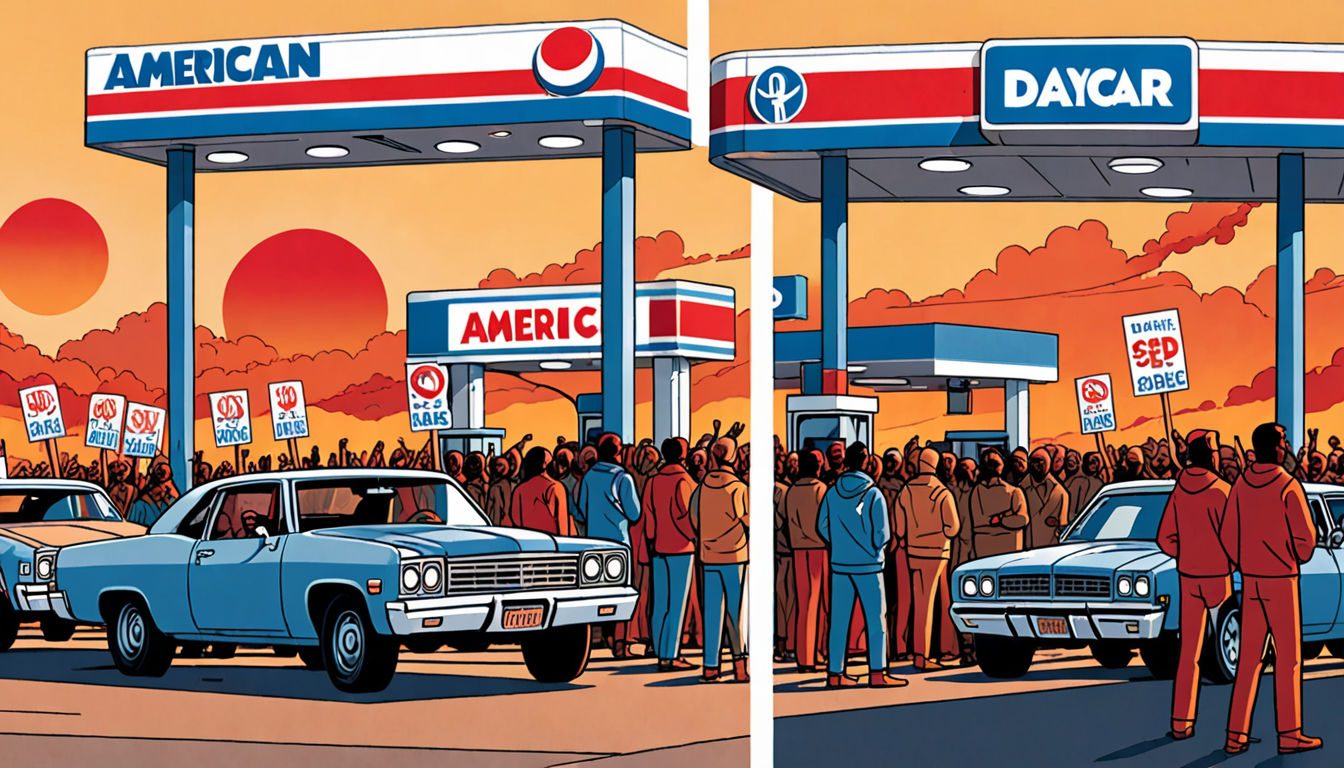
How the Iran war's economic shockwave is fueling the largest antiwar backlash since Iraq — and threatening to reshape the 2026 midterms
Executive Summary
- Oil surged 35% in one week to $90/barrel — the largest weekly gain on record — as the Iran war enters Day 7, with Qatar's energy minister warning of $150 oil if Gulf exporters shut down entirely
- The US economy shed 92,000 jobs in February while gas prices climbed 20+ cents in a single week, creating a combustible mix of war fatigue, economic pain, and political anger just months before critical midterm primaries
- A nascent antiwar movement is organizing nationwide — from "March for Peace" rallies in California to protest coalitions in Michigan — as Trump's 36% approval rating and demand for Iran's "unconditional surrender" collide with a DHS shutdown now entering its 21st day
Chapter 1: The Price at the Pump
On Friday, March 6, US crude oil breached $90 a barrel for the first time in over two years. The 35% weekly surge — the largest ever recorded by the WTI benchmark — was not merely a market reaction. It was a seismic repricing of the global energy architecture.
The immediate trigger was the escalating Iran conflict, now in its seventh day following Operation Epic Fury. But the price spike reflects something more fundamental: the physical infrastructure of Gulf energy production is breaking down. Kuwait began cutting output at several fields after running out of storage space. Kpler, the energy analytics firm, estimates that Saudi Arabia and the UAE could exhaust their holding capacity within 20 days, forcing production shutdowns that take weeks to reverse even after hostilities cease.
Qatar's energy minister Saad al-Kaabi delivered the most chilling assessment. In a Financial Times interview, he warned that if the war continued, all Gulf energy exporters would shut down production within weeks, driving oil to $150 a barrel. Even an immediate ceasefire, he said, would take "weeks to months" to restore Qatar's LNG exports after an Iranian drone strike damaged a critical terminal. Qatar accounts for roughly 20% of global LNG exports.
For American consumers, the arithmetic is brutal. AAA reported gas prices jumping more than 20 cents in a single week. Goldman Sachs estimates that sustained $90 oil adds at least 0.60 percentage points to US inflation — arriving precisely when the Federal Reserve faces its most agonizing policy dilemma in decades.
The Penn-Wharton Budget Model had already calculated that existing tariffs cost the average American household $1,300 annually. Now layer on a wartime energy shock. The combined burden — tariffs plus energy — threatens to extract $2,500-$3,500 per household annually, rivaling the cost-of-living squeeze during the 1979 oil crisis.
Chapter 2: The Jobs Black Hole Meets the Energy Shock
Friday's employment report landed like a second shockwave. The US economy lost 92,000 jobs in February — the worst monthly reading since the pandemic. Three of the last five months have now been negative. The unemployment rate ticked up to 4.4%.
The carnage spans sectors: DOGE-driven federal layoffs (-327,000 cumulative), AI-fueled information services cuts (-11,000), a Kaiser healthcare strike (-28,000), manufacturing contraction (-12,000). Wage growth held at 3.8% — just enough to signal sticky inflation but insufficient to offset the energy and tariff squeeze.
This creates the textbook definition of stagflation: rising prices with falling employment. The last time America faced a comparable convergence — the early 1970s — it took a decade and the most aggressive monetary tightening in history to resolve.
Jim Paulsen, the veteran Wall Street strategist, told Business Insider that "most of the economy is already in a recession" with technology as the sole bright spot. Business Insider reported that tech job losses are now outpacing both the 2008 financial crisis and the dot-com bust — a stunning claim that underscores how AI disruption and wartime economic stress are compounding simultaneously.
The Bureau of Labor Statistics, already operating under severe strain from the government shutdown's data collection gaps, had previously slashed 862,000 phantom jobs from prior reports. The true state of the labor market may be even worse than the headline figures suggest.
Chapter 3: The Antiwar Movement Awakens
Across America, a protest movement is taking shape with a speed that evokes the early days of the Iraq War opposition.
In Nevada County, California, Indivisible Nevada County and local Democrats organized a "March for Peace" for Saturday, March 7. In Kalamazoo, Michigan — a critical swing state — the Nonviolent Opponents of War invited residents to protest on Sunday. Indivisible Paw Paw planned a separate March 14 action.
Nationally, a coalition of left-wing organizations — including Code Pink, Democratic Socialists of America, ANSWER, American Muslims for Palestine, and the Black Alliance for Peace — has begun coordinating demonstrations in major cities. The National Iranian American Council joined the coalition, framing the strikes as violations of international law.
These are still early-stage mobilizations. But the Vietnam and Iraq precedents show how quickly antiwar sentiment can metastasize when economic pain intersects with military overreach. In 1966, Lyndon Johnson's approval rating was 48% when antiwar Democrats mounted primary challenges. Trump's 36% — with the Dow turning negative for 2026 and gas prices climbing — suggests far more fertile ground for opposition.
The comparison to 2003 is instructive. The Iraq War began with 72% public support. Opposition took years to build. The Iran war, by contrast, launched into an economy already weakened by tariff wars, AI disruption, and a government shutdown. The combustion speed is faster because the kindling was already dry.
Chapter 4: The Institutional Breakdown
The DHS shutdown — now in its 21st day — has become the most visible symbol of governmental dysfunction during wartime. Senate Democrats blocked DHS funding for a third time on March 5, insisting on immigration enforcement guardrails even as TSA agents work without pay, FEMA operates at reduced capacity, and CISA cybersecurity staff sit at home during an active military conflict.
The irony is devastating: the United States is prosecuting a war demanding "unconditional surrender" from Iran while unable to fund its own homeland security apparatus.
The House passed H.R. 7744 on a party-line 221-209 vote. The Senate returns Monday for another attempt. But the political calculus has shifted. Democrats initially calculated that the shutdown would damage Republicans. Now, with war consuming public attention, both parties face voter fury — Republicans for starting an unpopular war, Democrats for keeping the government closed during one.
Congress also failed — twice — to invoke the War Powers Resolution to constrain the Iran operations. The 47-53 Senate vote marked the eighth consecutive WPR defeat in American history. The constitutional framework designed to prevent unauthorized wars has been reduced to a symbolic gesture.
Meanwhile, the travel industry is reeling. Airlines for America CEO Chris Sununu warned that TSA disruptions during the busiest spring break travel period are threatening an already fragile sector. With eight Gulf nations' airspace closed, 18,000+ flights disrupted, and airline stocks plunging (IAG -12%, Wizz Air -20%), the aviation industry faces its worst week since the pandemic.
Chapter 5: Scenario Analysis
Scenario A: Managed De-escalation (20%)
Prerequisites: Iran's interim leadership accepts talks; Trump pivots from "unconditional surrender" to negotiated settlement; Gulf storage crisis forces pragmatic reassessment.
Trigger: Qatar and Kuwait storage reach physical limits, creating bipartisan pressure for diplomatic offramp.
Market implications: Oil retreats to $75-80, gas prices stabilize, DHS shutdown ends as political attention shifts to post-war reconstruction. Antiwar movement dissipates.
Historical precedent: Korean War armistice (1953) — military stalemate forced both sides to negotiate despite maximalist rhetoric.
Probability basis: Trump's demand for unconditional surrender and the ongoing bombing campaign suggest minimal appetite for compromise. Iran's interim leadership faces internal pressure to resist. Only physical constraints (storage, ammunition) could force a shift.
Scenario B: Protracted Conflict with Domestic Fracture (50%)
Prerequisites: War continues 4-8 weeks; oil stays above $85; DHS shutdown extends; NFP remains negative; primaries reveal antiwar voter energy.
Trigger: Texas and North Carolina primary results (already showing Democratic turnout surge) convince establishment Republicans that the war is politically toxic.
Market implications: S&P 500 enters correction territory, consumer discretionary collapses, safe havens (gold, utilities, defense) surge. Stagflation scenario becomes consensus.
Historical precedent: Vietnam War 1966-1968 — economic costs and body bags eroded support over 18-24 months, culminating in LBJ's withdrawal.
Probability basis: The Texas primary on Super Tuesday already showed unusual Democratic turnout. Crenshaw — a hawkish Republican — lost his primary. The antiwar energy is detectable even in red districts. With 36% approval and rising gas prices, the political trajectory favors protracted domestic opposition.
Scenario C: Escalatory Spiral (30%)
Prerequisites: Iran retaliates with Gulf infrastructure attacks; Hezbollah fully re-enters the conflict; storage crisis forces involuntary production shutdowns; oil exceeds $120.
Trigger: Successful Iranian strike on Saudi or UAE oil infrastructure (Ras Tanura pattern) combined with Hormuz strait remaining closed.
Market implications: Emergency Fed action, potential recession declaration, gold to $6,000+, consumer spending collapse. Political crisis deepens as midterms approach.
Historical precedent: 1973 oil embargo — quadrupled oil prices, triggered stagflation, and reshaped global politics for a decade.
Probability basis: Qatar's energy minister openly predicting $150 oil, Kuwait already shutting production, and the IRGC threatening to "set ablaze" western tankers all point to a meaningful risk of deeper supply destruction. Nine commercial vessels have already been attacked.
Chapter 5: Investment Implications
| Asset Class | Direction | Rationale |
|---|---|---|
| Energy (USO, XLE) | ▲▲ | $90+ oil, Gulf storage crisis, potential $150 |
| Defense (LMT, RTX, NOC) | ▲▲ | Wartime spending, ammunition depletion |
| Gold (GLD) | ▲▲ | Safe haven, $5,000+ sustained |
| Consumer Discretionary (XLY) | ▼▼ | $2,500+ household burden, jobs losses |
| Airlines (JETS) | ▼▼▼ | Gulf airspace closure, fuel costs, TSA disruption |
| Utilities (XLU) | ▲ | Defensive positioning, rate hike uncertainty |
| US Treasuries (TLT) | Mixed | Safe haven vs. inflation fears; gilt-style repricing risk |
| Private Credit (OWL, BX) | ▼▼ | Redemption cascade, AI software exposure, liquidity crisis |
Key risk: Qatar's $150 oil scenario would transform every asset class projection. The 20-day countdown on Gulf storage capacity is the single most important variable for near-term markets.
Conclusion
The Iran war's first week has delivered a verdict that no amount of military success can override: the home front is breaking. The $90 barrel, the 92,000 lost jobs, the 20-day DHS shutdown, and the emerging antiwar movement are not separate crises — they are a single interconnected failure of political economy.
History offers a clear pattern. Wars that arrive during economic expansions (Gulf War 1991, early Afghanistan 2001) sustain public support. Wars that arrive during economic stress (Vietnam by 1968, Iraq by 2006) generate fierce domestic opposition. The Iran war arrived into the worst economic confluence since 2008: tariff damage, AI displacement, federal workforce decimation, and now an energy shock.
The March for Peace marchers in Nevada County and Kalamazoo may be small today. But so were the first Vietnam War teach-ins at the University of Michigan in 1965. The question is not whether the antiwar movement grows — given the economic fundamentals, it will. The question is whether it grows fast enough to reshape the November midterms, and whether that political pressure can force a diplomatic offramp before the Gulf storage crisis makes the energy damage permanent.
The 20-day clock on Saudi and UAE storage capacity is, in many ways, a clock on the war itself. When the oil can no longer be stored, it stops flowing. And when it stops flowing, even the most committed war hawks must reckon with $150 oil and $6 gas.
That is the home front's ultimate veto.
Sources: Guardian, NPR, CNBC, CNN, Reuters, Financial Times (via Guardian), Kpler, AAA, BLS, Penn-Wharton Budget Model, Goldman Sachs, ISW, Business Insider
Leave a Reply