
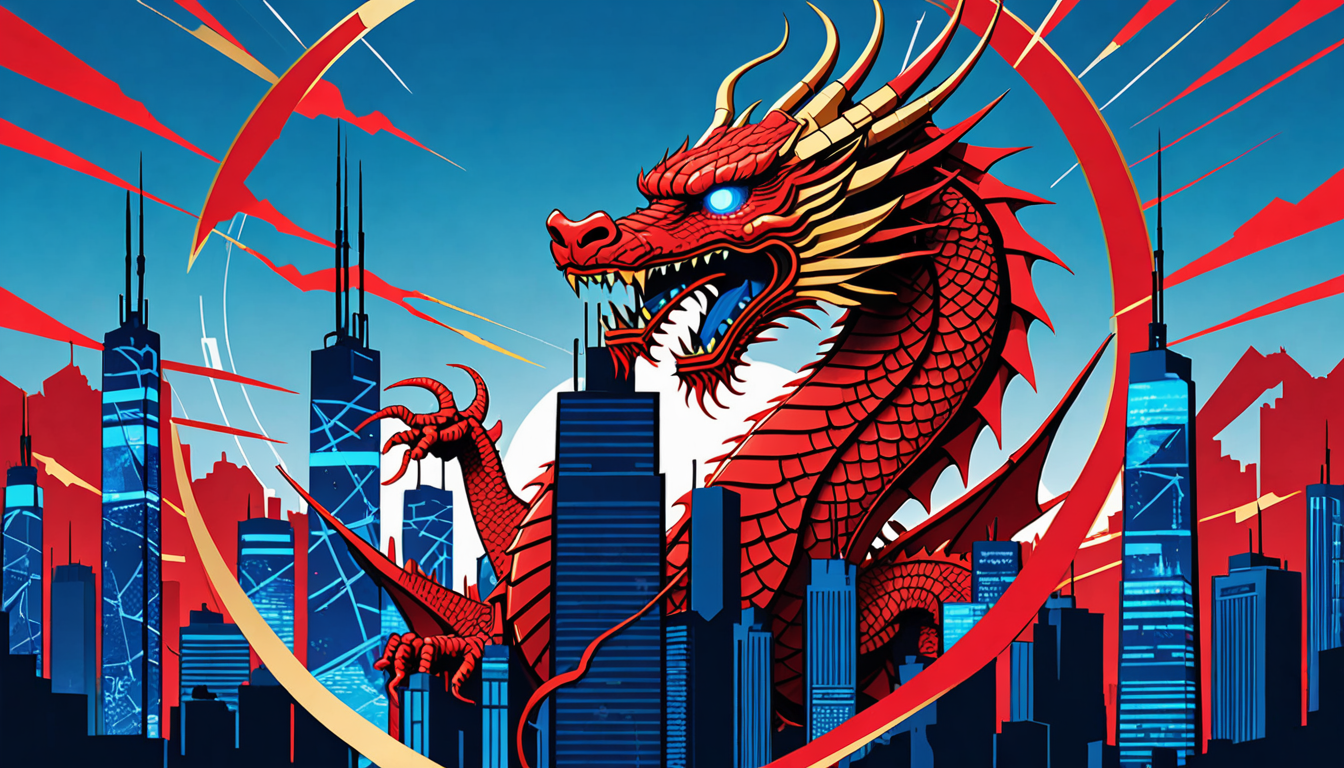
How America's Telecom Security Alliance Is Unraveling—One Base Station at a Time
Executive Summary
- Vietnam, a 2020 signatory to America's "Clean Network" anti-Huawei initiative, is now actively pursuing 5G contracts with Chinese firms ZTE and Huawei across all three major telecom operators—including the police-owned Mobifone, which already has a Huawei 5G base station operating near the US Consulate in Ho Chi Minh City.
- This reversal is not an isolated incident: at least nine US allies—including NATO members Hungary, Italy, Spain, the Netherlands, and Turkey—continue using Huawei in their 5G infrastructure, undermining the foundational premise of the Pax Silica digital containment strategy.
- The Clean Network's collapse reveals a structural flaw in US tech diplomacy: Washington offers security warnings but no price-competitive alternatives, leaving cost-sensitive nations little choice but to embrace Chinese equipment—particularly as the Iran war and Hormuz blockade strain budgets and redirect geopolitical attention.
Chapter 1: The Reversal — Vietnam's 5G About-Face
In 2020, Vietnam made a bold pledge. Joining the Trump administration's Clean Network initiative, Hanoi committed to excluding Huawei and ZTE from its 5G infrastructure—a decision celebrated in Washington as proof that even China's closest neighbors recognized the security risks embedded in Beijing's telecom equipment.
Six years later, that pledge is dead.
Reuters reported on March 6, 2026, that all three of Vietnam's major telecom operators have either signed or are actively negotiating 5G contracts with Chinese firms. Viettel and VNPT, the two largest carriers, signed supply agreements with ZTE and Huawei in 2025. Now Mobifone—the third-largest operator, placed under the Ministry of Public Security in 2025—is preparing a tender expected to assign substantial portions of its 5G buildout to Chinese suppliers.
The details are striking. Two sources told Reuters that Chinese firms could receive specific quotas in Mobifone's tender. A third said the decision to award contracts to Chinese companies had already been made. Most remarkably, a Reuters journalist visiting a rooftop in central Ho Chi Minh City found a Huawei 5G base station already mounted on a Mobifone-branded tower—within sight of the US Consulate General.
The timing is deliberate. The 5G push precedes a planned visit to China by Vietnam's General Secretary To Lam, signaling that telecom deals are part of a broader diplomatic warming between Hanoi and Beijing.
Chapter 2: The Clean Network's Autopsy — Death by a Thousand Defections
Vietnam's reversal is dramatic, but it is merely the most visible crack in an already shattered coalition.
The Clean Network initiative, launched by Secretary of State Mike Pompeo in 2020, aimed to build a global alliance of nations committed to using "trusted vendors"—primarily Ericsson and Nokia—instead of Chinese equipment. At its peak, the initiative claimed endorsements from over 60 countries and 200 telecom carriers.
By 2026, the alliance has largely evaporated.
| Country | Clean Network Status | Current Huawei/ZTE 5G Use |
|---|---|---|
| Vietnam | Joined 2020 | All 3 operators now using Chinese 5G |
| Hungary | NATO member | Huawei 5G active |
| Italy | G7 member | Huawei in non-core 5G |
| Spain | NATO member | Huawei in 5G infrastructure |
| Netherlands | NATO member | KPN switched from Ericsson to Huawei for 4G |
| Turkey | NATO member | Huawei 5G deployed |
| South Korea | US ally | Huawei in 5G infrastructure |
| Thailand | US partner | Huawei 5G active |
| Philippines | US ally | Huawei in 5G network |
| Brazil | G20 member | Huawei in 5G after Bolsonaro reversed course |
An October 2025 report by the Information Technology & Innovation Foundation (ITIF) titled "Backfire: Export Controls Helped Huawei and Hurt U.S. Firms" documented the paradox: US export controls had pushed Huawei to develop indigenous alternatives while simultaneously losing Washington its leverage over the very countries it sought to protect.
Germany, often cited as a Clean Network success story, plans to remove Huawei from its core 5G infrastructure—but not until 2029, and only from the core network. Peripheral components remain untouched. The UK set a 2027 deadline for Huawei removal but has faced repeated delays and cost overruns.
Chapter 3: Why Countries Choose Chinese 5G — The Economics of Defection
Vietnam's rationale is simple, and officials have stated it plainly: Chinese telecom equipment is cheaper and reliable. The security warnings from Washington, while acknowledged, are treated as an acceptable trade-off.
The cost differential is substantial:
| Vendor | Average Base Station Cost | Installation Timeline |
|---|---|---|
| Ericsson | $25,000-$35,000 | 6-8 months |
| Nokia | $22,000-$30,000 | 6-8 months |
| Huawei | $12,000-$18,000 | 3-5 months |
| ZTE | $10,000-$15,000 | 3-5 months |
For a developing country deploying tens of thousands of base stations, the savings from choosing Chinese vendors can reach hundreds of millions of dollars. Vietnam's 5G rollout, targeting nationwide coverage by 2028, would require an estimated 100,000-150,000 base stations. The cost difference between Ericsson and Huawei for that deployment: roughly $1-2.5 billion.
Washington's response—a State Department spokesperson warning that "Chinese intelligence and security services can legally compel Chinese citizens and companies to share sensitive data"—offers no financial counterweight. The US has not established a subsidy program for trusted vendor equipment in developing nations, nor has it offered concessional financing to offset the Chinese cost advantage.
This is the structural flaw at the heart of digital containment: America sells warnings; China sells infrastructure.
Chapter 4: The Security Calculus — Police Networks and Proximity to Diplomats
The security dimensions of Vietnam's reversal deserve special scrutiny.
Mobifone's placement under the Ministry of Public Security in 2025 means that a police-owned telecom operator is now building its surveillance-capable 5G infrastructure with equipment from a country whose intelligence laws mandate cooperation with state security services. The potential for Chinese intelligence to access Vietnamese police communications—and by extension, data on Vietnamese citizens, foreign diplomats, and businesses—represents a counterintelligence nightmare.
The discovery of a Huawei 5G base station near the US Consulate in Ho Chi Minh City illustrates the operational risk. 5G base stations, unlike their 4G predecessors, process data locally before relaying it to core facilities. This means the equipment itself—not just the central network—can potentially intercept and analyze communications. A Chinese-manufactured antenna within range of US diplomatic facilities is, from a security standpoint, a permanently installed signals intelligence platform.
The US has warned Vietnam that "future American investment could be jeopardized by reliance on non-trusted network providers," but this threat carries diminishing weight amid the current geopolitical environment. With US attention consumed by the Iran war, the Hormuz blockade, and the DHS shutdown, Washington's bandwidth for enforcing tech containment in Southeast Asia has effectively collapsed.
Chapter 5: Scenario Analysis — The Future of Digital Containment
Scenario A: Managed Retreat (45%)
Washington quietly accepts the collapse of the Clean Network, focusing enforcement only on Five Eyes nations and Japan. The Pax Silica framework narrows to a core group of 10-15 nations, creating a tiered digital world: trusted networks in allied capitals, Chinese-equipped networks everywhere else. Ericsson and Nokia lose 30-40% of their addressable market; Huawei's global 5G market share stabilizes at 35-40%.
Historical precedent: The COCOM technology export regime during the Cold War similarly narrowed over time to focus on core strategic technologies rather than attempting blanket containment.
Trigger: No new US subsidy mechanism for trusted vendor equipment by end of 2026; two or more additional Clean Network signatories defect.
Scenario B: Subsidy-Backed Counterstrike (30%)
Congress authorizes a $10-20 billion "Digital Infrastructure Security Fund" offering concessional financing for Ericsson/Nokia equipment in developing nations, modeled on the DFC or EXIM Bank. This would narrow the cost gap and provide a genuine alternative. Vietnam and others reconsider Chinese contracts.
Historical precedent: The Marshall Plan provided financial mechanisms to prevent European economic alignment with the Soviet Union. Japan's export credit agencies similarly subsidized infrastructure exports to compete with Chinese Belt and Road projects.
Trigger: A documented security breach traced to Chinese 5G equipment in an allied nation; bipartisan legislation post-midterm elections.
Scenario C: Digital Iron Curtain Hardens (25%)
The US escalates from warnings to sanctions, placing secondary restrictions on countries using Chinese 5G—blocking them from accessing US cloud services, AI chips, or financial networks. This fractures the global digital economy into two incompatible stacks but ensures containment within the Western sphere.
Historical precedent: The entity list regime for Huawei itself, which cut the company off from Google services and TSMC chips.
Trigger: A Chinese intelligence operation exposed using Vietnamese 5G infrastructure; escalation of the tech Cold War following the April Xi-Trump summit.
Chapter 6: Investment Implications
Losers:
- Ericsson (ERIC) and Nokia (NOK): Each loss of a major developing market narrows the addressable customer base. Vietnam alone represents $1-2B in potential 5G equipment revenue now flowing to Chinese competitors.
- Qualcomm (QCOM): As Chinese 5G networks increasingly use Huawei's own chipsets, Qualcomm's royalty and chip revenue from these deployments contracts.
Winners:
- Huawei (unlisted): Market share stabilization across Southeast Asia, Middle East, Africa, and Latin America.
- ZTE (0763.HK): The junior partner benefits disproportionately from defections as countries diversify their Chinese vendor exposure.
- Samsung Electronics: Positioned as a "third way" vendor—non-Chinese, non-European—Samsung's network equipment division could capture swing markets seeking both cost efficiency and security credibility.
Structural trades:
- Long European defense/security stocks (digital sovereignty mandates in EU will sustain Ericsson/Nokia in core allied markets).
- Short overweight positions in telecom equipment companies dependent on emerging market 5G contracts.
- The Pax Silica framework remains investable for semiconductor and AI infrastructure but is increasingly irrelevant for telecom equipment.
Conclusion
The Clean Network was always an aspiration, not an architecture. It offered ideology without incentives, warnings without alternatives. Vietnam's 5G reversal does not represent a betrayal of American interests so much as a rational response to American inattention.
As the Iran war consumes Washington's bandwidth, as DHS remains shuttered, as the 150-day Section 122 tariff clock ticks—the digital containment of China proceeds without its chief enforcer. Base station by base station, antenna by antenna, the invisible infrastructure of the next century is being built with Chinese components, in countries that once pledged to resist.
The question is no longer whether the Clean Network will survive. It is whether anyone in Washington has noticed it is already gone.
Leave a Reply