
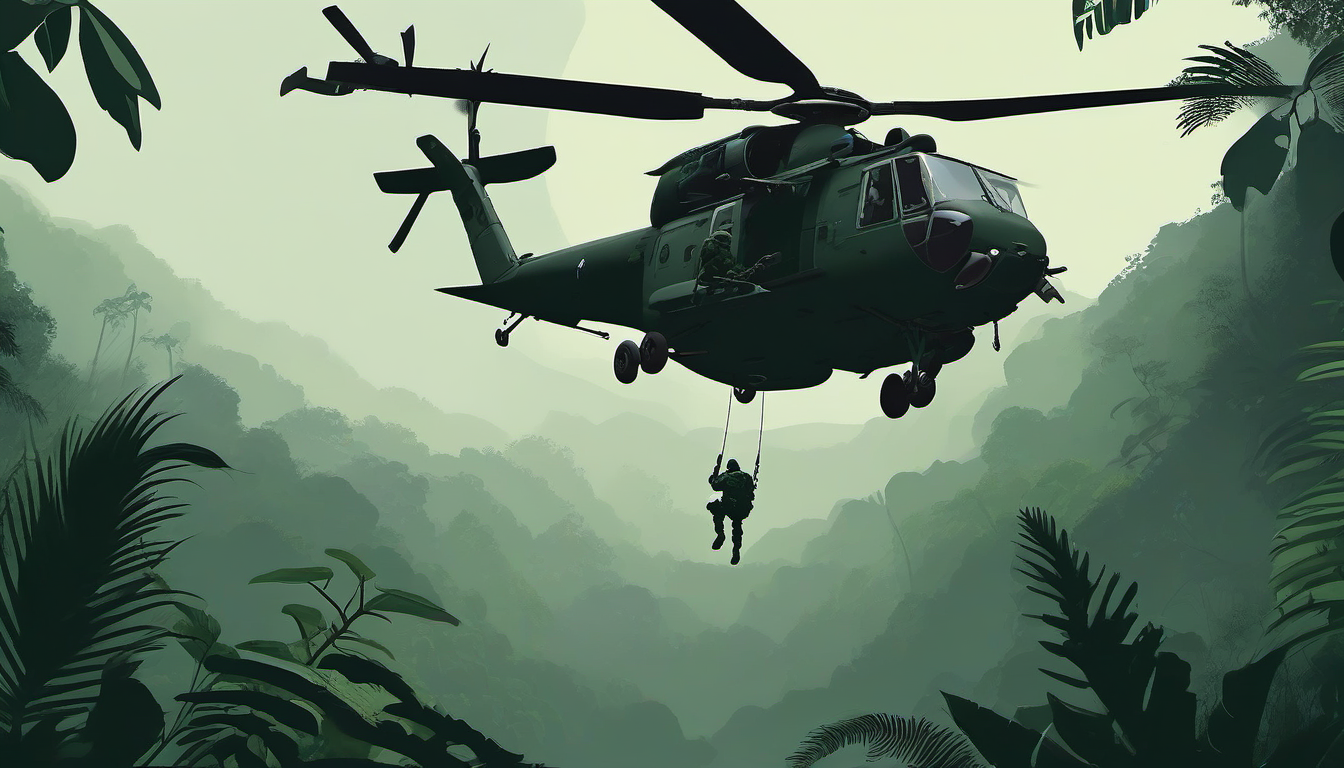
US Special Forces deploy to South America as the Trump Doctrine reshapes hemispheric security
Executive Summary
- The United States and Ecuador launched joint military operations against "designated terrorist organizations" on March 4, marking the most significant US ground force deployment in South America since the Cold War
- This escalation follows Ecuador recording its highest homicide rate in history (46.5 per 100,000) as Mexican and Colombian cartels transformed the country into a primary cocaine transit hub
- The operation represents a paradigm shift from law enforcement to military solutions in counter-narcotics—White House deputy chief of staff Stephen Miller explicitly declared "there is not a criminal justice solution to the cartel problem"
Chapter 1: The Fall of Ecuador's Peace
Ecuador was once South America's quiet exception. Sandwiched between Colombia's guerrilla wars and Peru's Shining Path insurgency, this small Andean nation maintained remarkably low crime rates through the 2000s and 2010s. That era is dead.
The transformation began around 2020, when Mexican cartels—the Sinaloa Cartel and Jalisco New Generation Cartel (CJNG)—established direct logistics networks through Ecuador's Pacific ports. The country's dollarized economy, weak prison system, and strategic location between Colombia's coca fields and Pacific shipping lanes made it an irresistible target. By 2023, Ecuador's homicide rate had quadrupled. By 2025, it reached 46.5 per 100,000—the highest in its recorded history, surpassing even Colombia.
The crisis exploded into global headlines in January 2024 when armed gangs stormed a live television broadcast in Guayaquil, holding journalists at gunpoint. President Daniel Noboa, a 36-year-old banana heir who won the presidency on a security platform, declared an "internal armed conflict" and deployed the military. Two years later, despite martial law measures, the violence has metastasized from coastal cities like Guayaquil and Esmeraldas into the interior provinces of Los Ríos and El Oro, where quiet agricultural towns have become killing fields for drug-related homicides, kidnappings, and extortion rackets.
Ecuador's prisons have become ungovernable fiefdoms. Gang massacres inside facilities—some leaving over 100 dead in single incidents—have demonstrated that the state has lost control of the very institutions meant to contain criminal organizations. The country's ports, particularly in Guayaquil and Manta, now serve as primary departure points for cocaine bound for the United States and Europe.
Chapter 2: The Military Turn
On March 4, 2026, the United States Southern Command (SOUTHCOM) announced that "Ecuadorian and US military forces launched operations against Designated Terrorist Organizations in Ecuador." A brief video showed helicopters deploying service members—but the Pentagon offered no further operational details.
What is known, from officials speaking on background to the New York Times, is that US Special Forces have been embedded with Ecuadorian commandos for months, preparing for raids targeting drug processing and storage facilities. American service members are officially in an "advise and support" role, not directly conducting combat operations—a distinction with a long and troubled history in US military interventions.
This deployment follows a deliberate escalation ladder:
- September 2025: Operation Southern Spear authorized US naval strikes on suspected drug boats in the Caribbean and Eastern Pacific, killing over 128 people
- February 2026: President Noboa ordered the foreign ministry to negotiate agreements allowing foreign special forces to operate temporarily alongside Ecuadorian security forces
- March 2026: Joint military operations commence
The framing is critical. SOUTHCOM described the targets as "Designated Terrorist Organizations"—language that invokes the Trump administration's designation of cartels as terrorist groups, which provides broader legal authority for military action than traditional counter-narcotics operations. Stephen Miller's speech to Latin American defense leaders on March 5 made the doctrinal shift explicit: "These organizations can only be defeated with military power."
Chapter 3: The Noboa Calculation
President Noboa faces an existential political calculus. His approval ratings have declined as violence persists despite two years of emergency measures. The February 2025 referendum that gave him expanded security powers has produced mixed results—homicides temporarily declined in targeted coastal areas but surged in interior regions as cartels adapted.
Noboa's decision to invite foreign military forces is extraordinarily sensitive in a region where US military intervention carries deep historical trauma. Ecuador itself expelled the US from the Manta airbase in 2009 under former president Rafael Correa, who campaigned on sovereignty. Noboa is betting that Ecuadorians' desperation for security overrides their skepticism of American military presence.
The arrangement serves both sides. For Noboa, US Special Forces bring intelligence capabilities, surveillance technology, and operational expertise that Ecuador's military lacks. For the Trump administration, Ecuador provides a willing partner for the "military solution to the cartel problem" that it cannot easily impose on Mexico—where President Sheinbaum has fiercely resisted any suggestion of foreign military operations on Mexican soil.
Ecuador also maintains unusually broad international security cooperation. It has worked with Israel on intelligence and counterterrorism training, with Italy on organized crime investigation methods, and with Colombia on border security. The US deployment fits within this pattern, though it represents a qualitative leap in scale and visibility.
Chapter 4: The Regional Domino
Ecuador is not an isolated case. The Trump administration's "military-first" approach to Latin American security is reshaping the hemisphere:
| Country | US Military Action | Status |
|---|---|---|
| Venezuela | Maduaro arrested, Southern Spear naval operations | Diplomatic relations restored March 5 |
| Ecuador | Special Forces deployment, joint operations | Active since March 4 |
| Mexico | El Mencho (CJNG leader) killed, cartel drone warfare | Ongoing violence, World Cup security crisis |
| Colombia | Border tensions with Ecuador, FARC remnants | Paz Total collapse, March 8 elections |
| Cuba | De facto naval blockade, oil supply cutoff | Humanitarian crisis, blackouts |
The pattern reveals a doctrine: the Trump administration is treating the Western Hemisphere as a theater of military operations comparable to the Middle East, with "narco-terrorism" serving the same function as "Islamic terrorism" in justifying the use of force. Miller's explicit statement that lawyers are irrelevant and only military power matters echoes the post-9/11 framing that produced two decades of war.
The simultaneous restoration of US-Venezuela diplomatic relations on March 5—with access to Venezuela's critical minerals as a key negotiating objective—reveals the transactional logic: security cooperation is coupled with resource extraction agreements.
Chapter 5: Historical Echoes
Plan Colombia (1999–2015)
The most relevant precedent is Plan Colombia, the $10 billion US counter-narcotics aid program that deployed American military advisors to assist Colombian forces. Plan Colombia is often cited as a success story: Colombian homicides dropped dramatically, the FARC was weakened, and coca cultivation was temporarily reduced. But critics note that coca production eventually returned to record levels, drug trafficking simply shifted to other countries—Ecuador among them—and the program enabled significant human rights abuses by Colombian military units receiving US support.
Operation Condor (1968–1989)
The darker historical parallel is Operation Condor, the US-backed network of South American military dictatorships that coordinated intelligence sharing and cross-border operations against left-wing movements. While the current operations target drug cartels rather than political dissidents, the combination of US special forces operating on foreign soil, expanded military authority, and designation of domestic groups as "terrorists" raises uncomfortable echoes for regional observers.
The Kingpin Strategy Paradox
The United States' own experience suggests that decapitation strategies against criminal organizations produce fragmentation, not elimination. The killing of CJNG leader El Mencho in February 2026 has already triggered retaliatory violence across eight Mexican states. In Ecuador, the removal of cartel leaders could similarly create power vacuums that smaller, more violent groups rush to fill.
Chapter 6: Scenario Analysis
Scenario A: Contained Success (25%)
Premise: US-Ecuadorian operations disrupt key logistics nodes, reducing drug flow and violence in targeted areas.
Basis: Plan Colombia's initial success in degrading FARC capabilities. Ecuador's smaller territory (283,561 km² vs. Colombia's 1.14 million km²) makes comprehensive operations more feasible. Noboa's strong executive powers under the state of emergency enable rapid coordination.
Trigger: Seizure of major port infrastructure used by cartels, combined with intelligence-led targeting of financial networks.
Limitation: Even in the best case, cocaine production in Colombia and Peru continues unabated. Ecuador's position as a transit country means that disruption here simply redirects trafficking routes through other Central American and Caribbean corridors.
Scenario B: Escalation and Mission Creep (45%)
Premise: Initial operations show tactical success but fail to reduce overall violence, leading to expanded US military presence and broader operations.
Basis: The historical pattern of US military interventions in the region, where "temporary" deployments become semi-permanent. Vietnam began with advisors. Colombia's Plan Colombia lasted 16 years. The current framing—"Designated Terrorist Organizations" rather than criminal groups—provides legal authority for open-ended operations.
Trigger: A high-profile attack on US personnel or a major escalation by cartel forces that demands a visible response. The Iran war consuming political attention means Ecuador operations receive minimal congressional oversight.
Risk: Civilian casualties, human rights abuses by Ecuadorian forces operating with US support, and the entanglement of US military operations with Ecuador's internal politics.
Scenario C: Blowback and Withdrawal (30%)
Premise: Operations provoke nationalist backlash in Ecuador, regional condemnation, or a high-profile failure that forces US withdrawal.
Basis: Ecuador's 2009 expulsion of the US from Manta base. Mexico's consistent rejection of foreign military presence. Colombia's current political shift under Petro away from US-aligned security cooperation.
Trigger: Civilian casualties from US-supported operations, evidence of extrajudicial killings, or a change in Ecuadorian political leadership. Ecuador's April 2025 elections showed significant opposition to Noboa's security approach; sustained operations could energize this opposition.
Chapter 7: Investment Implications
Defense & Security: Private military contractors and defense technology firms benefit from expanded hemispheric operations. L3Harris, Lockheed Martin's ISR (intelligence, surveillance, reconnaissance) platforms, and drone manufacturers see growing demand from Latin American security cooperation.
Commodities: Ecuador is the world's largest banana exporter and a significant shrimp producer. Sustained instability raises agricultural supply chain risks. Ecuador's nascent mining sector—copper and gold—faces operational disruptions from cartel control of rural areas.
Energy: Ecuador's oil production (approximately 480,000 bpd) faces logistical risks as violence spreads to interior regions near oil infrastructure in the Amazon. In the current global energy crisis triggered by the Hormuz blockade, any additional supply disruption is magnified.
Regional Risk Premium: The broader pattern of US military interventionism in Latin America—Venezuela, Ecuador, Caribbean operations, Mexico tensions—elevates the regional risk premium for all Latin American assets. The simultaneous Ecuador deployment and Venezuela diplomatic restoration suggest a grand bargain approach where security cooperation is exchanged for resource access.
Conclusion
The deployment of US Special Forces to Ecuador represents more than a counter-narcotics operation. It is the ground-level implementation of a new American doctrine that treats the Western Hemisphere as a military theater, where the distinction between law enforcement and warfare has been deliberately erased.
Stephen Miller's declaration that "there is not a criminal justice solution to the cartel problem" is the most candid articulation of this shift. The question is whether military power can achieve what decades of law enforcement, interdiction, crop eradication, and demand reduction have failed to accomplish—or whether it will repeat the cycle of intervention, temporary disruption, adaptation, and escalation that has defined the drug war since Nixon declared it in 1971.
Ecuador, caught between cartels that treat it as a logistics hub and a superpower that treats it as a staging ground, has limited agency in this equation. Noboa's gamble is that inviting the American military in will restore security faster than the political backlash arrives. History suggests the odds are not in his favor.
Sources: AP News, TIME, SOUTHCOM press release, New York Times, Reuters, El País, Democracy Now
Leave a Reply