
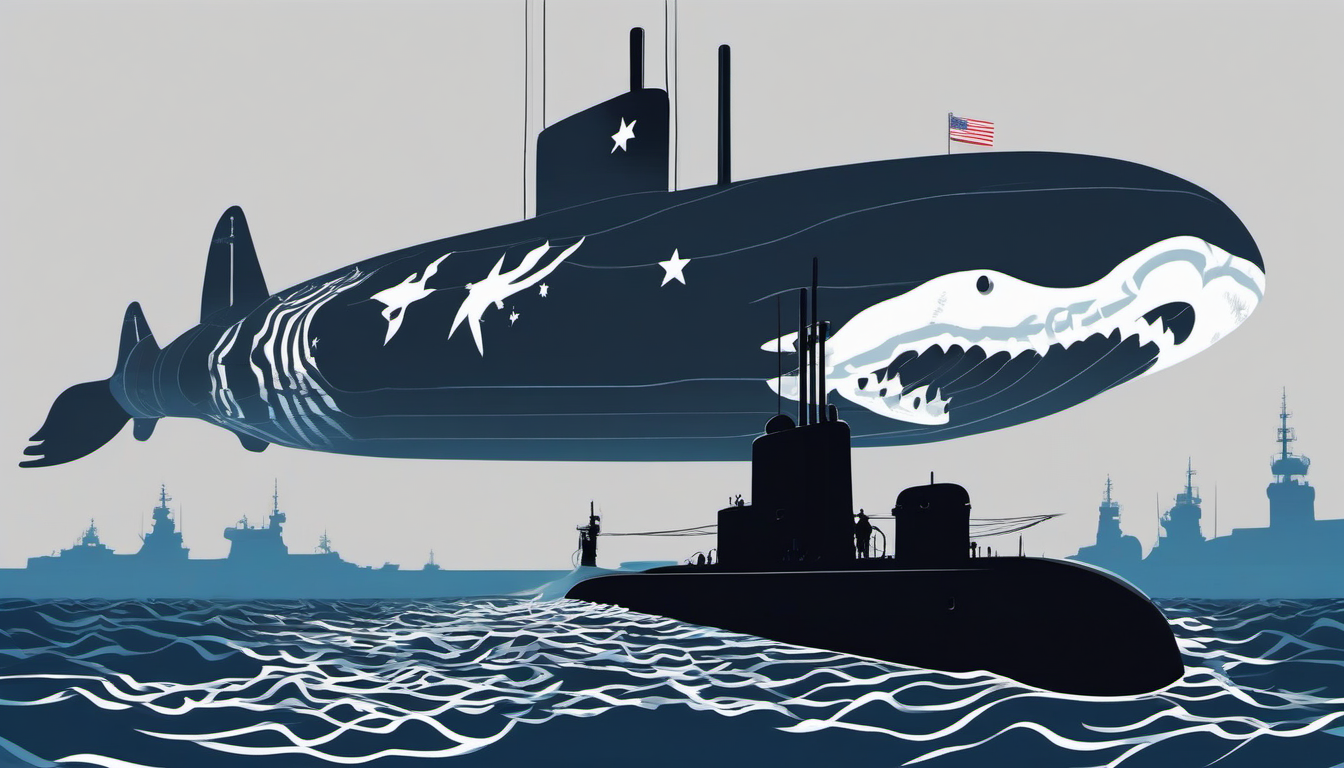
Three Australians aboard the submarine that sank an Iranian warship expose the hidden entanglement architecture of modern military alliances
Executive Summary
- The USS Minnesota's torpedo sinking of the IRIS Dena — the first submarine torpedo kill since World War II — has revealed that three Australian Navy personnel were aboard, embedded under the AUKUS training program.
- Over 50 Australian sailors serve across the US attack submarine fleet, with one in ten crew members on each boat being Australian — creating an inescapable entanglement mechanism that bypasses democratic war authorization.
- This incident exposes a fundamental tension in modern alliance architecture: training programs designed for peacetime capability-building become involuntary conscription mechanisms during wartime, dragging allies into conflicts without cabinet debate or parliamentary vote.
Chapter 1: The Torpedo Heard Around the World
On March 5, 2026, US Defense Secretary Pete Hegseth announced what submarine warfare historians will study for decades: an American submarine had torpedoed and sunk the IRIS Dena, an Iranian frigate sailing in international waters in the Indian Ocean, killing at least 87 of the approximately 180 crew aboard. It was the first time a US submarine had sunk an enemy vessel with a torpedo since the Second World War — an 81-year gap in which the weapon had existed purely as a deterrent.
"An American submarine sank an Iranian warship that thought it was safe in international waters. It was sunk by a torpedo, a quiet death," Hegseth told the Pentagon press corps. The Dena had been returning from Exercise MILAN 2026, a multinational naval exercise organized by India in the Bay of Bengal — attended by 72 nations just weeks earlier.
The attack instantly transformed the Iran war from an air campaign into a multi-domain conflict. But the real strategic shockwave came 24 hours later, when Australian Prime Minister Anthony Albanese confirmed what defense sources had been leaking: three Royal Australian Navy personnel were aboard the submarine when it fired the fatal torpedoes.
"I can confirm that there were three Australian personnel onboard that vessel," Albanese told Sky News Australia. "I can confirm also, though, that no Australian personnel have participated in any offensive action against Iran."
The distinction — aboard the submarine, but not "participating" in offensive action — immediately became one of the most contested legal claims of the war.
Chapter 2: The AUKUS Entanglement Machine
The presence of Australians aboard a US combat submarine was not an accident, an anomaly, or a secret. It was the explicit purpose of AUKUS Pillar I.
Under the $368 billion submarine deal signed in 2023, Australia committed to a decades-long pathway toward operating its own nuclear-powered attack submarines. The critical intermediate step: embedding Australian sailors within the US submarine fleet to build the institutional knowledge required to operate nuclear-powered vessels. By 2026, this program had grown to remarkable proportions:
| Metric | Figure |
|---|---|
| Australian personnel in US submarine fleet | 50+ |
| Ratio of Australians per US submarine crew | ~1 in 10 |
| Virginia-class submarines in rotation through HMAS Stirling (Perth) | 1-2 at any time |
| Total AUKUS Pillar I investment | $368 billion |
| First Australian-operated SSN delivery | ~2040 |
The USS Minnesota, widely reported as the submarine involved though not officially confirmed by the Pentagon, had itself rotated through the HMAS Stirling base in Western Australia in 2025. The integration was so deep that the vessel effectively operated as a joint US-Australian platform.
This is the hidden architecture of modern alliance entanglement. Unlike NATO's Article 5, which requires a political decision to invoke collective defense, the AUKUS training pipeline creates automatic entanglement — when the US goes to war, Australian personnel are already aboard combat vessels, with no decision point, no parliamentary debate, no cabinet vote.
Chapter 3: The Legal Labyrinth
The legal questions raised by the Dena sinking are unprecedented in modern international law.
Was the initial attack lawful? Professor Donald Rothwell of the Australian National University, a leading expert on international law, argued that while the initial US-Israeli strikes on Iran lacked clear legal basis, once armed conflict commenced, the Dena became a legitimate military target. "Armed conflict has commenced and the members of the Iranian navy are legitimate combatants for those purposes," he concluded.
Were Australians co-belligerents? This is the crux of the controversy. Albanese insisted that "no Australian personnel have participated in any offensive action against Iran." But on a submarine with a crew of approximately 130, where one in ten is Australian, the claim strains credulity. Submarine operations require integrated crew functions — navigation, sonar, weapons systems, communications — where every crew member contributes to the vessel's combat capability.
Greens senator David Shoebridge rejected the prime minister's framing entirely: "This makes Australia obviously, clearly, unambiguously, part of an illegal war, part of a war that is breaking down the norms of international law."
The Geneva Convention question. The submarine did not surface to render aid to Iranian survivors, who were later rescued by the Sri Lankan Navy. The Second Geneva Convention requires that combatants render aid to shipwrecked enemies. International law lecturer Juliette McIntyre of Adelaide University noted that while submarines have practical limitations, "because it was so far away from what you would call the main theatre of war, there wasn't necessarily any real risk to the submarine surfacing and rendering aid."
Iran's foreign minister, Seyed Abbas Araghchi, called the attack "an atrocity at sea, 2,000 miles from Iran's shores" and warned: "The US will come to bitterly regret the precedent it has set."
Chapter 4: Chain-Ganging — The Alliance Trap
The AUKUS submarine incident is the most vivid example of a phenomenon international relations scholars call chain-ganging — the mechanism by which alliance commitments drag states into conflicts they would otherwise avoid.
Historical Precedents
The chain-ganging dynamic has precedents, but none quite like this:
| Precedent | Year | Mechanism | Result |
|---|---|---|---|
| Austria-Hungary → Germany → WWI | 1914 | Formal alliance obligations | World War I |
| ANZUS → Vietnam | 1965 | Political solidarity, not treaty obligation | Australia's longest war |
| NATO → Afghanistan | 2001 | Article 5 invocation (first ever) | 20-year commitment |
| UK → Iraq | 2003 | "Coalition of the willing" | No treaty obligation |
| AUKUS → Iran | 2026 | Personnel already embedded | No decision point |
What makes the AUKUS case unique is the absence of a decision point. In every previous case, the allied government made a conscious choice — however politically constrained — to participate. Australia chose to join Vietnam, to invoke ANZUS for Afghanistan, to join the Iraq coalition. Each involved cabinet deliberation, however rushed.
In the AUKUS case, Australian personnel were already embedded in combat platforms before the conflict began. There was no moment at which the Australian cabinet decided to send personnel into harm's way in the Iran war. The decision had been made years earlier, when the training pipeline was established. The war merely activated a pre-positioned entanglement.
Doug Cameron, former ALP senator and national patron of Labor Against War, articulated the concern shared by many: the AUKUS agreement meant Australia could get "roped into" any future US conflict — not through political choice, but through structural inevitability.
Chapter 5: Scenario Analysis — The Cascading Entanglement
Scenario A: Containment — "Training, Not Combat" (40%)
Australia successfully maintains the legal fiction that its personnel were observers, not combatants. The incident generates domestic political controversy but no lasting damage to the AUKUS framework. The government quietly reviews protocols for embedded personnel during wartime.
Supporting evidence: The Albanese government has significant political incentive to contain the fallout. International law experts largely agree the attack on the Dena was lawful within the context of armed conflict. The Australian public, while divided on the Iran war, broadly supports AUKUS.
Trigger conditions: Iran does not specifically name Australia as a co-belligerent. No Australian personnel are killed or injured in subsequent operations. The war concludes before the issue gains sustained political traction.
Scenario B: AUKUS Stress Test — Alliance Under Strain (35%)
The incident becomes a political crisis that forces a fundamental review of AUKUS personnel embedding protocols. Australia establishes new rules requiring the withdrawal of embedded personnel when the host nation enters armed conflict. This weakens the training pipeline and delays Australia's submarine capability timeline.
Supporting evidence: Greens and crossbench senators are already demanding inquiries. If additional incidents occur — particularly if an Australian is killed aboard a US vessel — public opinion could shift dramatically. The 2022 precedent of the AUKUS deal surviving a change of government may not survive a wartime entanglement.
Historical parallel: New Zealand's nuclear-free policy (1984) showed that even close allies can fundamentally restructure alliance terms when domestic politics demands it. New Zealand was effectively expelled from ANZUS but maintained its sovereignty.
Scenario C: The Entanglement Precedent — Weaponized Integration (25%)
The incident establishes a precedent that other nations study and either emulate or avoid. Japan, South Korea, and other US allies begin reviewing their own embedded personnel programs. The Pentagon recognizes the strategic value of having allied personnel aboard combat platforms as a tripwire mechanism that automatically commits allies to US conflicts — similar to how US forces in South Korea serve as a tripwire against North Korean aggression, but in reverse.
Supporting evidence: The US already has extensive personnel exchange programs with Japan (GSDF embedded in US Army units), South Korea (liaison officers), and NATO allies. The precedent could transform every embedded officer into a potential chain-gang link.
Risk: If allies perceive embedded programs as entanglement traps rather than capability-building tools, they may pull back from integration — paradoxically weakening the alliance network the programs were designed to strengthen.
Chapter 6: Investment Implications
Defense Sector
The AUKUS revelation reinforces the defense supercycle thesis. Australian defense stocks — particularly those tied to the submarine program — face a paradox: the strategic rationale for AUKUS is strengthened by the Iran war (demonstrating the need for advanced submarine capability), but political risk to the program has increased.
Key exposures: ASC (submarine builder), BAE Systems Australia, Austal (surface combatants as alternative), Babcock International (submarine sustainment).
Alliance Risk Premium
Global defense stocks exposed to US alliance structures may begin pricing in "entanglement risk" — the probability that allied nations will be drawn into US conflicts through structural mechanisms rather than political choice. This is particularly relevant for:
- Japan: 50,000+ US personnel based in Japan, extensive integration programs, constitutional constraints on collective self-defense
- South Korea: 28,500 US troops, operational control transfer debate, Yoon verdict
- Philippines: EDCA bases, South China Sea tensions
- UK/France: E3 Iran war involvement already materializing
Submarine Industrial Base
The torpedo sinking validates the submarine as a decisive combat platform for the first time in 81 years. This has implications for:
- HII/General Dynamics: Virginia-class production rate (currently 1.1/year vs. 2/year target)
- Hanwha Ocean/HD Hyundai Heavy Industries: Korean submarine exports
- Naval Group: French Barracuda program
- TKMS: German submarine exports
Conclusion
The three Australian sailors aboard the USS Minnesota represent something far larger than a diplomatic embarrassment. They are the living embodiment of a structural transformation in how modern alliances work — and how they can drag nations into wars they never chose to fight.
The AUKUS submarine program was designed to build Australia's sovereign submarine capability over three decades. Instead, within its first few years, it has become a mechanism for involuntary co-belligerency. The training pipeline, celebrated as the cornerstone of Indo-Pacific security cooperation, has been revealed as a potential entanglement trap — one that bypasses the democratic processes traditionally required before a nation goes to war.
For the 50+ Australian sailors still serving aboard US submarines in an active war zone, the question is no longer theoretical. And for every allied nation with personnel embedded in the US military, the AUKUS precedent carries an uncomfortable lesson: in the age of integrated alliances, the decision to go to war may have already been made.
Sources: The Guardian, Reuters, ABC Australia, NYT, CFR, ANU International Law, CSIS, Australian Parliament Hansard
Leave a Reply