
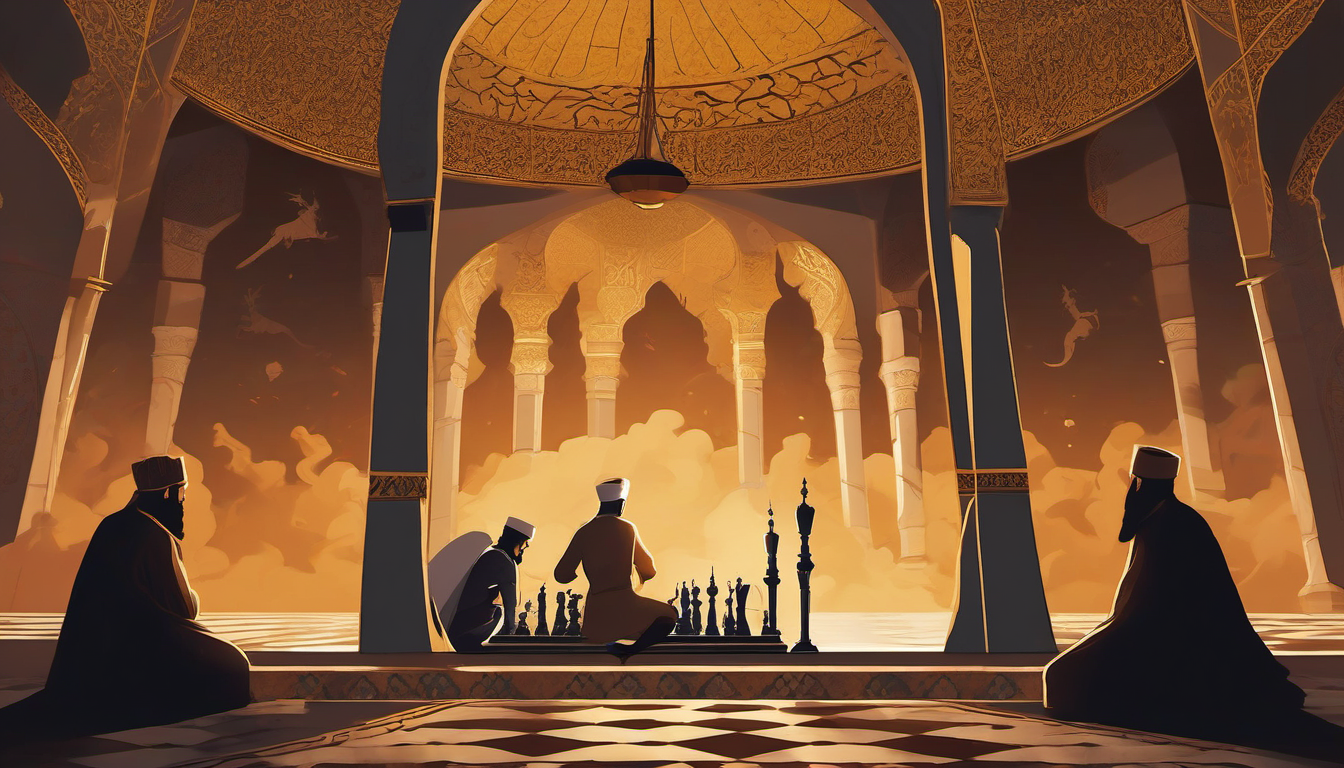
As Mojtaba Khamenei emerges as frontrunner to succeed his assassinated father, Iran faces a succession crisis unlike anything in its 48-year history — and the outcome will shape the war's trajectory
Executive Summary
- Iran's Assembly of Experts is nearing selection of Mojtaba Khamenei, the late supreme leader's son, as successor — a hardline choice that signals the regime's refusal to negotiate under fire and virtually guarantees escalation of the conflict with the US and Israel.
- China has deployed special envoy Zhai Jun to the Middle East in its first major wartime mediation bid, but Beijing's deep alignment with Tehran undercuts its credibility as a neutral broker — raising the question of whether this is diplomacy or strategic positioning.
- The succession process is occurring under unprecedented conditions: the Assembly of Experts' Qom headquarters was bombed by Israel, 50+ senior officials were killed in the February 28 strikes, and the IRGC — not civilian leadership — is effectively directing the war, creating a potential path toward a military-clerical hybrid regime.
Chapter 1: The Assassination and Its Aftermath
On February 28, 2026, US-Israeli airstrikes struck Tehran and killed Ayatollah Ali Khamenei, Iran's supreme leader for 36 years. The strike was part of a broader decapitation campaign that targeted some 50 top officials across Iran's political and military hierarchy. It was the most consequential rupture in the Islamic Republic's political system since the death of its founder, Ayatollah Ruhollah Khomeini, in 1989.
The difference between 1989 and now could hardly be starker. Khomeini died of natural causes in peacetime, and the transition to Khamenei — though he held inferior religious credentials, being only a hojatoleslam elevated to ayatollah for the occasion — was managed and orderly. The Assembly of Experts convened, deliberated, and selected a successor within 24 hours.
Today, Iran is at war. Its leadership has been decapitated. Its Assembly of Experts headquarters in Qom was bombed by Israel on March 3 (though the building was empty at the time, according to IRGC-affiliated media). The 88-member body must now choose a successor while the country is under sustained aerial bombardment, its supreme leader's funeral has been postponed, and the Islamic Revolutionary Guard Corps is waging a multi-front war across the Persian Gulf.
A three-person interim council has been formed under the constitution: Alireza Arafi (deputy chairman of the Assembly of Experts and director of Iran's Islamic seminaries), President Masoud Pezeshkian, and Gholam-Hossein Mohseni-Eje'i, head of the judiciary. But this council is a constitutional formality. The real power lies with the IRGC, which has closed the Strait of Hormuz, launched indiscriminate attacks on Gulf states hosting US bases, and is operating according to what analysts describe as a "pre-prepared script."
Chapter 2: The Son Rises — Mojtaba Khamenei
Mojtaba Khamenei, born in 1969, is the second son of the late supreme leader. He studied theology after high school, served briefly in the Iran-Iraq war at 17, and spent decades operating in the shadows of Iranian power before emerging as the leading succession candidate.
His political career traces the arc of Iran's internal power struggles. After the embarrassing defeat of Khamenei's preferred candidate Ali Akbar Nategh Nuri in the 1997 presidential election — where Nuri won just 25% of the vote — conservative factions undertook a structural reorganization. Mojtaba was central to this project.
He became notorious during the 2009 Green Movement protests, when reformists accused him of directly supervising the crackdown. Senior reformist politician Mostafa Tajzadeh alleged that his and his wife's legal cases were under Mojtaba's personal oversight. Protesters chanted his name in the streets — not as a hero, but as a symbol of repression.
In 2022, he received the title of ayatollah, an essential prerequisite for the supreme leadership. He became a regular presence at his father's political meetings and played a central role in managing the elder Khamenei's substantial financial empire. He also wielded influence over the Islamic Republic Broadcasting Corporation, the state media apparatus.
His closest political allies reveal his orientation: Ahmad Vahidi, the newly appointed IRGC commander; Hossein Taeb, former head of IRGC intelligence; and Mohammad Bagher Ghalibaf, the current speaker of parliament. This is the hardline core of the Islamic Republic.
Iran International, an opposition media outlet, reported that the Assembly of Experts had already elected Mojtaba, though this has not been formally confirmed. The New York Times cited three unnamed Iranian officials who described him as the clear favorite. Bloomberg reported that the wartime council proceedings have exposed deep factional divisions, but the IRGC's advocacy for Mojtaba appears decisive.
Israel's defense minister Gideon Saar has warned that Mojtaba will be assassinated if selected — a threat that underscores how the succession itself has become a front in the war.
Chapter 3: The Other Candidates and the Factional Divide
The Assembly of Experts is reportedly choosing from a field of six candidates. Understanding who they are reveals the fault lines within Iran's political elite.
Mojtaba Khamenei represents continuity and IRGC dominance — the "dig in and fight" option. His selection would signal that Iran has no intention of seeking accommodation with Washington.
Hassan Khomeini, grandson of the revolution's founder, represents a more moderate possibility. He carries the symbolic weight of the Khomeini name but lacks the IRGC's backing. In peacetime, he might have been a compromise candidate. In wartime, the IRGC's preference is unlikely to be overridden.
Alireza Arafi, currently a member of the Guardian Council and deputy chairman of the Assembly of Experts, is the "institutional" candidate — a seasoned politician with genuine religious credentials. He sits on the interim council itself, giving him a unique position, but he lacks an independent power base.
The hereditary nature of Mojtaba's candidacy is deeply controversial. Former Prime Minister Mir Hossein Mousavi warned as early as 2022: "News of this conspiracy have been heard for 13 years. If they are not truly pursuing it, why don't they deny such an intention once and for all?" The Assembly responded with a bland assurance about selecting "the most qualified."
The irony is unmistakable: a revolution born in 1979 to overthrow a hereditary monarchy may now install what amounts to a hereditary theocratic dynasty. The Khamenei family's hold on power — through direct succession from father to son — would mark a fundamental transformation of the Islamic Republic's founding mythology.
| Candidate | Background | IRGC Support | Religious Credentials | War Stance |
|---|---|---|---|---|
| Mojtaba Khamenei | Son of late leader, shadow operator | Very High | Ayatollah (2022) | Maximum resistance |
| Hassan Khomeini | Grandson of founder | Low-Moderate | Hojatoleslam | Potentially moderate |
| Alireza Arafi | Guardian Council, seminary head | Moderate | High | Institutional continuity |
Chapter 4: China's Mediation Gambit
Into this volatile succession crisis steps China. On March 5, Foreign Minister Wang Yi announced that Beijing would send special envoy Zhai Jun to the Middle East to mediate between the warring parties. Zhai has served as China's Middle East envoy since 2019.
China's intervention has two dimensions: strategic and performative.
The strategic dimension is clear. China is the largest buyer of Iranian oil, and the war is disrupting energy supplies across the Gulf. Premier Li Qiang, speaking at the Two Sessions on March 5, set China's GDP growth target at 4.5–5% — the lowest in decades — and warned that "multilateralism and free trade are under severe threat." Beijing cannot afford the energy price shock that the Hormuz closure is producing.
The performative dimension is equally important. China sees an opportunity to cast itself as a "force for peace," following its brokering of the 2023 Saudi-Iran rapprochement. But as Ja Ian Chong of the National University of Singapore observes, China is "way more closely aligned with Iran than with either the U.S. or Israel" — fundamentally undermining its claim to neutrality.
The deeper question is what China's mediation bid reveals about the limits of its strategic partnerships. Beijing has invested heavily in Iran, yet its support does not extend to military protection. If China cannot or will not defend its strategic partners when they are under attack, what is a Chinese partnership actually worth?
Trump's response to China's offer has been dismissive. The US administration views the succession question — not mediation — as the pathway to ending the war. Washington's explicit goal remains regime change, and the selection of Mojtaba Khamenei would only harden that resolve.
Chapter 5: Scenario Analysis
Scenario A: Mojtaba Installed, War Escalates (50%)
Rationale: The IRGC controls the military and has the strongest factional position. Mojtaba is their candidate. The Assembly of Experts, operating under existential threat, is unlikely to defy the only institution capable of defending the regime. The 1989 precedent shows the Assembly prioritizes stability over credentials.
Trigger conditions: Formal announcement (possibly delayed past Khamenei's funeral for security reasons). IRGC consolidation of war direction under Ahmad Vahidi.
Consequences: War extends. No negotiation pathway. Israel follows through on assassination threat, creating a cycle of leadership targeting. China's mediation fails. Gulf states move from neutrality to active participation against Iran. Oil prices remain elevated above $120/barrel.
Historical precedent: When North Korea's Kim Jong-il died in December 2011, the succession of his son Kim Jong-un was managed by the military establishment. The hereditary transfer was accompanied by aggressive external behavior (nuclear test in February 2013) to consolidate internal legitimacy. Mojtaba's path follows a similar logic — wartime succession demands maximum hardline posture.
Scenario B: Delayed Succession, IRGC Junta (30%)
Rationale: Given the assassination threat against any named successor, the regime may keep the three-person interim council in place indefinitely while the IRGC prosecutes the war. This avoids putting a target on anyone's back and allows the military to operate without political constraints.
Trigger conditions: Continued Israeli strikes on leadership targets. Failure to find a secure location for the Assembly of Experts to convene. Pezeshkian's ineffectiveness as nominal leader creates a vacuum the IRGC fills.
Consequences: Iran evolves toward a quasi-military regime with weakened clerical legitimacy. The Velayat-e Faqih (guardianship of the jurist) system erodes in practice while being maintained in rhetoric. Decision-making becomes faster and more aggressive, but the regime loses its ideological foundation.
Historical precedent: Egypt after the 2013 military coup. The military initially maintained a civilian facade (interim president Adly Mansour) before Sisi formalized military control. In Iran, the IRGC may follow a similar trajectory — operating behind the interim council while accumulating effective power.
Scenario C: Internal Fracture and Negotiation (20%)
Rationale: The war has destroyed Iran's air defenses, its nuclear program, and much of its military infrastructure. Continued bombardment with no end in sight could fracture the elite. President Pezeshkian, a genuine moderate, might find space to pursue diplomatic channels — particularly if China's mediation provides political cover.
Trigger conditions: Military exhaustion (ammunition depletion within 2–3 weeks at current rates). Gulf states joining the war against Iran. Internal protests resuming in major cities. A faction within the IRGC calculating that survival requires negotiation.
Consequences: Ceasefire talks within 4–6 weeks. Possible model: a scaled-down nuclear deal in exchange for partial sanctions relief and security guarantees. Mojtaba's candidacy is shelved in favor of a compromise figure like Arafi.
Historical precedent: The Iran-Iraq war ceasefire of 1988, when Khomeini himself described accepting the UN resolution as "drinking poison." Eight years of devastating war ultimately produced pragmatic acceptance. But that took eight years, and the current conflict is far more asymmetric.
Chapter 6: Investment Implications
Defense sector: The succession of a hardliner virtually eliminates near-term ceasefire prospects. Raytheon (RTX), Lockheed Martin (LMT), and Northrop Grumman (NOC) remain structural beneficiaries. Missile production bottlenecks (PAC-3 at 6–7/month) create particular tailwinds for interceptor manufacturers.
Energy: Brent crude remains supported above $110–120 while Hormuz is closed. A Mojtaba succession adds a hawkish premium. If Gulf states enter the war (Scenario A), upside risk to $140+. Natural gas prices remain elevated given Qatar's production halt. CF Industries (CF), Nutrien (NTR) benefit from fertilizer supply disruption.
Chinese equities: Beijing's mediation failure (most likely outcome) keeps geopolitical risk premium on Chinese markets. But defense budget increase (+7%) benefits domestic defense stocks. Energy importers face margin compression.
Safe havens: Gold continues its structural bull run ($5,400+). Dollar strength persists as the US prosecutes a foreign war with domestic energy self-sufficiency. Bitcoin's "digital gold" thesis remains under stress as it trades as a risk asset (-47% from ATH).
Risk factor: Israeli assassination of Mojtaba Khamenei post-selection would create a succession crisis within a succession crisis — the most destabilizing outcome for all asset classes.
Conclusion
Iran's wartime succession is not merely a question of who replaces Khamenei. It is a test of whether the Islamic Republic's founding architecture — the Velayat-e Faqih system — can survive the simultaneous destruction of its military, its leadership, and its founding mythology.
The likely selection of Mojtaba Khamenei transforms the 1979 revolution's anti-monarchical narrative into an ironic mirror image: a dynastic succession, backed by military force, under wartime conditions. Whether this consolidates the regime or accelerates its internal contradictions remains the central question.
China's mediation effort, meanwhile, reveals the structural limits of Beijing's global ambitions. A great power that cannot protect its partners or achieve credible neutrality is performing diplomacy, not practicing it.
The coming weeks will determine whether Iran chooses continuity through blood succession or fractures under the weight of a war it cannot win militarily. History suggests the former — revolutionary regimes rarely surrender from the top. The Iranian regime's survival instinct, forged through 45 years of isolation, sanctions, and war, should not be underestimated. But neither should the unprecedented nature of what it now faces.
Related Reading
- Iran's Next Leader: Assembly of Experts Nears Naming Khamenei's Successor — Bloomberg
- Who or What Will Replace Iran's Supreme Leader — The Conversation
- Ammunition Equation: Who Runs Out First
🔗 More coverage: Middle East Hub
Leave a Reply