
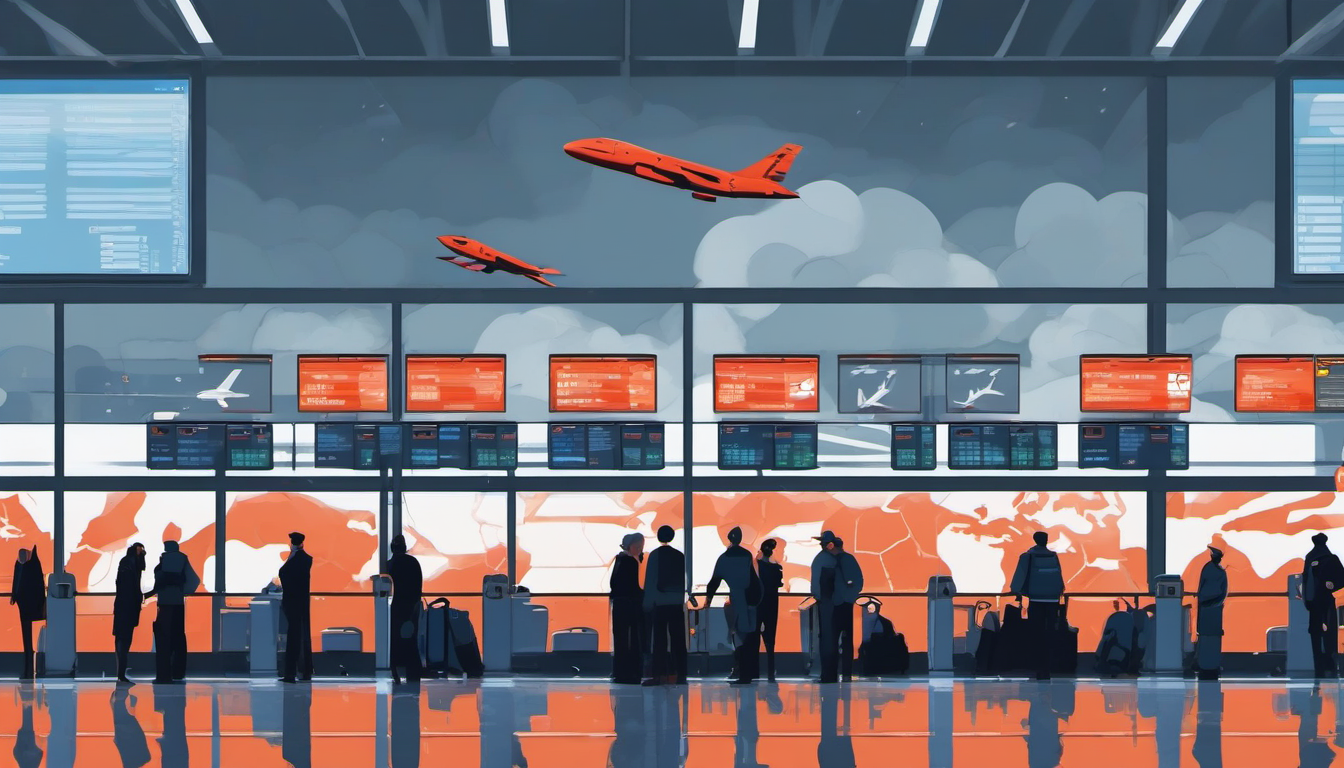
How a government shutdown, a Middle East war, and cartel violence are converging to create the worst aviation crisis since 9/11 — just as Spring Break begins
Executive Summary
- The global aviation system faces an unprecedented triple disruption: DHS shutdown (Day 18, TSA working without pay), Iran war (8 countries' airspace closed, Middle East hubs shut down), and Mexican cartel violence (airports shuttered, highways blocked) — all converging 11 days before Spring Break peak travel.
- TSA's 65,000 officers received reduced paychecks on March 3; they will miss their first full paycheck on March 17 — the exact day Spring Break peak travel begins. The collision course has been set.
- Over 18,000 international flights have been disrupted by Middle East airspace closures. Dubai, Doha, and Abu Dhabi — three of the world's busiest transit hubs — are effectively offline. Airlines are rerouting across already congested airspace, creating cascading delays into domestic US and European networks.
Chapter 1: The Home Front — DHS Shutdown Enters Its Third Week
On March 3, 2026, approximately 61,000 Transportation Security Administration officers received their first reduced paychecks since the Department of Homeland Security funding lapsed on February 14. These are the people who screen 2.5 million passengers daily at 440 US airports. They are classified as "essential" — meaning they must report to work. But they are not getting fully paid.
The DHS shutdown, now in its 18th day, originated from an impasse in Congress over immigration enforcement. Democrats blocked the DHS appropriations bill over concerns about ICE detention policies, while Republicans refused to separate TSA and FEMA funding from the broader DHS package. The result: a sprawling department encompassing border patrol, Coast Guard, FEMA, Secret Service, CISA (cybersecurity), and TSA — all either furloughed or working without guaranteed pay — during an active war.
The last major DHS shutdown, a 43-day ordeal in late 2025, provides a grim preview. TSA absences doubled or tripled at some airports. Checkpoint wait times ballooned. The US Travel Association estimated $6 billion in permanent losses to the travel industry. The Congressional Budget Office calculated $7–14 billion in permanently lost economic activity.
This time, the stakes are higher. The FBI and DHS have warned of heightened domestic terrorism risk stemming from the Iran conflict. Yet CISA — the agency responsible for cybersecurity defense — has furloughed 62% of its workforce. Coast Guard personnel protecting ports are unpaid. FEMA's grant processing system, FEMA Go, is offline because the staff who run it have been sent home.
"When we have conflicts overseas, we see that the ramifications are that there are higher threats here at home as well," DHS Secretary Kristi Noem told the Senate Judiciary Committee. She praised TSA officers for "still showing up." The question is: for how long?
The critical date is March 17. If the shutdown persists, TSA officers will miss their first complete paycheck on the same day that Spring Break peak travel begins. In 2025, Spring Break generated 3.2 million daily passengers at US airports — a 28% surge over baseline. The system strains under normal conditions. Under the current scenario, it could buckle.
Chapter 2: The War in the Sky — Middle East Airspace Disappears
On February 28, the United States and Israel launched Operation Epic Fury against Iran. Within 72 hours, the conflict had spread to engulf seven countries. Iran's retaliatory missile and drone strikes hit targets in Saudi Arabia, the UAE, Bahrain, Qatar, and Kuwait. Hezbollah re-entered the war in Lebanon. A suspected Iranian drone struck the RAF base at Akrotiri in Cyprus.
The aviation consequences have been staggering. Eight countries have closed their airspace entirely or partially: Iran, Iraq, Lebanon, Syria, Yemen, Bahrain, Qatar, and — intermittently — the UAE. The three mega-hubs that serve as the world's primary East-West transit points — Dubai International (DXB), Hamad International in Doha (DOH), and Abu Dhabi International (AUH) — have suspended commercial operations.
Emirates, the world's largest international airline by passenger kilometers, halted all flights. Qatar Airways grounded its fleet. Etihad suspended operations until at least March 5. Together, these three carriers handle roughly 200 million passengers annually and connect Europe, Africa, and the Americas to South and East Asia. Their simultaneous shutdown has no precedent in commercial aviation history.
The ripple effects are global. European carriers flying to Asia must now reroute around the entire Middle East, adding 3–5 hours to flight times and requiring additional fuel stops. Cathay Pacific, Singapore Airlines, and Korean Air are rerouting over Central Asia or the Caucasus, creating congestion in airspace corridors never designed for this volume. Flight times from London to Singapore have increased from 13 to 17 hours.
For US airlines, the damage is cascading into domestic operations. Delta, which suspended its Atlanta-Dubai route, now has widebody aircraft stranded in wrong positions. These aircraft were scheduled for rotations that feed into domestic feeder routes. When a Boeing 777 that should be in Dubai is sitting idle in Atlanta, the schedule unravels across the entire network. On March 3, JFK recorded 196 disruptions. O'Hare logged 231. The total US disruption count: 2,934 flights — 187 cancellations and 2,747 delays.
Airline ticket prices for Europe-to-Asia routes have skyrocketed. Reuters reported fares of €2,400–3,600 for economy class on alternative routings. Private jet operators are charging £20,000 per seat for departures from Oman. A 13-seat charter from Oman to Paris: €215,000, nearly double the normal rate. Commodities analyst Michelle Wiese Bockmann described it as "worse than the pandemic. Disgraceful."
Chapter 3: The Southern Corridor — Cartel Violence Shuts Mexico
The third vector of disruption comes from an unexpected direction. On February 25, Mexican security forces killed Nemesio "El Mencho" Oseguera Cervantes, leader of the Jalisco New Generation Cartel (CJNG), in a firefight in Jalisco. The response was immediate and brutal. CJNG initiated narco-blockades across eight states. Highways were barricaded with burning vehicles. Guadalajara — Mexico's second-largest city and a major airport hub — was effectively paralyzed.
For American travelers, the timing could not be worse. Mexico is the number-one international destination for US Spring Break travelers, with an estimated 2.7 million Americans expected to visit in March 2026. The State Department issued fresh travel advisories for Jalisco, Sinaloa, Michoacán, Guerrero, and Tamaulipas. Some airlines have pre-emptively canceled routes to Guadalajara and Puerto Vallarta.
The cartel violence intersects with the broader security environment. With DHS partially shuttered, Customs and Border Protection is operating at reduced capacity at land border crossings. The FBI has diverted resources to domestic terrorism monitoring related to the Iran conflict. Local law enforcement in border states is stretched between cartel spillover concerns and federal coordination gaps.
Chapter 4: Scenario Analysis — What Happens Next?
Scenario A: Managed Chaos (40%)
Congress passes a narrow TSA/Coast Guard funding bill by March 14, before the paycheck cliff. Middle East airspace partially reopens as a ceasefire framework emerges. Mexico's cartel violence subsides as CJNG completes its retaliatory cycle. Spring Break is messy but survivable. Airlines absorb $8–12 billion in losses. Travel industry impact: $15–20 billion.
Basis for probability: Congress has shown willingness to separate TSA funding in past shutdowns. Republican senators from travel-dependent states (Florida, Nevada, Arizona) are already pushing standalone bills. Historical pattern: cartel violence spikes after kingpin removals peak within 10–14 days before establishing new equilibrium.
Scenario B: Spring Break Meltdown (35%)
The shutdown continues past March 17. TSA absences surge to 2018-level peaks (10% call-out rate). Airport security lines exceed 3 hours at major hubs. Middle East airspace remains closed as Iran conflict enters its fourth week. Mexico cartel violence sustains, closing multiple Pacific resort airports. Airlines cancel 15–25% of international schedules. Domestic delays cascade beyond manageable levels.
Basis for probability: The 2025 shutdown lasted 43 days before resolution. Political incentives to hold firm are strong on both sides — Democrats see DHS funding as leverage on ICE, Republicans see shutdown blame falling on Democrats. Iran conflict timeline: the Pentagon has signaled "weeks, not days." Mexico: kingpin strategy fragmentations typically produce 6–8 weeks of elevated violence.
Historical precedent: The 2018-2019 federal shutdown lasted 35 days. TSA absence rates doubled. Air traffic controllers staging a de facto work stoppage at LaGuardia ultimately forced the resolution. That shutdown did not coincide with a war or Spring Break.
Scenario C: Systemic Failure (25%)
A domestic terrorism incident linked to the Iran conflict occurs at a US airport, triggering emergency security protocols on top of already degraded TSA staffing. Ground stops cascade across the national airspace system. Combined with the Middle East closure and Mexico disruption, global aviation experiences its worst week since September 2001. The economic toll exceeds $50 billion. Airlines seek emergency federal support.
Trigger conditions: FBI and DHS have explicitly warned of blowback attacks. Austin experienced a shooting 18 hours after Operation Epic Fury began. CISA's cybersecurity capacity is degraded. The simultaneous presence of physical security gaps (understaffed TSA) and cyber vulnerabilities (furloughed CISA) creates an opening.
Chapter 5: Investment Implications
Immediate losers:
- Airlines: Legacy carriers with Middle East exposure (Delta, United, Lufthansa, Air France-KLM) face route revenue collapse. Low-cost carriers dependent on volume (Spirit, Frontier) are vulnerable to DHS-related delays reducing throughput.
- Travel & leisure: Booking Holdings, Expedia, Airbnb — Spring Break cancellations hit forward bookings. Mexican resort operators face cascading cancellations.
- Airport concessions: Duty-free operators, food service companies with airport contracts.
Potential winners:
- Alternative hub airlines: Turkish Airlines (if Turkey remains stable), Singapore Airlines, Ethiopian Airlines — airlines positioned to capture rerouted traffic.
- Defense contractors with aviation security: L3Harris, Leidos — any resolution will involve accelerated TSA technology investment.
- Domestic tourism: US theme parks, national parks, road-trip economy — Americans unable or unwilling to fly internationally redirect spending domestically.
- Private aviation: NetJets, Wheels Up, VistaJet — ultra-high-net-worth travelers pay any price to avoid the chaos.
- Cybersecurity: The CISA degradation will eventually produce a political backlash demanding massive reinvestment.
| Sector | Impact | Timeline |
|---|---|---|
| US airlines | Revenue -8 to -15% Q1 | Immediate |
| Gulf airlines | Revenue -90%+ | Duration of conflict |
| Travel booking platforms | Forward bookings -20 to -35% | 2–4 weeks |
| Private aviation | Revenue +40–80% | Immediate |
| Airport security tech | Contract acceleration | Post-resolution |
Conclusion
The global aviation system was not designed to absorb three simultaneous shocks of this magnitude. A government shutdown that strips 65,000 security officers of their pay. A war that closes 8 countries' airspace and shuts down three of the world's five busiest transit hubs. Cartel violence that makes the most popular US international destination dangerous. Each alone would be manageable. Together, they create a crisis that will define the 2026 travel season and could permanently reshape how the world thinks about aviation resilience.
The countdown to March 17 is ticking. In 12 days, unpaid TSA officers will face a choice between showing up for work and feeding their families — while 3.2 million Americans try to board planes for Spring Break. The system's breaking point may be closer than anyone in Washington wants to admit.
Sources: Christian Science Monitor, TravelTourister, The Guardian, CNBC, People, US Travel Association, CBO, AFGE, FlightAware, FAA
Leave a Reply