
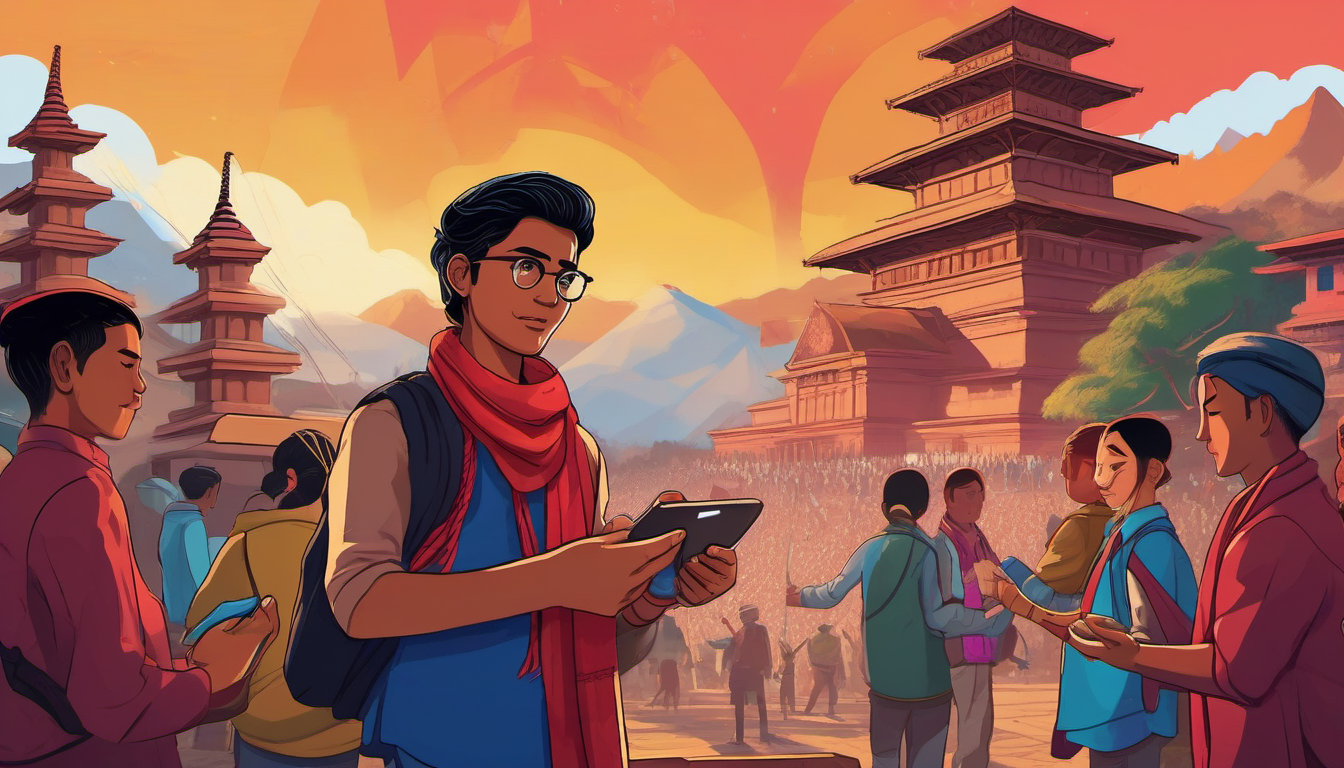
A rapper vs. a four-time prime minister — Nepal's most consequential election in a generation unfolds while the world looks elsewhere
Executive Summary
- Nepal votes today (March 5) in its first parliamentary election since the September 2025 Gen Z uprising that killed 77 people and toppled Prime Minister KP Sharma Oli — a contest that pits 35-year-old rapper-turned-mayor Balen Shah against the 74-year-old political veteran in his own constituency
- With 46% of the population under 24 and 800,000 first-time voters, the election tests whether street protests can translate into institutional power — or whether Nepal's entrenched party machinery simply absorbs the shock and reconstitutes itself
- The outcome carries implications far beyond the Himalayas: Nepal sits between China and India in an intensifying great power competition, and a new government's foreign policy orientation will reshape South Asian dynamics at a moment when both Beijing and Delhi are aggressively courting smaller neighbors
Chapter 1: The September Rupture
Nepal's political landscape was irrevocably altered on September 8, 2025. What began as youth protests against a social media ban imposed by Prime Minister KP Sharma Oli escalated within 48 hours into a nationwide uprising targeting decades of corruption, nepotism, and political stagnation. Security forces responded with live ammunition. At least 77 people were killed — the deadliest political violence in Nepal since the Maoist insurgency ended in 2006.
The social media ban was the spark, but the fuel had been accumulating for years. Nepal has cycled through 31 prime ministers in 35 years and 14 governments since becoming a republic in 2008. The same handful of leaders — Oli, Sher Bahadur Deuba of Nepali Congress, and the former Maoist commander Pushpa Kamal Dahal (Prachanda) — traded the premiership among themselves through an endless series of coalition realignments. Economic growth stagnated. Roughly 1,500 Nepalis leave the country daily to work in the Gulf states and Malaysia, many under exploitative kafala-like conditions. Remittances constitute roughly 25% of GDP — a metric that speaks not to economic health but to the failure of domestic opportunity.
The Gen Z protesters, coordinated through Discord servers and TikTok videos, demanded not just Oli's resignation but a fundamental restructuring of political accountability. They got the former but not the latter. Oli resigned. An interim government led by Chief Justice Sushila Karki — Nepal's first woman head of government — called elections for March 5, 2026.
The six months between uprising and election have been a peculiar limbo: the old parties scrambled to rebrand, the protest leaders debated whether to enter institutional politics, and one figure emerged as the embodiment of generational change.
Chapter 2: The Balen Phenomenon
Balendra "Balen" Shah defies easy political categorization. A civil engineer by training, he became famous as a rapper whose Nepali-language tracks excoriated corruption and political elitism. In 2022, running as an independent, he won the Kathmandu mayorship in a landslide — the first non-party candidate to win a major city in Nepal's democratic history.
As mayor, Balen became known for aggressive anti-encroachment drives and confrontational governance. His approval ratings soared among the young; his critics called him authoritarian and impulsive. When the September uprising toppled Oli, protest leaders on Discord forums voted Balen as their preferred interim leader. He declined, choosing instead to wait for elections — a decision that only burnished his democratic credentials.
His most dramatic move came in January 2026. Rather than contest any safe seat, Balen resigned as Kathmandu mayor and announced he would challenge Oli directly in Jhapa-5, the constituency Oli has won six consecutive times. It was a deliberate provocation: the rapper against the political patriarch, in his own backyard.
Campaign rallies illustrated the contrast starkly. When Balen's truck rolled through Damak, the constituency's main city, crowds surged from rooftops, balconies, and side streets to catch a glimpse. Women who couldn't get close enough for selfies reportedly broke down in tears. When Oli's motorcade passed through the same streets, it was largely ignored.
Yet Balen's campaign carries risks. He has given almost no policy interviews, preferring social media posts to press conferences. His rally speeches rarely exceed three minutes. He once posted "Fuck America, Fuck India, Fuck China" on Facebook before deleting it — a flippancy that alarms those who worry about Nepal's delicate geopolitical positioning between two nuclear-armed neighbors. His policy platform remains thin: anti-corruption, good governance, youth employment — slogans more than strategies.
Chapter 3: The Old Guard's Gambit
Nepal's established parties have responded to the generational challenge with a mixture of contrition and calculation.
Nepali Congress (NC), the country's oldest party, executed the most visible transformation. The leadership that presided during the September crisis — including five-time Prime Minister Deuba — stepped aside. In January, the party elected 49-year-old Gagan Kumar Thapa as president and prime ministerial candidate. Thapa represents the party's reformist wing and has embraced the Gen Z movement's language of accountability. Senior leader Minendra Rijal acknowledged to Al Jazeera that the party "admitted mistakes were made" and is "asking for a second chance."
CPN-UML, Oli's communist party, took the opposite approach. Despite being forced from power by street protests, the party re-elected the 74-year-old Oli as president and prime ministerial candidate. In rare media comments, Oli remained unrepentant, calling the protesters "misled" youth whose "movement was hijacked by criminals" as part of "a conspiracy to topple my government." His party insists it has brought younger members into its ranks, but the structural message is clear: CPN-UML is doubling down on its base rather than adapting.
The Maoist Center and smaller parties are positioning themselves as potential kingmakers in what is almost certain to be a hung parliament. Nepal's mixed electoral system — 165 seats by first-past-the-post, 110 by proportional representation — makes single-party majorities virtually impossible and coalition governments the norm.
This structural reality haunts the election. Even if Balen's Rastriya Swatantra Party (National Independent Party) performs exceptionally well, it would almost certainly need coalition partners to form a government. The fear among Gen Z activists is that another coalition will reproduce the same "musical chairs" dynamics that triggered the uprising in the first place.
"We are scared of another coalition that fails to deliver," said Rakshya Bam, 26, a central figure of the September protests. "Even if it's a coalition, they must work together and not fail people's aspirations again."
Chapter 4: The Geopolitical Stakes
Nepal's election unfolds at a moment of intensifying great power competition in South Asia. The Himalayan nation of 30 million shares a 1,400-km open border with India and a 1,400-km border with China along the Tibetan Plateau. Both neighbors have historically treated Nepal as a strategic buffer — and both are watching this election with keen interest.
India has traditionally exercised dominant influence over Nepal's politics, economics, and security. The 2015 economic blockade — when India restricted fuel and goods supply to Nepal to protest a new constitution it considered unfavorable to the Madhesi population in Nepal's southern plains — remains a bitter memory. Modi's "neighborhood first" policy has struggled to compete with China's Belt and Road Initiative infrastructure commitments, which include a trans-Himalayan railway project connecting Kathmandu to the Tibetan rail network.
China has steadily expanded its footprint. BRI commitments in Nepal total several billion dollars, though actual disbursements lag far behind promises. Beijing's interest is partly strategic — Nepal sits atop the Tibetan Plateau's southern approach — and partly economic. Chinese investment in hydropower, roads, and communications infrastructure has grown substantially.
A Balen-led government would introduce unprecedented uncertainty into this equation. His "Fuck America, Fuck India, Fuck China" outburst, while juvenile, reflected a genuine populist sentiment: that Nepal should not be anyone's client state. Whether this translates into meaningful strategic autonomy or merely diplomatic chaos remains unknowable.
A Nepali Congress-led coalition under Thapa would likely maintain closer ties with India while pursuing a more balanced engagement with China. An Oli return — unlikely but not impossible — would revert to his historical pattern of playing Delhi and Beijing against each other.
| Factor | Balen / RSP | NC / Thapa | UML / Oli |
|---|---|---|---|
| India relations | Unpredictable; nationalist | Warm; traditional alignment | Transactional; plays both |
| China relations | Unpredictable | Cautious engagement | Active courting |
| BRI projects | Review likely | Selective continuation | Full acceleration |
| US engagement | Unknown | Status quo | Limited |
| Foreign policy style | Populist nationalism | Institutional diplomacy | Strategic hedging |
Chapter 5: Scenario Analysis
Scenario A: Balen Breakthrough (30%)
Balen defeats Oli in Jhapa-5 and RSP wins 40-60 seats nationally, making it the second or third largest party. Balen forms a coalition with Nepali Congress and smaller parties.
Rationale: The "Balen effect" at rallies suggests genuine grassroots momentum. First-time voters (800,000) and the under-40 demographic (30% of electorate) skew heavily toward new political formations. The September uprising's emotional resonance remains powerful six months later. Historical precedent: Bangladesh's 2026 election saw a similar post-uprising sweep by new forces.
Trigger conditions: High youth turnout (>65% in urban areas), vote-splitting among traditional parties, Balen's personal victory over Oli as a symbolic mandate.
Risks: Coalition instability, policy inexperience, diplomatic missteps with India/China, economic disruption.
Scenario B: Old Guard Reconstitution (45%)
Traditional parties collectively win 180+ seats. NC emerges as largest party (80-100 seats), CPN-UML second (60-80), Balen's RSP wins 20-35 seats. NC forms coalition with Maoist Center and smaller parties. Thapa becomes PM.
Rationale: Nepal's first-past-the-post system structurally advantages established parties with rural networks. CPN-UML retains strong loyalty in eastern Nepal. NC's leadership change and Thapa's relative youth provide "change within continuity." Historical pattern: 13 of Nepal's 14 post-republican governments were formed by the same three parties. Bangladesh's 2008 precedent — post-military-backed election returned traditional parties — suggests institutional inertia.
Trigger conditions: Low urban turnout, vote-splitting among new parties, effective patronage networks in rural constituencies.
Risk: Public disillusionment if the new government resembles previous coalitions, potential for renewed protests within 12-18 months.
Scenario C: Fragmented Chaos (25%)
No clear winner. RSP wins 30-50 seats but cannot form a stable coalition. Traditional parties are weakened but not defeated. Extended government formation negotiations lasting weeks or months.
Rationale: With 120+ parties registered and a mixed electoral system designed to prevent majorities, extreme fragmentation is structurally baked in. The proportional representation component (110 seats) distributes seats widely. Nepal's post-2008 history is a catalog of fragmented results followed by unstable coalitions. The 2017 election — the closest recent comparison — produced a CPN-UML majority only through a pre-election merger that subsequently collapsed.
Trigger conditions: Moderate turnout across all demographics, no party exceeding 70 seats, ethnic and regional parties winning enough PR seats to deny anyone a working majority.
Risk: Political paralysis, economic stagnation, loss of reform momentum, potential for extra-constitutional interventions.
Chapter 6: Investment Implications
Nepal's direct relevance to global investors is limited — its GDP is approximately $42 billion, its stock exchange (NEPSE) is thinly traded, and foreign portfolio investment is negligible. But the election carries indirect implications:
Hydropower concessions: Nepal has 83,000 MW of estimated hydropower potential, of which less than 3,000 MW is developed. Both Indian and Chinese companies hold major concession agreements. A new government's stance on these contracts — particularly the $2.5 billion West Seti project (Chinese-backed) and the Arun III project (Indian-backed) — will signal investment climate.
BRI infrastructure: Several billion dollars of Chinese BRI commitments remain unimplemented. A new government could accelerate, renegotiate, or shelve these projects, affecting Chinese construction firms and suppliers.
Remittance corridors: With $10+ billion in annual remittances, Nepal is a significant market for remittance companies. Political instability could affect migration policy and bilateral labor agreements with Gulf states and Malaysia.
Regional risk premium: The election is a barometer for democratic resilience in South Asia. Following Bangladesh's successful post-uprising election in February, a positive outcome in Nepal would reinforce the narrative that popular movements can produce institutional change — a signal that affects political risk pricing across the region.
Conclusion
Nepal's March 5 election is both intensely local and quietly global. At its core, it is a test of whether the emotional power of a youth uprising can survive contact with the mechanics of electoral politics — the ward-level patronage, the caste calculations, the rural-urban divide, and the structural advantages of parties that have spent decades building organizational machinery.
The world's attention is elsewhere. The Iran war, the Hormuz crisis, and collapsing energy markets dominate every headline. But in the Himalayan republic, 19 million people are casting ballots in what may be the purest test yet of whether Generation Z — a demographic that has toppled governments from Dhaka to Kathmandu — can build institutions as effectively as it can tear them down.
The answer matters far beyond Nepal's borders. If Balen Shah and his cohort prove that street power translates into governance capacity, it will embolden youth movements across the Global South. If the old guard absorbs the shock and reconstitutes itself, it will confirm that institutional inertia remains the most powerful force in democratic politics.
Either way, Nepal's ballot box revolution deserves attention. Even — especially — when the rest of the world is on fire.
Sources: Al Jazeera, The Guardian, Indian Express, Reuters, Chatham House, Wikipedia
Leave a Reply