
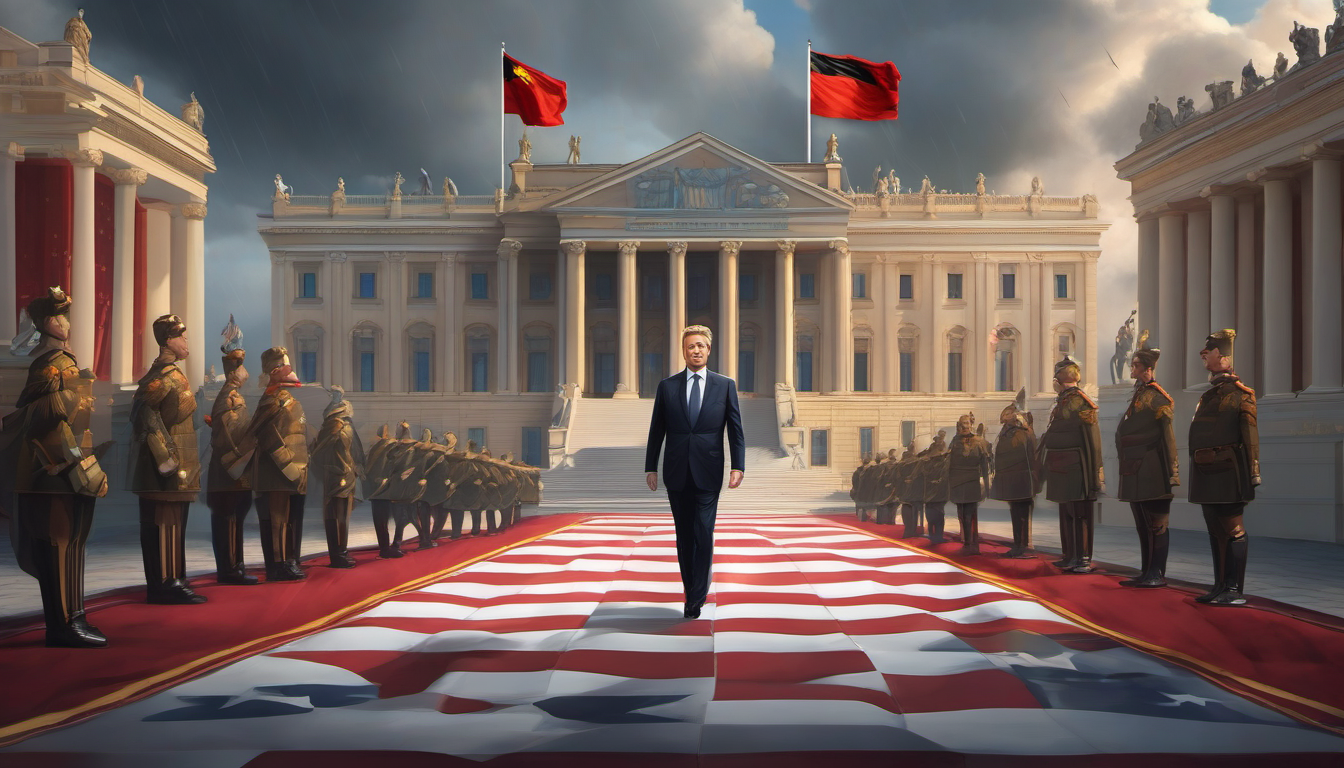
How the German Chancellor became Europe's indispensable broker by visiting Beijing and Washington in the same week — while the world burned
Executive Summary
- German Chancellor Friedrich Merz completed a remarkable diplomatic sprint — meeting Xi Jinping in Beijing last week and Donald Trump at the White House on March 3 — positioning Germany as Europe's pivotal intermediary between the two superpowers at a moment of maximum global instability.
- Merz navigated three simultaneous crises: the Iran war (offering base access while resisting direct involvement), the SCOTUS IEEPA tariff fallout (defending Spain within the EU and pushing for a US-EU trade deal), and Ukraine (showing Trump a map of territorial losses to keep Kyiv on the agenda).
- By gifting Trump a framed 1785 Prussia-US trade agreement — the first-ever American trade treaty — Merz signaled that Germany's new €550 billion rearmament and its economic heft make it the only European power capable of talking to both Washington and Beijing on equal terms.
Chapter 1: The Seven-Day Sprint
In the span of just seven days, Friedrich Merz accomplished something no European leader has attempted since the Cold War's end: consecutive summit-level visits to Beijing and Washington during an active multi-front war, a constitutional tariff crisis, and the largest European rearmament since 1945.
The itinerary was deliberate. Merz arrived in Beijing on February 25 with a delegation of 13 German CEOs — from Volkswagen, BMW, Siemens, Bayer, and Adidas — to meet President Xi Jinping and Premier Li Qiang. He then traveled to Hangzhou, touring Unitree's humanoid robot factory and Siemens Energy's facilities, sending an unmistakable message: Germany would not decouple from China's innovation ecosystem.
Days later, he walked into the Oval Office on March 3, as US and Israeli bombs fell on Tehran and Brent crude surged past $82. There, he presented Trump with a framed replica of the 1785 Treaty of Amity and Commerce between the United States and the Kingdom of Prussia — the first trade agreement the newly independent America ever signed.
The symbolism was exquisite: Germany was reminding America that their commercial relationship predated the Constitution itself.
The Context Machine
What makes Merz's shuttle extraordinary is not the logistics but the context. He was navigating between:
| Crisis | Beijing Dimension | Washington Dimension |
|---|---|---|
| Iran War | China's $400B strategic partnership with Iran; energy dependence via Hormuz | Germany offering base access; resisting boots on the ground |
| Tariffs | Airbus 120-aircraft deal; tech partnerships | SCOTUS IEEPA fallout; Section 122 at 15%; Spain embargo threat |
| Ukraine | Xi's refusal to pressure Putin meaningfully | Trump's "very high" priority claim; Merz's map demonstration |
| Rearmament | €550B defense spending; FCAS fighter fate | NATO 5% GDP demand; "Buy European" vs US defense exports |
No other European leader occupies this position. Macron is consumed by the Élongé nuclear doctrine. Starmer is managing the Brexit financial realignment and SAFE participation. Meloni is hosting the Milan Olympics under protest. Only Merz sits at both tables.
Chapter 2: The Beijing Play — De-Risking Without Decoupling
Merz's China visit was a masterclass in calibrated ambiguity. He criticized Chinese trade practices — overcapacity in EVs, market access barriers, intellectual property concerns — while simultaneously expanding engagement.
The headline deliverable was China's agreement to purchase up to 120 Airbus aircraft, a deal worth an estimated €15-20 billion that directly benefits the Hamburg and Toulouse assembly lines. But the deeper strategic play occurred in Hangzhou, where Merz's tour of Unitree's robotics facility signaled that Germany intended to remain embedded in China's next-generation industrial ecosystem.
What Merz Got
- Commercial wins: Airbus orders, automotive market access discussions for VW and BMW, Siemens Energy contracts
- Diplomatic framework: A "managed disagreement" model — both sides publicly acknowledging differences on Ukraine, Taiwan, and human rights while maintaining economic cooperation channels
- Intelligence: Direct insight into China's 15th Five-Year Plan priorities, unveiled at the Two Sessions opening on March 5, the same day Merz arrived back in Berlin
What Merz Conceded
- Silence on Taiwan: No public mention during the visit, a notable omission given Japan's recent constitutional revision and the First Island Chain militarization
- Muted Ukraine criticism: Merz did not press Xi publicly on arms supplies to Russia or sanctions evasion, saving his ammunition for the Washington leg
- Tech engagement: By touring Chinese AI and robotics facilities, Merz implicitly endorsed continued technology exchange at a moment when the Pax Silica alliance seeks to restrict it
The Historical Precedent
The last German chancellor to attempt this kind of Beijing-Washington shuttle was Angela Merkel, who visited both capitals in 2019 amid Trump's first trade war. But Merkel's visits were spaced months apart and occurred in peacetime. Merz compressed the cycle into seven days during an active war — a tempo that recalls Henry Kissinger's 1973 shuttle diplomacy during the Yom Kippur War, though with commercial rather than military objectives.
Chapter 3: The Washington Play — Base Access and the Spain Shield
At the White House, Merz faced a fundamentally different challenge: maintaining Trump's goodwill while establishing limits on German involvement in the Iran war.
The formula he devised was elegant. Germany would provide base access — allowing US forces to use facilities like Ramstein Air Base for logistics and medical evacuations — without committing combat troops. This required no Bundestag vote and kept Germany technically outside the conflict while providing material support.
"They're letting us land in certain areas, and we appreciate it," Trump told reporters. "We're not asking them to put boots on the ground."
But Merz's most consequential intervention came when Trump threatened to "cut off all trade with Spain" over Madrid's refusal to allow US forces access to Rota and Morón air bases. Merz pushed back in their closed-door meeting, reminding Trump that Spain was an EU member and could not be excluded from any trade agreement.
"We negotiate tariffs agreements with the European Union — that includes Spain," Merz told reporters afterward.
The Spain Shield: Why It Matters
This was not merely diplomatic courtesy. If Trump could unilaterally embargo a NATO ally for refusing to support the Iran war, the entire edifice of alliance-based trade would collapse. Every bilateral "tribute" deal signed over the past year — with India, Japan, Taiwan, Indonesia — rested on the assumption that compliance brought trade stability. Spain's punishment would demonstrate that even compliance offered no guarantee.
By defending Spain, Merz positioned Germany as the guarantor of EU trade unity — a role that France, consumed by its nuclear doctrine expansion, was unable to play.
The Ukraine Map
Perhaps the most revealing moment came when Merz showed Trump a detailed map of Ukraine's territorial situation. "Ukraine has to preserve its territory and their security interests," Merz said publicly.
This was a calculated gamble. With the Iran war dominating American attention and the Geneva peace talks frozen, Ukraine risked becoming a forgotten crisis. Merz used his bilateral access to physically put the map in front of Trump — a tactic that recalls Zelensky's early-war strategy of constant visual communication with Western leaders.
Trump's response was cautious but positive: negotiating a deal to end the Ukraine war remained "very high" on his priority list, and the US had "plenty of munitions to fight Iran and sell them to Europe for use in Ukraine."
Chapter 4: Germany's Structural Advantage
Merz's shuttle diplomacy works because Germany occupies a unique structural position in 2026:
Economic weight: Germany remains China's largest European trading partner (€253 billion in bilateral trade, 2025) and the EU's largest economy. The €550 billion rearmament program makes it the continent's most consequential defense spender.
Military restraint: Unlike France and the UK, which have committed to E3 participation in the Iran conflict, Germany has maintained a posture of "supportive non-belligerency" — providing base access and intelligence sharing without combat involvement. This preserves Berlin's diplomatic flexibility.
Institutional leverage: As the EU's de facto economic leader post-Brexit, Germany can credibly claim to speak for European trade interests — as Merz demonstrated by defending Spain.
Personal rapport: Merz has cultivated a relationship with Trump that his predecessor never achieved. Trump called him an "excellent leader" and drew explicit contrasts with Merkel. This personal capital is a wasting asset — it depends on continued German compliance — but it provides short-term diplomatic dividends.
The Bismarckian Echo
Historians will note the parallel to Otto von Bismarck's "honest broker" role at the 1878 Congress of Berlin, where Germany mediated between competing great powers despite having its own strategic interests. Merz is attempting something similar: positioning Germany as the indispensable intermediary between a belligerent America, a rising China, and a fragmenting Europe.
The risk is the same one Bismarck eventually faced: the broker's position collapses when the competing powers decide they no longer need mediation.
Chapter 5: Scenario Analysis
Scenario A: Germany as Europe's Anchor (40%)
Thesis: Merz's shuttle becomes a template for European middle-power diplomacy. Germany maintains trade relations with both superpowers, channels EU defense spending through its industrial base, and emerges as the continent's indispensable power.
Evidence:
- €550B rearmament creates structural demand for German defense industry (Rheinmetall, ThyssenKrupp Marine Systems)
- Airbus orders from both China and NATO allies diversify revenue
- Merz's personal rapport with Trump survives through the midterm elections
Trigger: Successful US-EU trade agreement under Section 122's 150-day window; Iran war ends without German combat involvement.
Historical precedent: West Germany's Ostpolitik under Willy Brandt (1969-1974), which maintained Western alignment while opening Eastern channels.
Scenario B: The Tightrope Snaps (35%)
Thesis: The contradictions of serving two masters prove unsustainable. Trump demands more from Germany on Iran; Xi punishes Merz for base access; the AfD exploits domestic opposition to war involvement.
Evidence:
- AfD at 25-27%, poised to exploit any perception of German war complicity
- China's entity list already targeted 40 Japanese firms; Germany could be next
- Trump's Spain embargo threat shows alliance loyalty provides no guaranteed protection
- FCAS fighter program collapse leaves Germany dependent on F-35 purchases, reducing leverage with both capitals
Trigger: Iranian retaliation strikes a German base; China restricts rare earth exports to Germany; AfD polls above 30%.
Historical precedent: Japan's failed attempt to maintain equidistance between US and China in the 2020s, culminating in forced alignment under Takaichi.
Scenario C: The New Concert of Europe (25%)
Thesis: Merz's shuttle catalyzes a broader European diplomatic offensive, with Germany leading a coordinated approach to both superpowers that replaces the failing NATO framework.
Evidence:
- E3/E6 structures emerging as alternative to NATO decision-making
- EU SAFE bonds creating independent defense financing
- Digital euro and EUREP challenging dollar hegemony
- Macron's Élongé doctrine provides nuclear umbrella, freeing Germany for economic diplomacy
Trigger: Successful Ukraine ceasefire brokered with German mediation; EU-China comprehensive investment agreement revived.
Historical precedent: The Concert of Europe (1815-1914), where great powers managed competition through regular consultation — though that system ultimately failed to prevent World War I.
Chapter 6: Investment Implications
Defense & Aerospace
- Rheinmetall (RHM.DE): Direct beneficiary of €550B German rearmament. Current backlog exceeds €40B.
- Airbus (AIR.PA): China's 120-aircraft order provides revenue certainty; military transport demand rising.
- HENSOLDT (HAG.DE): German defense electronics champion; sensor systems for European autonomous defense.
Automotive & Industrial
- Volkswagen (VOW3.DE): China market access preserved through Merz's Beijing engagement. 38% of VW revenues from China.
- Siemens Energy (ENR.DE): Energy infrastructure contracts in both markets; Hangzhou visit signaled continued partnership.
- BMW (BMW.DE): Premium positioning protects against Chinese EV competition more than mass-market rivals.
Risk Factors
- German corporate bonds may face repricing if AfD gains further or if base access leads to retaliatory attacks.
- EUR/USD sensitive to both Iran war duration and Section 122 tariff negotiations.
- Chinese ADRs with German exposure face entity-list risk if Pax Silica pressures escalate.
Key Monitoring Points
- Section 122 tariff negotiations (150-day window expires ~July 20): Will the US-EU deal materialize?
- Trump-Xi summit (late March/early April): Does the bilateral deal freeze out Europe?
- AfD polling: Domestic backlash could constrain Merz's diplomatic flexibility
- Iran war escalation: Any attack on German soil or bases would collapse the "supportive non-belligerency" posture
Conclusion
Friedrich Merz's seven-day sprint from Beijing to Washington represents something genuinely new in post-Cold War European diplomacy: a German chancellor simultaneously engaging both superpowers as an active intermediary rather than a passive ally. The 1785 Prussian trade agreement he gifted Trump was more than diplomatic theater — it was a statement of intent. Germany is reminding the world that it was doing business with America before America had a constitution, and it intends to keep doing business with everyone.
The question is whether the tightrope holds. Bismarck's honest broker lasted 12 years before the system of alliances he created consumed Europe. Merz has, at best, months before the Section 122 tariff deadline, the Trump-Xi summit, and the German domestic political cycle force choices that no amount of shuttle diplomacy can avoid.
For now, though, Merz has achieved something remarkable: he is the only leader in the world who sat across from both Xi Jinping and Donald Trump in the same week, during an active war, and left both meetings with the relationship intact. In a world of burning bridges, that is no small feat.
Sources: SCMP, CNA, Yahoo Finance, CFR China in Europe Monitor, The Local Germany
Leave a Reply