
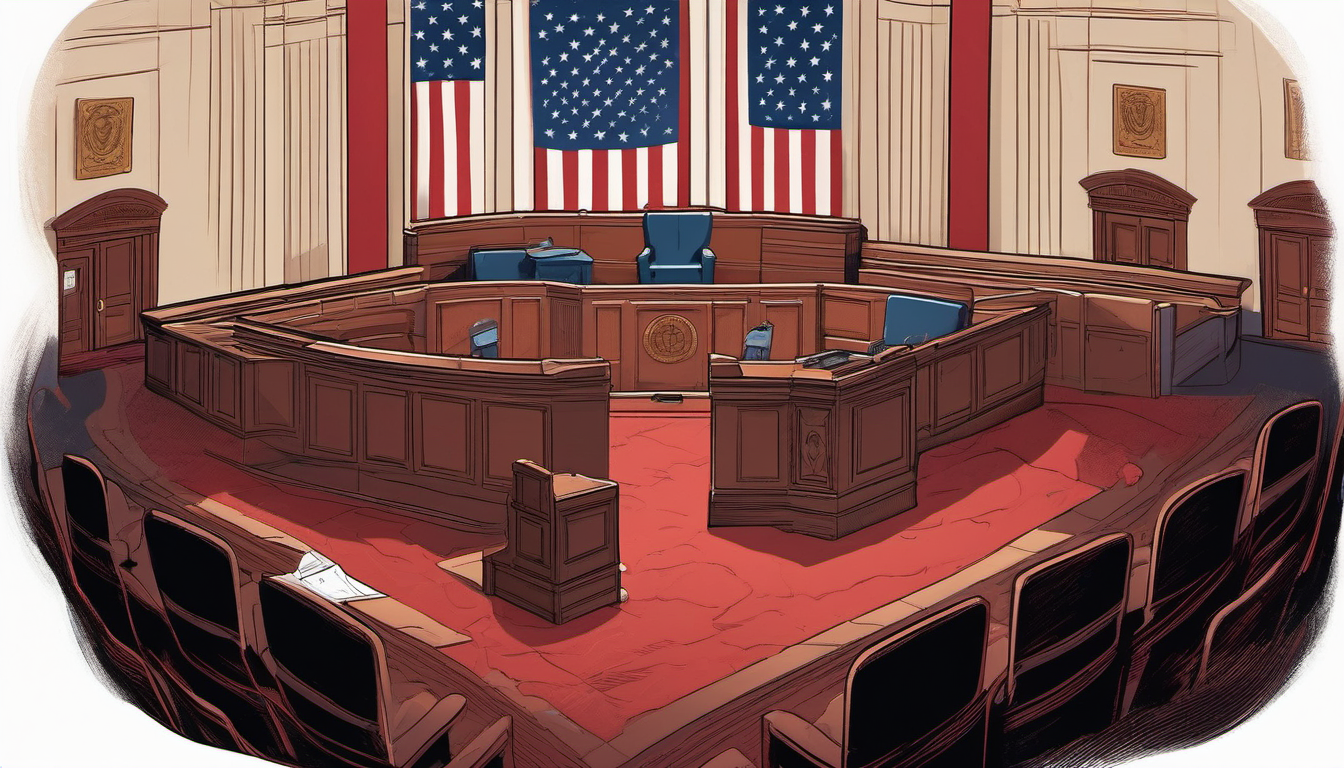
The 47-53 Senate vote on Iran marks the eighth consecutive failure of congressional war powers resolutions—and the quiet extinction of legislative control over American warfare
Executive Summary
- The U.S. Senate voted 47-53 on March 4 to reject a war powers resolution that would have forced President Trump to seek congressional authorization for the ongoing war with Iran—the eighth consecutive failure of such resolutions since June 2025.
- Only one Republican (Rand Paul) supported the measure, while one Democrat (John Fetterman) voted against it, revealing how partisan loyalty now trumps constitutional principle on questions of war and peace.
- With Defense Secretary Hegseth declaring operations are "accelerating, not decelerating" and ground troops explicitly not ruled out, the 1973 War Powers Resolution has been rendered functionally dead—completing a half-century erosion of Congress's most fundamental constitutional power.
Chapter 1: The Vote That Buried a Republic's Promise
On the evening of March 4, 2026, as American fighter jets struck targets across Iran for a fifth consecutive day and six U.S. service members lay dead, the United States Senate held what should have been the most consequential vote of the 119th Congress. Senator Tim Kaine of Virginia had introduced a war powers resolution directing "the removal of United States Armed Forces from hostilities within or against the Islamic Republic of Iran that have not been authorized by Congress."
The resolution failed 47-53, largely along party lines. The vote lasted approximately 15 minutes.
In those 15 minutes, the Senate effectively ratified a constitutional arrangement that the Founders would have found unrecognizable: a president waging open war against a nation of 90 million people, with no declaration of war, no congressional authorization, and no clear endpoint—while the legislature charged with deciding such matters voted to look the other way.
"If you don't have the guts to vote yes or no on a war vote, how dare you send our sons and daughters into war where they risk their lives," Kaine said before the vote. His words echoed through a chamber that had already decided not to listen.
Chapter 2: The Pattern of Abdication
The March 4 vote did not occur in isolation. It was the eighth war powers resolution Congress has voted on since June 2025—and all eight have failed. This pattern reveals something far more troubling than a single policy disagreement: it exposes the systematic collapse of legislative war-making authority.
| Date | Target | Senate Vote | Key Crossovers |
|---|---|---|---|
| June 2025 | Iran (3 nuclear sites) | ~45-55 | Paul (R) for; Fetterman (D) against |
| Jan 2026 | Venezuela (Maduro capture) | Advanced briefly | 4 GOP senators flipped, then retreated |
| Mar 4, 2026 | Iran (Operation Epic Fury) | 47-53 | Paul (R) for; Fetterman (D) against |
The Venezuela episode is particularly instructive. In January, four Republican senators initially supported a war powers resolution after the U.S. military captured former President Maduro. Trump publicly declared those four senators "should never be elected to office again." Two subsequently dropped their support, and the measure died. The message was unmistakable: cross the president on war powers, and face political destruction.
By the time the Iran vote arrived, potential Republican dissenters had been pre-disciplined. Only Rand Paul—whose libertarian brand depends on anti-war positioning—dared break ranks.
Chapter 3: The Constitutional Architecture of Surrender
The Founders were explicit. Article I, Section 8 of the Constitution grants Congress, not the president, the power "to declare War." James Madison wrote in 1793: "The constitution supposes, what the History of all Governments demonstrates, that the Executive is the branch of power most interested in war, and most prone to it. It has accordingly with studied care, vested the question of war in the Legislature."
The 1973 War Powers Resolution (WPR) was Congress's attempt to reassert this authority after Vietnam, requiring:
- Presidential consultation with Congress "in every possible instance" before deploying forces
- A 48-hour notification to Congress after deployment
- A 60-day limit on unauthorized engagements, with a 30-day withdrawal window
But as Secretary of State Rubio stated bluntly: "No presidential administration has ever accepted the War Powers Act as constitutional—not Republican presidents, not Democratic presidents."
This bipartisan presidential rejection has created a constitutional twilight zone. The law exists on paper but has never successfully constrained a president from military action. The 60-day clock is now ticking on Operation Epic Fury—but with six Americans dead and operations "accelerating," no one seriously expects Trump to withdraw forces at Day 60 without congressional approval.
Historical Precedents of Presidential War Without Congress
The pattern predates Trump:
- Korea (1950): Truman deployed forces without congressional authorization, calling it a "police action"
- Vietnam (1964-75): The Gulf of Tonkin Resolution provided thin legal cover for a decade of war
- Kosovo (1999): Clinton continued bombing after the House explicitly rejected authorization
- Libya (2011): Obama exceeded the 60-day WPR window, arguing the operation didn't constitute "hostilities"
- Syria/ISIS (2014-present): Obama and Trump used a 2001 AUMF—targeting al-Qaeda after 9/11—to justify operations against an entirely different organization in a different country
Each precedent expanded the executive's war-making space while Congress watched. Operation Epic Fury represents the logical endpoint: a full-scale air and naval war against a sovereign nation, with the president openly stating "it is not possible at this time to know the full scope and duration of military operations."
Chapter 4: The Fetterman-Paul Paradox
The two crossover votes reveal the strange political geometry of war powers in 2026.
John Fetterman (D-PA): The populist Democrat voted with Republicans to block the war powers resolution—the same position he took in June 2025. Fetterman has been the Democratic Party's most vocal supporter of Israel and has shown consistent willingness to back military action against Iran. His vote demonstrates that the war powers question has become entangled with the Israel-Palestine divide within the Democratic Party, making it impossible to build a clean pro-oversight coalition.
Rand Paul (R-KY): The libertarian Republican was the sole GOP vote for the resolution, consistent with his decades-long opposition to executive war-making. Paul had previously blocked Trump-era nominees over war powers concerns and filibustered drone strike authorities under Obama. But his isolation within his own party—one vote out of 53 Republicans—underscores how marginal the constitutional conservative position has become within the GOP.
The Fetterman-Paul paradox illustrates why war powers resolutions fail: the anti-war coalition is ideologically incoherent. Constitutional conservatives and progressive anti-war Democrats might agree on the principle of congressional authorization, but they disagree on everything else. This makes it impossible to sustain the political coalition needed to override a president during active hostilities.
Chapter 5: The Classified Briefing and the Information Asymmetry
Democrats emerged from a classified briefing on March 3 deeply unsettled. Senator Chris Murphy reported: "They told us in there that this is an open-ended operation that hasn't even really started in earnest yet. There will be more Americans killed. They refuse to take off the table the insertion of ground troops."
Senator Cory Booker added: "There clearly was no imminent threat."
This information asymmetry is structural. The executive branch controls intelligence, military planning, and the narrative of threat. By the time Congress receives classified briefings, operations are already underway, creating enormous political pressure to support the troops rather than question the mission. Voting against a war powers resolution becomes "supporting the troops"; voting for it becomes "undermining the commander-in-chief during wartime."
Defense Secretary Hegseth's language on March 4 was deliberately escalatory: "Iran's capabilities are evaporating by the hour, while American strength grows fiercer, smarter and utterly dominant. More bombers and more fighters are arriving just today." This rhetoric transforms the war powers debate from a constitutional question into a patriotism test.
Chapter 6: Scenario Analysis
Scenario A: Congressional Acquiescence (55%)
Congress continues to reject war powers resolutions. The 60-day WPR clock passes without consequence. The Iran conflict extends for weeks or months with no formal authorization, following the Kosovo/Libya precedent. The war powers framework becomes definitively dead letter.
Trigger conditions: Continued military success, limited U.S. casualties, public attention shifting to other crises
Historical parallel: Kosovo 1999, where Clinton exceeded the 60-day window and Congress simply accepted the fait accompli
Scenario B: Escalation Forces Congressional Action (30%)
Significant U.S. casualties, ground troop deployment, or a dramatic escalation (e.g., Hormuz closure causing economic crisis) shifts public opinion decisively against the war. Republican senators in competitive 2026 races face constituent pressure. A bipartisan coalition emerges to pass a war powers resolution—but Trump vetoes it, and the two-thirds override threshold proves impossible.
Trigger conditions: U.S. casualties exceeding 50, ground troop insertion, oil prices above $100/barrel, clear public opinion shift
Historical parallel: Vietnam-era congressional pushback, which took years to develop despite mounting casualties
Scenario C: Constitutional Confrontation (15%)
The SCOTUS IEEPA ruling from February—which established the "major questions" doctrine for executive power—creates a judicial pathway to challenge presidential war-making. A lawsuit challenges Operation Epic Fury's legality, and courts are forced to adjudicate war powers for the first time in a meaningful way. This would be unprecedented: courts have historically treated war powers as a "political question" beyond judicial review.
Trigger conditions: Legal challenge filed by members of Congress, a sympathetic court willing to hear the case, the IEEPA ruling providing doctrinal support
Historical parallel: No direct precedent—this would be constitutionally novel
Chapter 7: Investment Implications
The death of congressional war powers has concrete market implications:
Defense stocks: With no legislative brake on military operations, defense spending faces fewer constraints. The $1.5 trillion FY2027 Pentagon budget faces less opposition. Lockheed Martin, RTX, Northrop Grumman, and Anduril benefit from an executive branch unchecked by congressional oversight on operational decisions.
War premium persistence: Markets pricing in a "short war" scenario face the risk that open-ended authorization—or rather, the absence of any authorization requirement—means the conflict can extend indefinitely. Energy risk premiums should be priced for longer duration.
Governance discount: The combination of SCOTUS IEEPA (limiting tariff authority), Senate war powers failure (ceding military authority), and DHS shutdown (demonstrating legislative dysfunction) creates a composite governance risk. U.S. institutional credibility—already under strain—faces further erosion, supporting the dollar-weakening and gold-strengthening trends.
CBS News poll: Most Americans disapprove of the Iran war and believe the administration has not clearly explained its goals. About half expect the war to last months or years. This political vulnerability creates midterm election risk for defense-heavy portfolios if public opinion forces a policy reversal.
Conclusion
The 47-53 vote on March 4, 2026, will not be remembered as a close call. It will be remembered as the moment the American republic formally accepted that the power to make war belongs to the president alone.
The War Powers Resolution of 1973 was born from Vietnam's agony—an attempt to ensure that no president could again drag the nation into a prolonged conflict without the consent of the people's representatives. Fifty-three years later, that promise lies buried under eight consecutive failed votes, a politically disciplined majority, and a bipartisan presidential consensus that the law is merely advisory.
Senator Kaine promised to force more votes "in the coming weeks." He is performing constitutional CPR on a patient that has been dead for decades. The question is no longer whether Congress can reassert its war powers. The question is whether anyone still believes it should.
Leave a Reply