
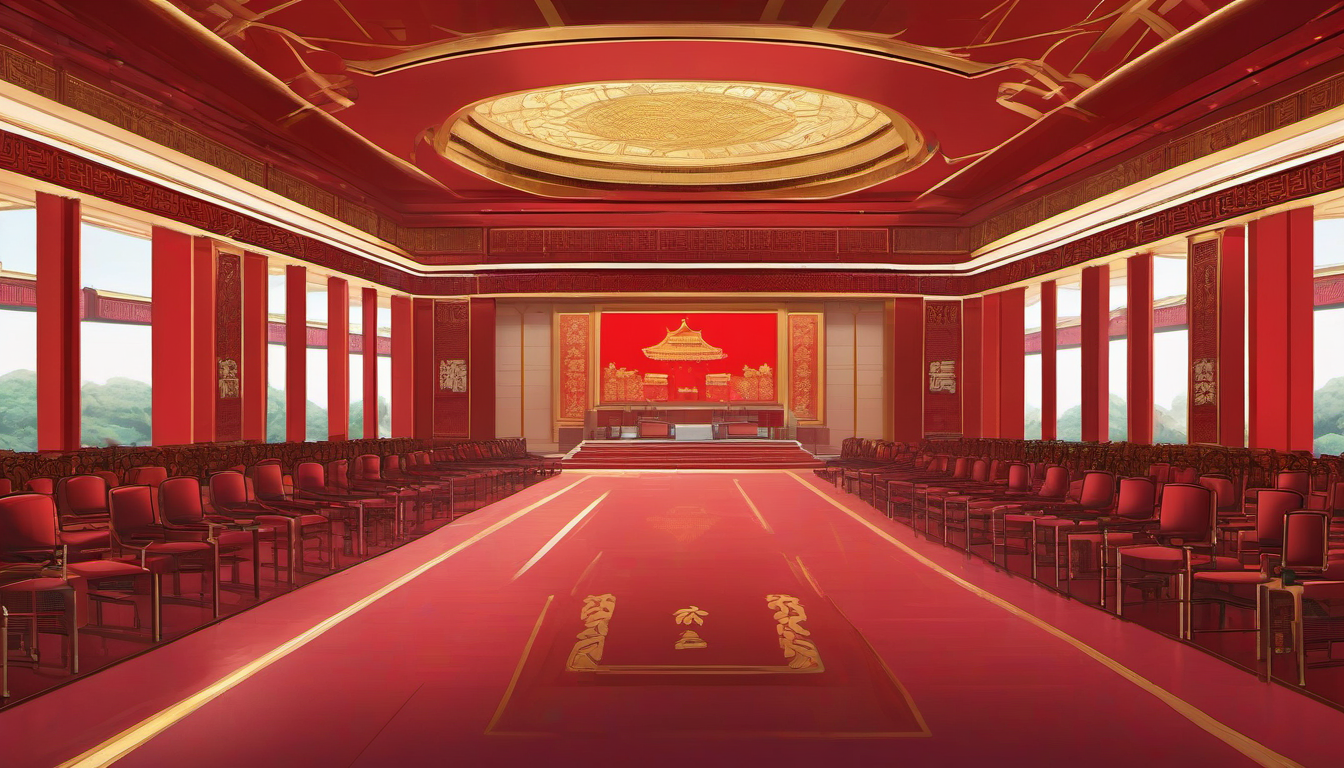
While the world burns, Beijing unveils its lowest growth target in 35 years — and calls it confidence
Executive Summary
- China's NPC opened March 5 with Premier Li Qiang announcing a GDP target of 4.5-5%, the lowest since 1991 and the first-ever range target, signaling a deliberate pivot from quantity to "high-quality growth"
- The 15th Five-Year Plan (2026-2030) shifts from defensive tech self-reliance to offensive deployment: AI integration across industry, semiconductor self-sufficiency acceleration, and "industries of the future" including quantum, fusion, and brain-computer interfaces
- Defense spending rises 7% to ¥1.91 trillion ($275 billion), but the real story is the 100+ military purges that have hollowed out the PLA's senior ranks — raising questions about whether China is building capability or merely consolidating loyalty
Chapter 1: The Lowest Bar in Three Decades
When Premier Li Qiang stepped to the podium at the Great Hall of the People on March 5, 2026, addressing nearly 3,000 delegates of the National People's Congress, the number that mattered most was not a record high but a record low.
China's GDP growth target for 2026: 4.5% to 5%.
This is the first time since 1991 that the target has fallen below 5%. It is also the first time Beijing has set a range rather than a single figure — a format Morgan Stanley analysts have noted China reserves "for periods of major economic stress." The previous three years all targeted "around 5%."
Yet Beijing is framing the lower target not as retreat but as strategic recalibration. Guo Shan, chief economist at Hutong Research, pointed out that China needs only 4.3% annual growth over the next decade to achieve its goal of becoming a "moderately developed country" by 2035. "After dealing with the US but still growing by 5% in 2025, Beijing has likely become more confident in setting and delivering China's growth target," Guo said.
The subtext is unmistakable: China is telling the world it no longer needs to chase headline growth numbers. It can afford to be patient.
| Metric | 2025 Target | 2026 Target | Change |
|---|---|---|---|
| GDP Growth | ~5% | 4.5-5% | First range target; lowest since 1991 |
| Urban Unemployment | 5.5% | 5.5% | Unchanged |
| New Urban Jobs | 12M+ | 12M+ | Unchanged |
| Budget Deficit | 4% GDP | 4% GDP | Record high maintained |
| Defense Spending | ¥1.78T | ¥1.91T ($275B) | +7% |
| Carbon Intensity Cut | — | -17% by 2030 | Below 18% pace needed |
Chapter 2: From Defense to Offense — The Technology Pivot
The 14th Five-Year Plan (2021-2025) was fundamentally defensive: survive US sanctions, reduce dependency on American chips, build alternative supply chains. The 15th is something different entirely.
"If the last Five-Year Plan's innovation policy was largely defensive, this one is much more proactive," said Yue Su, principal economist for China at the Economist Intelligence Unit. "Beijing appears to see the current wave of technological and industrial transformation as a historic opportunity to upgrade productivity."
The Communist Party's "recommendations" document, released last fall, called for "extraordinary measures" to achieve "decisive breakthroughs" in core technologies. The list of "industries of the future" reads like science fiction made policy: quantum technology, biomanufacturing, hydrogen and nuclear fusion power, brain-computer interfaces, embodied artificial intelligence, and 6G mobile communications.
But the crucial shift is from invention to deployment. China is no longer just trying to match Western technology — it is building the infrastructure to embed AI across its entire industrial machine. The concept of "new quality productive forces" (新质生产力), introduced by Xi Jinping in 2023, has now become the organizing principle of national economic strategy.
This is happening against a backdrop of genuine technological momentum. DeepSeek's AI models are competing with American frontrunners at a fraction of the cost. BYD has surpassed Tesla globally. Unitree's humanoid robots performed at the Spring Festival Gala. China's semiconductor equipment makers — NAURA, SMEE, AMEC — are rapidly climbing the value chain, with domestic equipment self-sufficiency reportedly targeting 70%.
The anti-involution (反内卷) policy is equally significant. China's State Administration for Market Regulation has moved to ban below-cost pricing in the auto industry, attempting to end the destructive price wars that hollowed out margins across entire sectors. The government work report explicitly addressed the need to shift from "relentless price competition" to quality and innovation.
Chapter 3: The War Window
The timing of the Two Sessions is extraordinary. China is unveiling its five-year economic blueprint while the Middle East burns.
Operation Epic Fury — the US-Israeli campaign against Iran that killed Ayatollah Khamenei and triggered Strait of Hormuz disruptions — has created both risks and opportunities for Beijing. China imported 13.4% of its seaborne crude from Iran before the conflict. The Hormuz bottleneck threatens energy security for an economy still 70% dependent on imported oil.
But the war has also handed China strategic leverage that no five-year plan could have engineered:
Energy buyer of last resort. As Western sanctions and war insurance collapse Gulf shipping, China's state-owned tankers and CIPS payment system become the only viable channel for sanctioned energy. Russia, now losing 65% of oil export revenue, is increasingly dependent on Chinese purchases at steep discounts. The war accelerates China's long-term goal of de-dollarizing energy trade.
Trade war truce. The US-China trade pause, agreed in October 2025, holds through March. Trump's expected visit to Beijing on March 31 means Washington cannot simultaneously wage war on Iran and escalate with China. Beijing is using this window to focus on domestic reform — precisely the "structural adjustment" that Dan Wang of Eurasia Group identified as the real purpose of the lower growth target.
Diplomatic capital. While the US destroys infrastructure in Iran and its allies debate participation, China can position itself as a voice for stability. Wang Yi's presence at the Two Sessions press conferences will likely emphasize multilateralism, development, and peaceful resolution — a sharp contrast to the images of burning refineries in Tehran.
Attention arbitrage. With global media fixated on the Middle East, China can advance sensitive initiatives — from the Ethnic Unity Law to military restructuring — with minimal international scrutiny.
Chapter 4: The Empty Chairs — Military Purge Continues
The CPPCC's standing committee voted last week to remove three more generals from its ranks. At least 19 delegates had their credentials revoked before the sessions began. These are the latest casualties of Xi Jinping's unprecedented military purge, which has swept away more than 100 senior officers since 2023.
The scale of the purge — the largest since the Cultural Revolution — raises uncomfortable questions about the People's Liberation Army's actual combat readiness. Xi has removed the commander and deputy commander of the Rocket Force, multiple generals involved in equipment procurement, and officers across all service branches.
The official justification is anti-corruption. The reality, according to William Yang of the International Crisis Group, is that "Xi is trying to ensure the Chinese Communist Party's governance system is run by absolute loyalty to him and that no one else has enough power base independent of him to potentially challenge his authority."
The defense budget increase of 7% to ¥1.91 trillion ($275 billion) — a slight deceleration from the 7.2% increase in 2025 — must be read against this backdrop. China is spending more on defense while simultaneously decapitating its military leadership. The 2027 PLA modernization deadline, widely interpreted as linked to Taiwan contingencies, looks increasingly strained by this internal upheaval.
Chapter 5: Scenario Analysis
Scenario A: Successful Rebalancing (35%)
China achieves 4.5-4.8% growth while genuinely shifting toward consumption-led development. Anti-involution policies stabilize margins, AI integration boosts productivity in manufacturing, and the trade truce with the US extends into a broader framework after the March 31 summit.
Rationale: China's 2025 GDP hit 5% despite trade war disruption, demonstrating genuine economic resilience. The EIU and Hutong Research assessments suggest Beijing has room to maneuver. Historical precedent: Japan's successful transition from high-growth to stable-growth economy in the 1970s-80s (before the bubble).
Trigger: Successful Trump-Xi summit producing a multi-year trade framework; property sector stabilization through targeted intervention; consumption subsidies generating genuine demand uplift.
Scenario B: Structural Stagnation (45%)
Growth achieves the target range but domestic demand remains weak. The Rhodium Group's assessment proves correct — fiscal spending generates declining returns as it flows through unproductive local government financing vehicles and zombie SOEs. The property sector continues to drag on household wealth. Blue-collar displacement from AI/automation offsets white-collar job creation.
Rationale: Logan Wright of Rhodium Group has documented the "declining payoff in terms of investment and economic activity for the same volume of lending or fiscal spending." China's household consumption remains stuck at 38% of GDP — well below the 60%+ in developed economies. The carbon intensity target shortfall (12% actual vs. 18% target in the 14th FYP) demonstrates the gap between aspiration and execution.
Trigger: Property prices continue declining in Tier 1 cities (S&P projects 10-14% further drops in 2026); consumer confidence fails to recover; trade truce collapses after Trump visit; Iran war disrupts energy supply chains.
Scenario C: External Shock Derailment (20%)
The Iran conflict escalates beyond containment, severing China's Middle Eastern energy supply. Hormuz closure forces emergency measures — rationing, SPR drawdowns, accelerated coal burning. Simultaneously, the US trade truce collapses, and PNTR revocation proceedings advance in Congress. China faces the nightmare scenario of simultaneous energy crisis and trade war.
Rationale: China's 13.4% Iranian oil dependence is significant but manageable; however, Hormuz handles 20% of global seaborne oil. A prolonged closure would drive prices above $100/barrel, adding 1-2 percentage points of inflation and forcing monetary tightening that undermines growth targets. Historical precedent: 1973 oil shock's impact on Japan's high-growth era.
Trigger: Hormuz closure exceeding 30 days; US-China trade truce collapse before March 31; OPEC+ unable to compensate supply loss; Chinese strategic petroleum reserves insufficient (estimated 80-90 days of imports).
Chapter 6: Investment Implications
Chinese tech self-reliance plays. The 15th FYP's emphasis on semiconductor equipment, AI deployment, and "industries of the future" channels massive state capital toward domestic champions. NAURA (北方华创), AMEC (中微公司), Cambricon (寒武纪), and autonomous driving firms are direct beneficiaries. However, the purge-driven uncertainty around military procurement creates headwinds for defense-adjacent tech.
Anti-involution winners. Companies with strong brand positioning and pricing power benefit from the end of destructive price wars. BYD's shift toward premium vehicles, Luckin Coffee's margin recovery, and firms in the "low-altitude economy" (drone logistics, urban air mobility) align with policy direction.
Energy hedging. China's acceleration of renewable deployment and nuclear construction is both climate policy and energy security strategy. The Iran war validates Beijing's long-term bet on energy independence. Solar, battery storage, and nuclear equipment manufacturers gain urgency.
Consumption skepticism. Despite policy rhetoric, the structural barriers to consumption-led growth remain formidable: property wealth destruction, social safety net gaps, and the demographic drag of a shrinking working-age population. Investors should demand evidence of genuine household income growth before rotating into domestic consumption plays.
Currency dynamics. The lower growth target and maintained 4% deficit suggest continued fiscal expansion. Combined with dollar weakness from US institutional crises (DHS shutdown, IEEPA ruling, war spending), the yuan could strengthen modestly — supporting capital inflows but pressuring export competitiveness.
Conclusion
China's 15th Five-Year Plan is less a plan than a positioning statement. By setting the lowest growth target in 35 years, Beijing is telling markets it values resilience over velocity. By pivoting from defensive tech self-reliance to offensive industrial transformation, it is betting that the next five years will determine whether China becomes a technological peer of the United States or remains permanently behind.
The Iran war has created an accidental stress test for this strategy. If China can navigate the energy disruption, maintain the trade truce, and deploy AI at industrial scale — all while the United States is simultaneously fighting a Middle Eastern war, managing a government shutdown, and processing a Supreme Court ruling that upended its tariff regime — Beijing's long game may prove vindicated.
But the empty chairs at the Great Hall of the People are a reminder that Xi's China is building its future on a foundation of political purges and enforced loyalty. History suggests that systems optimized for control eventually sacrifice the adaptability they need most.
The question is not whether China's economy can grow at 4.5%. It is whether a system that removes 100 generals in three years can produce the innovation it promises.
Sources: Guardian, Al Jazeera, CNN, CNBC, Reuters, Eurasia Group, Rhodium Group, Economist Intelligence Unit, Asia Society Policy Institute, Hutong Research, Morgan Stanley
Leave a Reply