
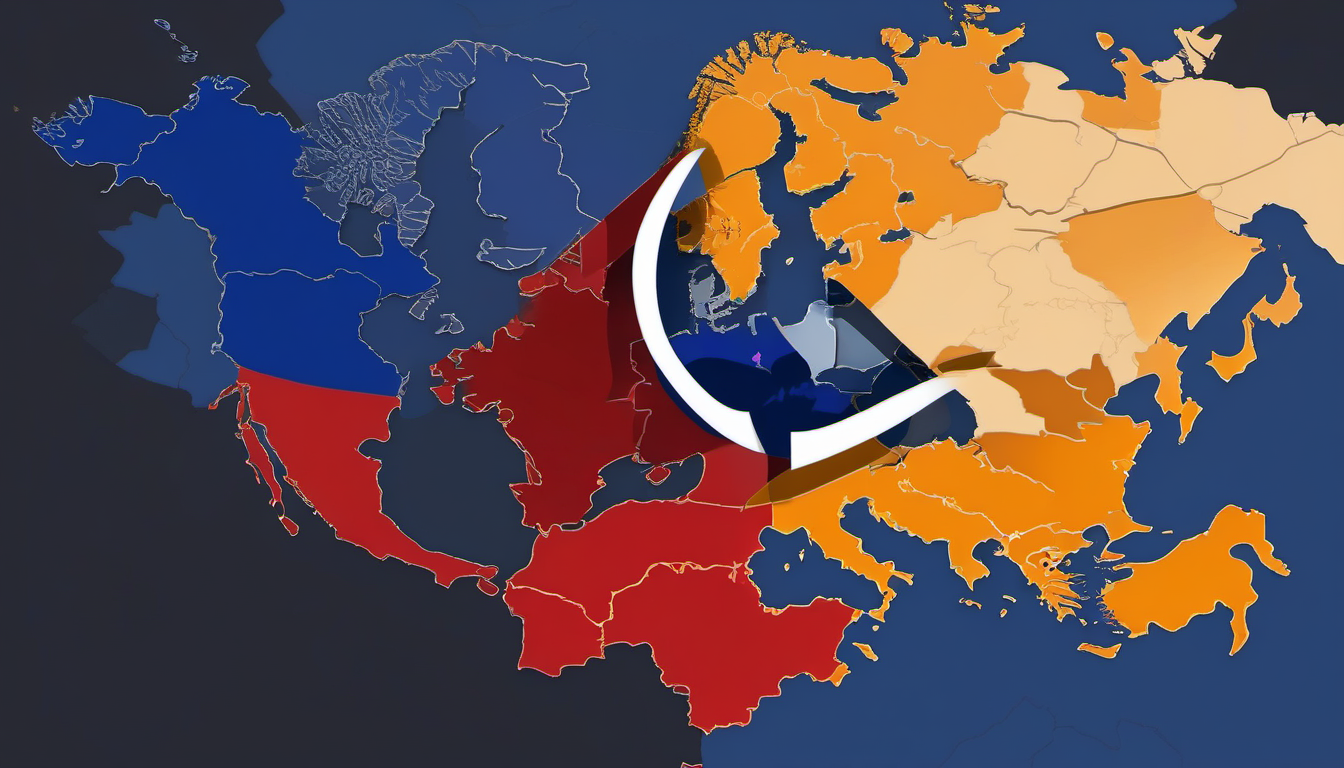
How America's war is splitting the Western alliance into three camps — and why Trump is using trade as a weapon to enforce loyalty
Executive Summary
- NATO has fractured into three distinct tiers over Operation Epic Fury: Germany actively supporting, UK/France offering limited "defensive" assistance, and Spain openly defying Washington — a split unprecedented since the 2003 Iraq War.
- Trump is weaponizing trade to punish dissent within the alliance, threatening to "cut off all trade with Spain" during an Oval Office meeting with German Chancellor Merz on March 3 — the first time a US president has openly threatened a full trade embargo against a NATO ally.
- The fracture exposes a fundamental contradiction in Europe's security architecture: the continent cannot simultaneously depend on American security guarantees, pursue strategic autonomy, and disagree with American wars — a trilemma that the Iran conflict has made impossible to ignore.
Chapter 1: The Oval Office Ultimatum
On March 3, 2026 — Day 4 of Operation Epic Fury — German Chancellor Friedrich Merz sat in the Oval Office facing Donald Trump. The meeting had been planned long before the first bombs fell on Iran, originally meant to discuss trade, Ukraine, and Merz's new €550 billion rearmament agenda. Instead, the Iran war consumed the agenda entirely.
What emerged was a live broadcast of NATO's internal fracture. Trump, flanked by Vice President Vance, Secretary of State Rubio, and Defense Secretary Hegseth, used the press availability to publicly shame allies who refused to join the coalition.
"Spain has been terrible," Trump told reporters. "Unfriendly. We're going to cut off all trade with Spain. We don't want anything to do with Spain." He then turned to Treasury Secretary Bessent, who confirmed on the spot that the Supreme Court's recent IEEPA ruling "reaffirmed your ability to implement an embargo."
The scene was extraordinary: a sitting US president, hosting one NATO ally, publicly threatening to economically destroy another NATO ally — all because of disagreements over a third country's war. Trump went further, claiming he could simply "fly in and use" Spain's Rota and Morón bases without permission. "Nobody's going to tell us not to use it," he said.
Merz, sitting beside Trump, did not defend Spain. Instead, he affirmed Trump's criticism: "We are trying to convince them that this is a part of our common security, that we all have to comply with this." Germany had clearly chosen its side.
Chapter 2: The Three Tiers of Europe
The Iran war has sorted European allies into three distinct camps, each with its own logic, risks, and strategic calculations.
Tier 1: The Willing — Germany, Poland, the Nordics
Germany, under Merz's new government, has positioned itself as America's most reliable European partner. Berlin's support for the Iran campaign is inseparable from its broader strategic calculation: it needs Trump's goodwill on Ukraine, trade, and the new €550 billion defense spending package. Merz told Trump they were "on the same page" on Iran and regime change.
This marks a historic shift. Germany, which refused to join the 2003 Iraq coalition under Schröder, is now America's chief European cheerleader. The difference: Merz is a conservative Atlanticist who sees alignment with Washington as Germany's path to strategic relevance in a dangerous world.
Poland and the Nordic states have similarly rallied to the US position, consistent with their instinctive Atlanticism forged during decades of Russian threat. For these nations, the calculus is simple: challenging American leadership on Iran risks American commitment to their own security.
Tier 2: The Hedgers — UK, France, E3
Britain and France occupy the uncomfortable middle ground. The UK has agreed to allow US use of two military bases in Cyprus for "defensive" strikes on Iranian missile sites, but Keir Starmer has resisted broader participation. Trump publicly criticized this as insufficient: "Some of the European nations have been helpful. Some have not. The UK has not been particularly helpful."
France is threading an even finer needle. Macron's March 3 nuclear doctrine speech — announcing France's first nuclear warhead increase in 30 years — was partly a response to the Iran crisis, positioning France as Europe's independent security guarantor. Yet France stopped short of questioning the legality of the US-Israeli strikes.
The E3 (UK, France, Germany) managed a joint statement warning Iran they were ready for "defensive action" to destroy its missile capabilities. But the word "defensive" was doing enormous heavy lifting — an attempt to participate without fully endorsing the offensive campaign.
Tier 3: The Defiant — Spain
Spain stands alone as the only major NATO member openly defying Washington. Prime Minister Pedro Sánchez declared on social media: "One can be against a hateful regime, as is the case with the Iranian regime, and at the same time be against an unjustified, dangerous military intervention outside of international law."
Spain's Foreign Minister Albares announced that US forces could not use the jointly operated bases at Rota and Morón for strikes not covered by the UN Charter. US aircraft were ordered to leave Spain on Monday. Madrid is also the only NATO member that refused the 5% GDP defense spending target Trump pushed last year, committing only to 2.1%.
Spain's position is legally coherent but strategically perilous. As Trump's trade embargo threat demonstrates, there is a price for principled dissent within the alliance.
Chapter 3: The EU's Impossible Voice
If NATO's fracture is a crack, the European Union's response is a shattered mirror.
The EU's foreign policy chief, Kaja Kallas, posted a stream of tweets conspicuously avoiding any questioning of the legality of US-Israeli strikes. EU foreign ministers issued a statement that stopped short of advocating regime change in Iran. But then European Commission President Ursula von der Leyen undercut the ministers entirely, posting that "a credible transition in Iran is urgently needed" — effectively endorsing regime change in a personal capacity.
This was, as the BBC's Katya Adler put it, "hardly a show of speaking with one voice."
The structural problem is that EU foreign policy requires unanimity among 27 member states. Spain's opposition alone is enough to prevent any unified EU position supporting the war effort. But the EU cannot take a unified position against it either, because Germany, Poland, and the Nordics support it.
The result is paralysis — the worst possible outcome for European credibility. Neither supporting nor opposing, neither relevant nor irrelevant, Europe is simply absent from the most consequential Middle Eastern conflict since 2003.
Chapter 4: Historical Parallels — Iraq 2003 and Beyond
| Factor | Iraq 2003 | Iran 2026 |
|---|---|---|
| US coalition demand | Join invasion or stay silent | Join strikes or face trade embargo |
| European dissenters | France, Germany, Belgium | Spain (primarily) |
| US retaliation | "Freedom Fries," diplomatic freeze | Full trade embargo threat, base seizure threat |
| Economic weapon | None (rhetorical only) | Explicit: "cut off all trade" |
| NATO article invoked | None | None (Article 5 not applicable) |
| UNSC authorization | None | None |
| Key EU split | Old Europe vs. New Europe | Atlantic Europe vs. Mediterranean Europe |
The 2003 Iraq War saw France and Germany oppose the US, with Rumsfeld dismissing them as "Old Europe." But there was a critical difference: the Bush administration never threatened economic warfare against NATO allies. The diplomatic freeze was real but informal.
Trump's 2026 approach is qualitatively different. He is explicitly threatening a full trade embargo — a sovereign nation's most extreme economic tool short of sanctions — against an ally within the same military alliance. Moreover, his claim that the Supreme Court's IEEPA ruling grants embargo authority represents a novel legal theory that would transform trade into a permanent coercion tool against allies.
The 1956 Suez Crisis offers a closer parallel. When Britain and France attacked Egypt without American approval, Eisenhower used financial pressure — threatening to crash the pound sterling — to force a withdrawal. In 2026, the dynamic is inverted: America is the attacker, and it is using financial threats to force allies to join, not to withdraw.
Chapter 5: Scenario Analysis
Scenario A: Managed Fracture (45%)
Description: The three-tier structure holds but does not deepen. Spain endures rhetorical abuse but no actual trade embargo (EU treaty complications make it legally impractical). UK/France maintain "defensive" participation. NATO continues to function for its core mission (territorial defense) while accepting disagreement on out-of-area operations.
Rationale: This is the most likely outcome because Trump's trade embargo threat faces enormous legal obstacles. Spain trades within the EU single market, and the US-EU trade deal signed in Scotland in 2025 would need to be renegotiated to exclude one member state — something the European Commission has already said it will block. Historical precedent suggests Trump's trade threats often exceed actual implementation (Canada, Mexico, EU all received similar threats that were later modified). The 45% probability reflects the strong institutional inertia that prevents NATO from formally splitting.
Trigger conditions: EU Commission firmly blocks selective trade action; Spain makes minor face-saving gesture (e.g., humanitarian contribution); Iran conflict ends within 4-6 weeks as Trump indicated.
Scenario B: Coerced Alignment (30%)
Description: Trump's pressure succeeds. Spain makes concessions (allowing base overflight, increasing defense spending commitment), UK expands beyond "defensive" operations. Europe effectively falls in line, as it did with the 2025 defense spending ramp-up.
Rationale: The 30% probability reflects Trump's demonstrated ability to force European compliance through sustained pressure. The Scotland trade deal gives Washington leverage — a 25% automobile tariff threat alone would devastate Spain's auto industry (Spain is Europe's second-largest car manufacturer). Merz's willingness to side with Trump against Spain signals that Germany will not protect dissenters. Historical frequency: in 7 of 10 post-Cold War US coalition-building efforts, initially reluctant European allies eventually joined in some capacity.
Trigger conditions: US implements targeted tariffs on Spanish goods; EU fails to present unified counter-response; UK opposition pressures Starmer to increase participation.
Scenario C: Alliance Rupture (25%)
Description: The fracture deepens into a structural crisis. Spain is effectively expelled from meaningful NATO participation. Other Mediterranean states (Portugal, Italy, Greece) face pressure to choose sides. The US-EU Scotland trade deal collapses. Europe accelerates strategic autonomy initiatives, with France's nuclear umbrella offer becoming the nucleus of an alternative security architecture.
Rationale: While 25% may seem high, this scenario accounts for the unprecedented nature of Trump's threats. No prior US president has threatened a full trade embargo against a NATO ally. If Trump follows through — even partially — it sets a precedent that alliance membership offers no protection against American economic coercion. This would validate Macron's long-standing argument that Europe needs independent defense capacity. The probability is constrained by the fact that a true rupture would damage American interests (loss of Mediterranean basing, intelligence sharing, and naval access).
Trigger conditions: Trump implements actual embargo measures; SCOTUS upholds expanded IEEPA authority for ally trade restrictions; Spain retaliates by expelling US forces from Rota/Morón; other EU states rally behind Spain in solidarity.
Chapter 6: Investment Implications
Defense Sector
The fracture accelerates European defense spending regardless of which scenario plays out. Germany's €550 billion package is already committed. France's nuclear expansion adds demand. Even in the "managed fracture" scenario, every European nation now has political cover to increase defense budgets. Rheinmetall (RHM.DE), Thales (HO.PA), Leonardo (LDOF.MI), BAE Systems (BA.L) remain structurally favored.
European Equities
Spain's IBEX 35 faces near-term risk from the embargo threat, though actual implementation probability is low. Spanish auto manufacturers (SEAT/Cupra parent VW, Renault Spain operations) and agricultural exporters (olive oil, wine) are most exposed. The broader Euro Stoxx 50 faces uncertainty from the trade deal question.
Currency
EUR/USD faces pressure from both the war premium (dollar strength) and the intra-European political crisis. The euro's structural weakness is amplified when the EU cannot present a unified foreign policy position. GBP/USD similarly pressured by UK's uncomfortable middle position.
Energy
The European gas price surge (worst since 2022) is partly a function of the alliance fracture — markets price in the possibility that coordination failures could worsen the energy crisis response. European utilities and energy importers face elevated hedging costs.
Safe Havens
Gold, US Treasuries, and the Swiss franc continue to benefit. The alliance fracture adds a layer of geopolitical risk premium beyond the direct war impact.
Conclusion
The Iran war has produced something the Cold War, the Balkans, Afghanistan, Iraq, and Libya never achieved: a US president publicly threatening to economically destroy a NATO ally for refusing to join a war. Trump's Oval Office performance on March 3 was not merely diplomatic theater — it was a live demonstration of a new transatlantic paradigm in which alliance membership is conditional on operational compliance.
For Europe, the trilemma is now explicit. It cannot simultaneously depend on American security guarantees, exercise independent foreign policy judgment, and avoid American economic punishment. Two of those three are possible. All three are not.
The question is which one Europe chooses to abandon — and whether the answer will be the same across all 27 EU member states. Based on current trajectories, it will not be. And that, more than any Iranian missile or American bomb, may be the most consequential outcome of Operation Epic Fury for the Western alliance.
Leave a Reply