
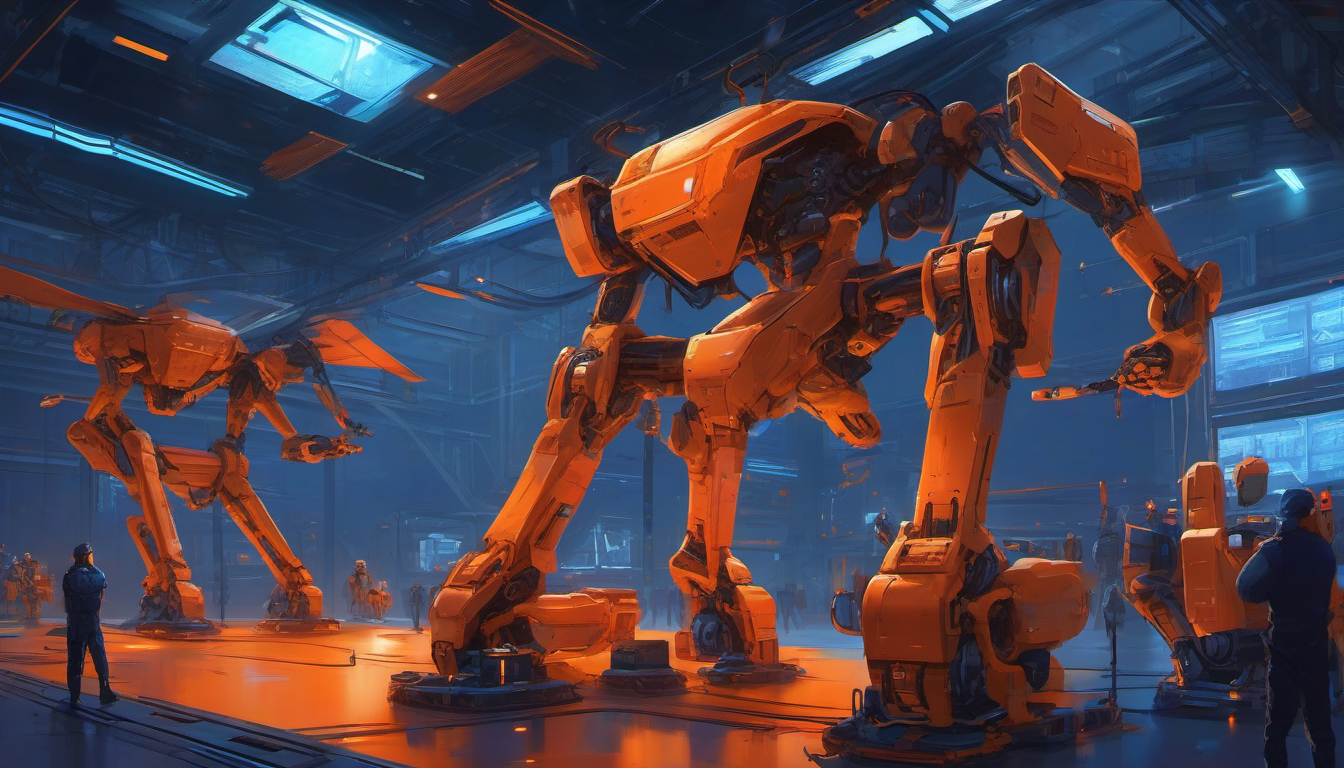
Anduril's $60 billion ascent, Anthropic's blacklisting, and the trillion-dollar question of who builds America's AI war machine
Executive Summary
- Anduril Industries is raising up to $8 billion at a $60 billion valuation — doubling in nine months — as the Iran war validates its autonomous weapons thesis and positions it as the first serious Silicon Valley challenger to legacy defense primes.
- The Trump administration's unprecedented "supply chain risk" designation of Anthropic has created a political loyalty test for tech companies seeking Pentagon contracts, splitting Silicon Valley into compliant insiders and exiled dissenters.
- A structural realignment of the $886 billion U.S. defense budget is underway: software-native firms like Anduril, Palantir, and OpenAI are capturing market share from Lockheed Martin and Raytheon, with war-driven urgency accelerating a transition that might otherwise have taken a decade.
Chapter 1: The $60 Billion Startup
Nine months ago, Anduril Industries closed its Series G at a $30.5 billion valuation, raising $2.5 billion led by Founders Fund. That was June 2025 — before Operation Epic Fury, before Hormuz, before the world changed.
Now Thrive Capital and Andreessen Horowitz are co-leading a new round that could bring $8 billion into the company at a valuation approaching $60 billion. Lux Capital and Founders Fund are also participating. Secondary market shares are trading at a 128.7% premium to the Series G price. Revenue doubled from roughly $1 billion in 2024 to $2 billion in 2025, and an IPO — potentially one of the largest tech listings of 2026 — is widely anticipated.
Palmer Luckey, the 33-year-old founder who once built Oculus Rift in his parents' garage, is now building what the company calls "Arsenal" factories — hyperscale manufacturing facilities designed to produce autonomous weapons systems at volumes and speeds that legacy contractors cannot match. The first Arsenal facility in Ohio is designed to produce advanced drones, missiles, and autonomous platforms faster than near-peer adversaries like China.
The timing is not coincidental. Operation Epic Fury has placed Anduril's core products — autonomous drones, AI-powered sensor networks, and software-defined command systems — at the center of real combat operations. The company's Lattice operating system, which fuses sensor data across domains, is being used by U.S. Central Command to coordinate over 50,000 troops, 200 fighter aircraft, and two carrier strike groups across the Persian Gulf theater.
For context: Lockheed Martin, the world's largest defense contractor, has a market capitalization of approximately $130 billion. Raytheon sits at roughly $150 billion. A $60 billion private valuation for a company with $2 billion in revenue — a 30x revenue multiple — implies that investors see Anduril not as a niche startup but as a future prime contractor capable of capturing a significant share of the $886 billion U.S. defense budget.
| Metric | Anduril (2026) | Lockheed Martin | Raytheon | Palantir |
|---|---|---|---|---|
| Valuation/Market Cap | ~$60B (private) | ~$130B | ~$150B | ~$250B |
| Revenue | ~$2B | ~$68B | ~$75B | ~$4.5B |
| Revenue Multiple | ~30x | ~1.9x | ~2x | ~55x |
| Founded | 2017 | 1926 | 1922 | 2003 |
| Employees | ~4,000 | ~122,000 | ~182,000 | ~4,000 |
The gap between Anduril's revenue and its valuation tells the story: investors are pricing in a future where software-native defense firms absorb an outsized share of military spending, much as SaaS companies displaced legacy enterprise software over the past decade.
Chapter 2: The Anthropic Purge — A Political Loyalty Test
On February 27, 2026, President Trump ordered all federal agencies to cease using Anthropic's AI products. Defense Secretary Pete Hegseth designated the company a "supply chain risk" — an extraordinary measure previously reserved for entities like Huawei and Kaspersky Lab. The $200 million Pentagon contract that triggered the dispute was cancelled.
The dispute centered on autonomous weapons. Anthropic had insisted on explicit contractual language prohibiting its AI models from being used for mass surveillance of U.S. citizens or deployed in lethal autonomous weapons systems. The Pentagon refused to accept these restrictions.
What happened next revealed the new rules of engagement between Silicon Valley and Washington. OpenAI — Anthropic's principal rival — swooped in to secure the contract within 48 hours. CEO Sam Altman announced that OpenAI's agreement contained the same two limitations Anthropic had sought, but framed differently: rather than explicit contractual prohibitions, OpenAI agreed that the Pentagon could use its technology for "any lawful purpose" while building technical safeguards into the models themselves.
The distinction is legally significant. Anthropic tried to constrain the government through contract law. OpenAI constrained itself through engineering, while giving the government contractual freedom. The Pentagon chose the company that said "yes" with caveats over the company that said "only if."
But the real weapon was Hegseth's supply chain risk designation. His interpretation — that "no contractor, supplier, or partner that does business with the United States military may conduct any commercial activity with Anthropic" — threatened to cut the company off not just from government revenue but from its entire enterprise customer base. Many of Anthropic's largest commercial clients, from defense contractors to consulting firms, also hold Pentagon contracts. If forced to choose between Anthropic and the Department of Defense, the choice is obvious.
Anthropic, reportedly on track for $18 billion in annual revenue, can survive the loss of $200 million in government contracts. It cannot survive being treated as a corporate pariah by the entire defense-adjacent economy.
Luckey's response was revealing. "At the end of the day," he wrote on X, "you have to believe that our imperfect constitutional republic is still good enough to run a country without outsourcing the real levers of power to billionaires and corpos and their shadow advisors." Coming from a billionaire whose company builds autonomous weapons, the irony was not lost on observers — but it correctly identified the new political calculus: in wartime, the government demands compliance, not conditions.
Chapter 3: The New Military-Industrial Complex
The Anthropic blacklisting did not occur in isolation. It accelerated a broader consolidation of defense AI around a small number of politically aligned firms.
Palantir Technologies has emerged as the primary beneficiary. After the Anthropic designation, the Department of Defense concentrated more national security AI work with Palantir, whose $448 million ShipOS contract and deepening role in Operation Epic Fury planning have made it indispensable. Its stock price bounced on the war, and its $250 billion market capitalization — at roughly 55x revenue — reflects the same bet investors are making on Anduril: that software-native firms will capture disproportionate value in 21st-century defense.
OpenAI traded ethical purity for market access, securing the Pentagon contract that Anthropic lost. The deal includes a third red line beyond surveillance and autonomous weapons — a ban on "social credit" style automated decision systems — and retains technical controls. But the fundamental compromise was made: OpenAI will work within the government's framework rather than demanding the government work within its own.
Legacy primes face a different kind of threat. Lockheed Martin, Raytheon, Northrop Grumman, General Dynamics, and Boeing — the "Big Five" that have dominated U.S. defense procurement for decades — still command the overwhelming majority of contract dollars. But their model is under siege. These firms operate on decade-long procurement cycles, cost-plus contracts, and hardware-centric architectures. Anduril ships software updates in weeks. The Pentagon's new Replicator initiative, which aims to field thousands of autonomous systems within 18-24 months, is designed around startup-speed iteration, not legacy-prime timelines.
The Iran war is accelerating this transition. When Operation Epic Fury required rapid integration of autonomous drones, AI-powered sensor fusion, and real-time command software across a multi-domain battlespace spanning seven countries, the systems that delivered were built by companies founded in the 21st century — not the 20th.
Chapter 4: Scenario Analysis
Scenario A: Defense Tech Supercycle (45%)
Thesis: The Iran war, European rearmament (Germany's €550 billion program), and escalating U.S.-China competition drive a sustained multi-year increase in global defense spending, with software-native firms capturing 15-25% of new spending.
Evidence:
- Global defense spending reached $2.4 trillion in 2025, with NATO members committing to 3.5% GDP targets
- Germany's debt-brake exemption for €550 billion in defense spending over four years is the largest European rearmament since the Cold War
- Anduril's Arsenal factories are designed for mass production of autonomous systems, potentially at 10x the unit cost advantage of legacy programs
- Palantir's government revenue grew 40%+ YoY in FY2025
Historical precedent: The post-9/11 defense boom (2001-2011) saw U.S. defense spending roughly double from $316 billion to $700 billion. New entrants like Palantir and L3 Technologies captured significant market share. The current environment combines wartime urgency with technological disruption — a more potent combination.
Trigger conditions: Continued Iran conflict beyond 30 days; European defense budgets materialize as committed; Anduril IPO validates public market appetite.
Scenario B: Political Backlash and Regulatory Correction (30%)
Thesis: The Anthropic blacklisting provokes a broader backlash against politicized defense procurement, either through Congressional action, court challenges, or a change in administration.
Evidence:
- Anthropic has argued Hegseth lacks statutory authority for the supply chain designation's scope
- Numerous OpenAI employees signed an open letter supporting Anthropic's position
- The precedent of weaponizing procurement rules against companies for policy disagreements could chill private sector innovation
- The 2003 DARPA FutureMAP cancellation showed public backlash can reverse defense-tech initiatives
Historical precedent: The Eisenhower-era military-industrial complex warnings led to procurement reform cycles roughly every 15-20 years. The last major cycle (Goldwater-Nichols, 1986) restructured civilian-military relationships.
Trigger conditions: Federal court injunction on the supply chain designation; Congressional hearings on defense AI procurement; Anthropic commercial revenue proves resilient despite designation.
Scenario C: Winner-Take-All Consolidation (25%)
Thesis: Anduril, Palantir, and OpenAI form an oligopoly over defense AI, marginalizing both legacy primes (on technology) and non-compliant startups (on politics), creating a new form of concentrated power.
Evidence:
- Anduril + Palantir + OpenAI collectively represent the primary AI capabilities available to the Pentagon after the Anthropic exclusion
- Network effects in defense AI (training data, security clearances, integration) create high barriers to entry
- Venture capital is flooding into compliant defense-tech startups while avoiding "AI safety" companies perceived as regulatory risks
- Luckey's Arsenal factories, if successful, combine software advantages with hardware manufacturing scale
Historical precedent: The 1990s defense industry consolidation — encouraged by then-Defense Secretary William Perry at the famous "Last Supper" dinner — reduced dozens of prime contractors to five. A similar dynamic could play out in defense AI, with political alignment replacing industrial capacity as the primary selection criterion.
Trigger conditions: Anduril IPO at $60B+ triggers FOMO capital flows; more AI companies accept Pentagon terms to avoid Anthropic's fate; legacy primes acquire defense-tech startups rather than build internally.
Chapter 5: Investment Implications
Defense-tech venture capital is experiencing unprecedented inflows. Anduril's $8 billion raise signals that late-stage defense-tech investing has become mainstream for generalist funds like Thrive Capital. Expect follow-on effects across the defense-tech startup ecosystem (Shield AI, Rebellion Defense, Epirus, Saildrone).
Public market proxies:
- Palantir (PLTR): Primary public market beneficiary of the defense AI concentration. The Anthropic ban and Iran war have strengthened its moat. However, the 55x revenue multiple already prices in significant growth.
- Anduril IPO watch: If 2026 brings an IPO at $60B+, it would be the largest defense-tech listing in history, potentially rerating the entire sector.
- Legacy primes at risk: Lockheed Martin (LMT), Raytheon (RTX), and Northrop Grumman (NOC) trade at 1.5-2x revenue. If investors conclude that software margins (60-80%) will displace hardware margins (10-15%) in future defense spending, multiples could compress further.
- Anthropic contagion: AI companies perceived as "safety-first" may face valuation pressure if the Anthropic precedent discourages enterprise customers from relying on firms that might clash with government clients.
The broader dynamic: The defense sector is undergoing the same software-eats-everything transition that transformed finance, transportation, and media. The difference is that this transition is happening under wartime conditions, with political loyalty as a gating factor. Investors who recognized this shift early — buying Palantir at its 2023 lows or participating in Anduril's Series F — have captured extraordinary returns. The question now is whether a $60 billion Anduril and a $250 billion Palantir still offer asymmetric upside, or whether the defense-tech trade has become consensus.
Conclusion
Palmer Luckey once built a virtual reality headset in a garage. Now he is building the autonomous weapons factories that may define 21st-century warfare. The $60 billion valuation is not just a number — it is a verdict on the future of the military-industrial complex.
The Iran war has done what decades of Pentagon reform efforts could not: it has created wartime urgency to adopt software-native defense systems at scale. Simultaneously, the Anthropic blacklisting has established a new political rule — companies that set conditions on how their technology is used by the military risk exile. Those that comply, prosper.
This is not the military-industrial complex Eisenhower warned about. It is something newer and potentially more powerful: a military-technological complex where a handful of politically aligned AI firms control the cognitive infrastructure of warfare, while venture capital provides the financing that defense budgets alone cannot.
Whether this concentration of power in few hands strengthens or endangers democratic governance is the trillion-dollar question. Markets, for now, have answered with their wallets. The $60 billion bet is on.
Disclaimer: This analysis is for informational purposes only and does not constitute investment advice.
Leave a Reply