
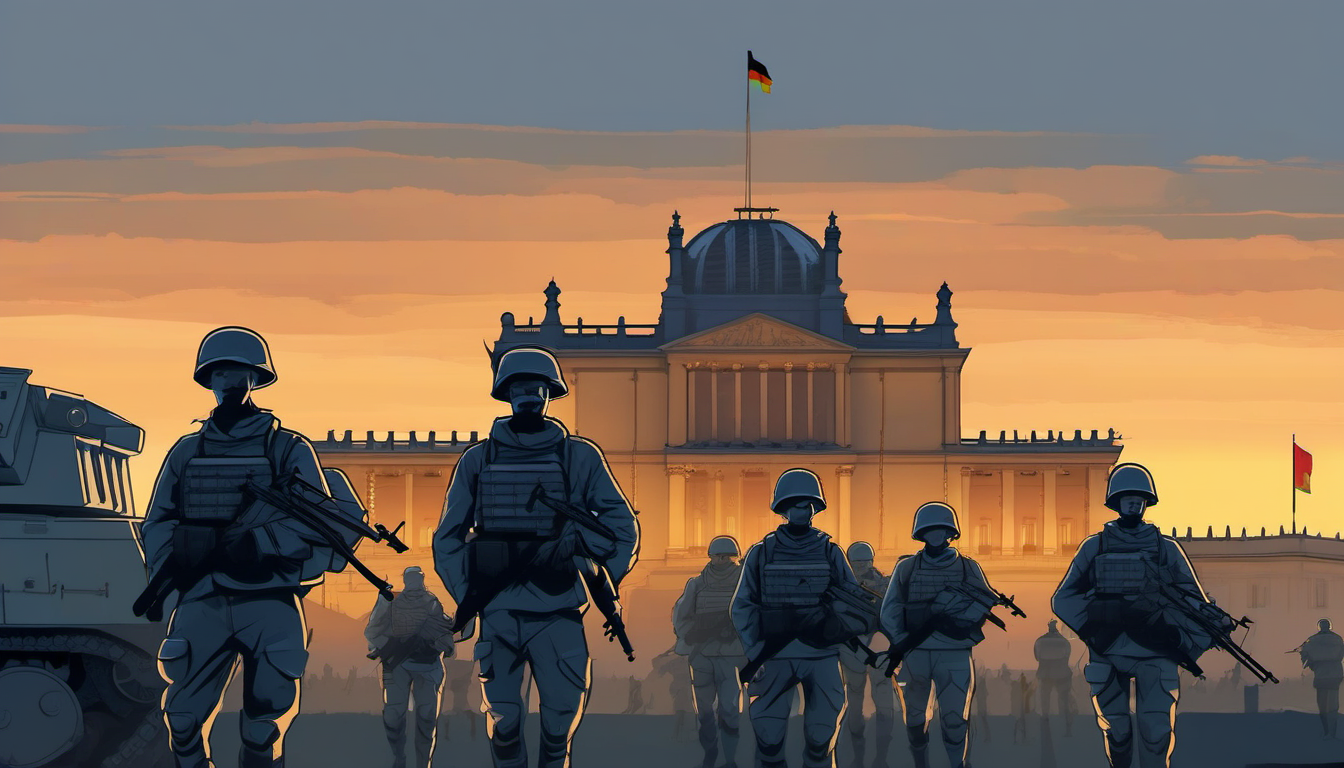
Chancellor Merz's drive to build Europe's largest conventional army is triggering a power shift that alarms Paris, Warsaw, and Rome alike
Executive Summary
- Germany will spend an estimated €550 billion on defense from 2026–2029, more than France and Britain combined on conventional forces, fundamentally reshaping the European military balance for the first time since reunification.
- The debt brake exemption for defense spending gives Berlin unlimited fiscal headroom that debt-burdened France, Italy, and the UK simply cannot match — creating a structural imbalance that could persist for decades.
- The Iran war and American disengagement have accelerated this transformation, but the real question isn't whether Germany rearms — it's whether it rearms for Europe or for Germany, and whether a future AfD-influenced government could redirect this military machine.
Chapter 1: The Scale of the Transformation
Germany's defense budget in 2026 stands at approximately $127 billion — by far the largest in Europe. Britain trails at $84 billion, France at $70 billion. By 2029, when Berlin hits its 3.5% of GDP target, annual spending could reach an estimated $189 billion.
These figures require context. Since reunification in 1990, Germany systematically dismantled its military. The Bundeswehr shrank from 500,000 troops to roughly 180,000. Equipment deteriorated to the point where, in 2018, none of Germany's six submarines were operational and barely a third of its Eurofighter jets could fly. Germany became the poster child for what critics called "free-riding" on American security guarantees.
The reversal began with Russia's 2022 invasion of Ukraine, when then-Chancellor Olaf Scholz declared a Zeitenwende — a turning point — and established a €100 billion special defense fund. But the real revolution came under Friedrich Merz. In March 2025, the Bundestag amended Germany's constitutional debt brake to exempt defense spending from borrowing limits. This single legislative act gave Berlin something no other major European power possesses: effectively unlimited fiscal capacity for military expansion.
Alongside the defense exemption, Merz secured a €500 billion infrastructure and green energy fund over ten years. Together, these represent the most dramatic expansion of German state spending since the Marshall Plan era.
| Country | 2026 Defense Budget | GDP % Target | Target Year | Nuclear Deterrent |
|---|---|---|---|---|
| Germany | $127B | 3.5% | 2029 | No |
| UK | $84B | 2.5% | 2027 | Yes (Trident) |
| France | $70B | 2.3% | 2028 | Yes (Force de Frappe) |
| Italy | ~$35B | 2.0% | 2028 | No |
| Poland | ~$40B | 4.0% | 2025 | No |
The gap becomes even more dramatic when nuclear costs are stripped out. Britain spends roughly $5–7 billion annually maintaining its Trident submarine fleet. France allocates an estimated $6–8 billion to its nuclear triad. Remove those costs, and Germany's conventional spending advantage over its two nuclear-armed neighbors approaches 2:1.
Chapter 2: Where the Money Goes — and Who Benefits
Over 95% of Germany's defense spending since 2022 has flowed to traditional programs: tanks, ammunition, combat aircraft, and naval vessels. Rheinmetall, Germany's largest defense contractor, has seen its stock price surge roughly 800% since February 2022. The company is expanding production of Leopard 2 tanks, Lynx infantry fighting vehicles, and artillery ammunition at an unprecedented pace.
Merz and Finance Minister Lars Klingbeil are now pushing for greater oversight and a pivot toward innovation. The Finance Ministry has demanded data on R&D allocation, and the government wants more contracts flowing to startups working on unmanned systems, military AI, and quantum technologies. But the Defense Ministry's counter-argument — that rapid operationalization of the Bundeswehr takes priority over experimental programs — reflects a genuine tension between speed and innovation.
Key procurement programs include:
- Leopard 2A8 main battle tanks: 123 ordered, with potential for 200+
- F-35A Lightning II: 35 aircraft to replace the Tornado fleet for nuclear sharing
- Eurofighter Typhoon Tranche 5: Next-generation electronic warfare variant
- K130 corvettes and F126 frigates: Naval expansion for Baltic and North Sea presence
- Arrow 3 ballistic missile defense: Joint program with Israel
- IRIS-T SLM/SLS: Short and medium-range air defense systems
- FCAS (Future Combat Air System): Franco-German-Spanish sixth-generation fighter (troubled)
Germany plans to invest €355 billion in new equipment through 2041, on top of the original €100 billion special fund.
Chapter 3: The Neighbors' Dilemma
The anxiety radiating from Paris, Warsaw, and Rome is not about a revived Wehrmacht marching across the Rhine. The fear is subtler and, in some ways, more consequential.
France views German rearmament as an existential threat to its defense industry. France funds its military-industrial base partly through arms exports — the Rafale fighter, CAESAR artillery, Scorpène submarines. A Germany that builds its own ecosystem around Rheinmetall, KNDS (the Franco-German tank joint venture), and Hensoldt risks marginalizing French firms. As Mark Leonard of the European Council on Foreign Relations noted, senior French officials now rank "sustained German defense spending" alongside Ukraine as a top security concern.
Poland, which already spends 4% of GDP on defense — the highest ratio in NATO — faces a different problem. Warsaw has built its rearmament strategy around American and Korean platforms (Abrams tanks, HIMARS, K2 Black Panthers, FA-50 fighters), deliberately bypassing European suppliers. A dominant German defense sector could pressure Poland to "buy European" — meaning buy German — at the cost of its strategic independence.
Italy worries about industrial displacement. Leonardo, Italy's national champion in aerospace and defense, competes directly with German firms in areas like helicopters, sensors, and electronics. Rome lacks the fiscal space for a matching buildup — Italy's debt-to-GDP ratio exceeds 140%.
The UK, post-Brexit, is increasingly marginal to European defense planning. Britain's defense industry (BAE Systems, Rolls-Royce) remains globally competitive but risks losing European market share as the continent consolidates around German-led platforms.
The FCAS program — the Franco-German-Spanish sixth-generation fighter — illustrates the dysfunction. Designed as a symbol of European defense cooperation, it has been mired in disputes over work share, intellectual property, and industrial leadership. Some defense analysts now expect the program to collapse, replaced by national or bilateral alternatives.
Chapter 4: Scenario Analysis
Scenario A: "European Integration" — Germany Embeds Rearmament in Multilateral Frameworks (30%)
Premise: Berlin channels spending through joint European programs, accepts common EU defense debt, and uses NATO structures to reassure neighbors.
Evidence for:
- Merz has publicly committed to European solidarity and NATO integration
- The SAFE (Security Action For Europe) initiative, while limited, signals willingness for collective approaches
- Historical precedent: Post-WWII Germany embedded its economic power in the European Coal and Steel Community, then the EU
Evidence against:
- Over 95% of spending goes to German industry, not joint programs
- FCAS dysfunction shows the limits of multinational defense cooperation
- No concrete proposal for common EU defense debt from Berlin
Trigger: Successful negotiation of common EU defense bonds; FCAS restructured with genuine work-sharing
Historical parallel: The 1951 European Coal and Steel Community — Germany voluntarily embedded its industrial power in a supranational framework to reassure neighbors. Success required genuine sovereignty-sharing, not just rhetoric.
Scenario B: "National Champion" — Germany Rearms Primarily for Itself (45%)
Premise: Berlin builds Europe's most powerful conventional force but optimizes for national industry and defense needs, paying lip service to European cooperation while pursuing bilateral deals.
Evidence for:
- 95%+ spending going to traditional German contractors
- Merz's explicit goal to build "Europe's largest and best army"
- The debt brake exemption is uniquely German — no structural mechanism exists to share this advantage
- Defense Ministry prioritizing "rapid operationalization" over cooperative innovation
Evidence against:
- Germany has no territorial disputes with neighbors
- Economic interdependence within the EU creates natural constraints
- The Bundeswehr's operational culture remains deeply NATO-integrated
Trigger: FCAS collapse; Germany launches national next-generation fighter program with Airbus Deutschland
Historical parallel: France under de Gaulle (1958–69) built an independent military capability while remaining in NATO's political structures. Germany could follow a similar "cooperative but autonomous" path.
Scenario C: "The AfD Wildcard" — Rearmament Continues Under Far-Right Influence (25%)
Premise: Alternative for Germany enters a coalition government within 5–10 years and redirects military policy toward nationalist, potentially pro-Russian positions.
Evidence for:
- AfD is the largest opposition party, polling 20–22%
- AfD opposes Ukraine aid and advocates rapprochement with Russia
- European precedent: Italy's Meloni pivoted right-wing populism into pro-NATO policy, but Hungary's Orbán took the opposite path
- Germany's constitutional protections (Grundgesetz) are strong but not immutable
Evidence against:
- The Brandmauer (firewall) against AfD coalition participation remains intact at the federal level
- Bundeswehr officers swear an oath to the constitution, not the government
- Institutional momentum of NATO integration would be difficult to reverse
Trigger: Economic recession + migration crisis → CDU/CSU minority government dependent on AfD support
Historical parallel: Weimar Republic's democratic institutions were robust on paper but crumbled under economic and political pressure. The parallel is imperfect but haunts European policymakers.
Chapter 5: Investment Implications
Defense sector (Overweight):
- Rheinmetall (RHM.DE) remains the primary beneficiary, but valuation is stretched at 30x+ forward P/E
- KNDS (unlisted, Franco-German JV) is a key platform for tank/artillery
- Hensoldt (HAG.DE) benefits from sensor and electronics demand
- RENK Group (R3NK.DE) — transmission and powertrain for military vehicles
European defense ETF exposure:
- iShares Europe Defence & Aerospace ETF (EUAD) — broadest exposure
- VanEck Defense ETF (DFNS) — includes European and US names
Fiscal spillovers:
- German Bunds: The debt brake exemption is net negative for bond prices long-term. The €500B infrastructure fund + uncapped defense borrowing could push Germany's debt-to-GDP from ~63% toward 80% by 2030
- Euro: Near-term positive (fiscal expansion boosts growth) but long-term uncertain (debt sustainability questions)
Losers:
- French defense primes (Dassault, Thales, Naval Group) face margin pressure if German firms capture European market share
- Italian Leonardo may lose positioning in European helicopter and electronics markets
- Countries competing for the same NATO budget pool (smaller Eastern European firms)
| Asset | Direction | Rationale |
|---|---|---|
| Rheinmetall | ▲ | Primary beneficiary of €550B spending |
| German Bunds | ▼ | Uncapped defense debt + infrastructure fund |
| EUR/USD | ▲ (near-term) | Fiscal expansion boosts eurozone growth |
| French defense stocks | ▼ | Market share erosion risk |
| European defense ETFs | ▲ | Sector-wide tailwind from NATO 3.5% target |
Conclusion
Germany's rearmament is the most consequential shift in European security since the end of the Cold War. It is not the fact of German military spending that alarms Europe's capitals — they have demanded it for years. It is the scale, the structural advantage of the debt brake exemption, and the uncertainty about Germany's long-term political trajectory.
The Iran war has accelerated a trend already in motion. With the United States consumed by Middle Eastern operations and increasingly unreliable as a European security guarantor, Germany's military buildup fills a genuine strategic vacuum. But the question that haunts Paris, Warsaw, and Rome — whether this rearmament serves Europe or only Germany — remains unanswered.
The answer will depend less on Berlin's rhetoric than on its procurement decisions, its willingness to share defense-industrial sovereignty, and whether the political center can hold against the AfD's rising influence. For investors, the European defense cycle is still in its early innings. For historians, the echoes — however distant — are impossible to ignore.
Sources: NYT, FT, Atlantic Council NATO Defense Spending Tracker, Agenzia Nova, European Council on Foreign Relations, IISS Military Balance 2026
Leave a Reply